上美股份

Search documents
珀莱雅突破百亿、上海家化亏损8亿:国产美妆市场的“洗牌进行时”
3 6 Ke· 2025-05-13 01:56
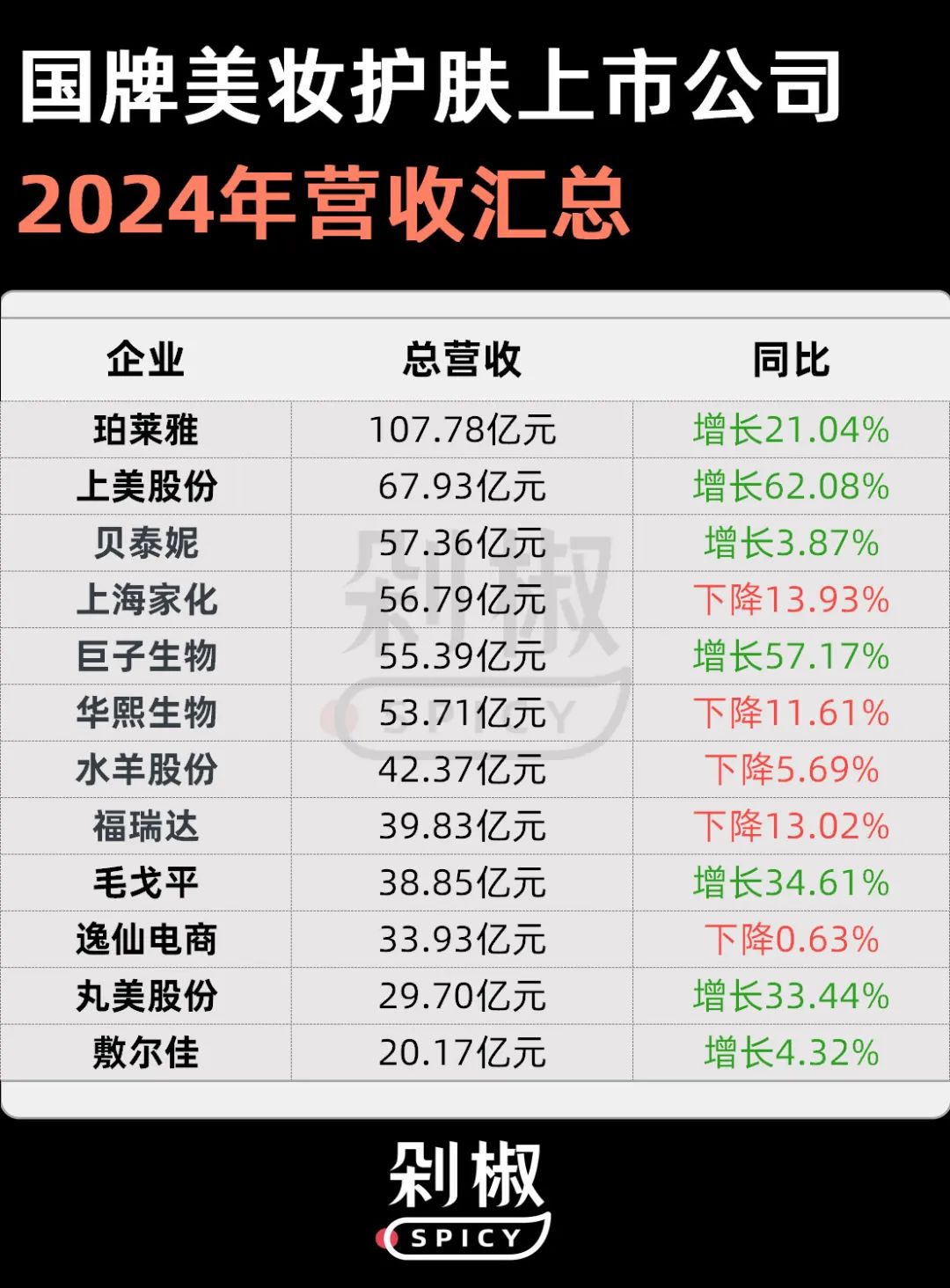
Core Insights - The performance of domestic beauty companies in China is showing significant divergence, with some achieving remarkable growth while others face declines, indicating a reshaping of the market landscape [1][4][42] Group 1: Company Performance - Proya has become the first domestic beauty company to enter the 10 billion yuan club, with a revenue of 10.778 billion yuan, growing by 21.04% [2] - Other companies like Shangmei and Juzi Biological also reported substantial revenue increases of 62.08% and 57.17% respectively, while Shanghai Jahwa experienced a revenue decline of 13.93% [2][3] - Six beauty companies have revenues exceeding 5 billion yuan, suggesting that this threshold will soon become a significant benchmark for the top 10 domestic beauty brands [1] Group 2: Profitability Trends - Juzi Biological leads in profitability with a profit of 2.062 billion yuan, up 42.06%, while Proya's profit reached 1.552 billion yuan, growing by 30% [3] - In contrast, Shanghai Jahwa reported a loss of 833 million yuan, marking a 266.60% decline, highlighting the stark differences in profitability among companies [3][11] Group 3: Market Dynamics - The current market dynamics indicate a shift towards efficacy-driven products, with companies that successfully launched standout products seeing better performance [4][5] - The competition is intensifying, with new entrants emerging and established brands needing to adapt to changing consumer preferences and market trends [7][30] Group 4: R&D and Strategic Focus - Companies are increasingly focusing on R&D, with most reporting a rise in R&D expenditures, indicating a strategic shift towards innovation and efficacy [20][21] - The trend of acquisitions and investments in technology is becoming a key strategy for companies aiming to enhance market share and scale [23][24] Group 5: Emerging Opportunities - The male skincare market is growing rapidly, presenting new opportunities for brands to capture this segment [36] - The aging population is creating demand for products targeting older consumers, which remains largely untapped [39] - As online sales plateau, brands are shifting focus to offline channels, indicating a potential new battleground for market share [40]


美妆618专家电话会
2025-05-12 15:16
Summary of the Beauty Industry Conference Call Industry Overview - The conference call focused on the beauty industry, particularly the performance and strategies of Tmall during the 2025 618 shopping festival [1][3]. Key Points and Arguments - **Changes in Sales Strategy**: Tmall has canceled the cross-store discount mechanism for the 2025 618 event, replacing it with direct discounts and smart coupons to stabilize daily sales growth. This shift aims to enhance user growth and public traffic while merchants rely more on technological discounts [1][4]. - **Sales Targets**: Tmall's overall sales target for the 2025 618 event is set at 862 billion yuan, with a projected growth rate of 13.5%. The beauty category aims for a sales target of approximately 13.2 billion yuan, expecting an 18% growth [3][4]. - **Investment in Marketing**: Tmall is investing heavily in marketing, including 20 billion yuan in cash subsidies for Taobao Live and 30 billion yuan in smart coupon subsidies from Alibaba. The total shelf subsidy has increased to 58 billion yuan [1][8][9]. - **Collaboration with Xiaohongshu**: Tmall has partnered with Xiaohongshu, investing 6.2 billion yuan to enhance advertising and direct traffic from Xiaohongshu to Tmall, aiming to increase store visit rates [1][10]. - **Performance of Key Brands**: Foreign brands like L'Oréal and Estée Lauder are seeing higher average order values and growth rates compared to domestic brands. Foreign brands are expected to grow at about 7-8%, while domestic brands are projected to grow at around 35% [2][12][13]. - **Consumer Behavior**: The post-00s demographic shows a willingness to accept price increases of 30-50% and an increase in purchase frequency and category diversity [4][13]. Additional Important Insights - **Focus on Quality and Brand**: The platform's algorithms and policies are increasingly favoring quality products and established brands, with a notable increase in average order values for leading brands [12][13]. - **Performance of Domestic Brands**: Domestic brands like Perlay and Kefu are aggressively marketing, with their advertising revenue growth outpacing GMV growth by 20-30 percentage points [22]. - **Price Strategy**: The overall merchant gross profit is expected to improve, with less aggressive price competition compared to the previous year [12][14]. - **Growth Targets for Specific Brands**: Various domestic brands have set ambitious growth targets for the 618 event, with some brands like Kefu aiming for a 50% growth rate [15][16][17][18][19]. Conclusion The 2025 618 shopping festival is characterized by strategic shifts in sales mechanisms, significant investments in marketing, and a focus on quality and brand reputation. The beauty industry is poised for growth, driven by both domestic and foreign brands adapting to changing consumer behaviors and market dynamics.

『内需消费』-『美护』对话 『个护』:国货品牌嘉年华
2025-05-12 15:16
Summary of Conference Call Records Industry Overview - The beauty and personal care industry has shown a recovery in Q1, with domestic brands gaining market share, particularly through category and channel breakthroughs. Companies like Luoyuchen and Jiahua have improved margins through organizational adjustments and product innovation [1][4] - The personal care market is experiencing stable growth with a trend towards premiumization. Domestic brands are gaining an advantage in emerging channels like Douyin, with strong revenue growth and consumer recognition of their market share increase [1][5] - Live-streaming e-commerce has provided domestic beauty and personal care brands with opportunities to effectively reach young consumers, enhancing brand awareness and sales channels [1][6] Key Companies and Performance - **Mao Geping**: Achieved significant growth above industry averages, expected to maintain a 30% compound annual growth rate (CAGR) over the next three years due to high-end offline channels and effective online marketing [1][9] - **Ruo Yuchen**: Experienced rapid sales growth through product design and marketing innovation, particularly in the fragrance laundry liquid and health products sectors, with a sales target of 1 billion yuan for 2025 [1][9] - **Baiya and Dengkang**: Both companies have shown good revenue growth, with Baiya leveraging live-streaming e-commerce for expansion and Dengkang focusing on high-end products through targeted marketing on platforms like Douyin [1][10][11] Market Trends and Consumer Behavior - The demand for personal care products is stable but has shown a consistent price increase trend, driven by inflation and a shift towards health and natural product preferences among consumers [1][5] - The beauty industry is characterized by a long-term growth potential, with domestic brands continuing to gain market share. Current valuations have not yet returned to pre-2021 levels, indicating potential for valuation improvement [1][14] Future Growth Potential - The sanitary napkin market has reached a certain ceiling in domestic sales, but there is still room for growth in absorbent products like diapers and adult care items, as well as potential expansion into overseas markets [1][17] - The toothpaste market is also large, with opportunities for growth in related categories such as toothbrushes and mouthwash, indicating a robust growth outlook for the oral care sector [1][18] - The cotton soft towel market, as a new product category, has significant market potential due to its higher price point compared to traditional paper products, with companies like Weijian Medical expanding their product lines to enhance brand presence [1][19] Valuation Insights - Most personal care brands have not yet experienced the valuation premiums seen in 2021, with current valuations aligning with growth rates. However, as domestic brands continue to validate their growth, there is potential for increased valuation premiums in the future [1][20][21] - In the Hong Kong market, companies like Shangmei have a valuation of approximately 24 times earnings, while in the A-share market, Pulaoya's valuation is around 20 times, both indicating investment attractiveness [1][15]



未知机构:申万化妆品周观点聚美丽大会指引美业发展国际集团在华触底反弹2025051-20250512
未知机构· 2025-05-12 02:00
Summary of Key Points from Conference Call Records Industry Overview - The beauty industry is currently experiencing a transformation, with a focus on technological beauty, refined operations, and AI assistance as highlighted during the recent 聚美丽大会 (Beauty Conference) held in Shanghai [1][3] - The conference emphasized the need for innovation in raw materials and operational excellence to enhance competitiveness in the market [4] Company Insights Shanghai Jahwa (上海家化) - For the year 2024, Shanghai Jahwa reported a revenue of 5.679 billion yuan, a year-on-year decline of 13.93%, and a net loss of 833 million yuan, a significant drop of 266.60% [2] - In Q1 2025, the company recorded a revenue of 1.704 billion yuan, down 10.59%, with a net profit of 217 million yuan, a decrease of 15.25% [2] - The personal care segment generated 2.379 billion yuan, down 3.42%, while the beauty segment saw a revenue of 1.050 billion yuan, down 29.81% [2] - A 2025 employee stock ownership plan aims to incentivize 45 mid-to-senior level employees, with targets set for profitability recovery and growth in the following years [2] Estée Lauder (雅诗兰黛) - Estée Lauder reported net sales of 3.55 billion USD (approximately 25.808 billion yuan) for Q3 of fiscal year 2025, reflecting a 10% decline, while net profit decreased by 53% [5] - Despite the overall decline, the gross margin has improved for four consecutive quarters, increasing by over 300 basis points, indicating effective recovery and growth strategies [5] - The skincare and haircare segments saw significant declines, while the fragrance segment experienced a 10% increase in revenue [5] - In the Asia-Pacific region, net sales fell by 1%, but China saw single-digit growth, helping to offset some market declines [5] Competitive Landscape - Domestic brands are aggressively competing in the beauty market, leading to a rebound in international brands, which is expected to drive demand growth [2] - The conference highlighted the importance of leveraging AI and refined operations to maintain competitiveness in a challenging market environment [4] Additional Insights - The 聚美丽大会 served as a platform for industry leaders to discuss trends and challenges, including the potential of emerging markets and the impact of tariffs [4] - Recommendations for investment include companies with strong brand matrices and innovative products, such as 上美股份, 珀莱雅, and 丸美生物, as well as e-commerce platforms like 若羽臣 [5]
未知机构:申万美护深圳上市公司见面会及近期调研反馈内需消费崛起国货美妆加速完善产品-20250512
未知机构· 2025-05-12 01:55
Summary of Conference Call Records Industry Overview - The beauty and personal care industry in China is experiencing significant growth, driven by domestic consumption and the expansion of domestic brands [1][2]. Key Company Insights Shangmei Co., Ltd. (上美股份) - **Sales Growth**: - Tmall sales increased by 30% - JD.com sales grew nearly 70% - Kuaishou and Pinduoduo saw growth between 150% to 200% [1] - **NewPage Performance**: - Q1 revenue reached 160 million, with a 100% growth rate - Expected profit margin improvement for the year [1] - **Product Launches**: - NanBeauty plans to launch mid-to-high-end cosmetics in the second half of the year - Jifang Hair Care is set to expand after obtaining necessary certifications [1] - **Douyin Growth**: - Sales recovery began in April, with an increase in self-broadcasting and improved profit margins [1] - **Marketing Strategy**: - X Peptide aims for a GMV of 1 billion, with new endorsements to enhance marketing effectiveness [1] - Increased brand promotion and collaborations with influencers, including Ding Yuxi as the global ambassador for Han Shu [1] Runben Co., Ltd. (润本股份) - **Revenue Growth**: - Overall revenue increased by approximately 30% in April, with online sales up by about 10% - Significant growth in offline non-platform distribution (toB business) exceeding 50%, particularly in the Sam's Club channel [2] - **Sales Performance**: - Sales in Sam's Club reached over 20 million in April, up from approximately 12 million in March [2] - **Future Projections**: - Anticipates a revenue growth of over 20% in Q2, maintaining a target of 30% growth for both revenue and profit for the first half of the year [2] Marubi Biotechnology Co., Ltd. (丸美生物) - **Q1 Performance**: - Revenue growth of 28% with a net profit increase of 22% [2] - **Annual Targets**: - Aiming for a 32% growth in net profit for the year, referencing the previous year's performance [2] - **Product Sales Forecast**: - Xiaohongbi Eye Cream projected to achieve over 500 million in sales for 2024, representing a 146% growth - Xiaojin Needle expected to reach 350 million in online sales, with a 96% increase, alongside a doubling of offline sales [2] Additional Insights - The emphasis on high-quality ingredients and effective products is becoming a key profitability driver for companies in the beauty sector [3]


商贸零售行业周报:关注零售行业中期投资策略:深挖情绪消费景气赛道
KAIYUAN SECURITIES· 2025-05-12 00:23
Investment Rating - The investment rating for the retail industry is "Positive" (maintained) [1] Core Insights - The retail industry is experiencing a slow recovery in social consumption, with overall business pressure on retail enterprises. The report emphasizes the importance of emotional consumption and suggests focusing on high-quality companies in high-growth segments [4][27] - The report identifies key segments within the retail industry, including traditional retail, gold and jewelry, cosmetics, and medical aesthetics, each with unique dynamics and investment opportunities [4][27] Summary by Sections Retail Market Overview - The retail industry index rose by 0.88% during the week of May 6 to May 9, 2025, underperforming the Shanghai Composite Index, which increased by 1.92% [6][15] - The brand cosmetics sector showed the highest growth, with a weekly increase of 2.89% and a year-to-date increase of 15.91% [18][21] Investment Strategy - The report recommends focusing on high-quality companies in segments driven by emotional consumption, including: 1. **Gold and Jewelry**: Emphasizing brands with differentiated products and consumer insights, recommending companies like Laopuhuangjin, Chaohongji, and Zhou Dasheng [7][48] 2. **Offline Retail**: Highlighting companies that are actively transforming and exploring new models, recommending Yonghui Supermarket and Aiyingshi [7][48] 3. **Cosmetics**: Focusing on domestic brands with strong growth potential, recommending brands like Pola, Shangmei, and Juzi Biological [7][49] 4. **Medical Aesthetics**: Suggesting attention to differentiated product manufacturers and leading medical aesthetic institutions, recommending Aimeike and Kedi-B [7][49] Segment Analysis - **Traditional Retail**: The report notes that offline retail must leverage its strengths in customer service and emotional satisfaction to attract consumers back from online channels [4][28] - **Gold and Jewelry**: The industry is shifting from supply-driven to demand-driven, with emotional consumption becoming a key factor. High-end and fashionable gold segments are emerging as significant opportunities [4][36] - **Cosmetics**: The industry is stable in the short term, with a long-term trend favoring domestic brands. Emotional consumption is spreading across various cosmetic categories [4][41] - **Medical Aesthetics**: The industry is experiencing accelerated differentiation, with high-end products showing resilience due to their safety and scarcity [4][44]




贝泰妮(300957) - 2025年5月9日投资者关系活动记录表
2025-05-11 15:50
Group 1: Business Strategy and Performance - The company plans to enhance the performance of brands ZA and Pomei by strictly executing operational budgets, controlling marketing ROI, and reducing ineffective expenditures to lower sales expense ratios [2] - In 2025, the company will focus on brand building, member operations, and overall collaborative growth, emphasizing its core strengths and enhancing organizational transformation [5] - The company aims to maintain its leadership in the sensitive skin care market by deepening the brand genes of "skin medicine," "plant technology," and "evidence-based medicine" [5] Group 2: Market Expansion and Product Development - The company will continue to explore overseas markets to improve profitability and support its main brand through collaborative efforts with its R&D team [6] - A new product, Silver Core Cream, has been launched targeting anti-aging needs for sensitive skin, featuring a proprietary ingredient aimed at combating aging factors [4] - The company plans to enhance online traffic conversion efficiency through a dual focus strategy on product and channel optimization [4] Group 3: Financial Management and Investor Relations - The company acknowledges the impact of various factors on stock price and emphasizes the importance of communication with investors through various market activities [3] - Management fees increased by 56% year-on-year, exceeding the industry average of 4-6%, prompting the company to implement measures to control expenses [7] - The company has established a market value management system to improve operational performance and provide better returns to investors [7] Group 4: Consumer Feedback and Product Quality - The company is committed to improving customer service and addressing feedback regarding product quality and after-sales support [8] - Concerns were raised about the quality of promotional gifts, leading the company to consider enhancing the quality of these items [3] - The company is focused on maintaining a balance between cost considerations and customer expectations for product quality [3]
关注零售行业中期投资策略:深挖情绪消费景气赛道
KAIYUAN SECURITIES· 2025-05-11 14:41
Group 1: Core Insights - The retail industry is experiencing a slow recovery in social consumption, with overall business pressure on retail enterprises [27][28] - The report emphasizes the importance of emotional consumption, suggesting that companies should focus on enhancing consumer service experiences and emotional satisfaction to drive positive accumulation [28][32] - The investment strategy highlights four main themes: gold and jewelry, offline retail, cosmetics, and medical aesthetics, each with specific recommendations for companies to watch [4][7][49] Group 2: Industry Dynamics - Traditional retail is facing challenges as online traffic growth approaches its peak, and issues like e-commerce tax audits arise, making offline experiences more valuable [4][28] - The gold and jewelry sector is shifting from supply-driven to demand-driven, with emotional needs like self-appreciation and national pride becoming significant [4][36] - The cosmetics industry is witnessing a rise in domestic brands, with emotional consumption trends spreading to various segments, including functional skincare and home fragrances [41][49] Group 3: Company Recommendations - For gold and jewelry, companies like Lao Pu Gold, Chao Hong Ji, and Zhou Da Sheng are recommended for their differentiated product offerings and consumer insights [7][48] - In offline retail, companies such as Yonghui Supermarket and Ai Ying Shi are highlighted for their proactive transformation and exploration of new business models [7][48] - In the cosmetics sector, brands like Pechoin, Mao Ge Ping, and Juzi Biological are noted for their strong performance and ability to adapt to market trends [7][49] Group 4: Market Performance - The retail industry index rose by 0.88% in the week of May 6-9, 2025, but has decreased by 5.81% since the beginning of the year, underperforming the broader market [6][15] - The brand cosmetics sector showed the highest growth, with a weekly increase of 2.89% and a year-to-date increase of 15.91% [18][21] - Individual stocks such as Huazhi Wine and New Xunda saw significant weekly gains of 13.4% and 12.2%, respectively [24][25]


化妆品医美行业周报:聚美丽大会指引美业发展,国际集团在华触底反弹-20250511
Shenwan Hongyuan Securities· 2025-05-11 14:40
Investment Rating - The report maintains an "Overweight" rating for the cosmetics and medical beauty sector, with specific recommendations for various companies based on their market positions and growth potential [5][12][17]. Core Insights - The cosmetics and medical beauty sector has shown weaker performance compared to the market, with the Shenwan Beauty Care Index rising by 1.7% from April 30 to May 9, 2025, which is lower than the Shenwan A Index by 0.6 percentage points [5][6]. - The "Jumeili Conference" held in Shanghai highlighted the industry's development direction amidst a challenging environment, emphasizing the importance of technology-driven beauty, refined operations, and AI assistance [5][12]. - Domestic brands are gaining traction, while international brands are also experiencing growth, with Estee Lauder reporting a return to positive growth in key brands in China during Q1 2025 [5][12][28]. Summary by Sections Industry Performance - The cosmetics and medical beauty sector's performance has been below market expectations, with the Shenwan Cosmetics Index increasing by 2.8%, outperforming the Shenwan A Index by 0.5 percentage points [5][6]. - The report notes a competitive landscape where domestic brands are aggressively entering the market, prompting international brands to rebound [5][12]. Company Analysis - Shanghai Jahwa's Q1 2025 results showed a revenue of 1.704 billion yuan, down 10.59% year-on-year, with a net profit of 217 million yuan, down 15.25% [5][13]. - Estee Lauder's Q3 2025 results indicated a net sales figure of 3.55 billion USD (approximately 25.8 billion yuan), a 10% decline year-on-year, but with a notable increase in gross margin [5][28]. - The report highlights the employee stock ownership plan at Shanghai Jahwa, aimed at binding key personnel and setting profit recovery targets for 2025 [5][17]. Market Trends - The report indicates that the retail sales of cosmetics in Q1 2025 reached 114.9 billion yuan, with a year-on-year growth of 3.2% [22][26]. - The domestic skincare market is projected to continue growing, with local brands capturing a significant market share, reflecting a shift in consumer preferences towards domestic products [36][38]. E-commerce Insights - The report provides data on the performance of domestic brands on e-commerce platforms, with notable growth in GMV for brands like Proya and Marubi [20][19]. - The overall e-commerce landscape for cosmetics is evolving, with brands leveraging social media platforms to enhance visibility and sales [5][12].

上市国货美妆洗牌:上美、巨子生物增长最快,华熙生物倒数
Nan Fang Du Shi Bao· 2025-05-11 09:20
Core Insights - The domestic beauty industry in China is expected to undergo a significant restructuring by 2025, with companies showing rapid growth driven by strong single-brand performance and a shift in consumer focus towards verified efficacy rather than just ingredient composition [2][10] Revenue Performance - Proya has become the first domestic beauty company to surpass 10 billion yuan in revenue for 2024, achieving 10.779 billion yuan, maintaining its top position [4] - Shangmei Co. has shown the fastest revenue growth, with a 62.1% increase from 4.191 billion yuan in 2023 to 6.793 billion yuan in 2024, rising from sixth to second place among the sample companies [3][4] - Other notable companies include Betaini with 5.736 billion yuan, Shanghai Jahwa with 5.679 billion yuan, and Juzhibio with 5.54 billion yuan, all showing varying degrees of growth [4] Brand Performance - Shangmei's brand Han Shu generated nearly 5.6 billion yuan in 2024, accounting for 82.3% of the group's total revenue, with a growth rate of 73.7% [5] - Juzhibio's brand Kefu Mei achieved 4.54 billion yuan in revenue, representing 82% of its total revenue, with a growth rate of 62.9% [6] Market Trends - The popularity of hyaluronic acid is declining, while "recombinant collagen" is emerging as a lucrative ingredient, reflecting a shift in consumer preferences towards efficacy-driven skincare [7][9] - The market is witnessing a transition from ingredient-focused to efficacy-focused products, with companies like Proya leveraging this trend to capture market share [10][11] R&D and Investment - There is a growing disparity between revenue growth and R&D investment among companies, with Proya's R&D expenditure at only 1.95% of total revenue, the lowest among the sample companies [12] - In contrast, Juzhibio, despite its rapid revenue growth, has a low R&D investment ratio of 1.9%, indicating a potential risk in long-term sustainability [12] Industry Dynamics - The beauty industry is moving towards a phase where product efficacy and R&D capabilities are becoming critical competitive factors, as opposed to relying solely on marketing [13] - The gap in revenue between leading and mid-tier companies is widening, suggesting a trend towards market consolidation and structural transformation within the industry [13]