
东阳光长江药业

Search documents
东阳光药集采丢标背后 单一产品依赖下的生存危机
Xin Lang Cai Jing· 2025-11-06 06:33
Core Insights - The domestic pharmaceutical market is undergoing a new round of reshuffling, with the 11th batch of national drug procurement results recently announced, marking a significant impact on various companies, particularly Dongyang Sunshine Pharmaceutical, which faced a crisis due to the loss of its core product, Oseltamivir granules [1][2]. Group 1: Impact of Procurement Results - The procurement results included 55 varieties and 453 products, covering high-demand treatment areas such as anti-infection, diabetes, and hypertension [1]. - Dongyang Sunshine Pharmaceutical's Oseltamivir granules contributed over 75% of its revenue in 2023, making it a critical product for the company [2]. Group 2: Consequences of Losing the Bid - Losing the bid means Dongyang Sunshine Pharmaceutical will lose access to public medical institutions, leading to a potential sharp decline in market share, revenue, and brand influence [2]. - The company’s heavy reliance on hospital channels for over 80% of its sales exacerbates the risk of revenue loss following the bid failure [2]. Group 3: Challenges in Transformation - Dongyang Sunshine Pharmaceutical has over 100 products in research across infection, chronic diseases, and oncology, but faces significant challenges in its transformation efforts [3]. - The company's R&D investment is relatively low, with 348 million yuan in the first half of 2025, only one-tenth of that of a competitor, limiting its ability to advance multiple projects simultaneously [3]. - The product pipeline is characterized by a lack of breakthrough innovations and severe homogenization, with existing products facing strong competition [3]. Group 4: Industry Reflection - The predicament of Dongyang Sunshine Pharmaceutical reflects the broader challenges faced by Chinese pharmaceutical companies under the dual pressures of national procurement and the need for innovative transformation [4]. - Companies that remain overly dependent on single products are at risk, and finding new growth avenues before the benefits of generic drugs diminish is crucial for survival [4].

利润近乎腰斩,韵达“行业老三”地位告急
Guan Cha Zhe Wang· 2025-11-05 06:43
Core Viewpoint - Yunda Holdings Group Co., Ltd. is facing significant challenges as its profit margins are sharply compressed despite maintaining revenue growth, with a notable decline in net profit and a historical challenge to its market position as the third-largest player in the express delivery industry [1][2][4]. Financial Performance - For the first three quarters of 2025, the company reported operating revenue of 37.493 billion yuan, a year-on-year increase of 5.59%, while net profit attributable to shareholders was 730 million yuan, a decline of 48.15% [1][2][3]. - The third quarter alone saw revenue of 12.660 billion yuan, up 3.29% year-on-year, but net profit dropped to 201 million yuan, down 45.21% [2][3]. - The company's gross profit margin fell to 6.74%, down from 9.87% the previous year, and the net profit margin decreased to 1.98%, a reduction of approximately 51% [4]. Market Position and Competition - Yunda's market share has declined to 13.2%, down 0.5% year-on-year, with a third-quarter market share of 13.0%, a decrease of 0.8 percentage points [7][8]. - The company is now facing increased competition from Shentong Express, which has surpassed Yunda in business volume, achieving 6.515 billion pieces in the third quarter, a 10.8% increase [7][8]. Operational Challenges - The company is experiencing operational difficulties, including network instability and increased customer complaints, with a total of 146,800 complaints reported, primarily related to lost, damaged, and delayed packages [8][16]. - Yunda's cash flow from operating activities has decreased by 48.11% to 1.667 billion yuan, indicating a weakening ability to generate cash from its core business [4]. Strategic Initiatives - In response to its challenges, Yunda is attempting to optimize its network, invest in smart technology, and introduce high-end products like "Smart Orange Network" and drone delivery services [15][20]. - Despite these efforts, the effectiveness of these strategies is limited by ongoing issues with franchise management, which have led to regulatory investigations and penalties [15][16]. Market Sentiment - There is a noticeable decline in investor confidence, as evidenced by Alibaba's reduction in shareholding from 1.44% to 0.71% within six months [13]. - The company's market capitalization has significantly lagged behind its competitors, indicating a lack of confidence in its future performance [13].



抗流感药需求激增,每年全球流感季死亡人数最高达65万人
21世纪经济报道· 2025-11-05 03:56
Core Viewpoint - The article discusses the increasing risk of influenza transmission due to the overlap of the flu season and the peak of outbound travel from China, highlighting the importance of antiviral treatments and the competitive landscape of flu medications in the market [4][8][10]. Group 1: Influenza Overview - Influenza is an acute respiratory infectious disease caused by influenza viruses, with seasonal outbreaks primarily occurring from October to February in the Northern Hemisphere [4]. - The high season for influenza coincides with the peak of outbound travel from China, raising public health concerns [4][8]. Group 2: Antiviral Treatments - Early antiviral treatment is crucial for influenza cases with severe risk factors, with the greatest benefit seen when treatment is initiated within 48 hours of symptom onset [4][10]. - The main antiviral drugs available in China include neuraminidase inhibitors, RNA polymerase inhibitors, and hemagglutinin inhibitors, with Oseltamivir and Baloxavir Marboxil being the preferred options [5][12]. Group 3: Market Dynamics - The market for influenza medications has become highly competitive, especially after the patent expiration of Oseltamivir in 2016, leading to a surge in generic versions [5][13]. - As of November 2023, there are nearly 140 drug approvals related to Oseltamivir in China, indicating a crowded market [13]. - Baloxavir Marboxil, a second-generation antiviral, has gained market share since its approval in 2021, with sales expected to exceed 1.5 billion yuan by 2024 [13][14]. Group 4: Market Growth Potential - The Chinese market for antiviral medications for influenza was valued at 10.74 billion yuan in 2023, showing a year-on-year growth of 197.51% [14]. - Forecasts suggest a compound annual growth rate of 20.2% from 2024 to 2028, with the market potentially reaching 26.9 billion yuan by 2028 [14].


Q3业绩季收官,看好制药装备受益海外需求提升
Xinda Securities· 2025-11-05 02:13
Investment Rating - The investment rating for the pharmaceutical and biotechnology industry is "Positive" [2] Core Viewpoints - The report highlights that the pharmaceutical equipment sector is expected to benefit from the rising overseas demand cycle [6][15] - The analysis of Q3 performance indicates a relatively high prosperity in sectors such as innovative drugs, CXO, and medical consumables, with a noted improvement trend in the medical device sector since Q3 [15][14] - The report suggests focusing on the flu-related sector in Q4, including vaccines, diagnostics, and drug terminals [15] Summary by Sections 1. Industry Overview - The pharmaceutical and biotechnology sector's weekly return was 1.31%, outperforming the CSI 300 by 1.74%, ranking 9th among 31 first-level sub-indices [13] - The chemical pharmaceutical sector had the highest weekly return at 3.07%, while the medical device sector ranked sixth with a decline of 1.15% [13] 2. Q3 Performance Analysis - Among the companies that disclosed Q3 results, 35% reported both revenue and net profit growth [14] - Approximately 48% of companies experienced revenue declines in Q3, with 20% showing growth between 0-10% [14] - The report identifies a significant number of companies with revenue growth exceeding 20% in various sub-sectors, particularly in chemical preparations and other biological products [14][15] 3. Sector Recommendations - For pharmaceutical equipment, companies like SenSong International, Dongfu Long, and Chutian Technology are recommended due to their expected benefits from overseas demand [15] - In the flu sector, companies such as Hualan Biological Engineering for vaccines and Dongyangguang Pharmaceutical for flu medications are highlighted [15] - Key players in the CXO and life sciences upstream chain include WuXi AppTec and Tigermed, among others [15] - The report also emphasizes high-end medical devices, suggesting companies like United Imaging Healthcare and Mindray Medical for their growth potential [15] 4. Market Performance and Valuation - The current PE (TTM) for the pharmaceutical and biotechnology industry is 30.62, slightly above the 5-year average of 29.08 [22][23] - The industry has shown a 20.89% increase over the last six months, indicating a positive trend despite recent fluctuations [18][21] 5. Recent Developments - The report notes significant policy updates and industry news, including the establishment of a new payment model by the National Medical Insurance Administration [49] - Recent company announcements include drug approvals and clinical trial advancements, reflecting ongoing innovation in the sector [52]
星展银行:全球快递市场将保持强劲增长 亚太地区成主要引擎
Xin Hua Cai Jing· 2025-10-31 10:47
Core Insights - The global express market is expected to achieve a compound annual growth rate (CAGR) of 7.9% from 2025 to 2029, despite ongoing challenges in global trade [1] - The Asia-Pacific region is identified as a key growth engine for the express market, with a projected CAGR of 10.5%, significantly outpacing North America's 6.0% and Europe's 5.9% [1] - The B2C segment is driving strong growth in the express market, with a forecasted CAGR of 10.8% from 2025 to 2029, compared to the B2B segment's 2.5% [1] Industry Performance - Global logistics giants are experiencing varied performance; UPS has faced operational challenges leading to weak second-quarter results, while FedEx reported its strongest revenue growth since the pandemic [2] - Chinese logistics companies are outperforming the market due to diversified portfolios and efficiency improvements, with SF Express achieving record net profits in the first half of 2025 [2] - Regulatory interventions since July 2025 are expected to curb irrational price competition in China, paving the way for a more rational market structure and recovery in profit margins [2]

国家邮政局:品牌公众满意度方面得分较高的为顺丰速运、京东快递
Xin Lang Cai Jing· 2025-10-29 02:07
Core Insights - The State Post Bureau released the results of the 2025 Q3 express service satisfaction survey and timely delivery rate test, indicating improvements in customer satisfaction and delivery efficiency [1] Summary by Categories Satisfaction Survey Results - The overall public satisfaction score for express services in Q3 2025 was 85.0, an increase of 1.3 points year-on-year [1] - The brands with the highest satisfaction scores were SF Express and JD Express [1] - Regions with high satisfaction scores included Henan, Tianjin, Jiangsu, Beijing, Qinghai, and Hebei, all scoring above 86 [1] - Satisfaction scores for order services were 90.7 for unified customer service hotline orders and 87.7 for orders via courier phone, increasing by 4.3 and 2.1 points respectively [1] - Satisfaction scores for collection services were 87.9 for collection staff service and 86.4 for collection time, increasing by 3.5 and 2.3 points respectively [1] - Satisfaction scores for information query services were 85.7 for full information push and 86.2 for timely and accurate logistics information, increasing by 0.9 and 0.7 points respectively [1] Timeliness Test Results - The overall delivery time for express services in Q3 2025 was 51.32 hours, reduced by 2 hours year-on-year [1] - Breakdown of delivery times showed that the average time for the dispatch processing stage was 8.50 hours (up by 0.28 hours), transportation stage was 29.94 hours (down by 2.50 hours), arrival processing stage was 9.95 hours (up by 0.29 hours), and delivery stage was 2.94 hours (down by 0.06 hours) [1] - The 72-hour timely delivery rate was 86.47%, an increase of 2.08 percentage points year-on-year [1] - Brands with higher 72-hour timely delivery rates included Postal Express and SF Express [1]
勃林格殷格翰IPF新药获批,打破十年市场垄断,百亿级呼吸赛道迎来重估
Ge Long Hui· 2025-10-24 10:40
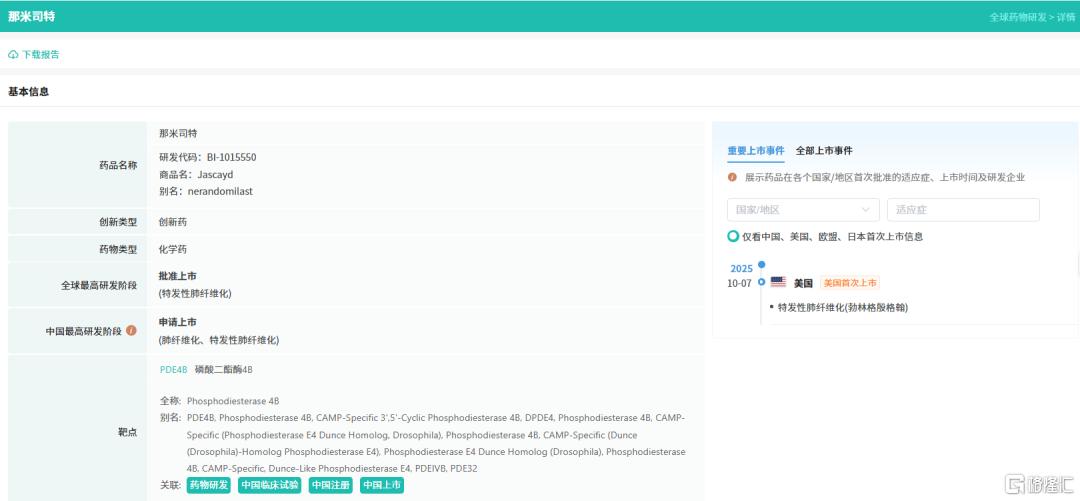
Core Insights - Boehringer Ingelheim's oral PDE4B inhibitor Nerandomilast has received priority review approval for the treatment of idiopathic pulmonary fibrosis (IPF), marking the first new drug approval in this area in over a decade [1][6] - This approval signifies a breakthrough in IPF treatment, as it is the first drug to meet primary endpoints in a Phase III clinical trial in ten years [1][6] Drug Information - Nerandomilast, also known as Jascayd, is a novel PDE4B inhibitor developed by Boehringer Ingelheim, targeting the PDE4B enzyme which is highly expressed in the lungs and associated with fibrosis and inflammation [3][6] - The drug has shown dual effects of anti-fibrosis and anti-inflammation, potentially benefiting IPF patients clinically [3] Market Dynamics - The IPF market is currently dominated by Boehringer Ingelheim's Nintedanib and Roche's Pirfenidone, with Nerandomilast's entry creating a "three-horse race" in IPF treatment [7] - Nintedanib's patent expiration is set for 2029, and Pirfenidone faces generic competition, indicating a shift in market dynamics with the introduction of Nerandomilast [7] Clinical Development - Nerandomilast received breakthrough therapy designation from the FDA in 2022, highlighting its potential in IPF treatment [6] - The drug's approval in China was based on positive results from the pivotal Phase III clinical trial FIBRONEER™-IPF, which was the first to achieve primary endpoints in a decade [6][10] Future Prospects - Following its approval, Nerandomilast is expected to bring new hope to patients with rare pulmonary fibrosis conditions [10] - The company has submitted an application for Nerandomilast for the indication of progressive pulmonary fibrosis, which could further expand its treatment scope [10]
半年豪掷107亿美元,脂肪肝成下一个“黄金靶点”?
Hu Xiu· 2025-10-20 09:21
Core Insights - The acquisition of Akero Therapeutics by Novo Nordisk for $5.2 billion marks a significant move into the FGF21 space, indicating the growing importance of metabolic disease treatments, particularly for metabolic dysfunction-associated steatotic liver disease (MASH) [2][12] - FGF21 is rapidly becoming a key target in the treatment of metabolic diseases, with major pharmaceutical companies like GSK and Roche also making substantial investments in similar assets, reflecting a competitive landscape reminiscent of the GLP-1 market boom [3][19] - The market for MASH is projected to reach $32.2 billion by 2030, driven by the increasing prevalence of obesity and type 2 diabetes, highlighting the commercial potential of FGF21 therapies [13][19] Company Strategies - Novo Nordisk's acquisition of Akero Therapeutics is part of a broader strategy to enhance its portfolio in the metabolic disease sector, especially after facing competitive pressures [16][18] - GSK's acquisition of Boston Pharmaceuticals' FGF21 asset aims to fill gaps in its MASH treatment offerings and is expected to complement its existing therapies [15][18] - Roche's acquisition of 89bio's FGF21 drug pegozafermin is intended to strengthen its position in cardiovascular and metabolic disease markets, showcasing a trend of major companies consolidating their portfolios through strategic acquisitions [16][18] Market Dynamics - The FGF21 target is emerging as a lucrative opportunity, with the potential to replicate the success seen with GLP-1 drugs, which have transformed into leading treatments for metabolic disorders [19][23] - The unique ability of FGF21 therapies to address late-stage liver disease (F4) provides a competitive edge over existing treatments, which are limited to earlier disease stages [13][19] - The ongoing trend of mergers and acquisitions in the FGF21 space is expected to intensify, driven by the substantial market size and the need for innovative therapies in metabolic diseases [22][23] Clinical Developments - Akero's Efruxifermin has shown promising clinical results, with nearly 50% improvement in liver fibrosis for F2-F3 MASH patients after 96 weeks of treatment, indicating its potential as a leading therapy in this area [11][19] - The advancements in protein engineering have allowed FGF21 drugs to overcome previous limitations, such as short half-lives, enabling less frequent dosing and enhancing their commercial viability [9][19] - Chinese pharmaceutical companies are also making strides in the FGF21 space, focusing on multi-target agents that could provide synergistic effects in treating metabolic disorders [20][21]



假期出货放缓原油运价下跌,2025年国庆中秋假期国际航线恢复 | 投研报告
Zhong Guo Neng Yuan Wang· 2025-10-14 03:09
Core Insights - The shipping sector is experiencing a slowdown in oil shipping rates due to reduced holiday shipments, while container shipping rates on long-distance routes are rebounding [3] - Shenzhen has introduced detailed policies to support low-altitude economic development, with international flight routes expected to resume during the 2025 National Day and Mid-Autumn Festival holidays [3] - China's express delivery volume is projected to reach 1.5 trillion packages 37 days earlier than expected in 2025, with YTO Express signing a strategic cooperation agreement with Huizhou City [3] Shipping Sector - The China Import Crude Oil Comprehensive Index (CTFI) was reported at 1407.48 points on October 9, down 26.2% from September 25 [3] - VLCC market activity has cooled significantly post-holiday, with total transaction volumes well below weekly averages [3] - The market for transatlantic and Gulf of Mexico routes has also seen a decline in shipping rates, with a temporary stabilization in rates observed as post-holiday shipping resumes [3] - On October 10, the market rate for shipping from Shanghai to European ports was $1,068 per TEU, up 10.0% from the previous period [3] - Rates for shipping from Shanghai to the West and East coasts of the U.S. were $1,468 per FEU and $2,452 per FEU, reflecting increases of 0.5% and 2.8% respectively [3] Aviation Sector - Shenzhen's transportation bureau has released measures to support the high-quality development of the low-altitude economy, effective from October 9, 2025, to December 31, 2026 [3] - During the 2025 National Day and Mid-Autumn Festival holidays, it is expected that 19.138 million passengers will be transported by civil aviation, with a daily average of 2.392 million, marking a 3.2% year-on-year increase [3] - International airlines are projected to operate over 2,000 international passenger flights daily, a year-on-year increase of 11.1% [3] Logistics and New Transportation Models - As of October 11, 2025, China's express delivery volume is expected to exceed 1.5 trillion packages, achieving this goal 37 days ahead of schedule compared to 2024 [3] - A strategic cooperation agreement was signed between the Huizhou Municipal Government and YTO Express for the construction of a supply chain hub in the Guangdong-Hong Kong-Macao Greater Bay Area [3] Industry Trends - The Baltic Air Freight Index has shown a month-on-month increase but a year-on-year decline [5] - The domestic shipping index has risen, along with dry bulk shipping rates [5] - In August 2025, express delivery volume increased by 12.29% year-on-year, with revenue up by 4.24% [5] - The average number of international flights in the first week of October 2025 was 1,940, a slight decrease of 0.16% month-on-month but an increase of 13.44% year-on-year [5] - From September 29 to October 5, the number of freight trucks on national highways was 44.137 million, a decrease of 27.55% month-on-month [5] Investment Recommendations - Companies in the equipment and manufacturing export chain are recommended for attention, including COSCO Shipping, China Merchants Energy Shipping, and Huamao Logistics [6] - Opportunities related to transportation demand driven by hydropower station construction in the lower reaches of the Yarlung Tsangpo River are highlighted, with a focus on Sichuan Chengyu, Chongqing Port, and Fulimin Transportation [7] - Investment opportunities in the low-altitude economy are suggested, particularly in CITIC Offshore Helicopter [7] - The highway and railway sectors are also recommended for investment, including Gansu Expressway, Beijing-Shanghai High-Speed Railway, and others [7] - The cruise and ferry sectors are noted for potential investment opportunities, with a focus on Bohai Ferry and Straits Shares [8] - E-commerce and express delivery sectors are highlighted, recommending SF Express, Jitu Express, and Yunda Express [8] - Investment opportunities in the aviation industry are suggested, focusing on Air China, China Southern Airlines, Spring Airlines, and others [8]
申万宏源交运一周天地汇:中方港口费反制航运造船再迎历史机会,滞港效率损失油散运费受益,关注中国制造船舶是否豁免
Shenwan Hongyuan Securities· 2025-10-12 06:12
Investment Rating - The report maintains a positive outlook on the shipping and shipbuilding industry, highlighting historical opportunities due to China's countermeasures against the U.S. [3] Core Insights - The report emphasizes that U.S. shipping companies have a minimal global market share, but U.S.-listed companies and those with over 25% U.S. ownership are significantly impacted. The report suggests that if U.S. investments in Chinese shipbuilding are exempted, there could be a surge in orders for Chinese vessels [3]. - Short-term disruptions are expected to lead to non-linear increases in shipping rates, with a decrease in available vessels and efficiency, benefiting oil and bulk shipping rates [3]. - The report recommends specific companies in the shipping sector, such as China Merchants Energy Shipping and China Shipbuilding Industry Corporation, while also highlighting the potential for increased demand in the shipbuilding sector [3]. Summary by Sections Shipping Market Performance - The transportation index increased by 1.09%, outperforming the Shanghai and Shenzhen 300 index by 1.60 percentage points. The road freight sector saw the highest increase at 3.04% [4]. - The report notes that the VLCC (Very Large Crude Carrier) rates increased by 31% week-on-week, reaching $83,684 per day, driven by seasonal demand and market disruptions [3]. Oil and Bulk Shipping - The VLCC rates experienced a significant rise, with a daily increase of over 40% due to market disturbances and seasonal demand [3]. - The report indicates that the BDI (Baltic Dry Index) rose by 1.8% week-on-week, reflecting strong performance in the bulk shipping sector [3]. Air Transportation - The report suggests that the airline industry is at a turning point, with expectations for significant improvements in airline profitability, recommending several airlines for investment [3]. Express Delivery - The express delivery sector is entering a new phase of competition, with three potential scenarios outlined for the industry's future performance [3]. Rail and Road Transportation - Rail freight volume and highway truck traffic are showing resilience, with rail freight increasing by 0.95% week-on-week [3]. High Dividend Stocks in Transportation - The report lists high dividend stocks in the transportation sector, highlighting companies with strong dividend yields and expected profit growth [19].