
海力风电

Search documents
国信证券:风电行业国内外有望迎来景气共振 需求与格局变化催生新机遇
智通财经网· 2025-12-19 03:41
Core Viewpoint - The wind power industry in China is experiencing rapid cost reduction and installation growth, particularly in onshore wind, while offshore wind is expected to recover significantly by 2025 due to major project initiations [1][2]. Onshore Wind Power - Since 2021, China's onshore wind power has entered a parity era, achieving rapid cost reductions through large-scale and technological advancements, leading to installations exceeding expectations [2]. - Intense competition in the main equipment segment has compressed profit margins, resulting in a situation where industry growth does not translate into increased profits [2]. - Price recovery in the onshore wind supply chain is expected in the second half of 2024, with improved profitability anticipated in 2025 as shipment volumes increase [2]. - The overseas market for onshore wind is witnessing explosive growth in orders, driven by competitive pricing, service, and localization advantages of Chinese manufacturers [2][3]. Offshore Wind Power - The offshore wind sector has faced installation challenges from 2022 to 2024 due to slow approval processes, but significant project initiations in regions like Jiangsu and Guangdong are expected to enhance industry conditions in 2025 [2][4]. - For 2026, domestic offshore wind installations are projected to rise to a range of 11-15 GW, representing a year-on-year increase of over 40% [4]. - The upcoming "15th Five-Year Plan" period is expected to see a total of 70-100 GW of new offshore wind installations nationwide, with record-high bidding anticipated [4]. Investment Recommendations - The global wind power industry is entering a new growth phase, with high certainty of performance increases in the sector [5]. - Key companies to watch in the main equipment segment include Goldwind Technology, Yunda Co., and SANY Renewable Energy, while component manufacturers like Delijia and Jinlei Co. are also highlighted [5]. - In the offshore wind sector, companies such as Dajin Heavy Industry, Haili Wind Power, and Oriental Cable are recommended for investment focus [5].

风电行业2026年度投资策略:国内外有望迎来景气共振,需求与格局变化催生新机遇
Guoxin Securities· 2025-12-18 12:53
Core Insights - The wind power industry is expected to experience a synchronous recovery in both domestic and international markets, driven by changes in demand and industry dynamics, creating new investment opportunities [1] - The report maintains an "outperform" rating for the wind power sector, indicating a positive outlook for investment [1] Group 1: Industry Review - Since 2021, China's onshore wind power has entered a parity era, with rapid cost reductions achieved through large-scale and technological advancements, leading to continuous installation exceeding expectations [3] - The competition within the main engine segment has significantly compressed the profitability of the industry chain, resulting in a situation where growth in volume does not equate to growth in profit [3] - The price of the onshore wind industry chain has been recovering since the second half of 2024, with profitability expected to improve in 2025 as shipment volumes increase [3][4] Group 2: Onshore Wind Power Outlook - For 2026, it is anticipated that new onshore installations in China will reach 120 GW, a year-on-year increase of 10%, setting a new historical high [4] - The industry chain prices are expected to have solid support, leading to significant recovery in main engine profits, with component segments showing notable operational leverage [4] - The CAGR for new onshore installations in emerging markets is projected to be 17% from 2024 to 2030, with domestic manufacturers expected to see substantial growth in export profits [4] Group 3: Offshore Wind Power Outlook - The report forecasts that new offshore installations in China will rise to a range of 11-15 GW in 2026, representing a year-on-year increase of over 40% [5] - The national offshore wind project development is expected to commence in 2026, with a total of 70-100 GW of new offshore installations projected during the 14th Five-Year Plan period [5] - The global offshore wind market is anticipated to see steady growth in orders and construction demand, particularly in Europe, where supply constraints for cables and piles are expected [5] Group 4: Investment Recommendations - The report suggests focusing on key players in the main engine segment such as Goldwind Technology, Yunda Co., and Sany Renewable Energy, while component manufacturers like Delijia and Jinlei Co. are also highlighted [6] - In the offshore wind sector, companies such as Dajin Heavy Industry, Haili Wind Power, and Oriental Cable are recommended for investment consideration [6]





浙商证券浙商早知道-20251218
ZHESHANG SECURITIES· 2025-12-18 12:51
Market Overview - The Shanghai Composite Index rose by 0.16%, while the CSI 300 fell by 0.59%, the STAR 50 decreased by 1.46%, the CSI 1000 dropped by 0.22%, and the ChiNext Index declined by 2.17%. The Hang Seng Index increased by 0.12% [2][3] - The best-performing sectors on Thursday were banking (+1.97%), coal (+1.89%), oil and petrochemicals (+1.25%), national defense and military industry (+0.9%), and light industry manufacturing (+0.86%). The worst-performing sectors included electric power equipment (-2.22%), telecommunications (-1.58%), electronics (-1.51%), comprehensive (-1.13%), and automobiles (-0.64%) [2][3] Key Recommendations - The report titled "Wind Power Industry Special Report" emphasizes the upward trend in both volume and price, highlighting the importance of offshore wind and international expansion [4] - The core viewpoint indicates that global wind power demand is expected to maintain steady growth, with a forecast of 186.2 GW of new installations in 2026, representing a 14.0% year-on-year increase. Onshore wind installations are projected to reach 161.5 GW (+7.7%), while offshore wind installations are expected to hit 24.7 GW (+85.6%). The compound annual growth rate for global wind power installations from 2024 to 2030 is estimated at 10.9% [4][5] - In Europe, offshore wind power is entering a peak installation period, with significant growth in onshore wind. WindEurope forecasts new offshore wind installations in Europe from 2025 to 2030 to total 43.04 GW, with a compound annual growth rate of 32% [5] - In China, the report notes that domestic onshore wind bidding prices are recovering, with a significant increase in bidding volume. The average winning bid for onshore wind turbines (including towers) rose to 2248 RMB/kW in October 2025, while the cumulative bidding volume for wind turbines reached 127.3 GW in the first three quarters of 2025, a 16% year-on-year increase [6] - The report suggests focusing on companies involved in wind turbine manufacturing, offshore wind infrastructure, and components, including Goldwind Technology, Yunda Co., Mingyang Smart Energy, and SANY Heavy Energy [6][7]
电力设备新能源行业周报:“反内卷”促扭亏,供需逐步修复-20251218
Guoyuan Securities· 2025-12-18 09:31
Investment Rating - The report maintains a positive investment outlook for the renewable energy sector, particularly focusing on solar and wind energy, indicating a recovery in supply and demand dynamics [2][3]. Core Insights - The report highlights a significant government initiative to optimize market pricing for centralized renewable energy generation, which is expected to enhance industry stability and competitiveness [3][20]. - The solar industry is positioned at the bottom of its cycle, with upcoming policy support likely to be a critical variable influencing future trends. The focus is on capacity consolidation in the silicon material segment and price regulation across the supply chain [3]. - The wind energy sector shows a balanced supply-demand structure, with strong profitability among companies. The report anticipates continued growth in offshore wind projects and an improving export situation [4]. - The electric vehicle (EV) sector is experiencing rapid growth, with a focus on cost benefits from low upstream raw material prices. The report suggests prioritizing companies that are likely to benefit from industry recovery [4]. Weekly Market Review - From December 8 to December 13, 2025, the Shanghai Composite Index fell by 0.34%, while the Shenzhen Component Index rose by 0.84%, and the ChiNext Index increased by 2.74%. The Shenwan Electric Equipment Index rose by 1.19%, outperforming the CSI 300 by 1.27 percentage points [10]. - Within sub-sectors, solar equipment, wind equipment, batteries, and grid equipment experienced varied performance, with notable increases in wind equipment (1.94%) and grid equipment (3.65%) [10][12]. Key Sector Tracking - The report emphasizes the importance of monitoring key players in the solar and wind sectors, recommending companies such as Aiko Solar, Flat Glass, GCL-Poly Energy, and JunDa Technology for solar, and Goldwind Technology and Yunda Co. for wind [3][4]. - The report also notes significant developments in the EV battery sector, highlighting companies like CATL and EVE Energy as key beneficiaries of the current market dynamics [4]. Industry News Highlights - A new 20GWh battery project by De Yi Energy was launched, focusing on high-performance battery production [18]. - Beijing Weilan New Energy has initiated IPO guidance, expanding its production capabilities across multiple regions [18]. - Samsung SDI secured a significant contract for lithium iron phosphate batteries, valued at over 96 billion RMB, indicating strong demand in the energy storage market [19]. - LG Energy Solution signed a battery supply agreement with Mercedes-Benz worth approximately 98.86 billion RMB, further solidifying its market position [20].
2026年风光储投资策略
2025-12-17 15:50
Summary of Key Points from Conference Call Records Industry Overview - **Wind Power Sector**: Positive investment outlook with an increase in sales cycles for onshore wind turbines and benefits from policy windows for offshore wind. A performance inflection point was noted in Q3 2025, with stable onshore installations expected in 2026 and offshore capacity potentially reaching 12GW. Emerging markets are showing rapid growth [1][18]. - **Energy Storage Market**: Strong domestic and international demand, with a projected growth rate of 40%-50% for 2026. The number of domestic tenders from January to October increased by over 150%, indicating a near doubling of the market next year. International demand is rising in the US, Europe, Middle East, India, and North Africa [1][5][8]. - **Photovoltaic Sector**: Strong supply-side performance with a robust spot market and effective supply control. Demand is increasing both domestically and internationally, with a potential supply-demand balance expected by 2027. Leading companies are likely to benefit first [1][3][19]. Core Insights and Arguments - **Investment Strategy for 2025**: Focus on energy storage and wind power sectors due to high industry fundamentals and strong order data. Leading companies are showing high profitability and relatively low valuations, making them attractive investment opportunities [2]. - **Onshore Wind Pricing**: Onshore wind prices are stabilizing, leading to profit recovery. Prices are expected to rise by 5%-10% in 2025, supported by a decrease in upstream supply chain costs [4][21]. - **Energy Storage Demand Drivers**: The growth in energy storage demand is primarily driven by the need for stability in renewable energy integration and government policies supporting storage systems [6][8]. - **Micro-Level Behavior Impact**: Increased production schedules among companies indicate a trend similar to past photovoltaic industry behaviors, suggesting a robust demand growth in the next 1-2 years [7]. Additional Important Insights - **Key Players in Energy Storage**: The entire energy storage value chain, including integration, PCS (Power Conversion Systems), thermal control systems, and auxiliary materials, shows significant development potential. Companies like Sungrow, Haibo, and Canadian Solar are highlighted as key players [9][10]. - **Market Performance of Key Companies**: Recent market adjustments for Sungrow and Haibo were attributed to overall market weakness, but their performance remains strong with no significant downward revisions in annual targets [11]. - **Risks for Canadian Solar**: After shareholder approval, trade and policy risks in the US market have significantly decreased, positioning Canadian Solar favorably for future growth [12]. - **Challenges in Exporting PCS**: Exporting PCS faces long certification cycles, particularly in North America, necessitating third-party sourcing for international operations [13]. - **Temperature Control Segment**: The temperature control segment is experiencing strong demand, with market leaders like Yingwei and Tongfei holding significant market shares. Anticipated price increases and new product iterations are expected to bolster this segment [14]. - **Global Energy Storage Demand**: Strong growth is expected in both domestic and international markets, with significant benefits for leading operators and suppliers across the energy storage value chain [15]. - **Residential Energy Storage Outlook**: The residential energy storage sector is recovering from inventory reduction phases, with growth expected in traditional markets and emerging regions like Indonesia [16][17]. - **Wind Power Supply Chain**: The wind power supply chain is characterized by improved profitability due to stable pricing and reduced costs in upstream supply chains [21][23]. - **Export Opportunities in Wind Power**: The export of wind turbines is expected to increase significantly, with higher margins compared to domestic sales, marking a key growth area for manufacturers [24]. - **Gearbox Sector Potential**: The gearbox sector is projected to grow due to its significant cost share in wind turbines and stable pricing, with companies like Delijia and Weili Transmission expected to perform well [25]. - **Investment Opportunities in Offshore Wind**: The offshore wind tower and cable sectors are poised for growth, with leading companies benefiting from high domestic demand and international expansion [26][27].
风电近期观点更新
2025-12-17 02:27
Summary of Wind Power Industry Conference Call Industry Overview - The wind power industry in China is showing strong performance, with domestic bidding data indicating a potential total of 130-140 GW for 2024, possibly reaching 160 GW, which is on par or higher than last year [1][2] - The offshore wind power sector is particularly robust, with bidding volumes around 10 GW, primarily concentrated in Guangdong and Zhejiang [2][13] Key Insights and Arguments - **Bidding Data**: As of December 10, 2024, bidding data is close to 120 GW, with a significant increase in bidding activity in early December, suggesting that the total installed capacity for the year may exceed 103 GW [1][2] - **Wind Turbine Prices**: Wind turbine prices have been on the rise, with average bidding prices reaching 1,857 RMB/kW (excluding towers) for certain projects. The average price for 5-7 MW turbines was over 1,770 RMB, while 10 MW projects averaged 1,280 RMB [4] - **Future Installations**: The expected installed capacity for 2025 is around 120 GW, showing significant growth compared to 2024. The market consensus indicates that total installations will be higher than this year [5][10] - **Component Prices**: There is a low probability of significant price increases for components, although some core components like bearings and gearboxes are experiencing tight demand [6][7] - **Hydrogen and Ammonia Policies**: New policies promoting green fuels, including hydrogen and ammonia, are expected to positively impact the wind power sector, enhancing future installation expectations [12] Additional Important Points - **Offshore Wind Power Trends**: From 2026, more than half of the projects will utilize jacket foundations instead of monopiles, indicating a shift in demand dynamics [14][16] - **European Market Outlook**: The European offshore wind market is optimistic, with several projects entering construction phases and new bidding rounds expected to bring more opportunities for Chinese companies [15][18][19][20] - **Southeast Asia Opportunities**: Countries like the Philippines and Vietnam are initiating offshore wind projects, which could provide significant opportunities for Chinese firms [21] - **Competitive Landscape**: Companies like Goldwind, Haizhuang Wind Power, and Tianjun Wind Power are well-positioned in the foundational pile segment, while smaller firms like Taisheng may also capture market share [22] This summary encapsulates the key points from the conference call regarding the wind power industry, highlighting both current performance and future expectations.
精准把脉,量身定制 如东市监助力海力风电产业链质量提升
Yang Zi Wan Bao Wang· 2025-12-15 10:50
Core Viewpoint - The article discusses the efforts of the Rudong Market Supervision Bureau to enhance the quality and development of the wind power equipment supply chain, focusing on establishing quality monitoring points and carbon footprint certification for Haile Wind Power [1][2]. Group 1: Industry Development - The wind power equipment sector is identified as one of the 50 key industrial chains within the provincial "1650" industrial system and is part of Rudong's nine traditional industrial chains [1]. - Key enterprises such as Haile Wind Power, Jiangsu Haizhuang, and Zhongtong Chengfei are leading the development of the industry, which has seen a steady growth in scale [1]. Group 2: Quality Management Initiatives - The Rudong Market Supervision Bureau is implementing a comprehensive quality management strategy, including policy promotion, specialized training, and quality assessments to address urgent quality issues in the wind power sector [1][2]. - A total of 105 companies, including 24 wind power generation firms, 30 manufacturing companies, and 51 supporting service providers, are collaborating to enhance quality management through digital upgrades and the creation of a quality map for the industry [2]. Group 3: Supply Chain Quality Monitoring - A quality monitoring point has been established in collaboration with Jiangsu Haile Wind Power Equipment Technology Co., Ltd., where representatives from five supply chain companies submitted quality commitment letters [2]. - The monitoring point will facilitate regular inspections and training sessions, aiming to improve product quality and service levels within the supply chain [2].
风电设备板块12月15日涨0.28%,飞沃科技领涨,主力资金净流入1.78亿元
Zheng Xing Xing Ye Ri Bao· 2025-12-15 09:08
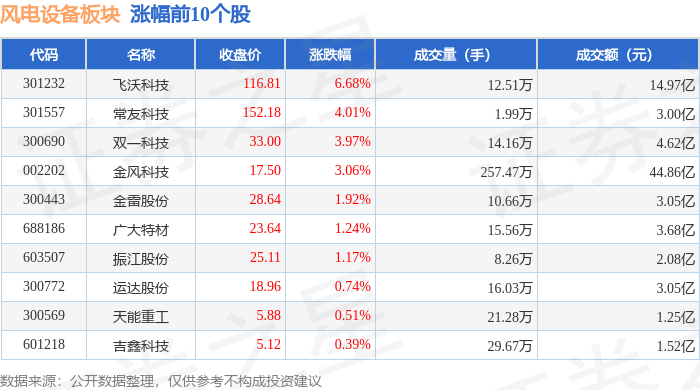
Group 1 - Wind power equipment sector increased by 0.28% on December 15, with Feiwo Technology leading the gains [1] - Shanghai Composite Index closed at 3867.92, down 0.55%, while Shenzhen Component Index closed at 13112.09, down 1.1% [1] - Notable gainers in the wind power equipment sector included Feiwo Technology (+6.68%), Changyou Technology (+4.01%), and Shuangyi Technology (+3.97%) [1] Group 2 - The wind power equipment sector saw a net inflow of 178 million yuan from main funds, while retail investors experienced a net outflow of 213 million yuan [2] - Key stocks with significant main fund inflows included Goldwind Technology (23.4 million yuan) and Taisheng Wind Energy (64.7 million yuan) [3] - Retail investors showed notable outflows in stocks like Taisheng Wind Energy (-85.18 million yuan) and Goldwind Technology (-21.7 million yuan) [3]



国信证券:AI时代电力设备需求增长迅速 全球储能系统装机需求持续释放
智通财经网· 2025-12-15 03:09
Core Insights - The report from Guosen Securities highlights several key areas of investment opportunity in the energy sector, particularly focusing on the growth of global energy storage demand, the expansion of AIDC power equipment industry, advancements in green methanol, adjustments in the photovoltaic supply side, recovery in the power grid equipment sector, and the impact of rising lithium battery material prices on profitability, as well as the progress in solid-state battery industrialization [1]. Group 1: Power Equipment Demand - The demand for power equipment is expected to grow rapidly in the AI era, driven by companies like Google Cloud, OpenAI, and TikTok planning to build data centers, which accelerates the infrastructure for AI [2]. - The global data center construction is accelerating, leading to an explosive growth in power demand for equipment in the AI sector [2]. Group 2: Energy Storage Demand - Global energy storage demand is continuously increasing, with a projected 404 GWh of installed capacity by 2026, representing a 38% year-on-year growth [3]. - Factors driving this demand include power supply shortages due to data centers in the U.S., unstable power grids in Europe, and supportive government policies in emerging markets [3]. Group 3: Lithium Battery Industry - The lithium battery supply chain is expected to see a reversal of the downtrend in prices, with significant recovery in prices and profitability anticipated by 2026 [4]. - New technologies such as steel-shell batteries, silicon anodes, and large energy storage cells are expected to achieve mass supply by 2026, while solid-state battery technology is accelerating towards industrialization [4]. Group 4: Wind Power Sector - The domestic wind power sector is projected to maintain a 10%-20% growth in new installations by 2026, supported by saturated orders and stable pricing [5]. - The profitability of wind turbine manufacturers is improving, with exports contributing to performance growth, indicating a synchronized recovery in both domestic and international markets [5]. Group 5: Photovoltaic Industry - The photovoltaic sector is undergoing supply-side adjustments, with a focus on cost reduction through new technologies such as low-silver and silver-free pastes, which are nearing mass production by 2026 [6]. - Companies in the photovoltaic industry are increasingly expanding into the semiconductor field, indicating a strategic shift in their business models [6].
风电2026年度策略报告:陆风装机有支撑,看好“十五五”两海成长空间-20251214
Soochow Securities· 2025-12-14 05:38
Demand: Onshore Wind Capacity Supported, Positive Outlook for Offshore Growth - In 2025, onshore wind capacity is expected to exceed 100GW, with a year-on-year growth of over 25% [2][11] - For offshore wind, the expected capacity for 2025 is between 8-10GW, with a year-on-year increase of 30%+ anticipated for 2026 [12][11] - The "14th Five-Year Plan" period is projected to see an average annual installation of 110-120GW for onshore wind and over 20GW for offshore wind [11][12] Offshore Cable: Voltage Levels Increasing, Leading Players Strengthening - The market size for offshore cables is expected to reach 10.7 billion yuan in 2025, a 62% increase year-on-year, with a compound annual growth rate of 26% from 2025 to 2030 [2][11] - The gross margin for 220kV cables remains stable at 35-40%, while higher voltage cables show promising margins of 45-55% [2][11] Tower and Pile: Domestic Profitability Turning Point, International Expansion Opportunities - Domestic capacity utilization rates have rapidly increased since Q2 2025, indicating a profitability turning point for related companies [2][11] - Internationally, companies are expanding their market share with significant profitability from single pile deliveries [2][11] Wind Turbines: Price Stabilization and Profitability Improvement Expected in 2026 - Wind turbine prices have stabilized, with a rebound of over 5% in bidding prices, leading to improved profitability for domestic manufacturers expected in 2026 [2][11] - Offshore orders and deliveries for wind turbine companies are significantly increasing, with offshore margins exceeding domestic margins by 5-10 percentage points [2][11] Investment Recommendations: Positive Outlook for Offshore Sector - The upcoming deep offshore projects are expected to catalyze growth, with a potential upward adjustment in mid-to-long-term installation levels [2][11] - Recommended stocks include those in the offshore wind sector such as 大金重工, 东方电缆, and others, as well as wind turbine manufacturers like 金风科技 and 明阳智能 [2][11] European Offshore Wind: Accelerated Planning Amid Energy Crisis - Following the energy crisis due to the Russia-Ukraine conflict, European countries are ramping up offshore wind planning, with auction volumes expected to increase significantly [2][21] - The average annual compound growth rate for European offshore wind installations is projected to reach 21% from 2025 to 2030 [2][37]


