蓝思科技

Search documents
汇丰环球投资管理(香港)有限公司减持蓝思科技18.06万股 每股作价约29.70港元
Zhi Tong Cai Jing· 2026-02-09 11:33
Group 1 - HSBC Global Asset Management (Hong Kong) Limited reduced its stake in Lens Technology (300433) by 180,600 shares at a price of HKD 29.7012 per share, totaling approximately HKD 5.364 million [1] - After the reduction, HSBC's latest holding is 18.04 million shares, representing a holding percentage of 5.98% [1]
汇丰环球投资管理(香港)有限公司减持蓝思科技(06613)18.06万股 每股作价约29.70港元

智通财经网· 2026-02-09 11:33
Group 1 - The core point of the article is that HSBC Global Asset Management (Hong Kong) Limited has reduced its stake in Lens Technology (06613) by selling 180,600 shares at a price of HKD 29.7012 per share, totaling approximately HKD 5.364 million [1] - After the reduction, HSBC's latest shareholding in Lens Technology stands at 18.04 million shares, representing a holding percentage of 5.98% [1]
全球航天强国加码太空光伏!卫星组网驱动产业化提速,海内外共振拉升产业估值中枢
Xin Lang Cai Jing· 2026-02-09 10:09
Core Viewpoint - The articles highlight the growing interest and investment in space photovoltaic technology among various companies in China, indicating a significant potential for growth in this sector by 2026 as commercialization accelerates. Group 1: Company Overview - Xizi Clean Energy (002534) is a leading clean energy equipment manufacturer in China, focusing on high-performance perovskite photovoltaic technology and aiming to become a core supplier of materials for space photovoltaics by 2026 [1][24]. - Shanghai Port Construction (605598) is a major infrastructure company that is expanding into space photovoltaic systems, leveraging its engineering capabilities to support commercial space projects [2][25]. - TuoRi New Energy (002218) has a long-standing presence in the photovoltaic industry and is optimizing its space photovoltaic products, expecting to increase market share by 2026 [3][26]. - Mingyang Smart Energy (601615) is acquiring technology to enhance its capabilities in space solar cell development, aiming to integrate its wind and solar energy expertise [4][28]. - Woge Optoelectronics (603773) specializes in flexible solar wing materials for satellites, with a focus on high-temperature resistant films, anticipating significant growth in the space photovoltaic sector [5][29]. Group 2: Growth Outlook - Companies are expected to benefit from the rapid commercialization of space photovoltaics, with projections indicating substantial growth opportunities by 2026 [1][2][3][4][5]. - The synergy between commercial aerospace and space photovoltaic industries is anticipated to drive rapid business growth for companies like Shanghai Port Construction and Mingyang Smart Energy [2][4]. - The demand for flexible solar wings and high-efficiency photovoltaic materials is expected to surge, positioning companies like Woge Optoelectronics and TuoRi New Energy as key players in the market [3][5]. Group 3: Technological Advancements - Companies are focusing on developing materials that can withstand extreme space conditions, such as high-performance perovskite and flexible solar films, which are crucial for the success of space photovoltaic applications [1][5][6]. - The integration of advanced technologies, such as N-type solar cells and high-efficiency components, is being prioritized by firms like Junda Co. (002865) and Sanan Optoelectronics (600703) to enhance their competitive edge in the space photovoltaic market [6][10][35]. - The ongoing research and development efforts in high-efficiency solar technologies are expected to yield breakthroughs that will facilitate the commercialization of space photovoltaic solutions by 2026 [3][4][5][6].



非金属建材行业周报:涨价链是主线,建材配置吸引力继续提升-20260208
SINOLINK SECURITIES· 2026-02-08 11:01
Investment Rating - The report maintains a positive outlook on the building materials sector, particularly focusing on price increase chains and structural prosperity chains [3][14]. Core Insights - The building materials sector is currently experiencing a price increase chain, with fiberglass leading the way due to a significant price rise in ordinary electronic cloth, which is expected to enhance profitability in the fiberglass sector [3][14]. - The report emphasizes the importance of the upcoming months (March-April) for potential growth, suggesting that investors should continue to focus on key sectors such as electronic cloth, domestic coatings/waterproofing, domestic cement, and domestic glass [3][14]. - The report highlights the potential of companies like Shengfeng Cement, which has a stable business model and is investing in new economic projects, indicating a strong cash flow and future investment returns [4][16]. Summary by Sections Weekly Discussion - The building materials sector is performing well, driven by price increases, particularly in fiberglass and electronic cloth [3][14]. - The report suggests a focus on structural prosperity chains and external demand chains, with a positive outlook for various sub-sectors [3][14]. Market Performance - The building materials index decreased by 0.67%, with specific sectors like glass manufacturing showing a 2.00% increase, while cement manufacturing saw a decline of 1.05% [21]. - The report notes that the average price of cement is currently 342 RMB/ton, down 53 RMB/ton year-on-year, with a national average shipment rate of 24.6% [17][31]. Price Changes in Building Materials - The average price of float glass increased to 1154.49 RMB/ton, reflecting a rise of 9.69 RMB/ton, with inventory levels showing a slight increase [17][44]. - The report indicates that the price of electronic cloth has risen significantly, enhancing the profitability outlook for the fiberglass sector [3][14]. Industry Trends - The report identifies a strong demand for AI-PCB upstream materials, particularly in substrate materials, driven by CPU shortages and price increases in downstream products [5][16]. - The report also highlights the importance of UTG glass and TCO glass in the aerospace energy sector, driven by advancements in solar energy production [4][15].

中国企业全球化与出海系列一:越世界,越中国
Sou Hu Cai Jing· 2026-02-08 02:58
Group 1 - The core viewpoint of the article is that Chinese enterprises are entering an accelerated phase of going global, which is essential for the transformation and upgrading of a manufacturing country and reflects the shift in China's economic development model [1][6]. - The transition from a GDP-driven, investment-focused model to a GNI-driven, innovation-focused model is highlighted, emphasizing the need for companies to integrate global resources to enhance production efficiency and global competitiveness [1][6]. - Chinese companies are moving into the 2.0 era of going global, transitioning from product exports to a systematic approach that includes "capacity + brand + channel," aiming for high-value segments of the industrial chain [1][6]. Group 2 - The article notes that the global easing cycle and the upturn in overseas industrial and infrastructure capital expenditure provide unexpected resilience in external demand for Chinese companies [2][6]. - Emerging markets are experiencing rapid industrialization and urbanization, leading to explosive demand for infrastructure and production equipment, while developed markets are driven by green transformation and AI infrastructure needs [2][6]. - Chinese companies are encouraged to focus on three main lines for overseas expansion: capital goods (electric power equipment, engineering machinery), high-value components (communication equipment, innovative pharmaceuticals), and consumer goods (two-wheeled vehicles, gaming) [2][6]. Group 3 - The article emphasizes that the essence of going global for Chinese enterprises is to occupy high-value segments of the industrial chain, which is a key stage in the economic transformation of a manufacturing country [6][7]. - The competitive advantages of Chinese companies in capital and technology-intensive industries, such as electric power equipment and engineering machinery, are highlighted, along with the resilience of exports under tariff pressures [6][7]. - The overseas gross profit margins of non-financial listed Chinese companies have consistently exceeded domestic margins, particularly in sectors like engineering machinery and automotive components [1][6].


算力需求强劲,关注CPO等新技术演进
Orient Securities· 2026-02-07 09:53
Investment Rating - The report maintains a "Positive" investment rating for the electronic industry, indicating an expectation of returns stronger than the market benchmark by over 5% [5]. Core Insights - Strong demand for computing power driven by AI applications is expected to continue, with significant investments from major cloud providers [8]. - The hardware supply-demand imbalance is spreading across various sectors, leading to price increases [8]. - New technologies such as CPO (Co-Packaged Optics) are anticipated to create additional demand [8]. Summary by Sections Investment Recommendations and Targets - Key investment targets include: - Semiconductor manufacturing: SMIC (688981, Buy), Hua Hong Semiconductor (01347, Buy) - Testing and packaging: Changdian Technology (600584, Buy), Tongfu Microelectronics (002156, Buy), and others [9]. - Server storage: Lianqi Technology (688008, Buy) - CPUs: Haiguang Information (688041, Buy), Longxin Technology (688047, Not Rated), and others [9]. - Passive components: Sanhua Group (300408, Buy), Fenghua Advanced Technology (000636, Not Rated) [9]. - Server manufacturing: Industrial Fulian (601138, Buy), Huaqin Technology (603296, Buy) [9]. - Analog and power chips: Naxin Micro (688052, Buy), Sierui Technology (688536, Not Rated), and others [9]. - Semiconductor equipment: Zhongwei Company (688012, Buy), Northern Huachuang (002371, Buy), and others [9]. - Optical devices/chips: Zhishang Technology (301486, Not Rated), Tianfu Communication (300394, Not Rated), and others [9]. AI Applications and Edge Computing - Key targets in edge AI applications include: - AI main control chips: Amlogic (688099, Buy), Hengxuan Technology (688608, Buy) - Edge storage: Zhaoyi Innovation (603986, Buy), Bawei Storage (688525, Buy) [10]. - Terminal manufacturers: Hikvision (002415, Buy), Luxshare Precision (002475, Buy), BYD Electronics (00285, Not Rated), and others [10]. - Core components for AI edge: Huanxu Electronics (601231, Buy), Sunny Optical Technology (02382, Buy), and others [10].





2026年省重点建设项目出炉,共计389个项目 长沙一批重点项目入选
Chang Sha Wan Bao· 2026-02-06 03:21
社会民生方面,将重点推进长株潭生态绿心"一厅一道"生态绿道、长沙奥体中心、湖南省体育训练基地 (含国家训练基地)建设项目和湖南体育职业学院整体搬迁项目、中南大学湘雅医院国家医学中心建设 项目等。 生态环保方面,将重点推进全省全域土地综合整治工程、沿江干支流污水厂网河湖一体化综合治理项 目、城市黑臭水体治理项目、全省大气污染防治能力建设有关项目以及长沙市新开铺污水处理厂厂网一 体质效提升工程等。 基础设施项目包括交通网项目67个、水利网项目13个、能源网项目24个、新基建项目10个、物流网项目 32个及6个其他项目。湖南将加快推进长沙至赣州铁路(湖南段)、邵阳至永州铁路、铜仁至吉首铁路 (湖南段)、宜昌至常德铁路(湖南段)、永州至清远至广州铁路(湖南段)、黔江至吉首铁路(湖南 段)等铁路项目,G4京港澳高速长沙广福至株洲王十万(朱亭)段扩容工程、G4京港澳高速岳阳龙湾 至长沙广福段扩容工程、G9907浏阳沙市至宁乡高速公路(长沙北横高速)、许广高速茶亭互通至长沙 绕城高速公路、浏阳至江背高速公路项目、长沙至吉首高速公路长沙至安化段等高速公路,以及长沙机 场改扩建工程、低空经济产业配套基础设施项目(长沙坪塘通用机 ...
光伏股集体弱势 行业经营压力依然显著+太空光伏技术引争议
Ge Long Hui· 2026-02-06 02:51
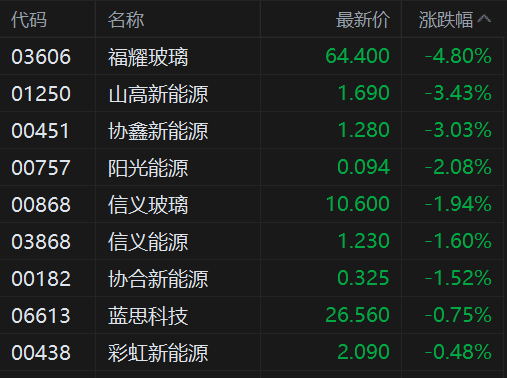
Group 1 - The Hong Kong solar energy stocks collectively declined, with notable drops including Fuyao Glass down nearly 5%, Shunfeng Photovoltaic down 3.4%, and GCL-Poly Energy down 3% [1][2] - The Ministry of Industry and Information Technology emphasized that addressing industry internal competition will be a top priority this year, indicating that the industry is undergoing a deep adjustment period with significant operational pressures on companies [1] - The China Photovoltaic Industry Association stated that the "space photovoltaic" technology is still in the early stages of exploration and validation, making it premature to determine a clear technical direction [1] Group 2 - Specific stock performance includes Fuyao Glass at 64.400 with a decline of 4.80%, Shunfeng Photovoltaic at 1.690 down 3.43%, and GCL-Poly Energy at 1.280 down 3.03% [2] - Other companies such as Sunshine Energy, Xinyi Glass, and Xinyi Energy also experienced declines, with percentage drops ranging from 1.52% to 2.08% [2] - The overall market sentiment reflects a cautious outlook as companies are reinforcing risk warnings amid ongoing challenges in the photovoltaic sector [1]

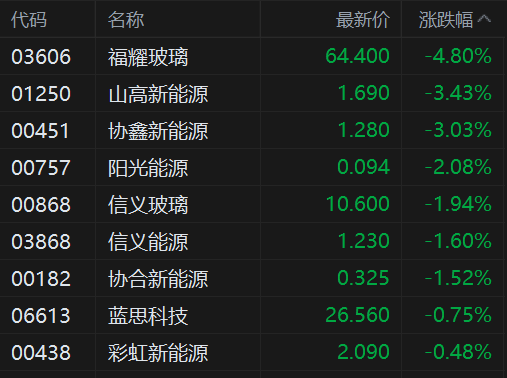
港股异动丨光伏股集体弱势 行业经营压力依然显著+太空光伏技术引争议
Ge Long Hui A P P· 2026-02-06 02:41
Group 1 - The Hong Kong solar energy stocks collectively declined, with notable drops including Fuyao Glass down nearly 5%, Shunfeng Photovoltaic down 3.4%, and GCL-Poly Energy down 3% [1] - The China Photovoltaic Industry Association hosted a seminar where Wang Shijian, Deputy Director of the Electronic Information Department of the Ministry of Industry and Information Technology, emphasized that addressing industry competition will be a top priority this year [1] - The industry is undergoing a new round of deep adjustment, with significant operational pressures on companies due to unresolved supply-demand mismatches [1] Group 2 - Liu Yiyang, Executive Secretary of the China Photovoltaic Industry Association, stated that the "space photovoltaic" technology is still in the early stages of exploration and validation, making it premature to determine a clear technical direction [1] - Some listed companies have simultaneously strengthened risk warnings in response to market discussions [1]
2026年,钱从哪挣?
创业家· 2026-02-05 10:21
Core Viewpoint - The article discusses the importance of exploring international markets for Chinese companies in response to domestic demand shortages and increasing competition, emphasizing the need for a comprehensive approach to overseas expansion that includes the entire value chain [2][5][6]. Group 1: Value Chain Expansion - The concept of "going overseas" has evolved from merely exporting products to relocating the entire value chain, including branding, research and development, and business models to foreign markets [8][11]. - An example is Miniso, which engages with its millions of private domain users to understand their preferences and directly opens stores overseas to enhance brand recognition [12][13]. Group 2: Collaborating with Industry Leaders - Many industry leaders are beginning to expand internationally, but successful overseas operations require integrating complex supply chain systems and collaborating with local partners [14][15]. - Tesla's Shanghai Gigafactory exemplifies this, as it operates efficiently due to the support of numerous upstream and downstream suppliers within a 300-kilometer radius [18][20]. Group 3: Leveraging Unique Advantages - Companies are finding success in international markets by leveraging their unique advantages, such as cost efficiency and product innovation [23][25]. - For instance, a factory owner in Yiwu has opened a store on a cross-border platform, where products can sell for double the domestic price [26]. Group 4: Building Long-Term Trust - Establishing long-term trust with customers is crucial, as demonstrated by the story of Pang Donglai, who prioritizes employee welfare and customer service, leading to a loyal customer base [31][34]. - This trust allows businesses to better understand customer feedback and improve their offerings [35][36]. Group 5: Meeting Evolving Consumer Needs - The article highlights a shift in consumer behavior, where individuals are willing to pay for enhanced experiences, indicating a growing demand for services that cater to these desires [39][46]. - Businesses must create scenarios that fulfill these needs, as traditional mass-market opportunities diminish [43][44].