
长江存储

Search documents
“世界光谷”全球产业合伙人大会在武汉举行 现场签约项目总投资额超过200亿元
Zheng Quan Ri Bao Wang· 2026-02-01 12:11
Group 1 - The "World Optics Valley" Global Industry Partner Conference was held in Wuhan, attracting nearly 200 representatives from top tech companies, investment institutions, and academic organizations [1] - The total investment amount for projects signed during the conference exceeded 20 billion yuan, covering key areas such as optoelectronic information, life health, modern services, and future industries [1] - The East Lake High-tech Zone's "14th Five-Year Plan" aims to establish a modern industrial system with one trillion-level, two 500 billion-level, and several hundred billion-level emerging pillar industries [1] Group 2 - A world-class integrated storage and computing industry base will be developed around Yangtze Storage, covering a 60 square kilometer area, focusing on cutting-edge research and development [2] - The successful hosting of the conference marks a significant milestone in the East Lake High-tech Zone's commitment to high-level opening up and building a global innovation cooperation system [2] - "World Optics Valley" is poised to integrate global wisdom and resources, collaborating with global industry partners to drive technological innovation and high-quality development [2]

“中国芯片起步晚、发展快”这个说法,并不准确
Guan Cha Zhe Wang· 2026-02-01 06:11
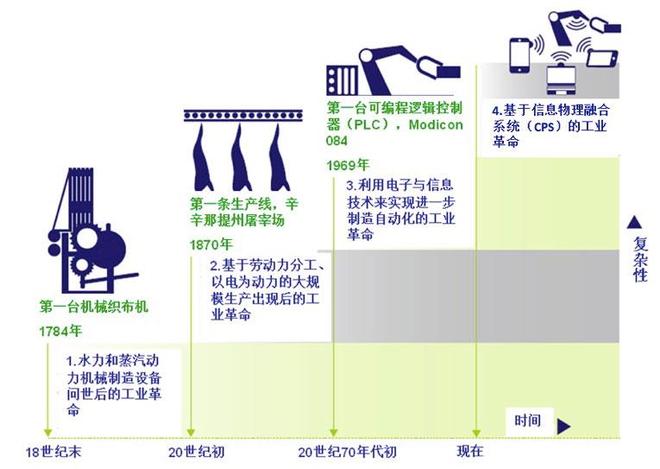
Group 1 - The U.S. House Foreign Affairs Committee has passed a bipartisan proposal to transfer the review authority of advanced AI chip sales to China to Congress, highlighting the long-term strategy of the West to restrict key technologies to China [1] - China's chip industry is accelerating its self-sufficiency process in response to external restrictions, with major foundries like SMIC and Hua Hong operating at full capacity and leading in mature process technologies [1] - Despite limitations in advanced processes, China is making significant progress in developing 7nm and 5nm technologies, with an increasing rate of chip self-sufficiency and accelerated R&D in high-end AI and server chips [1] Group 2 - Chips are compared to "modern oil," being integral to various devices, from smartphones to household appliances, emphasizing their unseen yet critical value in today's technology [2] - The automotive industry has become a significant market for chips, with modern vehicles containing hundreds of chips for various functions, showcasing the evolution of technology reliance on semiconductors [3] - The fourth industrial revolution is characterized by the integration of strong and weak electricity, with chips playing an essential role in this convergence [4][5] Group 3 - Key technological turning points in the chip industry include the invention of the transistor, the development of integrated circuits, and advancements in storage technologies like DRAM and flash memory, which have significantly influenced the global chip landscape [7][10] - The rise of the foundry model has transformed the semiconductor industry, allowing companies to focus on design while outsourcing manufacturing, leading to a concentration of chip production in East Asia [12][13] Group 4 - China's chip industry is at a critical historical stage, having made substantial investments and advancements since the trade war, although it still faces challenges in catching up with global leaders [14][19] - The development path of China's chip industry has been unique, starting from the top of the value chain and gradually moving down to design and manufacturing, particularly after the trade war [17][18] Group 5 - China has made significant progress in the storage chip sector, achieving self-sufficiency in DRAM and flash memory, with companies like Yangtze Memory Technologies and ChangXin Memory Technologies ranking among the top globally [26] - The domestic chip industry is experiencing rapid advancements in equipment localization, with notable progress in various semiconductor manufacturing equipment, although challenges remain in high-end lithography machines [27][28] Group 6 - The rapid development of AI has significantly impacted the chip industry, leading to increased demand for memory and processing power, with Chinese companies benefiting from the domestic production capacity [29][30] - The emergence of models like DeepSeek indicates a shift in China's approach to AI, focusing on optimizing models to work efficiently within existing hardware limitations [32] Group 7 - The Chinese chip industry must balance self-sufficiency with open collaboration, recognizing the importance of both government support and market dynamics in driving growth [39] - By 2030, the goal is for China to achieve self-sufficiency across the entire semiconductor supply chain, including the development of competitive global chip companies [38]

传长江存储三期项目提速,提前一年量产!
是说芯语· 2026-02-01 04:00
以下文章来源于芯智讯 ,作者芯智讯浪客剑 芯智讯 . "芯智讯"——有料的科技新媒体!专注于半导体产业链、智能手机产业链、人工智能、AR/VR、智能硬 件及汽车电子等相关领域。 1月30日消息,根据业内最新传闻显示,在全球存储芯片供应持续紧缺的背景下,中国最大的NAND Flash制造商── 长江存储(YMTC)位于武汉的三期项目(第三座晶圆厂)投资项目正 以惊人的速度加 快建设,原定于2027年才能达成的量产目标,有望提前至2026年下半年正式启动。 长江存储三期项目于2025年9月正式动工。该项目的公司主体—— 长存三期(武汉)集成电路有限 责任公司(以下简称"长存三期")成立于9月5日,注册资本207.2亿元。 股东信息显示,长存三期由长江存储持股50.19%、湖北长晟三期投资发展有限责任公司持股 49.81%。其中,湖北长晟三期投资发展有限责任公司为湖北国资旗下企业,这一背景为新公 司提供了坚实的资本与政策支持。 按照常规半导体建厂周期,需要等到2027年才能具备正式量产能力。但是,据业内人士透露,长江存储 近期已开始密集进行NAND Flash 生产设备的采购订单发送与工厂启动设置作业,显示其进度已 ...
中国光谷举办全球产业合伙人大会 签约额超200亿元
Zhong Guo Xin Wen Wang· 2026-02-01 02:01
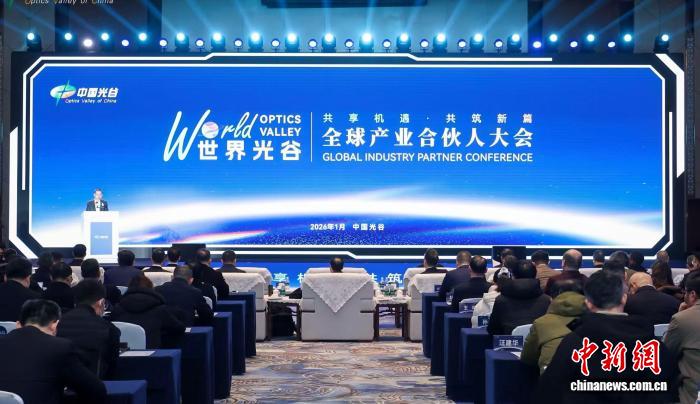
中国光谷举办全球产业合伙人大会 签约额超200亿元 图为未来产业项目签约环节。 主办方供图 现场,光电子信息、生命健康、未来产业等领域产业项目集中签约,光谷"突出贡献产业合伙人""全球 产业合伙人"获授牌。(完) 来源:中国新闻网 编辑:郭晋嘉 中新网武汉2月1日电 (卢琪 朱凌燕 曾宪雯)"世界光谷"全球产业合伙人大会1月31日在武汉东湖高新区 (又称"中国光谷")举行,产业项目签约额超200亿元,涵盖光谷现代化产业体系各核心领域。大会以"共 享机遇,共筑新篇"为主题,科技企业、投资机构、高校院所近200名代表参会。 "AI将推动全球半导体产业迈入万亿美元规模。"长江存储执行副总裁、首席运营官程卫华表示,半导体 产业是AI价值链占比最高的产业,而中国企业在EDA(电子设计自动化)、设备、材料等关键环节占比仍 显薄弱,这既是挑战,更是巨大的增长空间。 据介绍,光谷将以长江存储为中心,打造世界级存算一体化产业基地,实施"梧桐树计划",引进上下游 合作伙伴,通过"对齐"需求、设计、技术路线与供应链,构建高效协同的"5分钟协作圈"。 "九峰山实验室是目前全球规模最大、先进程度最高的化合物半导体中试平台,截至目前,通 ...
“世界光谷”有了“产业合伙人” 80亿元投资存算一体产业园一期项目
Chang Jiang Ri Bao· 2026-02-01 01:00
Core Insights - The "World Optics Valley" Global Industry Partner Conference was held, where ten institutions were awarded the title of "Global Industry Partner" [2] - The conference aimed to attract global partners and is part of a strategic declaration to build a world-class industrial cluster [2][4] - Total investment from signed projects exceeded 20 billion yuan, covering key sectors such as optoelectronic information, life health, modern services, and future industries [2] Investment and Projects - The conference resulted in a total investment of over 20 billion yuan, with significant projects in various sectors [2] - An 8 billion yuan integrated computing and storage industrial park project targets core areas of integrated circuits [3] - Notable projects include the AI innovative drug technology park and the national headquarters for robotics, focusing on humanoid robots and low-altitude economy [3] Strategic Goals - The East Lake High-tech Zone aims to create a world-class integrated computing and storage industrial base centered around Yangtze Storage, covering a 60 square kilometer area [3] - The strategy emphasizes aligning demand, design, technology routes, and supply chains to create an efficient collaboration network [3] - The next five years will focus on "world vision, international standards, unique characteristics of Optics Valley, and high positioning" to achieve decisive progress in building "World Optics Valley" [3]
存储公司业绩普遍预增 机构预计短缺和涨价会持续
Zhong Guo Jin Rong Xin Xi Wang· 2026-01-30 15:06
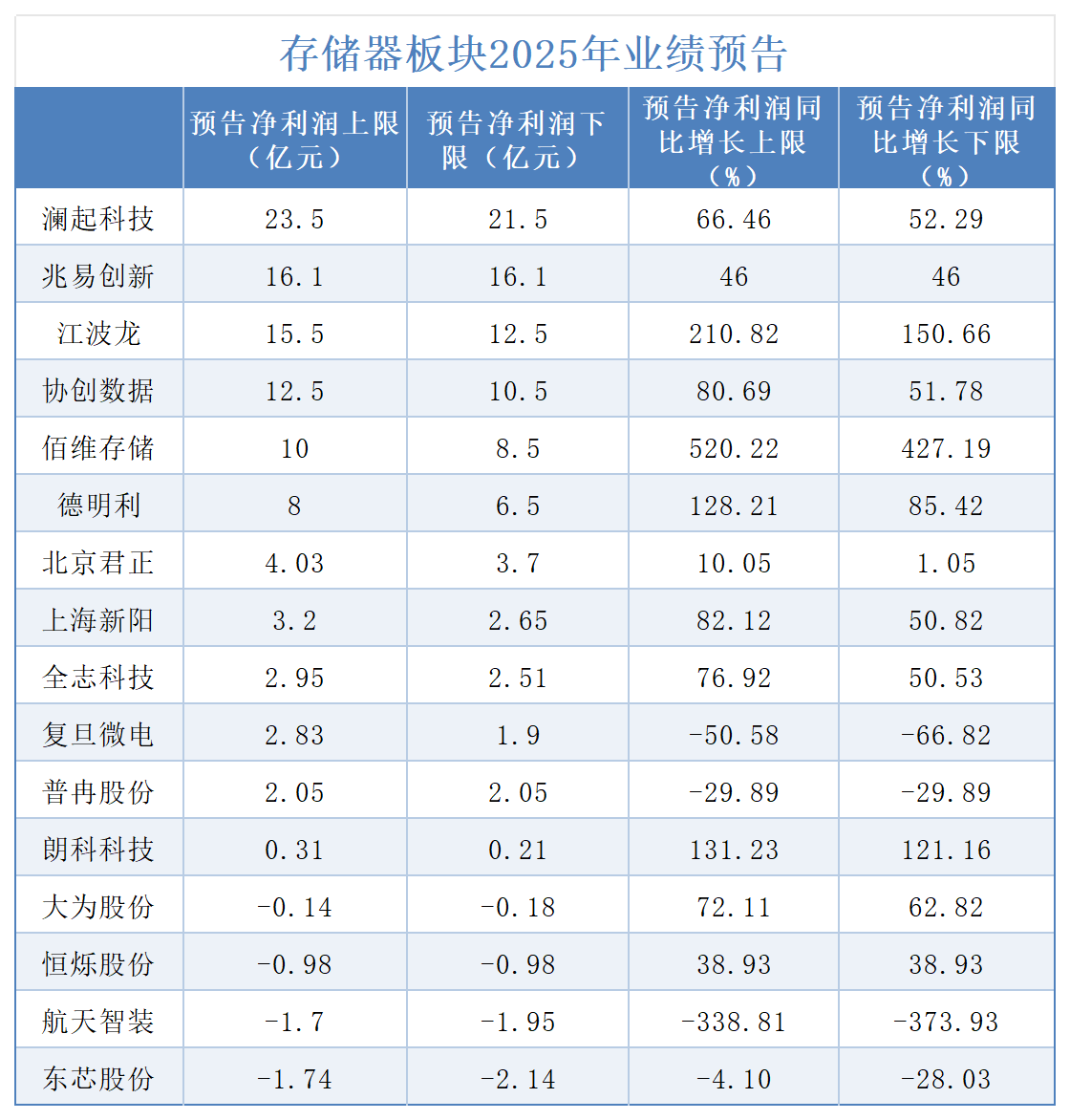
Core Viewpoint - The storage industry is experiencing a significant increase in profitability, driven by the growth of AI and computing power, leading to a high prosperity cycle and rising product prices [1][7]. Group 1: Company Performance Forecasts - Baiwei Storage is expected to achieve a net profit of 8.5 billion to 10 billion yuan in 2025, representing a year-on-year growth of 427.19% to 520.22% [2][3]. - Jiangbolong forecasts a net profit of 12.5 billion to 15.5 billion yuan, with a year-on-year increase of 150.66% to 210.82% [4][3]. - Demingli anticipates a revenue of 103 billion to 113 billion yuan, with a year-on-year growth of 115.82% to 136.77%, and a net profit of 6.5 billion to 8 billion yuan, reflecting an increase of 85.42% to 128.21% [6][3]. Group 2: Industry Trends and Drivers - The growth in the storage sector is primarily attributed to the booming AI and computing power industries, which have led to a high demand and rising prices for storage products [7][8]. - The global storage industry is expected to maintain high prosperity through 2026, with price increases anticipated to continue throughout the year, particularly driven by AI demand [7][8]. - The current cycle of price increases is influenced by structural supply-demand mismatches, with AI server demand significantly outpacing other segments [8][7]. Group 3: Market Dynamics and Future Outlook - The storage market is projected to expand due to increasing data and AI proliferation, with a notable rise in demand for storage technology across various sectors [8][7]. - The price of storage products has already seen substantial increases in 2025, with further rises expected in 2026, driven by both AI servers and general server demands [8][7]. - Companies are actively expanding production capacities in response to the favorable market conditions, with domestic manufacturers like Baiwei Storage and Jiangbolong leading the charge [7][8].



芯片巨头,赚翻了
半导体芯闻· 2026-01-30 11:22
Core Insights - The surge in demand for AI data centers has led to a tight supply of storage semiconductors, resulting in record quarterly performances for both Samsung Electronics and SK Hynix [1][2] - Both companies are expected to supply the sixth generation of high bandwidth memory (HBM4) amid a supply-demand imbalance [1][3] Financial Performance - Samsung Electronics reported a revenue of 93.8 trillion KRW and an operating profit of 20.1 trillion KRW for Q4 2025, marking year-on-year increases of 23.7% and 209.2% respectively [1] - The semiconductor division of Samsung saw a 46% year-on-year revenue growth, reaching 44 trillion KRW, with operating profit soaring by 465.5% to 16.4 trillion KRW [1] - SK Hynix achieved a record revenue of 32.8267 trillion KRW in Q4, a 66.1% year-on-year increase, with operating profit rising by 137.2% to 19.1696 trillion KRW [1] Market Dynamics - The rapid expansion of AI data centers by major North American tech companies like Google, Microsoft, and Amazon has significantly increased the demand for storage semiconductors [2] - Despite a limited growth rate of DRAM bit shipments at around 10%, average selling prices (ASP) have surged by 25% to nearly 40% [2] - In NAND flash memory, SK Hynix's bit growth rate is approximately 10%, while Samsung's bit shipments have slightly declined, yet both companies' performance remains strong due to substantial price increases [2] HBM Market Trends - The HBM market is experiencing a supply shortage, exacerbated by AMD's announcement of its next-generation AI chip "MI455" featuring 432 GB of HBM4, which is 50% higher in capacity than similar products from Nvidia [3] - Both Samsung and SK Hynix have indicated that customer demand for HBM products far exceeds their current supply capabilities, leading to anticipated competition for market share [3] Future Product Strategies - Samsung and SK Hynix are preparing for the next generation of HBM (HBM4E) and customized HBM products, with both companies actively working to meet customer-specific requirements [4] - SK Hynix is focusing on customized HBM as a core competitive factor, while Samsung plans to initiate wafer trial production for customized HBM products in the second half of the year [4] NAND Flash Market Outlook - The demand for NAND flash memory is expected to grow significantly as AI applications shift focus towards inference stages, positioning NAND as a critical component in AI infrastructure [5] - The export value of Korean NAND flash memory is projected to reach 1.3 billion USD by January 2026, reflecting a 108% year-on-year increase [6] - Both Samsung and SK Hynix are adjusting their production strategies, focusing on high-margin products like HBM while maintaining stable pricing to enhance profitability [6][7]
从算力到端侧:AI硬件景气上行 端侧AI成2026年主线
Ge Long Hui· 2026-01-29 07:13
Group 1 - The demand for AI computing power is continuously rising, driven by the needs of AI inference and related hardware supply-demand imbalances [1] - In the semiconductor upstream foundry and packaging sectors, foundries are raising prices for certain mature process foundry services due to increased AI-related power demand and production cuts by major manufacturers [2] - The storage industry is projected to reach a value of $551.6 billion by 2026, with a year-on-year growth of 134%, driven by AI [2] Group 2 - Domestic computing power hardware is making significant technological breakthroughs, with companies like Cambrian, Haiguang Information, and Moore Threads emerging in the computing chip sector [3] - In the packaging field, domestic manufacturers are advancing in advanced packaging technologies, with Changdian Technology achieving important progress in optoelectronic packaging [3] - AI is expected to accelerate its integration into various hardware products and industrial scenarios by 2026, creating investment opportunities across the industry chain [4] Group 3 - Investment targets in AI computing-related hardware include foundry manufacturers like SMIC and Hua Hong Semiconductor, and semiconductor equipment companies such as Zhongwei Company and Northern Huachuang [5] - In the end-user storage sector, companies like Zhaoyi Innovation and Baiwei Storage are highlighted, along with terminal manufacturers such as Hikvision, Lenovo Group, and Xiaomi Group [6]
电子元器件,涨声一片!
是说芯语· 2026-01-29 06:47
Price Increases in Semiconductor and Electronic Components Industry - Resonac announced a price increase of 30% for copper-clad laminates and adhesive films starting March 1, 2026, due to tight supply and rising costs of raw materials and labor [3] - Nanya Plastics will raise prices for all CCL products and PP by 8% starting November 20, 2025, citing increases in international copper prices and raw material costs [7] - TrendForce predicts that the average capacity utilization rate of global 8-inch wafer foundries will rise to 85%-90% in 2026, leading to price increases of 5%-20% for wafer foundry services across the board [8] - TSMC plans to increase prices for advanced technology nodes (5nm, 4nm, 3nm, 2nm) by 8%-10%, with a 50% increase for 2nm wafers starting in 2026 [10] - SMIC has implemented a price increase of approximately 10% for certain capacities [11] - Several packaging and testing companies have begun raising prices, with increases nearing 30% due to high demand and full capacity utilization [13] Memory Chip Price Increases - Samsung has raised NAND flash prices by over 100% and plans to increase server DRAM prices by 60%-70% in Q1 2026 [15] - SK Hynix is also raising server DRAM prices by 60%-70% and has negotiated significant price increases for LPDDR memory used in iPhones, approaching 100% [16] - Micron has announced a general price increase of approximately 20% across its product lines [17] - NAND flash wafer prices increased by over 10% in December 2025, with SSD prices rising by 15%-20% [24] Passive Components Price Adjustments - Various passive component manufacturers, including Yageo and Panasonic, have announced price increases for capacitors and resistors ranging from 8% to 30% [26][31] - ROHM Semiconductor has raised prices for thick film resistors by 8%-20% [38] - Multiple manufacturers are adjusting prices due to rising raw material costs and supply chain pressures [47] Power Devices and Other Electronics - Huazhong Microelectronics confirmed price increases for certain IGBT products due to rising copper and raw material costs [48] - Several semiconductor companies, including Jiangxi Tianyi and Wuxi Zongxiang Technology, have raised prices for specific products by 10%-20% [82][83] CPU and GPU Price Trends - AMD and Intel are planning to increase server CPU prices by up to 15% due to high demand from large enterprises [62] - NVIDIA and AMD are expected to raise GPU prices in early 2026, with multiple price adjustments anticipated throughout the year [79]


以资本、生态和校友“三驾马车”驱动湖北新质生产力跃升
Zhong Guo Fa Zhan Wang· 2026-01-28 06:01
Core Viewpoint - The article emphasizes the strategic importance of Hubei Province during the "14th Five-Year Plan" period, highlighting the need for a shift in investment strategies from project-based to ecosystem-focused approaches to foster new productive forces and enhance industrial competitiveness [1][2]. Investment Strategy - Investment in Hubei should transition from "quick investments" to "precise investments," focusing on long-term and systematic approaches that link laboratories, industry chains, and application scenarios [1]. - Key areas for investment include foundational research in hard technology, enhancing industrial chains, and early-stage incubation of future industries [1][2]. Capital Structure - A dual ecosystem of "patient capital + industrial capital" should be established to attract social capital to early-stage innovation projects, encouraging major enterprises to set up corporate venture capital (CVC) funds [2]. - Long-term capital should be introduced to support major technological infrastructure projects through specialized financial tools [2]. Post-Investment Services - A platform for "investment + empowerment" should be created, providing deep services such as technical iteration and market access to invested companies [2]. - The establishment of a "returning alumni" venture capital fund aims to attract local talent back to Hubei, enhancing the connection between talent and capital [2]. Global Business Ecosystem - The establishment of the Yangtze River International Chamber of Commerce serves as a global business ecosystem, facilitating connections between domestic and international resources [3][4]. - This platform plays a crucial role in reducing transaction costs and enhancing the resilience of domestic and international supply chains [4]. Alumni Economy - The "alumni economy" is identified as a strategic resource for Hubei, promoting the integration of talent, innovation, and industry [5][6]. - The province has initiated actions to develop the alumni economy, focusing on overcoming challenges such as resource fragmentation and incomplete service chains [6][7]. Talent Development - A "three-dimensional driving" model is proposed to convert top-tier academic resources into industrial advantages, emphasizing the need for a flexible talent circulation system and innovative institutional reforms [7][8]. - The establishment of a "new engineering education and industry integration base" aims to align talent supply with industry demand [10][12]. Technology and Innovation - The article suggests implementing a "launch empowerment" project to create a seamless connection between research, education, and industry [10]. - A focus on building a "virtual industrial cluster" platform is recommended to facilitate online connections and collaborative innovation across the supply chain [12].
