Lazada

Search documents
极兔速递(01519.HK):Q2东南亚件量同比高增66% 持续看好公司三市场齐发力
Ge Long Hui· 2025-07-11 03:05
Core Viewpoint - J&T Express has reported significant growth in its operational data for Q2, particularly in Southeast Asia, where parcel volume increased by 66% year-on-year, indicating strong market performance and potential for continued expansion [1][2][3] Group 1: J&T Express Operational Performance - In Q2, the total average daily parcel volume for the group reached 81.2 million, a year-on-year increase of 23.5%, with Southeast Asia contributing 18.5 million parcels daily, reflecting a 66% growth [1] - For the first half of the year, the group's average daily total parcel volume was 76.9 million, up 26% year-on-year, with Southeast Asia showing a 57% increase [1] - The company’s parcel volume in China grew by 14.7% in Q2, reaching an average of 61.7 million parcels daily [1] Group 2: Southeast Asia E-commerce Growth - According to Momentum Works, the total GMV for Southeast Asian e-commerce platforms is projected to reach $128.4 billion by 2024, dominated by Shopee, Lazada, and TikTok Shop [1] - TikTok Shop's GMV in Southeast Asia is expected to grow from $163 million in 2023 to $226 million in 2024, increasing its market share from 13.2% to 17.6% [2] - During a recent promotional event, TikTok Shop achieved a GMV growth of 123% year-on-year, indicating strong consumer engagement [2] Group 3: Market Position and Growth of J&T Express - J&T Express has maintained its position as the leading courier operator in Southeast Asia since 2020, with a market share of 28.6% projected for 2024, an increase of 3.2 percentage points from 2023 [2] - The company has experienced substantial growth in parcel volume, with year-on-year increases of 87.3%, 16.3%, and 28.9% from 2021 to 2023, culminating in 3.24 billion parcels in 2023 [3] - In Q1 2025, J&T Express's parcel volume in Southeast Asia is expected to grow by 50%, with Q2 showing an even larger increase of 66% [3] Group 4: Financial Projections and Valuation - The company’s net profit forecasts for 2025, 2026, and 2027 are projected at $3.80 billion, $5.76 billion, and $8.23 billion respectively, with adjusted net profits of $4.67 billion, $6.63 billion, and $9.09 billion [4] - The estimated market value for the Southeast Asian segment is projected at $10 billion based on an EBITDA multiple of 11x for 2026 [4] - The total target market value across three markets is estimated at HKD 100.1 billion, with a target price of HKD 11.16, indicating a potential upside of 33% [4]
氪星晚报|百度智能云曦灵手语数字人荣膺联合国“AI向善”杰出案例奖;WaytoAGI社区发起“超级创作者计划”;中国和马来西亚互免签证协定即将生效
3 6 Ke· 2025-07-10 11:23
Group 1 - Shanghai Disneyland has halted offline sales of its new summer product line due to excessive resale prices, with items originally priced over 100 yuan being sold for nearly 500 yuan by scalpers [1] - The remaining inventory of the summer series will be sold online through Tmall, while other themed products will still be available through lottery and retail stores [1] Group 2 - Meituan has refuted claims regarding the number of delivery riders with higher education, stating that there is no factual basis for the reported figures of 300,000 undergraduate students working as delivery riders [1] Group 3 - Baidu's AI sign language digital human has been recognized with the United Nations "AI for Good" Outstanding Case Award, highlighting its role in providing accessible information for the hearing-impaired community [2] Group 4 - WaytoAGI community has launched the "Super Creator Program," aimed at gathering global AI creators and enterprises to foster collaboration and incubate outstanding AI projects [3] Group 5 - Samsung Electronics plans to launch its first tri-fold smartphone by the end of this year, expanding its Galaxy series with a new form factor [4] Group 6 - Lazada has been recognized as the most beloved brand in Thailand, achieving an advertising awareness rate of 65.7% in June 2025 [4] Group 7 - "Ruyuyuan Technology" has completed a 29 million yuan Series A financing round, which will support its development in the destination charging sector [6] Group 8 - The Shanghai Stock Exchange has held a policy briefing for investment institutions regarding the Sci-Tech Innovation Board, aiming to enhance communication and support for innovation-driven development [8]

航运巨头反垄断调查风暴:一场正在重塑国际货代市场的底层革命
Sou Hu Cai Jing· 2025-07-07 07:06
Core Insights - The article discusses the significant impact of the Kenyan Competition Authority's (CAK) antitrust investigation on the logistics and freight forwarding industry in East Africa, leading to a transformation in pricing and operational dynamics [1][2]. Pricing System Collapse - The CAK's investigation revealed a price-fixing agreement between shipping giants Maersk and CMA CGM, which had established a uniform terminal handling fee of $99 per 20-foot container, undermining the pricing foundation of the international freight market [2]. - Multinational shipping companies control over 70% of logistics contracts, creating a closed network that disadvantages local logistics firms, which own 90% of truck assets but only handle 30% of transport business [2]. - The investigation has led to a dramatic increase in complaints related to detention fees, with a reported 270% rise in customer complaints due to disputes over these fees in 2024 [2]. Supply Chain Financial Impact - Trade financing data from Dubai's NBD Bank indicates an 18 percentage point increase in the credit refusal rate for East African routes in Q1 2025, with 62% of refusals linked to shipping document delays [3]. - The average cash turnover rate for freight forwarding companies has decreased by 35% due to the "hidden pricing" controlled by shipping giants, leading to increased reliance on costly short-term financing [3]. Logistics Path Reconstruction - Following the CAK investigation, local logistics firms gained a 15% operational share at the new container terminal in Mombasa, resulting in a 210% year-on-year increase in cargo transported via the Nairobi-Malaba railway [4]. - In the cross-border e-commerce sector, there was an 85% increase in packages transported from Djibouti to Ethiopia in Q2 2025, while the traditional Mombasa route's share dropped to 48% [4]. Service Capability Transformation - A survey indicated that only 12% of local freight forwarding companies had rail intermodal operation qualifications in 2024, but this figure rose to 39% by July 2025 [5]. - The complexity of managing multiple documents in intermodal transport has led to a 30%-50% increase in service premiums for companies capable of integrating these operations, while traditional sea freight services have seen profit margins shrink to below 8% [5]. Market Structure Evolution - The CAK's investigation exposed the systemic control exerted by shipping giants over the freight forwarding market, with companies under exclusive contracts with Maersk facing 18%-22% lower booking costs compared to independent freight forwarders [6]. - Following the investigation, the CAK mandated shipping companies to allocate 20% of their capacity to independent freight forwarders, resulting in a market share increase for these companies from 17% to 31% in June 2025 [6]. Supply Chain Collaboration Changes - The breaking of shipping giants' monopolies has prompted freight forwarding companies to seek cross-segment collaborations, leading to the creation of a "door-to-door full chain service package" that is 15%-20% cheaper than bundled services from shipping giants [7]. - This decentralized collaboration model resulted in a 75% year-on-year revenue increase for alliance members in the first half of 2025, while companies relying solely on traditional shipping channels experienced a 12% revenue decline [7].

出海下半场的“风口”,就是AI创新
3 6 Ke· 2025-07-02 11:29
Core Insights - The globalization of Chinese enterprises is shifting from efficiency-driven to technology-enabled, with a focus on AI integration and product innovation [1][4][18] - The 2025 Alibaba Cloud Summit highlighted the importance of AI and cloud computing in the global expansion of Chinese companies, particularly in the cross-border e-commerce and consumer electronics sectors [1][4] Group 1: Industry Trends - Chinese companies are leveraging AI technology to enhance product capabilities and operational efficiency, marking a new phase in their globalization journey [1][4][12] - The collaboration between companies like Heewo and Alibaba Cloud exemplifies the integration of AI in educational technology, enhancing learning experiences through smart hardware [5][7] - Lazada, a leading cross-border e-commerce platform, is utilizing AI to improve logistics and user experience, demonstrating the critical role of AI in operational strategies [8][9] Group 2: Company Innovations - Anker, a successful smart hardware brand, is fully embracing AI across its product development and operational processes to redefine its brand and product categories [12][14] - JoggAI, a digital marketing service provider, is leveraging AI for content creation and customer engagement, showcasing the potential of AI in enhancing digital services for cross-border e-commerce [14][15] - The partnership between Alibaba Cloud and various companies is facilitating the development of a globalized infrastructure that supports AI applications, ensuring compliance and operational efficiency [16][17] Group 3: Infrastructure and Support - Alibaba Cloud's global infrastructure provides essential support for high-value technology exports, enabling seamless collaboration and consistent user experiences across borders [16][17] - The availability of AI tools and services from Alibaba Cloud allows companies to rapidly develop and deploy solutions tailored to local market needs, enhancing their competitive edge [17][18] - Compliance with international standards is a key focus for Alibaba Cloud, with over 150 certifications achieved to assist Chinese enterprises in navigating complex IT regulations abroad [17]

出海「越南」放贷:新牌照、新机遇
3 6 Ke· 2025-07-02 07:38
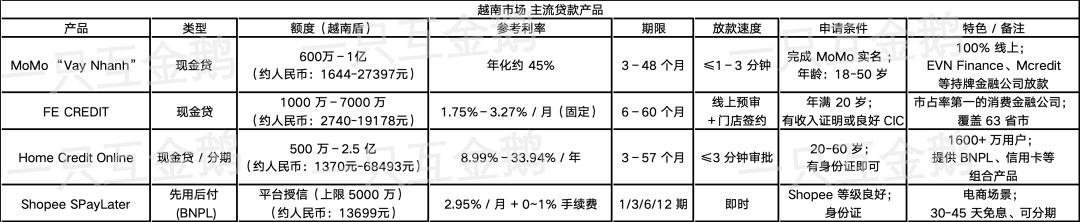
Core Insights - Vietnam's population reached 100.3 million in 2023, with a GDP of $476.3 billion and a GDP growth rate of 7.09% in 2024, making it an attractive market for consumer finance [1][2][3] Group 1: Market Potential - The large population and rapid economic growth position Vietnam as a suitable market for consumer finance, particularly cash loans [1] - Previous attempts by Chinese financial companies to enter the Vietnamese market in 2017 and 2018 ended in failure around 2020 due to regulatory issues and high bad debt rates [2][3][4] - Recent changes in the Vietnamese market, including the introduction of a "regulatory sandbox" for fintech, have renewed interest among Chinese financial companies [5][6] Group 2: Regulatory Developments - The Vietnamese government issued Decree No. 94/2025/ND-CP on April 29, 2023, which will take effect on July 1, 2025, aimed at establishing a regulatory sandbox for fintech innovation [9][10] - The regulatory sandbox allows P2P lending service providers to participate, indicating a potential easing of regulations in this area [12][13] - The sandbox will enable the accumulation of data for the State Bank of Vietnam, which will help in managing risks and developing a national credit information database [15][16] Group 3: Participation Requirements - P2P lending companies must meet strict requirements, including local registration, a qualified management team, and no foreign investment [18] - The application process involves submitting detailed plans and undergoing a review by the State Bank of Vietnam and other relevant departments [19][20] - The regulatory framework includes provisions for consumer protection, requiring companies to disclose risks and establish complaint mechanisms [25] Group 4: Market Landscape - Vietnam has a growing mobile payment and e-commerce sector, with major players like MoMo, ZaloPay, and ViettelPay already established [29][31] - MoMo, a leading fintech company, has over 60 million users, capturing 70% of the e-wallet market [31] - The e-commerce sector is also expanding rapidly, with significant growth in transaction volumes reported in early 2023 [32] Group 5: Competitive Landscape - Various mainstream lending products are available in Vietnam, including cash loans from MoMo, FE Credit, and Home Credit, each with different terms and conditions [35] - Despite the presence of mainstream players, there are still non-mainstream or "black market" lenders operating in the background [36] - The Vietnamese youth population is increasingly familiar with loans, indicating a potential market for consumer finance products [37]
中美确认伦敦框架细节;阿里海外电商有望单季盈利丨出海周报
2 1 Shi Ji Jing Ji Bao Dao· 2025-06-30 02:07
Group 1: Trade Relations - The Chinese Ministry of Commerce confirmed that China and the U.S. reached a consensus on a framework to implement the Geneva consensus, which includes accelerating rare earth exports from China and the U.S. lifting certain restrictions on China [1] - The Ministry criticized the U.S. unilateral imposition of "reciprocal tariffs" on global trade partners, calling it a form of bullying that disrupts the multilateral trade system [2] Group 2: Foreign Investment and Trade - From January to May, China's non-financial direct investment abroad reached $61.6 billion, a year-on-year increase of 2.3%, with significant investment in Belt and Road countries [3] - The Yangtze River Delta region's foreign trade volume surpassed 100 trillion yuan, with imports and exports growing by 5.2% year-on-year in the first five months of the year [4] Group 3: E-commerce and Technology - Southeast Asia's e-commerce market is dominated by three platforms: Shopee, Lazada, and TikTok Shop, which together hold over 80% of the market share [5] - Alibaba's international digital commerce group reported a 29% year-on-year revenue growth, with cross-border business showing strong performance [6] - Alibaba Cloud plans to deploy full-stack AI capabilities globally to support Chinese enterprises going abroad [7] Group 4: Logistics and Market Expansion - Cainiao has established a cross-border logistics network among six Gulf countries, enabling package delivery within three days [8] - Temu has officially entered the Turkish market, setting up an operations center in Istanbul and launching a "same-day delivery" service [9] Group 5: Consumer Brands and Market Entry - Stone Technology has submitted an application for listing on the Hong Kong Stock Exchange [11] - The partnership between Ningji and Thailand's Charoen Pokphand Group aims to expand in Southeast Asia and enhance supply chain collaboration [15] - Anker Innovations' eufyMake launched a 3D texture UV printer that broke Kickstarter records with over $420 million raised [16] Group 6: Automotive Industry - WeRide has reportedly submitted a secret application for listing in Hong Kong, focusing on autonomous driving technology [17] - XPeng Motors is deepening its collaboration with Alibaba Cloud to enhance its technology for overseas markets, achieving a 370% year-on-year increase in overseas sales [18] - Geely has officially entered the Greek market with the launch of its electric SUV model [20]
“出海”生态圈加速形成,中国(广东)-东盟跨境电商合作交流会举行
Guang Zhou Ri Bao· 2025-06-10 16:14
Core Insights - Emerging markets are currently the largest increment in China's foreign trade, with the bilateral trade volume between ASEAN and Guangdong expected to exceed 1.45 trillion yuan in 2024, representing an 8% year-on-year growth [1] - Cross-border e-commerce is playing a crucial role in promoting "Guangdong manufacturing" to go global and enhancing cross-border supply chain cooperation [1] Group 1: Opportunities in Southeast Asia - ASEAN has been Guangdong's largest trading partner for five consecutive years, showcasing significant advantages in industrial collaboration and digital empowerment [3] - The Guangdong Provincial Council for the Promotion of International Trade plans to continue promoting e-commerce standardization and cross-border service efficiency [3] - Malaysia is emerging as a "golden springboard" for Chinese enterprises entering the ASEAN market due to its rapid e-commerce development and high internet penetration [3] Group 2: E-commerce Platforms and Innovations - Chinese merchants are increasingly entering ASEAN markets through platforms like Shopee and Lazada, which are becoming global e-commerce growth engines [4] - Lazada offers a fully managed model that alleviates the challenges of going overseas, allowing sellers to focus on supply while the platform handles operations and logistics [4] - Shopee has developed a localized fulfillment engine to address cross-border logistics challenges, achieving delivery times of 2-3 days and reducing logistics costs by up to 83% [4] Group 3: Local Market Adaptation - Despite the opportunities in ASEAN, competition is fierce, and companies face challenges such as a lack of technology and talent [5] - A case study highlighted a Malaysian batik brand that successfully entered the Indonesian and Vietnamese markets by localizing its products and hiring local designers [5] - Future cooperation between Guangdong and Thailand could be enhanced through supply chain collaboration, logistics upgrades, and cross-border payment cooperation [5] Group 4: Logistics and Payment Solutions - J&T Express has achieved 100% coverage in Indonesia through 82 transit centers, addressing high logistics costs for mid-distance sea transport [6] - The company is also forming strategic partnerships with leading mobile payment platforms in ASEAN to promote digital payment methods and improve e-commerce penetration [6]
跨境电商运营:2025年全球电子商务趋势报告:购物行为、物流偏好与市场动
Sou Hu Cai Jing· 2025-06-10 11:27
Core Insights - The report highlights diverse trends in the global e-commerce market and changing consumer behaviors, indicating that 52% of global consumers shop online at least once a month, with China, Morocco, and Nigeria leading in browsing activity [1][2] - Mobile shopping is predominant, with 83% of millennials using retailer apps, and voice search gaining traction in markets like India and Turkey, where 47% of social shoppers utilize voice commands [1][2] - Logistics and return experiences are critical, as 72% of consumers expect free shipping, and 55% prefer free returns, with high shipping costs (58%) and long delivery times (52%) being significant pain points [1][2] E-commerce Landscape - Social commerce is increasingly influential, with 37% of clothing purchases made through social media, particularly in Turkey and Nigeria, where social shopping penetration exceeds 30% [2][3] - Cross-border shopping is prevalent, with 60% of consumers purchasing overseas at least once a month, driven by factors like free shipping (55%) and secure payment options (50%) [2][3] - Sustainability is emerging as a key demand, with 93% of Nigerian consumers concerned about delivery's environmental impact, and 57% of global consumers willing to pay a premium for eco-friendly options [2][3] Regional Market Differences - Significant regional variations exist, with Mercado Libre dominating 94% of the Argentine market, while Amazon leads in the US and Europe, and Shopee and Lazada have over 80% penetration in Southeast Asia [3] - The growth of second-hand trading and subscription models is notable, with platforms like Vinted promoting a circular economy in Europe, and 42% of UAE consumers engaging in subscription clothing services [3] - Overall, the global e-commerce landscape is evolving towards mobile, social, and localized experiences, with logistics, technological innovation, and sustainability practices becoming competitive core elements [3]

探谋:2025年东南亚电子商务市场洞察报告
Sou Hu Cai Jing· 2025-06-07 01:36
Market Growth and Potential - Southeast Asia is a significant economic engine in the Asia-Pacific region, with the e-commerce market accelerating since the mid-2010s. The total Gross Merchandise Value (GMV) is expected to reach $159 billion in 2024, representing a year-on-year growth of 15%. The compound annual growth rate (CAGR) is projected to be 10.42% until 2029. Indonesia leads with a GMV of $56.81 billion, while Malaysia has the lowest growth rate at 10.63%. Vietnam and Thailand are experiencing growth rates exceeding 15% [1][2][3]. Consumer Behavior and Preferences - In terms of product categories, electronics are the best-selling items in Indonesia, Malaysia, and the Philippines, while fashion, food, and beauty products are also popular. Indonesia shows a strong demand for food products, and Thailand has a high demand for beauty and personal care items. Shopee dominates the market with the highest monthly traffic across all five countries, particularly in Vietnam (170 million) and Indonesia (130 million). TikTok Shop, although not included in website traffic rankings, is rapidly growing, with a projected GMV of over $21 billion in 2024, primarily in Thailand and Indonesia. Social media penetration exceeds 70%, and mobile e-commerce accounts for over 60% of B2C transactions in Indonesia and Thailand [2][3][4]. E-commerce Platform Competitive Landscape - Shopee leads the market with a 45.9% market share, followed by Lazada. The merger of TikTok and Tokopedia has resulted in a combined market share of 28.1%, reshaping the competitive landscape. TEMU, under Pinduoduo, has quickly entered multiple markets with a daily GMV exceeding $1 million, although it faces regulatory challenges. The main sales categories are electronics, fashion, and beauty, with TikTok Shop's beauty and personal care sales accounting for 38% of its total sales. Shopee has significant traffic advantages in Vietnam and Indonesia, while Tokopedia's monthly traffic in Indonesia exceeds 60 million [3][4][5]. Regulations, Logistics, and Market Entry - Foreign investment regulations vary, with the Philippines and Vietnam being more open to foreign capital, allowing cross-border sales without local entities. In contrast, Indonesia and Thailand have strict requirements for establishing local entities, with Indonesia imposing a foreign ownership limit of 49% (up to 100% under specific conditions). Logistics costs as a percentage of GDP vary significantly, with the Philippines at 27% and Thailand at 14%. Malaysia and Thailand exhibit higher logistics efficiency, while overall tariffs are low, though certain categories (like electronics and toys) require certification, with Indonesia's import tariffs reaching as high as 150% [4][5]. Emerging Trends and Opportunities - Social commerce and live streaming are on the rise, with TikTok Shop's sales expected to grow by 115% year-on-year in 2024, driven primarily by Thailand and Indonesia, contributing over 60% of sales. KOL marketing is becoming a key strategy for brands to reach consumers, with Facebook and TikTok as primary platforms for collaboration. Chinese platforms are also emerging, with Alibaba investing over $5.8 billion in Lazada, and Chinese companies deeply engaging in regional competition through capital cooperation and localization strategies. The report highlights that Southeast Asia's e-commerce market presents high growth potential and complexity, necessitating businesses to adapt to local regulations, logistics characteristics, and consumer preferences while leveraging social marketing and localization strategies for market expansion [5][6].

Philippines Social Commerce Market Databook 2025, Featuring Resellee, cafe24 corp, Facebook, Instagram and YouTube
GlobeNewswire News Room· 2025-06-05 13:22
Core Insights - The Philippines social commerce market is projected to grow at an annual rate of 17.2%, reaching USD 2.30 billion by 2025, following a CAGR of 21.8% from 2021-2024 and expected to reach approximately USD 4.17 billion by 2030 with a CAGR of 12.6% from 2025-2030 [2][4] Market Dynamics - Growth is driven by the integration of social media platforms with e-commerce functionalities and consumer demand for interactive shopping experiences [3][4] - Increased internet access and social media usage are key factors contributing to the growth of the social commerce sector [6] Competitive Landscape - Major players include Lazada, Shopee, and Facebook, with new entrants like Temu intensifying competition [6][10] - The rise of live commerce and partnerships with influencers are crucial for enhancing consumer engagement and driving sales [9][10] Technological Advancements - Companies are focusing on AI-driven personalization, live commerce features, and augmented reality shopping developments to enhance consumer experiences [7][9] - The integration of secure payment solutions and digital wallets is shaping the shopping experience [9] Strategic Developments - The social commerce sector is witnessing strategic alliances and advancements in payment solutions, particularly in the Buy Now, Pay Later (BNPL) segment [14] - The regulatory environment is evolving, with guidelines from the Philippine Competition Commission influencing mergers and acquisitions in the digital market [14]