
香港交易所

Search documents
智通ADR统计 | 11月20日
智通财经网· 2025-11-19 22:42
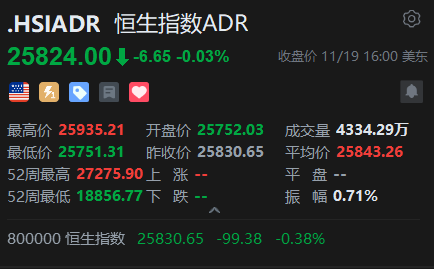
Market Overview - The Hang Seng Index (HSI) closed at 25,824.00, down by 6.65 points or 0.03% as of November 19, 16:00 Eastern Time [1] - The index's highest price during the day was 25,935.21, while the lowest was 25,751.31, with a trading volume of 43.34 million shares [1] Major Blue-Chip Stocks Performance - HSBC Holdings closed at HKD 107.800, down by HKD 1.800 or 1.64% compared to the previous close [2][3] - Tencent Holdings closed at HKD 622.500, down by HKD 1.000 or 0.16% [3] - Alibaba Group (ADR) saw an increase, closing at HKD 156.400, up by HKD 1.800 or 1.16% [3] - Xiaomi Group closed at HKD 38.820, down by HKD 1.960 or 4.81% [3] - AIA Group closed at HKD 77.950, down by HKD 0.600 or 0.76% [3] Stock Price Changes - The stock prices of major companies showed mixed results, with some experiencing declines while others saw slight increases [2][3] - Notable declines included Kuaishou Technology, which closed at HKD 63.500, down by HKD 1.150 or 1.78% [3] - Ctrip Group saw an increase, closing at HKD 574.500, up by HKD 10.000 or 1.77% [3]





港交所参与者市场占有率报告:10月C组市占率按月跌至3.71%
Zhi Tong Cai Jing· 2025-11-19 11:44
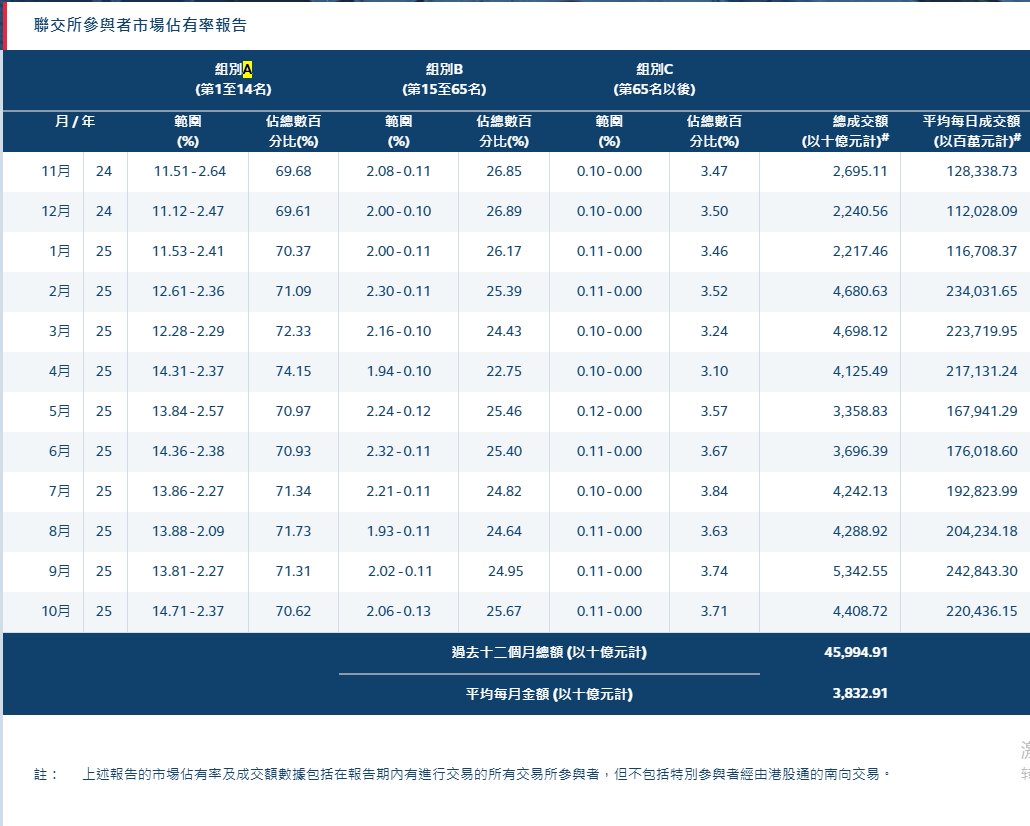
Core Insights - The Hong Kong Stock Exchange (HKEX) reported a total trading volume of approximately HKD 45.99 trillion over the past 12 months, with an average monthly trading volume of about HKD 3.83 trillion [1][2] Market Share Analysis - In October, the market share of Group A (top 14 brokers by trading volume) decreased from 71.31% in September to 70.62% [1] - Group B (brokers ranked 15th to 65th) saw an increase in market share from 24.95% in September to 25.67% in October [1] - Group C (remaining brokers) experienced a slight decline in market share from 3.74% in September to 3.71% in October [1] Monthly Trading Volume - The average daily trading volume for October was approximately HKD 220.44 billion, down from HKD 242.84 billion in September [2] - The total trading volume for the past 12 months was reported at HKD 45,994.91 billion, with an average monthly amount of HKD 3,832.91 billion [2]

香港交易所:香港期货交易所有限公司已取得证监会批准,于2025年11月28日推出恒生生物科技指数期货
Ge Long Hui· 2025-11-19 09:32
Core Viewpoint - The Hong Kong Futures Exchange has received approval from the Securities and Futures Commission to launch the Hang Seng Biotechnology Index futures on November 28, 2025 [1] Group 1 - The approval marks a significant development for the Hong Kong Futures Exchange, expanding its product offerings in the biotechnology sector [1] - The introduction of the Hang Seng Biotechnology Index futures is expected to attract more investors and enhance market liquidity [1]
香港证监会梁仲贤:正积极与内地合作 探讨可行机制便利投资者参与内地衍生品
Zhi Tong Cai Jing· 2025-11-19 09:09
Group 1 - The Hong Kong Securities and Futures Commission (SFC) is collaborating with mainland authorities and the Hong Kong Stock Exchange to develop Hong Kong as an offshore risk management hub [1] - The SFC is exploring the Southbound Swap Connect to allow mainland investors to utilize Hong Kong's swap market for expanding their risk management toolkit [1] - The introduction of the Swap Connect has seen significant growth, with trading volume reaching approximately 10% of the mainland interest rate swap market, totaling over 8.5 trillion RMB as of September [1][2] Group 2 - Since the introduction of the regulatory framework in 2014, Hong Kong's OTC derivatives market has rapidly developed, with the nominal value of Asian stock OTC positions reaching 800 billion USD, a 70% increase over three years [2] - The majority of OTC stock derivatives positions cover Asian securities outside of Hong Kong, with one-third tracking Hong Kong-listed stocks and indices, while two-thirds involve other Asian securities [2] - Hong Kong has become the largest OTC derivatives market related to mainland assets globally, driven by the growth of RMB foreign exchange and interest rate derivatives [2] Group 3 - The OTC stock derivatives market for locally listed securities in Hong Kong has reached 250 billion USD, doubling in size over the past three years, aligning with a 40% growth in exchange-traded derivatives [3] - The combined OTC and exchange-traded derivatives market accounts for 12% of the free float market capitalization of Hong Kong's stock market, indicating a strengthening position as a risk management hub in Asia [3] - The outstanding OTC derivatives positions cover over 2,000 stocks and ETFs, with approximately 80% related to stocks and 20% to indices [3]
这场资本与产业对接会在深圳成功举办
母基金研究中心· 2025-11-19 08:36
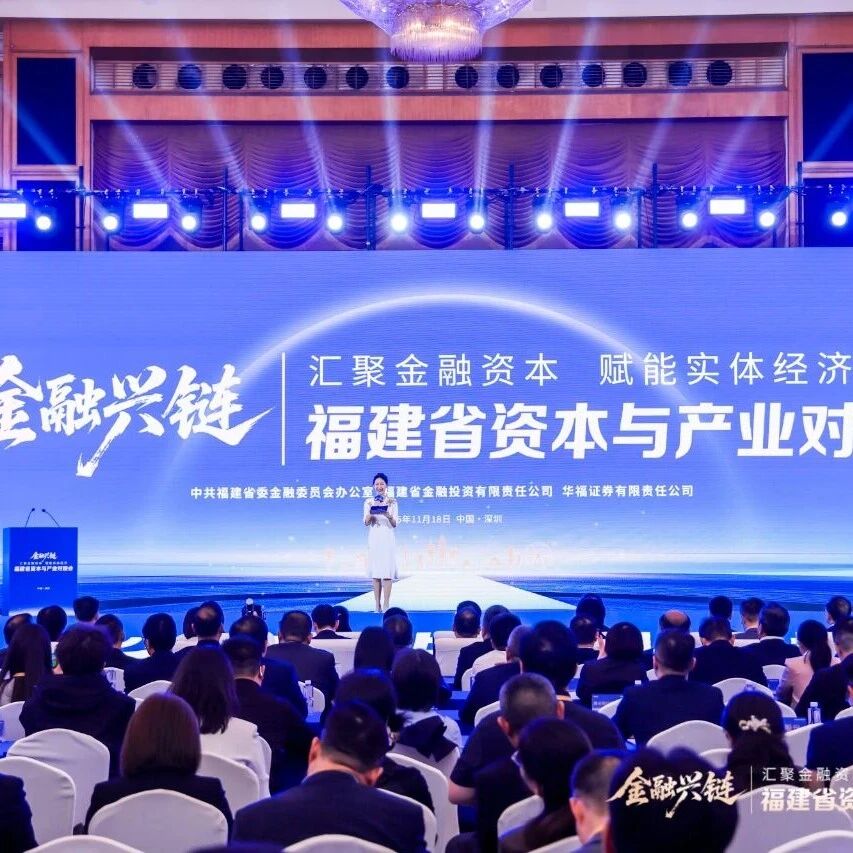
Group 1 - The event aimed to implement the requirements from the 20th National Congress regarding the improvement of the capital market functions that coordinate investment and financing [3] - Over 250 financial institutions and leading private equity firms participated, connecting with more than 300 quality enterprise representatives from Fujian Province and the Greater Bay Area [4] - The event featured presentations from various financial service providers and showcased five companies that shared their development plans and financing needs [4] Group 2 - The event included specialized sessions on themes such as biomedicine + new materials, artificial intelligence + high-end equipment manufacturing, and integrated circuits + next-generation information technology [4] - A "Walk into Shenzhen Stock Exchange" activity was organized, allowing nearly 50 quality enterprises to learn about innovative bond issuance practices and deepen their understanding of multi-level capital markets [4] - The event also provided training for companies looking to list in Hong Kong, with participation from over 200 enterprise representatives [4][5] Group 3 - The event was jointly organized by the Fujian Provincial Financial Office, Fujian Jin Investment, and Huafu Securities, emphasizing the goal of attracting quality financial resources to Fujian's industrial sector [5] - The focus was particularly on serving technology innovation enterprises and key industrial projects to inject financial momentum into the construction of Fujian's modern industrial system [5]
专访许正宇:打造国家“国际资产保管箱” 香港金融现新棋局
2 1 Shi Ji Jing Ji Bao Dao· 2025-11-18 23:17
Core Insights - Hong Kong's financial markets have shown significant growth, with the Hang Seng Index rising over 30% and the Hang Seng Tech Index nearly 40% this year, outperforming major global markets [1] - The Hong Kong government is leveraging its unique "One Country, Two Systems" advantage to explore new growth areas in asset management, fintech, and commodity markets, aligning with national strategies [1] Financial Technology and Digital Assets - Hong Kong has risen to the top position in the Global Financial Center Index (GFCI) for fintech, reflecting a clear focus on empowering the real economy rather than speculative activities [2] - The government successfully priced its third batch of digital green bonds at 10 billion HKD, marking the largest issuance of tokenized government bonds globally [2] - The government is cautious about stablecoins, emphasizing their role in addressing real economic issues rather than speculation, with limited initial licensing planned for next year [3] Capital Market Reforms - The implementation of T+1 settlement is a key reform aimed at enhancing market efficiency, with plans to transition from T+2 to T+1 by next year [4] - The Hong Kong Stock Exchange anticipates that by 2027, 88% of global stock markets will adopt T+1 or T+0 settlement cycles, which will improve synergy with A-shares [4] - The government is working on optimizing the dual-class share structure to balance international market integration and protection for small investors [4][17] Asset Management and Global Capital - As of the end of 2024, Hong Kong manages over 4 trillion USD in assets, with approximately 60% from overseas, highlighting its role as a global asset custodian [5] - The government is actively attracting family offices and optimizing tax exemption policies to enhance its appeal as a financial hub [11] Commodity Market Development - Hong Kong has made significant strides in the commodity market, including being integrated into the London Metal Exchange's global delivery network and achieving over 8000 tons of metal storage in just nine months [6] - The government plans to increase gold storage capacity to 2000 tons and is working on a central clearing system for gold, aiming to enhance its influence in the global gold market [7][15] Supporting Mainland Enterprises - Hong Kong is increasingly becoming a platform for mainland enterprises to expand internationally, with a record number of companies registered in Hong Kong for overseas operations [8] - The government is consolidating various agencies to create a one-stop platform to support mainland companies in their overseas ventures [8] Legal and Regulatory Framework - Recent legal revisions allow companies registered abroad to re-domicile in Hong Kong, with nearly 20 applications received, including from large international firms [9] - The government is focused on creating a secure environment for global operations, enhancing Hong Kong's attractiveness as a stable financial center [13]
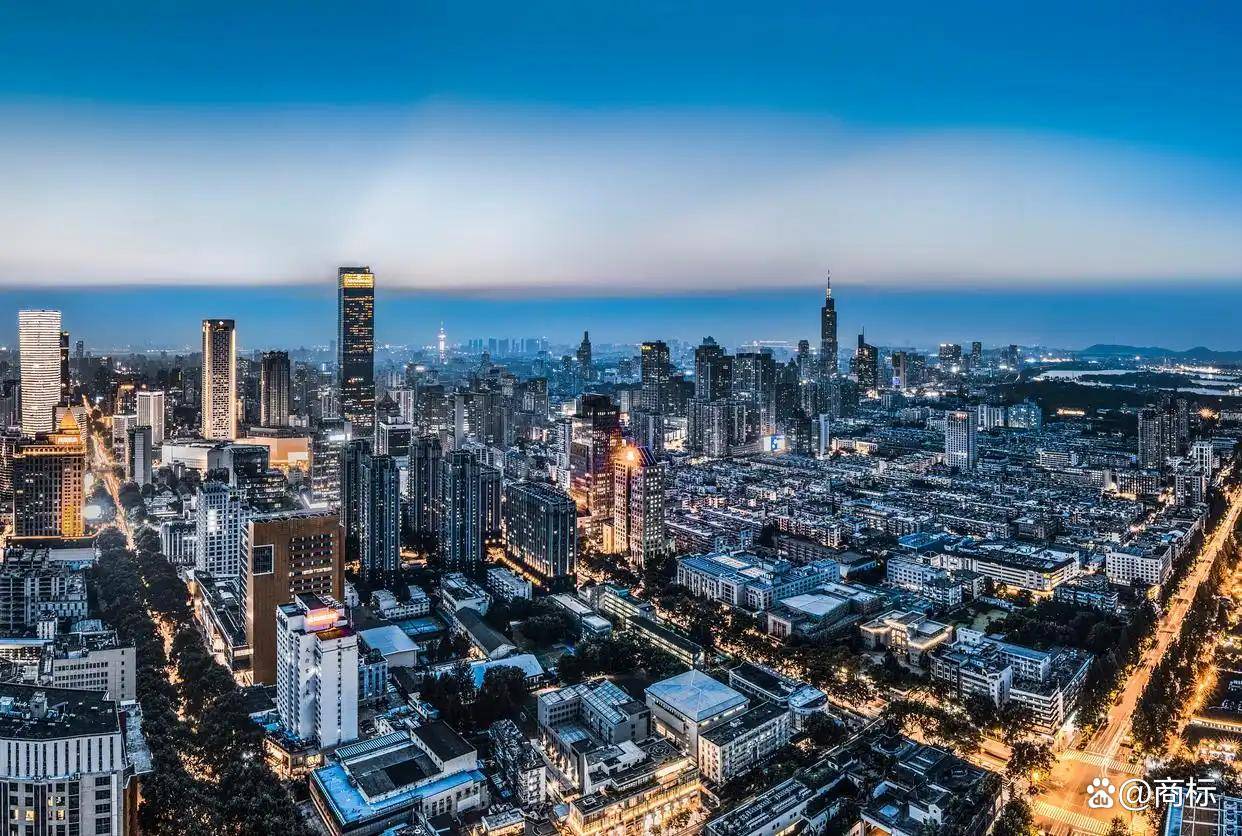
全球GDP50强城市新格局:香港略胜莫斯科,杭州约2.2万亿,南京第44!
Sou Hu Cai Jing· 2025-11-18 18:39
Core Insights - The global economic landscape is undergoing unprecedented changes, with Chinese cities like Hong Kong, Hangzhou, and Nanjing emerging as significant players alongside traditional giants like New York and Tokyo [1][2]. Group 1: Hong Kong - Hong Kong's GDP reached 28,993 billion RMB, ranking 17th globally, surpassing Moscow by approximately 1,686 billion RMB [2][4]. - The city's economic strength is driven by its financial and logistics sectors, with over 2,500 listed companies on the Hong Kong Stock Exchange and a total market capitalization exceeding 35 trillion RMB [4]. - Hong Kong faces challenges such as a high dependency on the real estate sector and the need to diversify into emerging industries like digital economy [4][2]. Group 2: Hangzhou - Hangzhou's GDP stands at 21,860 billion RMB, placing it 32nd globally, with over 60% of its GDP derived from the digital economy [5][6]. - The city benefits from policies like the Zhejiang Free Trade Zone and the G60 Science and Technology Corridor, attracting numerous innovative enterprises and achieving over 100,000 annual patent grants [6]. - Hangzhou's rapid growth is accompanied by challenges such as high housing prices and intense talent competition, necessitating a balance between innovation and inclusivity for sustainable development [8]. Group 3: Nanjing - Nanjing's GDP is 18,501 billion RMB, ranking 44th globally, showcasing its robust manufacturing base and proactive technological transformation strategy [8][10]. - The city is strategically located at the intersection of the Yangtze River Economic Belt and the Belt and Road Initiative, supported by local universities and government policies to foster intelligent manufacturing [10]. - Nanjing's infrastructure, including a port with a cargo throughput of 250 million tons and a high-speed rail network, enhances its economic connectivity, although it must address the high proportion of traditional industries to improve economic quality and efficiency [10].
外资投行密集唱多中国股市
财联社· 2025-11-18 11:10
Core Viewpoint - The recovery momentum of Chinese tech stocks is still in its early stages as China emerges as an AI superpower, attracting Western capital back to the market [1] Group 1: Investor Sentiment - Investors are eager to position themselves as their portfolios lack exposure to the Chinese AI trend [2] - Global investors have begun reallocating funds to some of China's largest and most liquid stocks, benefiting from recent policy stimulus and technological breakthroughs [3] Group 2: Market Comparisons - The recovery of Chinese tech stocks is at an earlier stage compared to the Nasdaq's growth, with lower price-to-earnings ratios compared to similar growth and profitability peers in the U.S. [4] Group 3: Foreign Investment Interest - U.S. investment firms managing global funds are increasingly interested in Chinese stocks, with investors from the Middle East, Southeast Asia, and Europe focusing on gaining exposure to China [5] - Middle Eastern investors seek stable long-term capital in China's digital economy, while European investors are drawn to the Chinese market due to a lack of local AI firms [6] Group 4: IPO Activity - The number of Chinese companies applying for IPOs in Hong Kong has reached a high level, covering various sectors including internet, software, AI, robotics, and tech supply chains [6] - Hong Kong IPO fundraising reached HKD 216 billion (approximately USD 27.8 billion) in the first ten months of this year, more than three times the amount from the same period last year [7] Group 5: Positive Outlook from Foreign Investment Banks - Despite a global tech stock pullback, several foreign investment banks are bullish on the Chinese stock market, citing advancements in the tech sector as a key reason [8] - Morgan Stanley predicts further gains in the Chinese stock market by 2026, with target prices for MSCI China Index, Hang Seng Index, and CSI 300 Index set at 90 points, 27,500 points, and 4,840 points respectively [9] - UBS anticipates another prosperous year for the Chinese stock market, driven by favorable factors including innovation, with a target for the MSCI China Index at 100 points, indicating a 14% upside from current levels [10]



港股18日跌1.72% 收报25930.03点
Xin Hua Wang· 2025-11-18 10:47
Market Overview - The Hang Seng Index fell by 454.25 points, a decrease of 1.72%, closing at 25,930.03 points [1] - The total turnover for the day on the main board was HKD 242.11 billion [1] - The Hang Seng China Enterprises Index dropped by 153.56 points, closing at 9,174.84 points, a decline of 1.65% [1] - The Hang Seng Tech Index decreased by 111.15 points, closing at 5,645.73 points, down 1.93% [1] Blue-Chip Stocks - Tencent Holdings decreased by 2.04%, closing at HKD 623.5 [1] - Hong Kong Exchanges and Clearing fell by 1.28%, closing at HKD 416.8 [1] - China Mobile saw a slight increase of 0.06%, closing at HKD 86.8 [1] - HSBC Holdings dropped by 2.23%, closing at HKD 109.6 [1] Local Hong Kong Stocks - Cheung Kong Holdings fell by 2.57%, closing at HKD 39.44 [1] - Sun Hung Kai Properties decreased by 2.25%, closing at HKD 100.1 [1] - Henderson Land Development dropped by 2.8%, closing at HKD 29.84 [1] Chinese Financial Stocks - Bank of China fell by 1.48%, closing at HKD 4.65 [1] - China Construction Bank decreased by 1.09%, closing at HKD 8.15 [1] - Industrial and Commercial Bank of China dropped by 1.23%, closing at HKD 6.43 [1] - Ping An Insurance fell by 2.27%, closing at HKD 58.2 [1] - China Life Insurance decreased by 3.11%, closing at HKD 26.14 [1] Oil and Petrochemical Stocks - Sinopec increased by 0.23%, closing at HKD 4.44 [1] - PetroChina fell by 0.11%, closing at HKD 8.84 [1] - CNOOC dropped by 3.11%, closing at HKD 21.8 [1]
专访许正宇:打造国家“国际资产保管箱”,香港金融现新棋局
2 1 Shi Ji Jing Ji Bao Dao· 2025-11-18 09:28
Core Viewpoint - Hong Kong is experiencing a significant resurgence as an international financial center, with the Hang Seng Index and Hang Seng Tech Index showing substantial growth, driven by global capital seeking diversification and safe havens [1] Financial Technology and Asset Tokenization - Hong Kong has risen to the top position in the Global Financial Center Index for fintech, emphasizing a shift from speculative practices to empowering the real economy through technology [2] - The Hong Kong government successfully issued its largest digital green bond, totaling HKD 10 billion, marking a significant milestone in asset tokenization [2] Stablecoins and Regulatory Approach - The Hong Kong government is cautiously approaching stablecoins, with legal frameworks in place and a limited initial issuance planned for next year, focusing on solving real economic issues rather than speculation [3] Capital Market Reforms - Hong Kong is implementing T+1 settlement to enhance market efficiency, with plans to release a consultation document next year to facilitate this transition [4] - The Hong Kong Stock Exchange anticipates that by 2027, 88% of global stock markets will adopt T+1 or T+0 settlement cycles, improving synergy with A-shares [4] Asset Management Growth - As of the end of 2024, assets under management in Hong Kong exceeded USD 4 trillion, with approximately 60% from overseas, highlighting both past achievements and future potential [5] Commodity Market Expansion - Hong Kong is actively expanding its commodity market, achieving significant milestones such as being included in the London Metal Exchange's global delivery network and increasing gold trading volumes [7][8] - The average daily trading volume of gold in Hong Kong exceeded HKD 940 million in 2024, reflecting the market's vitality [7] Support for Outbound Chinese Enterprises - The number of companies with overseas parent companies based in Hong Kong reached a record high of 9,960 in 2024, with a significant portion from mainland China [9] - The Hong Kong government is integrating various agencies to support mainland enterprises in their global expansion efforts [9][10] Global Financial Center Positioning - Hong Kong aims to solidify its role as a "stable cornerstone" in the global investment landscape, leveraging its unique advantages to attract family offices and optimize tax policies [11] - The government is exploring tax incentives to attract global corporate treasury centers to Hong Kong, addressing the growing demand for high-end financial services from outbound enterprises [12][13] Gold Market Strategy - Hong Kong is enhancing its gold storage capacity to 2,000 tons and is collaborating with the Shanghai Gold Exchange to strengthen its position in the global gold market [8][15] - The establishment of a central clearing system for gold is planned for next year, aiming to attract international capital seeking safe storage options [15] Financial Innovation and Market Competitiveness - The government is focused on optimizing the "same share, different rights" system to align with international standards while protecting small investors [17] - Continuous market rule optimization is expected to enhance the breadth and depth of the market, reinforcing Hong Kong's competitiveness as an international financial center [17]