
光大证券

Search documents
【十大券商一周策略】布局跨年行情!“赚钱效应”最好的时间窗,即将打开
券商中国· 2025-11-30 14:52
Group 1 - The market is characterized by a slow bull trend with reduced volatility and improved Sharpe ratios compared to the past, but subjective long positions have limited improvement and continue to underperform quantitative strategies [2] - The current market structure shows an increase in allocation funds and quantitative funds, while subjective stock-picking funds are limited, leading to a higher demand for valuation and safety margins from subjective long positions [2] - A significant change in domestic demand is needed to unlock market potential, with recommendations to focus on resource and traditional manufacturing sectors, as well as companies expanding overseas [2] Group 2 - December is expected to open a favorable window for "profit-making effects," with the correlation between market movements and fundamentals being weaker in November [3] - The "spring market" period, which lasts about 20 trading days from the Spring Festival to the Two Sessions, is anticipated to provide good profit opportunities, especially for stocks with positive earnings forecasts [3] - Many sectors have already adjusted by approximately 20%, making December a suitable time for observation and potential investment [3] Group 3 - The cross-year market is supported by easing overseas disturbances and improved risk appetite, with expectations for clearer economic and industrial development guidance from year-end meetings [4] - The market is advised to maintain a bullish outlook and continue to invest in Chinese assets, focusing on high-growth sectors such as AI, advantageous manufacturing, and structural recovery in domestic demand [5] - Key sectors to watch include resource products, new consumption, and technology growth, particularly in AI and domestic computing power industries [5] Group 4 - The market is likely to choose an upward direction after three months of consolidation, with a high probability of a cross-year rally in December [6] - Investment opportunities are expected to arise from the political bureau meeting and central economic work meeting, focusing on resource products, service consumption, and technology sectors [6] - The dual focus on large-cap indices like the Shanghai 50 and the Sci-Tech 50 is recommended for the upcoming cross-year market [6] Group 5 - The market sentiment is expected to improve as December approaches, with significant policy observations anticipated, which could catalyze the cross-year market [8] - Key investment themes include commercial aerospace, AI applications, energy storage, military industry, and innovative pharmaceuticals, particularly those related to the "14th Five-Year Plan" [8] - The improvement in overseas liquidity and the adjustment of previous high-performing sectors are also expected to benefit the market [8] Group 6 - Historical data indicates that policy factors are crucial for the initiation of cross-year rallies, with macroeconomic data playing a less decisive role [9] - The cross-year rally typically starts before a weak market, driven by expectations of policy easing and improved liquidity [9] - Key sectors to focus on include semiconductors, energy storage, robotics, AI applications, and pharmaceuticals, especially if new policy directions emerge from the central economic work meeting [9]






高盛2026宏观展望,今年经济开局,政策加码稳5%增长?
Sou Hu Cai Jing· 2025-11-30 14:47
关键时刻政策密集出手,降息、财政扩张、楼市消费新政齐上阵,这波组合拳能否稳住5%增长目标? 背后的逻辑和看点值得细细说道。 2025年的经济走势真是让人猜不透,一边是出口逆势狂飙给市场送惊喜,一边是房地产和消费拖后腿让 人捏把汗。 十五五"开局这盘棋,到底能不能下赢?关键还得看政策这波神操作。 新能源车出口大增 哈喽大家好,今天小无带大家聊聊"十五五"开局的经济大棋局。一边是出口顶着关税压力逆势狂飙,成 为稳增长的硬核支撑;一边是房地产、消费深陷调整泥潭,拖累经济步伐。 先说说最让人意外的出口表现,简直是逆袭中的战斗机!谁能想到,美国对华关税4月飙到100%以上, 5月才回落至30%。 这么折腾下来,中国全年出口增速居然有望冲到8%,而且各行各业都跟着发力。这可不是靠运气,也 不是短期抢出口能撑起来的,而是中国制造业实打实的硬实力。 现在咱们的出口早就不是单一产品厉害,而是形成了技术、产业链、服务一条龙的综合优势。 冶金、化工这些老产业通过升级改造,既保住了质量又没乱涨价,传统市场守得牢,新兴市场也打得 开。 | 举办时间 | 国外劳商 | 会议名称 | 王霞 | 地点 | | --- | --- | --- ...

光大证券:A股市场仍处牛市 但短期或宽幅震荡
智通财经网· 2025-11-29 08:44
Group 1 - The overall direction of the A-share market is still in a bull market, but it may enter a wide fluctuation phase in the short term. Compared to previous bull markets, there is still considerable room for index growth, but the duration of the bull market may be more important than the magnitude of the increase under the government's guidance for a "slow bull" policy [1][3] - In November, major A-share indices generally declined, with the STAR 50 index experiencing the largest drop of 7.1%, while the Shanghai 50 index saw the smallest decline of 1.3%. The performance across industries showed significant differentiation, with sectors like comprehensive, banking, and media leading in gains [2] - The Hong Kong stock market also experienced fluctuations in November, influenced by expectations of U.S. Federal Reserve interest rate cuts and concerns over AI bubbles. The Hang Seng Index and other indices showed mixed performance, with the Hang Seng Technology Index declining by 4.9% [2] Group 2 - In terms of investment strategy, short-term focus should be on defensive and consumer sectors, while mid-term attention should remain on TMT (Technology, Media, Telecommunications) and advanced manufacturing sectors. During the fluctuation phase, previously lagging sectors may perform better, particularly high-dividend and consumer sectors [3] - For the Hong Kong market, a "dumbbell" strategy is recommended, focusing on technology growth and high-dividend stocks. The market's overall profitability remains strong, and despite recent gains, valuations are still relatively low, making long-term investment attractive [4][5] - Specific areas of interest include domestic policies supporting self-sufficiency in technology, chip manufacturing, and high-end manufacturing, as well as independent internet technology companies with their own growth potential [5]

全部撤回!券商资管申请公募牌照,排队队伍清零!
券商中国· 2025-11-29 03:18
Core Viewpoint - The article highlights the complete withdrawal of several brokerage asset management subsidiaries from the public fund license application process, indicating a significant shift in the industry as the deadline for compliance with new regulations approaches [2][3][6]. Group 1: License Application Status - As of November 28, no brokerage asset management companies are currently in line to apply for public fund licenses, marking a total withdrawal from the application process [3]. - Initially, four companies, including Guotai Junan Asset Management, were in the queue for public fund licenses, but all have now withdrawn their applications [2][6]. - The withdrawal of applications is seen as a response to regulatory signals indicating that no new public fund licenses would be granted to brokerage asset management firms [6]. Group 2: Regulatory Background - The asset management industry is undergoing a transformation due to the 2018 regulations requiring brokerage firms to convert their "public collective" products to comply with public fund standards by the end of 2025 [8]. - The transition has led to various strategies, including changing management to public fund institutions, converting products to private funds, or liquidation [9]. Group 3: Industry Trends - The article notes that only 14 out of 30 brokerage asset management subsidiaries have successfully obtained public fund licenses, with the majority of applications failing to progress [7]. - The trend of transferring management of collective products to affiliated public fund companies is becoming common among brokerage firms, as seen with companies like CITIC Asset Management and GF Asset Management [10]. - Some firms are also exploring partnerships with unrelated fund companies for managing their products, indicating a diversification of management strategies [10][11].
公募规模36.96万亿创历史新高 机构展望A股12月慢牛可期
2 1 Shi Ji Jing Ji Bao Dao· 2025-11-28 23:34
Group 1 - The total scale of public funds in China has reached a record high of 36.96 trillion yuan, marking the seventh time this year it has set a new record [2][3] - As of November 23, 2025, a total of 1,340 new funds have been established this year, with a total issuance scale of 1,044.598 billion yuan, continuing a trend of over 1 trillion yuan in annual new fund issuance for the seventh consecutive year [2][3] - The stock fund sector has shown remarkable performance, with 750 new stock funds established this year, raising 382.015 billion yuan, accounting for 36.57% of the total new fund scale [3] Group 2 - In November, the A-share market experienced high-level fluctuations, with major indices like the ChiNext Index and the STAR Market Index showing signs of recovery after a dip [4][5] - The financing activities in the A-share market have been positive, with net purchases exceeding 9.8 billion yuan, particularly in the electronics and communications sectors [4][5] - The market is currently viewed as being in a "second phase of a bull market," with institutions suggesting a focus on technology growth sectors and advanced manufacturing as key investment areas [6][7]
光大证券荣获“第七届新浪财经金麒麟最佳分析师评选”3项大奖
Xin Lang Zheng Quan· 2025-11-28 10:52
Core Insights - The seventh Sina Finance Golden Unicorn Best Analyst Awards results were announced on November 28 [1] Group 1 - Everbright Securities won one research award in a specific field [1] - Everbright Securities received two major awards in the elite analyst category [1] - One industry from Everbright Securities ranked first in its category [1]
A股新动向,融资客、主力资金,加速进场
Zheng Quan Shi Bao· 2025-11-28 10:33
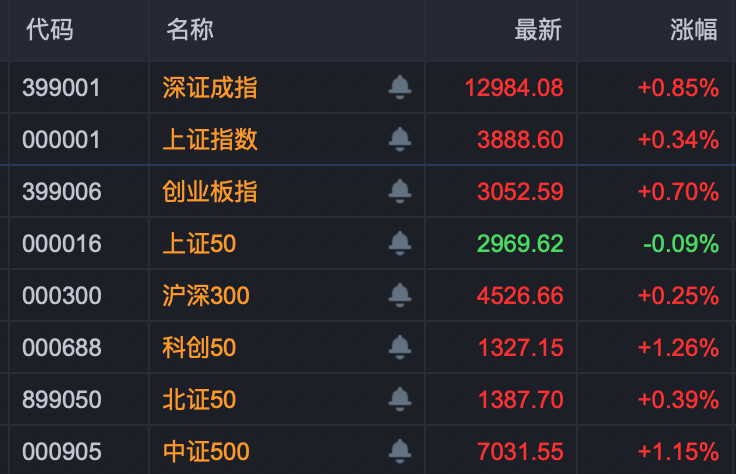
Market Overview - A-shares have rebounded this week, with the ChiNext Index surpassing 3000 points and the Sci-Tech 50 Index rising above 1300 points. The Shenzhen Component Index frequently approached the 13000-point mark, while the Shanghai Composite Index and CSI 300 also saw increases. Overall trading volume decreased to 8.68 trillion yuan, marking the lowest level in over four months [1]. Index Performance - The latest index performances are as follows: - Shenzhen Component Index: 12984.08 (+0.85%) - Shanghai Composite Index: 3888.60 (+0.34%) - ChiNext Index: 3052.59 (+0.70%) - Sci-Tech 50 Index: 1327.15 (+1.26%) - CSI 300: 4526.66 (+0.25%) - North China 50: 1387.70 (+0.39%) - CSI 500: 7031.55 (+1.15%) - FIF 50: 2969.62 (-0.09%) [2]. Capital Inflows - Margin traders added over 9.8 billion yuan to A-shares this week, with the electronics sector receiving over 5.6 billion yuan in net purchases, and the communications sector gaining over 4.5 billion yuan. Other sectors such as defense, media, machinery, transportation, real estate, and computers also saw net inflows exceeding 1 billion yuan. Conversely, non-bank financials experienced a net sell-off of nearly 1.7 billion yuan, with pharmaceuticals, power equipment, and home appliances also facing net sales exceeding 100 million yuan [2]. Institutional Investment Trends - Major funds showed significant bottom-fishing activity, with most industries experiencing net inflows. The electronics sector saw over 58 billion yuan in net inflows, while communications received over 37 billion yuan. Other sectors like computers and machinery also gained over 20 billion yuan. Only banking, transportation, agriculture, and food and beverage sectors experienced slight net outflows [3]. Market Outlook - Looking ahead, Ping An Securities suggests that the market remains in a high-level consolidation phase, with improved safety margins following recent pullbacks. Attention is drawn to important domestic policy signals expected in December. The recommendation is to maintain a balanced allocation, focusing on technology growth sectors, advanced manufacturing benefiting from demand recovery, cyclical sectors poised for price increases, and dividend assets with ongoing value [3]. 6G Technology Focus - The 6G sector has gained significant market attention, with the index rising 8.44% over five consecutive days, nearing historical highs. Companies like TeFa Information and LeiKe Defense have seen multiple trading halts due to price surges [4]. The Ministry of Industry and Information Technology has emphasized accelerating 6G technology development and application ecosystem cultivation, with over 300 key 6G technologies already identified [6]. AI and 6G Integration - Galaxy Securities highlights the potential for artificial intelligence to complement communication technologies, suggesting that advancements in AI could enhance the intelligence of 6G systems. The development of 6G is expected to drive the growth of AGI trends, with significant breakthroughs in frontier technologies anticipated [6].
又见券商资管 批量变更管理人!
Zhong Guo Ji Jin Bao· 2025-11-28 09:40
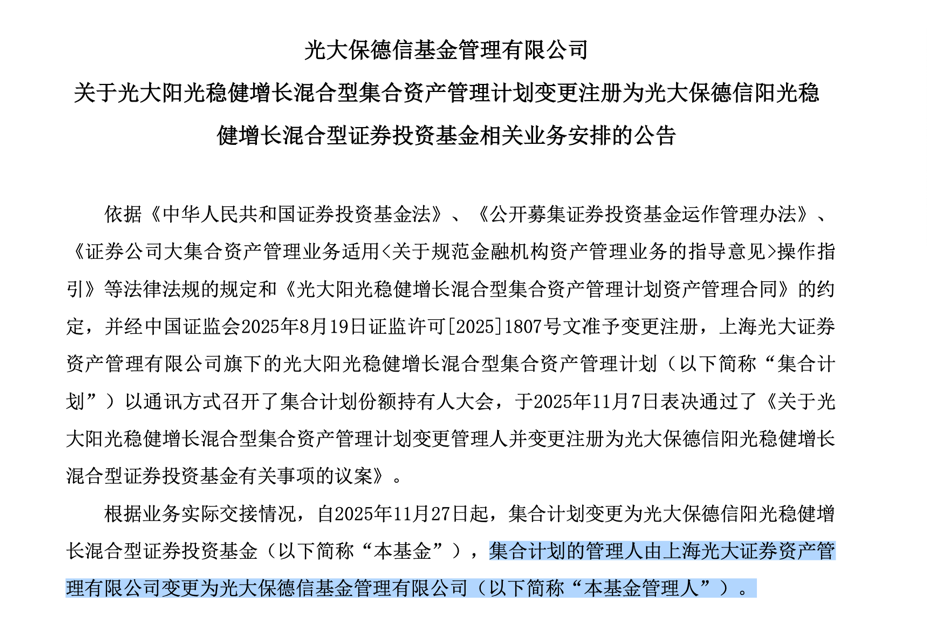
Core Viewpoint - The article discusses the recent changes in management for several large collective investment products under Guangzheng Asset Management, indicating a trend of transitioning these products to public fund management companies as the deadline for compliance with new regulations approaches [5][6]. Group 1: Management Changes - On November 27, Guangzheng Asset Management transferred eight large collective investment products to Everbright Pramerica Fund Management, which is 55% owned by Everbright Securities [5]. - This transfer is part of a broader trend where many securities firms are moving their collective investment products to affiliated public fund companies due to the expiration of the transitional period for compliance with new asset management regulations [5][6]. Group 2: Industry Trends - The transition to public fund management is becoming the mainstream approach for securities firms that do not hold public fund licenses, as they face three options: liquidation, extension, or changing the management [5][6]. - The pace of management changes has accelerated, with multiple firms, including GF Asset Management and Huafu Fund, also announcing similar transitions in November [6][7]. - As of now, only Guojin Asset Management remains in the queue for public fund license applications, while several firms, including Guangzheng Asset Management, have withdrawn their applications [8][9]. Group 3: Market Competition - The asset management industry is experiencing intense competition, particularly in fixed income and cash management products, from public funds and bank wealth management subsidiaries [9]. - Analysts suggest that the public fund path is more suitable for leading institutions with comprehensive financial ecosystems and retail channels, while specialized securities firms may find private fund paths more advantageous [9].
又见券商资管,批量变更管理人!
中国基金报· 2025-11-28 09:22
Core Viewpoint - The article discusses the recent management changes of large collective investment products under Guangzheng Asset Management, indicating a trend of transitioning these products to public fund management companies as the deadline for regulatory compliance approaches [2][5]. Group 1: Management Changes - On November 27, Guangzheng Asset Management transferred 8 large collective products to Everbright Pramerica Fund Management, which is 55% owned by Everbright Securities [5]. - This transfer is part of a broader trend where many securities firms are moving their collective investment products to affiliated public fund companies to comply with new regulations [5][7]. Group 2: Industry Trends - The transition period for securities firms' collective investment products is nearing its end, with many firms opting to change management to avoid issues related to liquidation or investor concerns [5][7]. - In 2024, Guangzheng Asset Management reported revenues of 675 million yuan and a net profit of 219 million yuan, with assets under management reaching 3,114 billion yuan, reflecting a growth of 3.71% from the beginning of the year [5]. Group 3: Regulatory Compliance - According to the 2018 asset management regulations, securities firms must complete the public offering transformation of their collective products by the end of the transition period, with options including liquidation, extension, or management change [5][8]. - The article notes that many firms have chosen to change management to public fund companies, which has become a mainstream approach in the industry [5][8]. Group 4: Competitive Landscape - The article highlights that securities firms face intense competition from public funds and bank wealth management subsidiaries, particularly in fixed income and cash management products [8]. - Analysts suggest that the public fund path is more suitable for leading institutions with comprehensive financial ecosystems, while specialized securities firms may find private paths more advantageous [8].

今天,A股有这四大看点!
天天基金网· 2025-11-28 08:45
Market Overview - The A-share market experienced a narrow fluctuation on November 28, with trading volume dropping to a near four-month low, indicating a lack of strong market activity [2] - The Shanghai Composite Index fell by 1.67% in November, ending a six-month streak of gains after reaching a ten-year high earlier in the month [2] - The ChiNext Index saw a decline of 4.23% in November, with a recovery trend observed in late November driven by the computing hardware sector [2] Sector Performance - Key sectors showing positive momentum included the battery supply chain, Hainan, Fujian, and computing hardware, while banking, vitamins, and traditional Chinese medicine stocks faced declines [2] - The overall market sentiment improved, with a notable increase in the number of stocks hitting the daily limit up [4] Trading Volume and Trends - The trading volume for the day was 1.6 trillion yuan, marking the lowest level since September [3] - Historical data indicates that December trading volumes have been lower than November in 70% of the past ten years, with only a few exceptions in 2019, 2020, and 2021 [8] Future Outlook - Analysts from various brokerages maintain a cautiously optimistic outlook, suggesting that the market may enter a wide-ranging consolidation phase in the short term [9] - Focus areas for investment include defensive and consumer sectors in the short term, while TMT (Technology, Media, and Telecommunications) and advanced manufacturing sectors are expected to perform well in the medium term [9] Sector-Specific Insights - The commercial aerospace sector is poised for growth, with projections indicating that China's commercial aerospace market could reach 7.8 trillion yuan by 2030 [16] - The semiconductor industry is expected to attract new capital, with several AI-focused ETFs recently launched to capitalize on this trend [18] - The 6G technology sector is gaining traction, with significant advancements anticipated in the integration of AI and communication technologies [20]
