
乐鑫科技

Search documents
芯片、模组厂商争先布局,溢价高达10倍的AI玩具赛道为什么这么火?
3 6 Ke· 2025-04-25 10:41
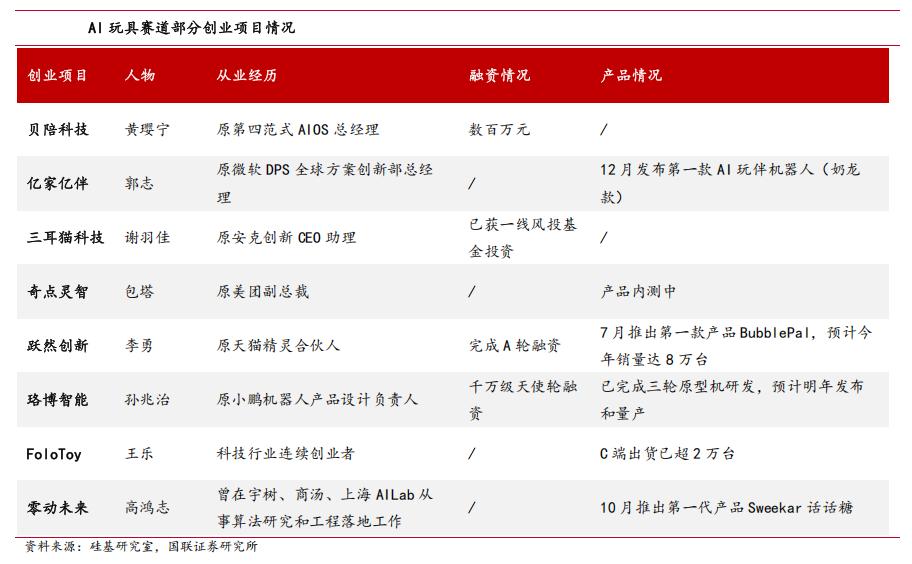
当 AI 这股风吹向玩具赛道,一片巨大的蓝海市场正在被撬动。 普通玩具被赋予 AI 功能之后,不但身价倍增,连销量也跟着蹭蹭倍涨。有业内人士表示,大模型让普通玩具卖出超 10 倍的溢价,原本 9.9 元的玩具,被 AI 改造后售价高达 99 元。在深圳,某创新科技公司靠售卖 AI 玩具,一天就完成了 52 万元直播的成交金额。 而诸如卡西欧 AI 宠物 Moflin、特斯拉机器人玩具 Tesla Bot Action Figure、实丰文化新一代 AI 玩具"AI魔法星"、萌宠智能宠机器人 Ropet、字节跳动的 AI 陪伴玩偶"显眼包"之类自带品牌光环的产品备受消费者青睐,有些甚至在二手市场的价格一路水涨船高。 也许是看中其前景广阔,国内多名大厂高管下场加码 AI 玩具赛道,包括原美团副总裁、原天猫精灵合伙人、原小鹏机器人产品设计负责人等等……其 中,已有产品得到了市场的初步认可——比如,天猫精灵前合伙人李勇成立的跃然创新(Haivivi)在 2024 年 7 月推出 AI 玩具挂件"BubblePal",截至 25 年 3 月,该产品在抖音单平台的销售额已经超过 2000 万元。 | | Al 玩具赛道部 ...


乐鑫科技(688018) - 乐鑫科技2024年限制性股票激励计划首次授予部分第一个归属期归属结果公告
2025-04-24 13:41
证券代码:688018 证券简称:乐鑫科技 公告编号:2025-037 乐鑫信息科技(上海)股份有限公司 2024 年限制性股票激励计划首次授予部分 第一个归属期归属结果公告 (1)2024 年 3 月 12 日,公司召开第二届董事会第二十四次会议,会议审 议通过了《关于审议<公司 2024 年限制性股票激励计划(草案)>及其摘要的议 案》《关于审议<公司 2024 年限制性股票激励计划实施考核管理办法>的议案》 以及《关于提请股东大会授权董事会办理公司 2024 年限制性股票激励计划相关 事宜的议案》等议案。公司独立董事就本激励计划相关议案发表了独立意见。 同日,公司召开第二届监事会第十七次会议,审议通过了《关于审议<公司 2024 年限制性股票激励计划(草案)>及其摘要的议案》《关于审议<公司 2024 年限制性股票激励计划实施考核管理办法>的议案》以及《关于核实公司<2024 年限制性股票激励计划激励对象名单>的议案》,公司监事会对本激励计划的相关 事项进行核实并出具了相关核查意见。 (2)2024 年 3 月 13 日至 2024 年 3 月 22 日,公司对本激励计划拟激励对 象的姓名和职务在公司内 ...
人形机器人当“车模”,科创人工智能ETF华夏(589010)近1周累计上涨2.12%
Sou Hu Cai Jing· 2025-04-24 06:13
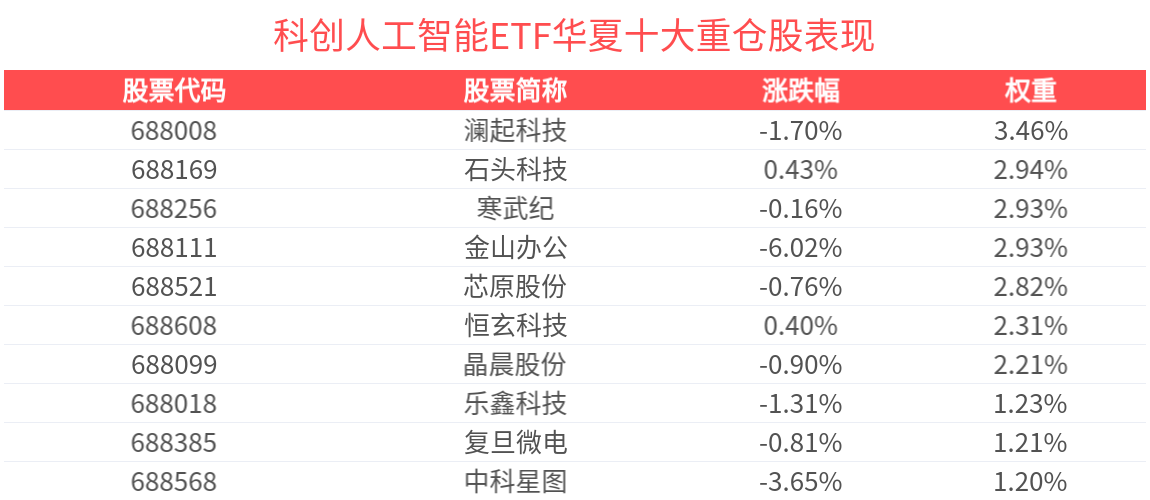
费率方面,科创人工智能ETF华夏管理费率为0.50%,托管费率为0.10%,费率在可比基金中最低。 科创人工智能ETF华夏(589010)紧密跟踪上证科创板人工智能指数,上证科创板人工智能指数从科创板市场中选取30只市值较大的为人工智能提供基础资 源、技术以及应用支持的上市公司证券作为指数样本,以反映科创板市场代表性人工智能产业上市公司证券的整体表现。 | 股票代码 | 股票简称 | 涨跌幅 | 权重 | | --- | --- | --- | --- | | 688008 | 澜起科技 | -1.70% | 3.46% | | 688169 | 石头科技 | 0.43% | 2.94% | | 688256 | 寒武纪 | -0.16% | 2.93% | | 688111 | 金山办公 | -6.02% | 2.93% | | 688521 | 芯原股份 | -0.76% | 2.82% | | 688608 | 恒玄科技 | 0.40% | 2.31% | | 688099 | 晶晨股份 | -0.90% | 2.21% | | 688018 | 乐鑫科技 | -1.31% | 1.23% | | 68 ...

AI技术商业化加速,科创AIETF(588790)早盘溢价交易,奥比中光涨超2%
Xin Lang Cai Jing· 2025-04-22 03:51
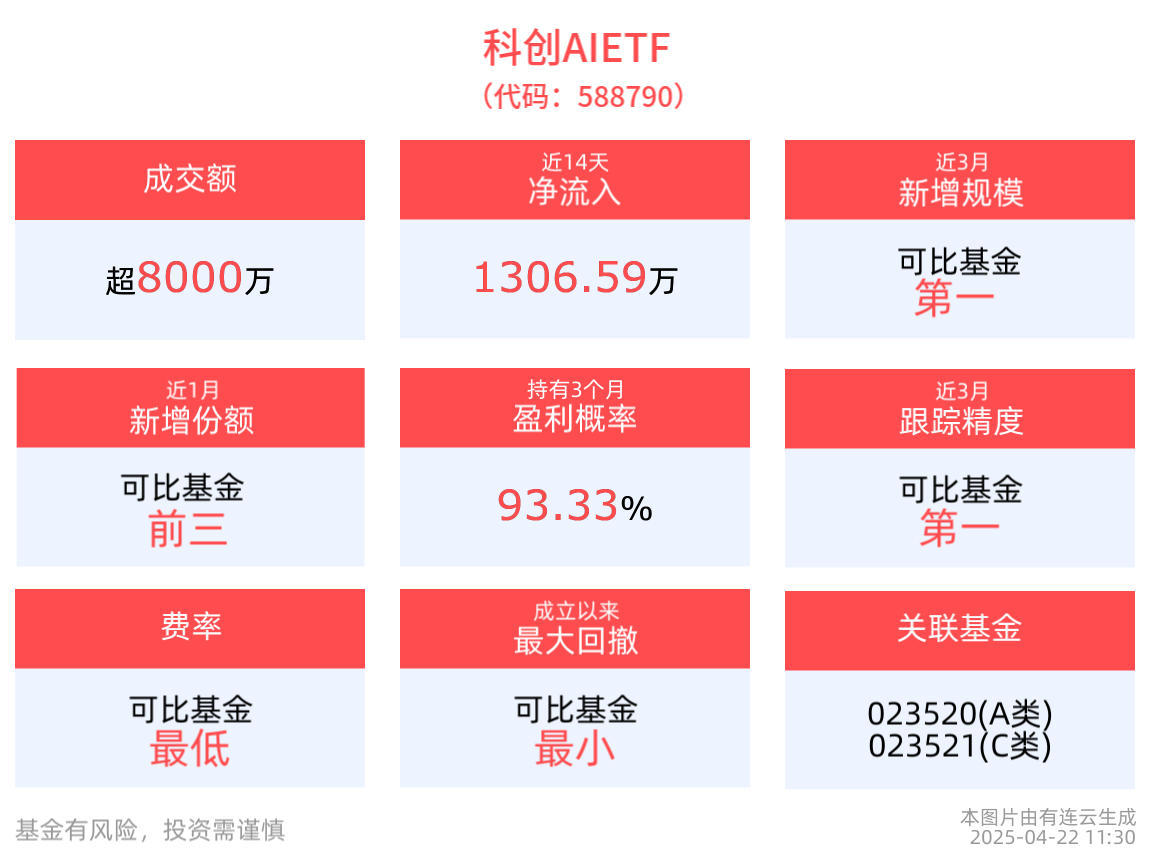
Group 1 - The core viewpoint highlights the ongoing decline of the Shanghai Stock Exchange Sci-Tech Innovation Board Artificial Intelligence Index, which fell by 1.23% as of April 22, 2025, with mixed performance among constituent stocks [3] - The AI application landscape is accelerating, with significant releases from OpenAI, including the GPT-4.1 series and enhancements in AI capabilities, indicating a robust growth trajectory in AI technologies [3] - The Sci-Tech AI ETF closely tracks the performance of the Shanghai Stock Exchange Sci-Tech Innovation Board Artificial Intelligence Index, which comprises 30 large-cap companies providing foundational resources and technologies for AI [4] Group 2 - The report from Guotai Junan Securities emphasizes the broad application of AI across various sectors, including securities research, banking, and insurance, suggesting a promising future for companies developing specialized AI models and products [4] - The Sci-Tech AI ETF has seen a significant growth in scale, increasing by 21.80 billion in the last three months, ranking it among the top in its category [4] - The ETF has also experienced a notable increase in shares, with a growth of 3,600,000 shares in the past month, placing it in the middle tier of comparable funds [4] Group 3 - Leveraged funds are increasingly investing in the Sci-Tech AI ETF, which recorded a net purchase of 1.1618 million in financing this month, indicating strong investor interest [5] - The ETF has demonstrated strong performance metrics, with a maximum monthly return of 15.59% since inception and a historical three-month holding profitability rate of 93.33% [5] - The management fee of the Sci-Tech AI ETF is competitive at 0.50%, with a custody fee of 0.10%, making it one of the lowest in its category [5] Group 4 - The top ten weighted stocks in the Sci-Tech Innovation Board Artificial Intelligence Index include companies like Lanke Technology and Chip Original, with the top ten collectively accounting for a significant portion of the index [7]

新挑战催生“芯”机遇 科创板芯片设计公司手握“硬招”
Shang Hai Zheng Quan Bao· 2025-04-17 19:05
Core Insights - The 2024 annual performance briefing for the chip design sector on the Sci-Tech Innovation Board highlighted the optimistic outlook of companies regarding new technologies and market applications, particularly in humanoid robotics and low-altitude economy [1] - Companies expressed confidence in their ability to navigate potential impacts from the U.S. "reciprocal tariffs," with many reporting minimal direct exposure to U.S. markets [3][4] Group 1: Market Opportunities - The humanoid robotics market is still in the R&D phase, with companies like Chipone Technology expressing a positive outlook despite unclear performance requirements [1] - Companies such as Amlogic are collaborating with firms like Yushutech to develop robotic arms, indicating a proactive approach to capturing market opportunities [1] - Ruichuang Micro-Nano has diversified into infrared, microwave, and laser sensing fields, providing various products for the robotics industry [2] Group 2: Low-altitude Economy and Satellite Internet - Companies like Zhenlei Technology are actively engaging in the low-altitude economy, offering mature products and technical services [2] - Zhenlei Technology's digital phased array satellite communication system is positioned for next-generation low-orbit satellite applications, with positive customer feedback and orders anticipated for 2025 [2] Group 3: Impact of U.S. Tariffs - Companies such as Jucheng Technology and Biyimi reported that their exports to the U.S. are negligible, thus minimizing the impact of U.S. tariff policies on their operations [3][4] - Zhenlei Technology noted that its core products have reached competitive levels with major U.S. firms, benefiting from domestic market conditions [3] - Companies like Lexin Technology and Chipsea Technology also reported low exposure to U.S. exports, allowing them to maintain stable profit margins [3][4] Group 4: Supply Chain and Operational Strategies - Chipsea Technology is focused on optimizing customer and regional structures to achieve scale, emphasizing innovation in full signal chain chips [5] - The company has established efficient partnerships with leading manufacturers in the supply chain to ensure stable production capacity and timely delivery [5]
乐鑫科技20250416
2025-04-16 15:46
乐鑫科技 20250116 摘要 • 乐鑫科技受关税政策直接影响较小,因直接出口美国比例低,且已进行全 球生产制造布局,可根据客户需求调整供应链,但需关注美国区价格上升 是否导致需求下降。 • 受益于智能家居国补政策,公司一季度家居产品增速良好,但非家居部分 增长更快,整体增长高于家居部分。智能家居类产品占比约 6~7 成。 • 公司定增用于研发路由器 Wifi 7 芯片,将采用先进制程技术。同时,在 AI 领域,正与 ESCRIT 合作推广语音交互和视觉感知联合方案,并已在语音 模型方面取得进展。 • 乐鑫科技支持各大云厂商的大模型,但不绑定任何一家,根据客户需求提 供支持。并购 M5Stack 有助于公司更接近开发者,增强整体竞争力,促 进 AI 应用产业化。 • 全球 WiFi MCU 市场规模约为 8 至 10 亿量级,公司将继续加大投入,巩 固和扩大市场份额。Wi-Fi 7 相关市场容量预计可达 6 至 7 亿片。 • 2024 年公司芯片模组 ASP 有所增长,主要由于产品结构变化和高端市场 需求增加。未来将主推高性能方案,包括与 AI 结合的人机交互技术,进一 步推动 ASP 上升。 • 公司预 ...
资本市场丨美国关税政策对科创板公司影响各异
Sou Hu Cai Jing· 2025-04-14 07:10
Core Viewpoint - The adjustment of US tariff policies has led to significant volatility in global markets, prompting nearly 700 A-share listed companies to announce share buybacks and shareholder increases, collectively exceeding 30 billion yuan [1][23]. Group 1: Company Responses to Tariff Adjustments - As of April 10, 2025, nearly 700 A-share listed companies have implemented stock buybacks totaling over 30 billion yuan and announced 135 shareholder increase plans [1][23]. - Companies in high-tech sectors such as machine vision, drones, semiconductors, and 3D perception technology are primarily involved in buybacks, aiming to stabilize stock prices amid market fluctuations [3][15]. - Several companies, including Daotong Technology and Ninebot, reported limited impact from the tariff adjustments due to their diversified market presence and proactive measures to mitigate risks [4][16]. Group 2: Sector-Specific Impacts - The impact of US tariffs varies across sectors; companies heavily reliant on the US market face increased costs and reduced demand, while those with lower dependency experience minimal effects [6][17]. - In the high-end equipment sector, companies that export to the US or rely on US-imported components face order reductions and supply chain disruptions, while self-sufficient firms are less affected [6][17]. - The biopharmaceutical sector sees generic drug exporters impacted by tariffs, while innovative drug companies face limited short-term effects [6][17]. Group 3: Market Reactions and Strategies - The recent surge in buybacks and shareholder increases is seen as a strategy to stabilize stock prices and restore investor confidence amid tariff-related uncertainties [10][11]. - Central enterprises have played a significant role in this buyback wave, with 48 state-owned groups announcing increases to support market stability [11][19]. - Experts suggest that companies should diversify markets, optimize supply chains, enhance technological innovation, and establish risk management systems to better cope with trade tensions [18][19]. Group 4: Future Outlook - The ongoing tariff disputes are expected to require negotiation for resolution, with significant impacts on companies exporting to the US [6][17]. - The capital market is showing signs of recovery, supported by government measures and increased participation from institutional investors [7][20]. - Companies are encouraged to strengthen governance, improve R&D capabilities, and enhance competitiveness to maintain long-term stability in the capital market [20][21].

破解AI硬件落地困局,火山引擎RTC重塑智能交互生态
创业邦· 2025-04-11 10:24
Core Viewpoint - The release of the RTC open-source solution by Volcano Engine is seen as a pivotal moment for the smart hardware industry, shifting focus from mere hardware accumulation to enhancing human-device interaction [1][4]. Industry Challenges - The Chinese smart hardware industry faces significant challenges despite optimistic market predictions, such as the education sector's AI hardware market projected to reach 16.5 billion yuan in 2024. Mainstream products are experiencing functional saturation, leading to poor user interaction [3][2]. - Technical limitations and cost pressures hinder the commercialization of general humanoid robots, with their human-machine interaction capabilities failing to achieve revolutionary breakthroughs [2][3]. - The integration of large models with IoT devices is viewed as a potential solution, yet practical implementation remains fraught with challenges, including increased latency under weak network conditions and high access costs [2][3]. RTC Open-Source Solution Innovations - The RTC solution incorporates an "end-cloud collaboration" approach, integrating hardware streaming, voice recognition, voice synthesis, and large model technology, enabling smart hardware to engage in meaningful dialogue [5][6]. - The architecture is designed to be "hardware-friendly," allowing low-power devices to run complex dialogue models with optimized memory consumption below 300KB, facilitating rapid prototype development [5][6]. - The solution offers a natural dialogue experience, utilizing AI noise reduction and real-time voice detection to ensure seamless interaction even in noisy environments, maintaining stable communication under high packet loss [6][7]. - The "multi-modal brain" capability allows devices to understand visual cues and respond appropriately, transforming hardware from mere command executors to intelligent agents capable of observation and decision-making [7][8]. Ecosystem Collaboration - The RTC solution has attracted partnerships with over ten chip and module manufacturers, enhancing the ecosystem and enabling diverse applications, such as AI toys and smart sleep aids [7][8]. - The collaboration emphasizes the importance of an open ecosystem to accelerate innovation and foster healthy competition among industry players [13]. Future Insights - The industry must prioritize user value and emotional engagement in product development, moving beyond technical achievements to create meaningful user experiences [13]. - The ongoing evolution of AI technology is reshaping the hardware industry, with the key to success lying in translating complex algorithms into user-friendly applications [13][14].

上证智能家居指数报3134.80点,前十大权重包含海信视像等
Jin Rong Jie· 2025-04-11 08:02
Core Viewpoint - The Shanghai Smart Home Index has shown a decline of 13.88% over the past month, while it has increased by 4.46% over the last three months and 0.99% year-to-date, reflecting the overall performance of listed companies in the smart home sector [2]. Group 1: Index Performance - The Shanghai Smart Home Index reported a value of 3134.80 points [1]. - The index is based on a sample of companies involved in smart home components, terminal devices, system integration, and related services, with a base date of June 29, 2012, set at 1000.0 points [2]. Group 2: Index Composition - The top ten weighted companies in the index include: Aojie Technology (3.98%), Chipone Technology (3.6%), Rockchip Electronics (3.35%), Hengxuan Technology (2.53%), Quectel Wireless Solutions (2.5%), Espressif Systems (2.48%), Will Semiconductor (2.44%), XGIMI Technology (2.41%), Jiechang Drive (2.4%), and Hisense Visual Technology (2.39%) [2]. - The index is composed entirely of companies listed on the Shanghai Stock Exchange, with the information technology sector making up 58.04%, consumer discretionary at 25.15%, communication services at 10.51%, and industrials at 6.29% [3]. Group 3: Index Adjustment Mechanism - The index samples are adjusted biannually, with adjustments occurring on the next trading day after the second Friday of June and December each year [3]. - Weight factors are generally fixed until the next scheduled adjustment, with special circumstances allowing for temporary adjustments [3].

东海证券晨会纪要-20250411
Donghai Securities· 2025-04-11 03:32
Group 1: Inflation Data and Economic Indicators - In March 2025, the core CPI turned positive, with a year-on-year change of -0.1%, an improvement from -0.7% in the previous month, while the PPI showed a year-on-year decline of -2.5% [7][8] - The CPI's month-on-month decline of -0.4% was slightly better than the five-year average of -0.6%, indicating a seasonal strength [8] - The core CPI's month-on-month increase of 0.6% was significantly above the five-year average of 0.0%, contributing to its year-on-year rise to 0.5% from -0.1% [9] Group 2: Anhui Heli (600761) Company Overview - Anhui Heli reported a revenue of 17.325 billion yuan in 2024, a year-on-year increase of 0.99%, and a net profit of 1.32 billion yuan, up 0.18% [11] - The company achieved a sales volume of 340,200 units in 2024, a growth of 16.53%, surpassing the industry growth rate of 9.52% [12] - The international sales reached 6.928 billion yuan, reflecting a year-on-year increase of 13.33%, with a gross margin of 26.20% [13] Group 3: Machinery Equipment Industry Insights - In March 2025, excavator sales reached 29,590 units, a year-on-year increase of 18.5%, with domestic sales growing by 28.5% [16][17] - The overall sales of excavators in the first quarter of 2025 totaled 61,372 units, marking a year-on-year increase of 22.8% [17] - The recovery in domestic demand for excavators is attributed to increased infrastructure investment and supportive government policies [17] Group 4: Semiconductor Industry Trends - The semiconductor industry showed signs of recovery in March 2025, with global demand improving, particularly in AI servers and electric vehicles [21][22] - Prices for storage modules and DRAM chips are expected to rise due to supply constraints and increased demand from AI applications [24][25] - The overall semiconductor sales in February 2025 saw a year-on-year increase of 17.10%, indicating a positive demand trend [24]