
英维克

Search documents
寻找A股甲骨文
36氪· 2025-09-18 00:19
Core Viewpoint - Oracle's recent financial report revealed a significant increase in remaining performance obligations (RPO) to $455 billion, a 359% year-over-year growth, primarily driven by a rumored $300 billion cloud computing contract with OpenAI [4][5]. Group 1: Oracle's Cloud Business - Oracle Cloud Infrastructure (OCI) was launched in 2016 and targets high-performance computing (HPC) and large-scale AI workloads, differentiating itself through high cost-performance, full-stack services, and a relatively independent position among cloud providers [8][9][10]. - OCI's architecture innovations, such as "Off-box Network Virtualization," enhance hardware performance and security, while its flat data center network architecture reduces latency and costs compared to competitors [8]. - OCI's full-stack service offerings include IaaS, PaaS, and SaaS, and it promotes a multi-cloud strategy, allowing clients to deploy services across major platforms like Microsoft Azure and Amazon AWS [9]. Group 2: Market Comparison - No domestic companies fully match Oracle's model, as firms like Yonyou and Kingdee lack significant investments in cloud infrastructure and IaaS capabilities [12][18]. - The Chinese IaaS market is dominated by major players such as Alibaba, Tencent, Huawei, and telecom operators, but these companies have weaker neutrality compared to Oracle [13][17]. - Independent cloud service providers may find opportunities as AI application developers diversify their cloud service providers, but they still face challenges due to their limited business structures and cash flow stability [18]. Group 3: Investment Opportunities - The "sell shovel" approach, focusing on upstream suppliers of cloud infrastructure, is highlighted as a promising investment avenue, particularly in data center hardware [20]. - Investment in AI servers, network devices, and storage equipment is projected to dominate data center expenditures, with AI servers accounting for 60%-80% of the main equipment investment [22]. - The power supply system, cooling systems, and management systems are critical components of data centers, with a growing trend towards liquid cooling solutions expected to dominate the market by 2026 [25].



储能行业点评报告:国内新型储能行动方案落地,储能需求有望超预期
ZHESHANG SECURITIES· 2025-09-17 04:57
Investment Rating - The industry investment rating is "Positive" (maintained) [7] Core Insights - The domestic new energy storage action plan has been launched, with a clear installation target set at over 180GW by 2027, leading to direct project investments of approximately 250 billion yuan [1] - The market mechanism for new energy storage is expected to improve marginally, with various provinces implementing capacity compensation and pricing policies to enhance investment returns [2] - Domestic energy storage bidding reached a historical high in August, with a total of 25.8GW/69.4GWh of systems and equipment contracted, indicating a significant year-on-year growth of 131% in bidding scale [3] - Internationally, energy storage demand is also experiencing high growth, particularly in the U.S. and emerging markets, driven by urgent needs for flexible resources and improved economic viability [4] Summary by Sections Domestic New Energy Storage Action Plan - The action plan outlines a target of over 180GW of new energy storage installations by 2027, with an estimated investment of around 250 billion yuan [1] - By the end of 2024, the installed capacity is projected to reach 73.76GW, with an average annual installation of 35GW/142GWh expected from 2025 to 2027 [1] Market Mechanism Improvement - The action plan encourages new energy storage to participate in energy markets and auxiliary service markets, aiming to establish a reliable capacity compensation mechanism [2] - Capacity pricing policies have been introduced in several provinces, with standards set at 330 yuan/kW·year in Gansu and 165 yuan/kW·year in Ningxia starting January 2026 [2] Domestic Bidding and Demand - In August, the domestic energy storage market saw a record high in bidding, with 80GW/272GWh contracted from January to August, reflecting a year-on-year increase of 131% in scale [3] - The shift from policy-driven to market-driven demand is anticipated as profitability models become clearer [3] International Market Trends - The U.S. has extended tariff exemptions, accelerating the installation pace of energy storage projects, while Europe and other emerging markets are also witnessing robust demand [4] Recommended Focus Areas - Attention is recommended for energy storage system integrators and manufacturers, battery cell producers, thermal control manufacturers, and companies related to power intelligence [5]
AIDC液冷:液冷加速渗透,中国厂家迎出海机遇
2025-09-17 00:50
Summary of AIDC Liquid Cooling Conference Call Industry Overview - The liquid cooling technology has become a necessary choice for high power density AI training models, with single cabinet power density reaching 70-200 kW, requiring efficient cooling [1][2] - Liquid cooling systems are categorized into contact (silent) and non-contact (cold plate, phase change), with cold plate systems being the mainstream, accounting for approximately 85% of the market [1][4] Key Insights and Arguments - The global penetration rate of liquid cooling is expected to increase from 21% in 2023 to 43% by 2028, with a projected market size of approximately $7.5 billion in 2025, $15 billion in 2028, and $25 billion in 2030, reflecting a compound annual growth rate (CAGR) of about 25% from 2025 to 2035 [1][7] - The upgrade from NVIDIA's GB200 to GB300 has seen an increase in the value of each computer train from $30,000 to $34,000, and the value of UQD has risen from $100 to approximately $110, indicating a non-linear growth in CDU costs as thermal power increases [1][8] Market Dynamics - Domestic manufacturers possess full-chain or key component manufacturing capabilities, which positions them to capture a larger share of the global market, especially as overseas manufacturers have limited production capacity and weak expansion intentions [1][5] - The liquid cooling system consists of primary side (cooling towers, dry coolers, chillers) and secondary side components (cold plates, CDU, manifold, UQD), with CDU being the core component that has a high technical barrier [1][6] Competitive Landscape - Major global liquid cooling suppliers include Taiwanese companies such as AVC, Shuanghong, and Coolmaster, while domestic suppliers include Yingweike, Tongfei, and Feirongda, with some like Yingweike and Tongfei also targeting international markets [1][10] - Potential domestic suppliers capable of providing full-chain solutions to NVIDIA or other CSP manufacturers include Yingweike, Feirongda, and Kexin New Energy, among others [1][13][14] Technical Aspects - The CDU (Central Processing Unit) has a high technical barrier and is the only component that can be classified as equipment, with core indicators including supply liquid temperature stability, temperature difference control, and system cleanliness [1][11] - NVIDIA's approach to liquid cooling technology differs from domestic practices, as it employs a single GPU per liquid cooling plate, while domestic solutions often use one plate for two GPUs due to lower chip thermal power [1][9] Future Outlook - The liquid cooling market is expected to grow significantly, driven by the increasing thermal power demands of data centers and the shift from traditional air cooling to liquid cooling solutions [1][2][7]
液冷赛道持续升温 多家公司深度布局
Zheng Quan Shi Bao· 2025-09-16 18:10
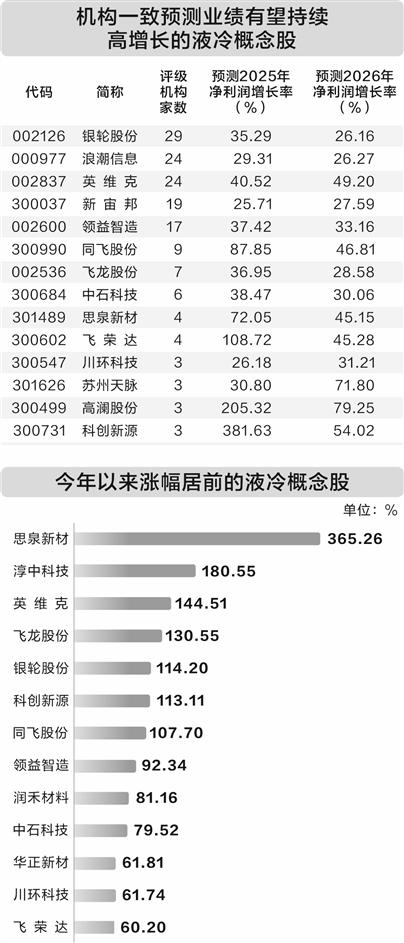
Core Viewpoint - The liquid cooling sector is gaining traction due to the increasing demand for cooling solutions in AI and high-performance computing, with significant growth expected in the market over the next few years [6][7][9]. Group 1: Market Trends - The global AI liquid cooling market is projected to reach $8.6 billion by 2026, indicating rapid market growth [7]. - In China, the liquid cooling market for intelligent computing centers is expected to reach 18.4 billion yuan in 2024, a 66.1% increase from 2023, and could grow to approximately 130 billion yuan by 2029 [7]. Group 2: Company Performance - Silver Wheel Co. (银轮股份) has the highest institutional ratings at 29, with a stock price increase of over 114% this year. The company is expected to see net profit growth of 35.29% in 2025 and 26.16% in 2026 [9]. - Other companies like Inspur Information (浪潮信息) and Invech (英维克) are also projected to have net profit growth rates exceeding 20% in the coming years [9]. Group 3: Technological Developments - NVIDIA is pushing suppliers to develop microchannel liquid cooling plates (MLCP) to address the rising heat from AI GPU chips, with prices 3 to 5 times higher than traditional cooling solutions [6]. - Liquid cooling is becoming the mainstream solution due to its efficiency and ability to handle the increasing power density of chips, as traditional air cooling methods are no longer sufficient [6][7]. Group 4: Company Initiatives - New Zobang (新宙邦) is actively participating in setting standards for liquid cooling and has developed mature products for various data center applications [8]. - High Lan Co. (高澜股份) offers a range of liquid cooling solutions and aims to maintain a Power Usage Effectiveness (PUE) of below 1.1 [8].


液冷新风向?英伟达要求供应商开发新散热技术
DT新材料· 2025-09-16 16:04
Core Insights - The article discusses the increasing demand for AI computing power and the challenges in thermal management, particularly the introduction of microchannel liquid cooling plate (MLCP) technology as a potential solution [2][57]. Group 1: MLCP Technology Overview - MLCP technology integrates a metal cover and liquid cooling plate with a microchannel design, enhancing cooling efficiency and reducing system size [4][6]. - The cost of MLCP is projected to be 3 to 5 times higher than existing cooling solutions, with manufacturing costs for GPUs potentially increasing by 5 to 7 times if MLCP is widely adopted [2][4]. Group 2: Thermal Management Challenges - The thermal power of the Rubin GPU is expected to rise from 1.8 kW to 2.3 kW, necessitating the introduction of MLCP technology by late 2026 [7][9]. - Current cooling solutions may not suffice for the increasing power demands of AI chips, indicating a critical need for advanced thermal management technologies [2][9]. Group 3: Industry Developments - Boyd, a leading supplier, has delivered 5 million liquid cooling plates to large-scale data centers, highlighting the growing importance of liquid cooling technology in AI computing [10]. - The article emphasizes that MLCP technology is gaining traction in the industry, with ongoing research and development efforts to address its challenges [6][57]. Group 4: Future Outlook - The article concludes that MLCP technology represents a significant advancement in thermal management for high-power AI platforms, despite facing production and technical validation challenges [57][59]. - The upcoming Thermal Management Industry Conference will focus on the latest developments in MLCP and liquid cooling technologies, providing a platform for industry experts to discuss solutions to the growing thermal challenges in AI computing [59].


市场形态周报(20250908-20250912):本周指数普遍上涨-20250916
Huachuang Securities· 2025-09-16 11:45
Quantitative Models and Construction Methods 1. Model Name: Heston Model - **Model Construction Idea**: The Heston model is used to calculate the implied volatility of near-month at-the-money options, serving as a market fear index. Implied volatility reflects market participants' expectations of future volatility[7] - **Model Construction Process**: The Heston model is a stochastic volatility model where the variance of the underlying asset follows a mean-reverting square-root process. The model is defined by the following equations: $$ dS_t = \mu S_t dt + \sqrt{v_t} S_t dW_t^S $$ $$ dv_t = \kappa (\theta - v_t) dt + \sigma \sqrt{v_t} dW_t^v $$ Here: - \( S_t \): Underlying asset price - \( v_t \): Variance of the asset price - \( \mu \): Drift term - \( \kappa \): Speed of mean reversion - \( \theta \): Long-term variance - \( \sigma \): Volatility of variance - \( W_t^S, W_t^v \): Two Wiener processes with correlation \( \rho \)[7] --- Model Backtesting Results 1. Heston Model - **Implied Volatility Results**: - SSE 50: 19.61% (down 0.12% from last week) - SSE 500: 23.23% (down 0.17% from last week) - CSI 1000: 25.45% (down 0.49% from last week) - CSI 300: 20.56% (up 0.29% from last week)[8] --- Quantitative Factors and Construction Methods 1. Factor Name: Multi-Sector Timing Factor (Scissors Difference) - **Factor Construction Idea**: This factor is based on the difference in the number of stocks with bullish and bearish signals within sector indices. It aims to identify timing opportunities by analyzing the relative strength of bullish versus bearish signals[14] - **Factor Construction Process**: - For each sector index, calculate the number of stocks with bullish and bearish signals daily - If no bullish signals exist, set the bullish count to 0; similarly, if no bearish signals exist, set the bearish count to 0 - Compute the scissors difference as the difference between the bullish and bearish counts - Normalize the scissors difference to obtain a ratio for comparison across sectors[14] - **Factor Evaluation**: The backtesting results show that the timing model based on this factor outperforms the respective sector indices in all cases, demonstrating excellent historical performance[14] --- Factor Backtesting Results 1. Multi-Sector Timing Factor - **Performance Metrics**: - The timing model outperformed the respective sector indices in 100% of cases - Specific sector examples: - Building Materials: Annualized return 25.14%, maximum drawdown -37.98%, index annualized return 2.98%, index maximum drawdown -58.37% - Light Manufacturing: Annualized return 21.94%, maximum drawdown -37.91%, index annualized return 3.35%, index maximum drawdown -67.79% - Electric Power & Utilities: Annualized return 17.15%, maximum drawdown -41.46%, index annualized return 2.6%, index maximum drawdown -67.22%[14][15][17]
机械行业周报2025年第37周:智平方达成1000台具身智能机器人战略合作,工程机械需求持续复苏-20250916
EBSCN· 2025-09-16 11:12
Investment Rating - The report maintains a "Buy" rating for the mechanical industry [1] Core Viewpoints - The mechanical industry is experiencing a recovery in demand, particularly in the engineering machinery sector, driven by significant projects such as the construction of the Yarlung Tsangpo River hydropower project, which is expected to generate substantial new demand for engineering machinery [14][15] - The humanoid robot sector is poised for a breakthrough in 2025, with mass production expected to drive down costs and enhance data collection capabilities, thus promoting wider adoption [6] - Liquid cooling technology is becoming increasingly important due to the rising power consumption of chips, with a projected increase in the adoption of liquid cooling systems in data centers [7][8] Summary by Relevant Sections Humanoid Robots - Significant investments in humanoid robotics have been made, including a nearly 1 billion yuan A+ round financing for a startup focused on embodied intelligence [4] - The year 2025 is anticipated to be a pivotal year for humanoid robot mass production, with expectations of overcoming data scarcity issues [6] Liquid Cooling - Innovations in liquid cooling technology are being driven by the need for efficient thermal management in high-performance chips, with a notable shift towards liquid cooling systems in new data centers [7][8] Engineering Machinery - The engineering machinery sector is benefiting from the commencement of major infrastructure projects, with domestic sales of excavators showing a year-on-year increase of 14.8% in August 2025 [15] - The report highlights the potential for continued growth in the engineering machinery sector due to policy support and the ongoing internationalization and electrification trends [15] Robotics and Automation - The report notes a significant increase in the sales of various types of forklifts, with a year-on-year growth of 14.4% in July 2025, indicating a robust market for automated solutions [16] - The penetration rate of unmanned forklifts is expected to rise significantly, with a projected 39.3% increase in sales in 2025 [16] Semiconductor Equipment - The report discusses the acceleration of domestic substitution for semiconductor equipment due to geopolitical tensions and trade restrictions, emphasizing the importance of local manufacturers [18][19] New Energy Equipment - The report highlights advancements in battery technology, including the introduction of solid-state batteries, which are expected to revolutionize the energy storage market [21][22]
飞龙股份:子公司安徽航逸部分项目已开始小批量供货
Ju Chao Zi Xun· 2025-09-16 09:49
Group 1 - The company established a subsidiary, Anhui Hangyi Technology Co., Ltd., in Wuhu, Anhui, focusing on the research, production, and sales of liquid cooling pumps for data centers, renewable energy storage, and charging piles, with a power range of 16W to 22kW [2] - The company has over 40 clients in the liquid cooling sector, including HP, Shunling Environment, and Delta, and has a maximum production capacity of 1.2 million electronic pumps per year to meet the growing demand [2] - Currently, the company is involved in over 120 projects in the liquid cooling field, with some already in mass production, and is integrating thermal management technology with various advanced sectors such as AI cooling, 5G base stations, and renewable energy [2] Group 2 - In the first half of the year, the company reported revenue of 2.162 billion yuan, a year-on-year decrease of 8.67%, while net profit attributable to shareholders increased by 14.49% to 210 million yuan [3] - The company's net profit excluding non-recurring items reached 218 million yuan, reflecting a year-on-year growth of 24.65% [3]

海外算力需求再超预期,国产生态加速成熟 | 投研报告
Zhong Guo Neng Yuan Wang· 2025-09-16 01:44
Core Insights - The AI computing infrastructure is experiencing a dual resonance of supply and demand, with the liquid cooling server industry poised for a significant breakthrough [1][2] - Nvidia's new Rubin architecture chips have completed tape-out and are set for mass production next year, with global data center infrastructure capital expenditure expected to reach $3-4 trillion over the next five years [2] - The competitiveness of the domestic AI industry chain is continuously improving, exemplified by Cambrian's approved fundraising of 3.985 billion yuan for large model chip and software platform development, with a staggering 4347% year-on-year revenue increase in the first half of the year [1][2] Industry Summary - Overseas computing demand has exceeded expectations, accelerating the maturation of the domestic ecosystem [2] - Oracle's latest financial report indicates a projected 77% surge in cloud infrastructure revenue, with unconfirmed performance obligations skyrocketing to $455 billion, including a $300 billion contract with OpenAI [2] - The upgrade in cooling demand driven by enhanced computing density necessitates liquid cooling technology, which is becoming essential due to the advanced process of Rubin chips [2] - Major cloud providers are expected to significantly boost liquid cooling server demand through substantial collaborations and capital investments [2] Company Insights - Cambrian's fundraising approval and its remarkable revenue growth highlight the potential of domestic AI companies [2] - Shenghong Technology has also received approval for a 1.9 billion yuan fundraising aimed at overseas AI-related production capacity [2] - Industry leaders are accelerating the integration of domestic computing clusters and ecosystems through the development of a series of chips and open platforms [2] Investment Perspective - The sector shows strong AI beta resonance across established overseas companies, companies still validating overseas chains, and purely domestic companies [3] - The power generation sector remains a logical choice for simultaneous volume and profit growth, with recommendations for companies like Keta Power [3] - Other recommended companies include AIDC leasing target Hongjing Technology, and those benefiting from power upgrades such as Yingweike and Shenling Environment [3]

液冷:星辰大海可期,坚定看好产业大趋势
2025-09-15 14:57
Summary of Liquid Cooling Technology Conference Call Industry Overview - The focus is on liquid cooling technology innovations primarily in the server and data center sectors, with existing solutions including cold plate, spray, and silent cooling methods. The unidirectional cold plate method is highlighted as the mainstream solution due to its high thermal efficiency and cost-effectiveness [1][4]. Key Points and Arguments - **Drivers of Liquid Cooling Technology Development**: 1. Continuous increase in chip and cabinet power consumption, with CPUs now exceeding 10 kW and cabinet peak power reaching 120-130 kW [5]. 2. Strict PUE (Power Usage Effectiveness) requirements, with new data centers needing to maintain a PUE below 1.25 [5]. 3. Total Cost of Ownership (TCO) considerations, where unidirectional cold plate systems show significant economic advantages over traditional air cooling [5]. - **Market Growth Projections**: - The domestic market is expected to reach 4-5 billion yuan in 2025 and grow to 7-8 billion yuan by 2026. The global market is projected to approach 100 billion yuan by 2026 [1][10]. - **Key Components of Liquid Cooling Systems**: - Liquid cooling plates and CDU (Central Distribution Unit) each account for approximately 30% of the system's value. Other components like manifolds and quick connectors contribute an additional 10-20% [9]. - **Challenges for Silent Cooling Solutions**: - Silent cooling methods face challenges due to high costs and environmental concerns regarding refrigerants, limiting their market viability [8][6]. - **Opportunities for Chinese Companies**: - Chinese firms are gaining ground in the global liquid cooling supply chain, with some technologies now comparable to international competitors. There is potential for increased orders, especially in high-value segments [11]. Additional Important Insights - **Liquid Cooling System Components**: - The liquid cooling system includes critical components such as liquid cooling plates, CDU, and quick connectors, which are essential for effective thermal management [9]. - **Future Trends**: - The liquid cooling industry is expected to experience a steeper growth trajectory compared to other segments like optical modules by 2026, with a focus on companies that can achieve order breakthroughs [16]. - **Competitive Landscape**: - Companies like Invec are noted for their comprehensive capabilities in both server and data center liquid cooling solutions, positioning them well for future growth [17]. - **Research and Development**: - Ongoing exploration of integrating microchannels into cooling plates is underway, which could enhance thermal performance, although this is still in the research phase [7]. This summary encapsulates the key discussions and insights from the conference call regarding the liquid cooling technology sector, highlighting its growth potential, challenges, and the competitive landscape.