拓普集团

Search documents
汽车热管理概念下跌0.53%,主力资金净流出77股
Zheng Quan Shi Bao Wang· 2025-09-30 08:59
Market Overview - As of September 30, the automotive thermal management sector declined by 0.53%, ranking among the top decliners in the concept sector [1] - The sector experienced a net outflow of 2.913 billion yuan, with 77 stocks seeing net outflows, and 6 stocks exceeding 100 million yuan in outflows [2] Key Performers - The top gainers in the automotive thermal management sector included: - Fulin Precision with a rise of 19.98% - Jinfu Technology with an increase of 10.61% - Bohai Automobile with a gain of 9.91% [1][6] - Conversely, ST Meichen faced a significant drop of 20% [1] Capital Flow - The leading stocks with net outflows included: - Huagong Technology with a net outflow of 1.472 billion yuan - Midea Group with a net outflow of 600 million yuan - Heertai with a net outflow of 542 million yuan [2] - Stocks with net inflows included: - Fulin Precision with a net inflow of 515 million yuan - Top Group with a net inflow of 201 million yuan - Sanhua Intelligent Control with a net inflow of 95 million yuan [2][6] Sector Comparison - Other notable sectors included: - Zinc metal with a gain of 3.62% - Lead metal with a gain of 3.61% - Cobalt metal with a gain of 3.49% [2]




汽车零部件板块9月30日跌0.14%,ST美晨领跌,主力资金净流出6.4亿元
Zheng Xing Xing Ye Ri Bao· 2025-09-30 08:42
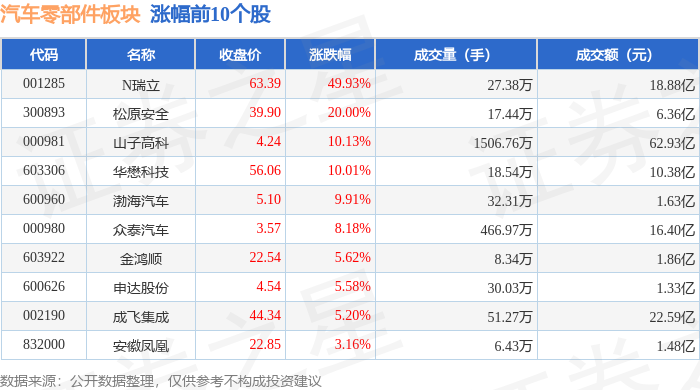
Market Overview - The automotive parts sector experienced a slight decline of 0.14% on September 30, with ST Meichen leading the drop [1] - The Shanghai Composite Index closed at 3882.78, up 0.52%, while the Shenzhen Component Index closed at 13526.51, up 0.35% [1] Stock Performance - Notable gainers in the automotive parts sector included: - N Ruili (Code: 001285) with a closing price of 63.39, up 49.93% and a trading volume of 273,800 shares, totaling 1.888 billion yuan [1] - Songyuan Safety (Code: 300893) with a closing price of 39.90, up 20.00% and a trading volume of 174,400 shares, totaling 636 million yuan [1] - Shanzi Gaoke (Code: 000981) with a closing price of 4.24, up 10.13% and a trading volume of 15.0676 million shares, totaling 6.293 billion yuan [1] Fund Flow Analysis - The automotive parts sector saw a net outflow of 640 million yuan from major funds, while retail investors contributed a net inflow of 274 million yuan [2] - Major funds showed significant inflows in stocks like Shanzi Gaoke and N Ruili, while experiencing outflows in stocks like Zongtai Automobile [3] Individual Stock Insights - N Ruili had a major net inflow from retail investors of 494 million yuan, while it faced a net outflow of 948 million yuan from major funds [3] - Shanzi Gaoke experienced a net inflow of 838 million yuan from major funds, but had a net outflow of 431 million yuan from retail investors [3]


“牛市旗手”如愿爆发!行情要来了?别慌!一定要抓住主线
Mei Ri Jing Ji Xin Wen· 2025-09-30 05:40
Core Viewpoint - The "15th Five-Year Plan" is being formulated, focusing on stabilizing growth across key industries, with a series of measures aimed at enhancing supply capacity, expanding effective markets, and optimizing the development ecosystem [1][2]. Industry Summaries - **Key Industries for Growth**: At least nine industries have released growth stabilization plans, including electronics, power equipment, automotive, steel, non-ferrous metals, petrochemicals, building materials, machinery, and light industry, covering both high-end manufacturing and traditional raw materials [1]. - **Investment Focus Areas**: Key investment themes identified include new productive forces, "anti-involution" sectors, consumer sectors, and "dual" fields. Technology companies with genuine technological barriers are expected to be a significant investment focus under the "15th Five-Year Plan" [1]. - **Market Performance**: The A-share market saw collective gains, with the Shanghai Composite Index rising by 0.90%, and the Shenzhen Component and ChiNext Index increasing by 2.05% and 2.74%, respectively, indicating a positive market sentiment [3][4]. - **Sector Highlights**: The securities sector experienced a significant short-term surge, with the index rising nearly 7%, contributing to overall market optimism. Other sectors such as light industry, non-ferrous metals, and battery technology also showed strong performance [4][10]. - **Battery and Energy Storage Demand**: The demand for energy storage batteries is robust, with major battery manufacturers operating at full capacity and orders extending into early next year. The goal is to reach a new energy storage installation capacity of over 180 million kilowatts by 2027, driving an estimated investment of about 250 billion yuan [10]. - **AI and Robotics Sector**: The "AI+" initiative is expected to be a core driver of new productive forces, with a focus on integrating AI with the real economy for large-scale application [2][12]. The humanoid robot sector is also gaining attention, with key stocks showing significant price increases [12][13]. - **Gold and Silver Market**: The expectation of continued interest rate cuts by the Federal Reserve is driving the current bull market in gold and silver, with companies like Zijin Mining being pivotal in the performance of the non-ferrous metals sector [11].


2025年中国汽车压铸件行业政策、产量、市场规模、重点企业及未来趋势研判:汽车产业蓬勃发展,带动汽车压铸件规模达264亿元[图]
Chan Ye Xin Xi Wang· 2025-09-30 01:35
Industry Overview - The automotive die-casting industry involves the use of die-casting technology to produce metal components for vehicles, utilizing materials such as aluminum, zinc, and magnesium [1][11] - The industry's growth is driven by the rapid rise of the automotive sector, particularly in electric vehicles, with increasing demand for lightweight and energy-efficient components [1][11] - China's automotive die-casting market is projected to grow from 18.988 billion yuan in 2017 to 26.429 billion yuan in 2024, with a compound annual growth rate (CAGR) of 4.84% [1][12] Industry Development History - The industry has evolved through three main phases: the initial phase from 1953 to 1981, the startup phase from 1982 to 2006, and the rapid development phase from 2007 to present [4][5] - The current phase is characterized by significant advancements in technology and production capabilities, with a focus on high-performance and high-precision die-casting products [4][11] Policy Support - Recent government policies have emphasized the importance of the die-casting industry, promoting advanced casting techniques and green manufacturing practices [6] - The National Development and Reform Commission issued guidelines to encourage the use of lightweight alloys and automation in die-casting processes [6] Industry Chain - The die-casting industry supply chain includes upstream raw materials (aluminum, magnesium, iron, zinc) and equipment (die-casting machines), with the manufacturing process occurring in the midstream and automotive manufacturing in the downstream [4][7] Market Trends - The industry is moving towards precision, customization, lightweighting, and green manufacturing as key trends [14][15][17][18] - Precision die-casting is increasingly important to meet the stringent requirements of automotive components, while customization allows for tailored solutions to meet diverse client needs [14][15] - Lightweight materials are being adopted to enhance fuel efficiency and performance, particularly in electric vehicles [17] - Environmental sustainability is becoming a core focus, with efforts to reduce carbon footprints through the use of recycled materials and cleaner production methods [18] Key Companies - Major players in the automotive die-casting industry include Top Group, Guangdong Hongtu, Aikodi, and BYD, which are expanding their capabilities in both traditional and new energy vehicle sectors [2][12] - Guangdong Hongtu's die-casting business has gained global recognition, focusing on lightweight aluminum products and comprehensive solutions for automotive manufacturers [12][13]


地产首席看好物业机器人 建材首席推荐AI产业链 传统行业分析师转型成“刚需”?
Mei Ri Jing Ji Xin Wen· 2025-09-29 21:17
Group 1 - The core viewpoint of the articles highlights the increasing necessity for traditional industry analysts to adapt and incorporate emerging technologies like AI and robotics into their research, driven by the ongoing "technology bull market" since September 24, 2024 [1][2][3] - Analysts from traditional sectors such as real estate and building materials are actively promoting emerging technology themes, indicating a shift in focus towards high-growth areas [2][3] - The performance of emerging technology sectors has significantly outpaced traditional industries, with the average trading volume of top technology sectors being 19 times greater than that of the lowest-performing sectors since the "9·24" market event [3][4] Group 2 - There is a notable trend of cross-industry transformation among analysts, with many recognizing the need to expand their research boundaries to remain relevant in a changing market landscape [4][5] - Analysts from traditional sectors are increasingly reacting to technology news with the same speed as their counterparts in tech industries, showcasing a shift in research dynamics [2][5] - Despite the push towards technology, traditional industries still hold investment value, particularly in high-dividend sectors like coal and utilities, which are seen as attractive in a low-interest-rate environment [6][7]

特斯拉Optimus持续利好,产业链上市公司“齐飞”!
Robot猎场备忘录· 2025-09-29 16:10
Core Viewpoint - The article highlights the positive developments surrounding Tesla's Optimus robot, indicating a strong recovery in the robotics sector, particularly among companies in the T-chain, following a series of favorable events and announcements from Tesla and Elon Musk [2][3][4]. Summary by Sections Tesla and Optimus Developments - Tesla's stock experienced a significant increase of 4.02% on September 26, marking the largest gain of the week [4] - Elon Musk announced on September 27 that Tesla is working hard to scale up Optimus production [4] - A visit from the UAE National Media Office Chairman to Tesla's headquarters included a demonstration of the Optimus robot, showcasing its capabilities [5] Market Reactions and Trends - Following the positive news, the robotics sector, especially T-chain companies, saw a strong recovery on September 29, with several stocks hitting their daily limits [7] - The overall performance of the robotics sector in Q3 was bolstered by continuous positive catalysts from Tesla's Optimus, despite experiencing significant pullbacks [7] Key Catalysts in September - September saw multiple catalysts for Tesla and Optimus, including the release of Tesla's "Master Plan Part IV," which emphasized the importance of AI and humanoid robots [7] - Musk's potential compensation plan, which could reach $1 trillion, is contingent on delivering 1 million humanoid robots over the next decade [7] - Notable events included a nearly 14% increase in Tesla's stock over two days and significant insider buying by Musk [9] Future Outlook - The article anticipates a strong Q4 for the robotics sector, with numerous upcoming events related to the Optimus Gen3 launch and production [10] - A comprehensive list of nearly 70 companies involved in the Tesla Optimus supply chain has been compiled, indicating a robust ecosystem supporting the development of humanoid robots [11] Industry Insights - The article emphasizes the importance of understanding the latest developments in the humanoid robot supply chain, with ongoing updates available through dedicated platforms [13][14]

地产首席看好物业机器人 建材首席推荐AI产业链……“科技牛”特征明显 传统行业分析师转型成“刚需”?
Mei Ri Jing Ji Xin Wen· 2025-09-29 14:05
Core Insights - The trend of traditional industry analysts shifting towards emerging technologies like AI and robotics has become a necessity for career development in the current market environment [1][3][5] - Since the "9·24" market event, emerging technology themes have dominated the market, while traditional cyclical industries have been neglected [2][3] Group 1: Market Trends - Emerging technology sectors, including electronics, computers, and medical biology, have seen significant trading volumes, with the average trading amount of the top five sectors being 19 times that of the bottom five sectors [3] - The average increase in share prices for the top five sectors since "9·24" is 80%, surpassing the average increase of nearly 40 percentage points for the bottom five sectors [3] Group 2: Analyst Behavior - Analysts from traditional sectors are increasingly incorporating emerging technologies into their research, with some even organizing field research on robotics applications in property management [2][5] - The speed at which traditional industry analysts respond to technology news has improved, matching that of their counterparts in the tech sector [2][3] Group 3: Cross-Industry Trends - The trend of analysts crossing into new fields is seen as a necessary adaptation, with some analysts stating that without this shift, they would struggle to remain relevant [5][6] - The historical context shows that traditional industries can still hold investment value, as evidenced by past performance in sectors like coal and cement during market recoveries [6] Group 4: Future Outlook - Despite the shift towards technology, there remains a demand for in-depth research in traditional sectors, as some analysts continue to produce well-received reports [6] - The overall trend indicates a decline in the number of analysts focused on traditional industries, as newer firms concentrate on technology and biotech sectors [6][7]
地产首席看好物业机器人,建材首席推荐AI产业链……“科技牛”特征明显 传统行业分析师转型成“刚需”?
Mei Ri Jing Ji Xin Wen· 2025-09-29 13:59
Core Insights - Emerging technologies have become the main theme in the market, overshadowing traditional cyclical industries since the "9·24" market event [2][3] - Analysts from traditional sectors are increasingly incorporating AI and robotics into their research, reflecting a necessary shift in their professional development [1][5] Group 1: Market Trends - Since "9·24", the average increase in technology-heavy sectors such as electronics, computers, and medical biology has been around 80%, significantly outperforming traditional sectors like coal and steel, which lagged behind by nearly 40 percentage points [3] - The top five sectors by transaction volume are all technology-oriented, with an average transaction amount 19 times greater than the bottom five sectors [3] Group 2: Analyst Behavior - Analysts from traditional industries are adapting to the new market dynamics by focusing on emerging technologies, with some even organizing field research on robotics applications in property management [2][5] - The trend of traditional analysts crossing into tech research is becoming a necessity for career survival, as indicated by a notable shift in their focus areas [5][6] Group 3: Industry Dynamics - The historical performance of traditional industries like coal and cement shows that they still hold investment value, especially in a low-interest-rate environment where dividend-paying assets are in demand [7] - Despite the rise of new research forces focusing on technology and biotech, there remains a market for in-depth studies from seasoned analysts in cyclical industries [7][8]
【周观点】9月第3周乘用车环比+12.9%,继续看好汽车板块
东吴汽车黄细里团队· 2025-09-29 13:49
Investment Highlights - The core point of the article is the analysis of the automotive industry performance in the third week of September, highlighting a significant increase in compulsory insurance registrations and the performance of various automotive sub-sectors [10][11]. Weekly Review - In the third week of September, 508,000 compulsory insurance registrations were recorded, representing a week-on-week increase of 12.9% and a month-on-month increase of 8.2% [10][50]. - The performance of automotive sub-sectors ranked as follows: SW motorcycles and others (+5.0%), SW auto parts (+0.4%), SW passenger cars (-0.9%), SW commercial cargo vehicles (-2.5%), and SW commercial passenger vehicles (-3.0%) [10][11]. - The top five stocks covered this week included Luxshare Precision, Songyuan Co., Xusheng Group, Changshu Automotive Trim, and Hengshuai Co., with notable increases [10][28]. Research Outcomes - The team released in-depth reports titled "AI Smart Car Era is [Product is King]", "Robotaxi is Reshaping the Automotive Travel Market", and "2025 Mainstream City NOA Test Drive Report - September Shanghai Edition" [3][10]. Industry Changes - Key developments include the anticipated early release of Tesla's FSD version 14, a partnership between XPeng and Alibaba Cloud for quantum encryption technology, the launch of the ideal i6 electric SUV priced at 249,800 yuan, and significant pre-orders for the H5 and M7 models [4][10][11]. Investment Opportunities - Three main investment themes are identified: 1. **AI Smart Car**: Focus on Robotaxi and Robovan industries, with key players including Tesla, XPeng, and various technology providers [6][12]. 2. **AI Robotics**: Emphasis on component suppliers such as Top Group and Junsheng Electronics [12]. 3. **Traditional Automotive**: Opportunities in buses, heavy trucks, and two-wheelers, with companies like Yutong Bus and China National Heavy Duty Truck [7][12]. Market Performance - The A-share automotive sector outperformed the Hong Kong market this week, with motorcycles showing the best performance. Notable changes include the official listing of Chery in Hong Kong and the launch of new models by various manufacturers [5][11].

四季度,把握这些主线!
Ge Long Hui· 2025-09-29 10:00
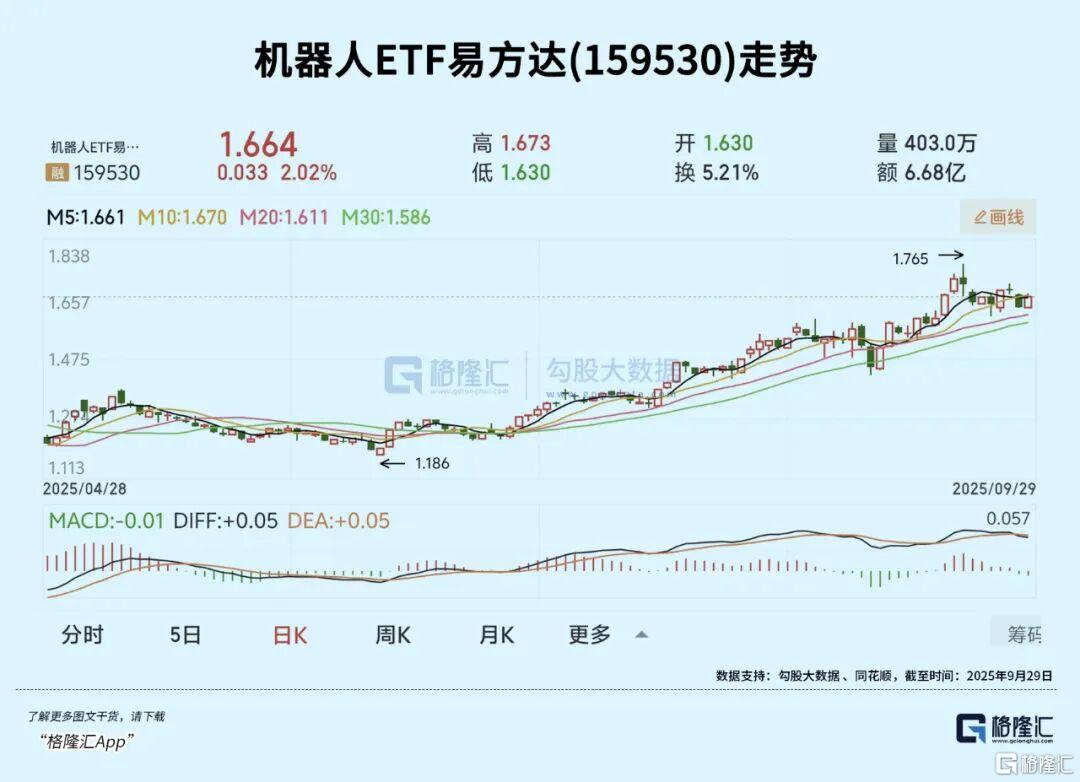
Market Overview - The three major indices collectively rose, with the Shanghai Composite Index up 0.9%, Shenzhen Component Index up 2.05%, and ChiNext Index up 2.74% on the second-to-last trading day before the holiday [1] - The securities sector surged, leading the indices higher, indicating a bullish sentiment in the market [1] Robotics Sector - The humanoid robot sector is expected to see a mainline market trend officially begin in the fourth quarter, following significant changes in the industry logic during the past three quarters [3][5] - Major contracts have been awarded, including a record procurement contract of 250 million yuan by UBTECH, marking a milestone in humanoid robot commercialization [5] - Domestic leading companies are increasingly securing large-scale orders, indicating a clearer outlook for mass production in the coming year [5] Investment Opportunities - The recent surge in the humanoid robot sector is supported by a positive cycle of technological breakthroughs, order confirmations, and capital catalysts [8] - The robot ETF (159530) has seen significant net inflows, with 8.85 billion yuan entering the fund despite a slight decline in the index [8][10] - The robot industry index has outperformed the broader robot index, with a year-to-date increase of 41.11% compared to 3.73% for the latter [8][11] Semiconductor Sector - The semiconductor industry is experiencing a positive outlook driven by AI demand, with significant capital expenditures benefiting equipment and materials companies [17] - Domestic semiconductor companies are seeing increased orders and market share, particularly in key areas like AI GPUs and semiconductor equipment [19] - The semiconductor materials and equipment index has a high weight of 82.48%, indicating a strong focus on these segments within the industry [20] Future Catalysts - Key events in the upcoming months, including Tesla's shareholder meeting and various robotics conferences, are expected to act as catalysts for the humanoid robot sector [4] - The market is likely to shift focus towards sectors with structural growth, such as semiconductors, new energy, humanoid robots, and innovative pharmaceuticals, as liquidity remains ample [23]