万纬物流

Search documents
刘强东的第七个IPO 500亿“独角兽”京东产发递表港交所
Sou Hu Cai Jing· 2026-01-27 12:50
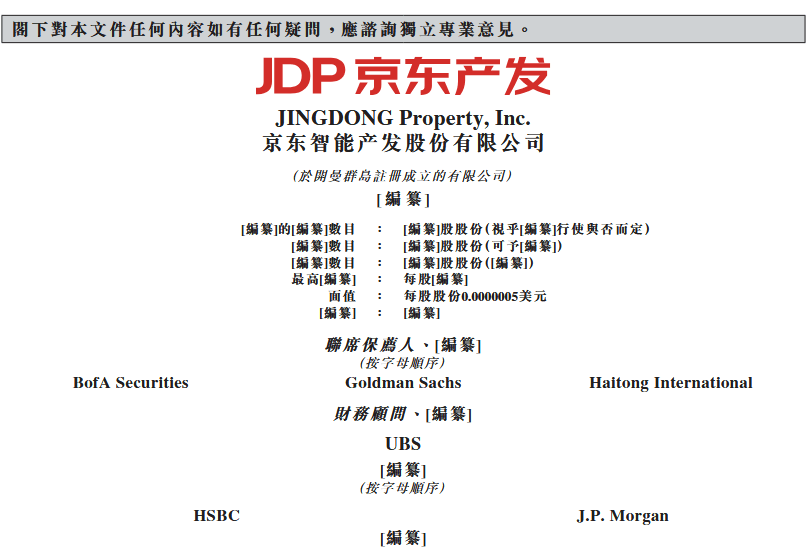
Core Viewpoint - JD Smart Development Co., Ltd. has submitted its prospectus for an IPO, marking it as the seventh company under JD Group to seek public listing, following JD Group, Dada Group, JD Health, JD Logistics, Debang Co., and JD Industry [1][9]. Company Overview - JD Smart Development is a platform enterprise focused on the development, operation, and asset management of modern supply chain infrastructure, aiming to provide integrated supply chain solutions through high-standard logistics parks, industrial parks, and data centers [3]. - The company has established a three-dimensional business model that emphasizes heavy asset development, light asset operation efficiency, and capital cycle empowerment [3]. Business Structure - The company has three main pillars driving its operations: - Infrastructure solutions, which are the main revenue source, contributed 2.564 billion RMB in the first nine months of 2025, accounting for 85.4% of total revenue [5]. - Asset value enhancement focuses on optimizing existing assets, achieving a cumulative asset appreciation of 1.3 billion RMB from 2020 to 2024, with an average return rate of 40% [6]. - Fund and partnership investment platform management promotes a light asset transformation, with a projected management fee income of 197 million RMB in 2024, reflecting a compound growth rate of 30% [6]. Financial Performance - In 2023, the company reported total revenue of 2.9 billion RMB, expected to grow to 3.4 billion RMB in 2024, with a 21.2% increase in revenue for the first nine months of 2025 compared to the same period in 2024 [12]. - The company experienced a net loss of 1.829 billion RMB in 2023, which is projected to decrease to 1.2 billion RMB in 2024, and further to 159 million RMB in the first nine months of 2025 [14]. - Adjusted net profit is expected to grow significantly, with a 77% increase in the first nine months of 2025 compared to the same period in 2024 [12]. Market Context - The IPO submission aligns with the trends in intelligent manufacturing and supply chain infrastructure upgrades, driven by policies like "Made in China 2025" and the "14th Five-Year Plan" [17]. - The demand for high-standard, intelligent infrastructure is increasing globally, providing a broad market space for companies like JD Smart Development [19]. Competitive Landscape - The domestic supply chain infrastructure industry is becoming increasingly competitive, with major players like ProLogis and Wanwei Logistics intensifying their market presence [15]. - JD Smart Development aims to differentiate itself by leveraging JD Group's core supply chain capabilities and focusing on emerging sectors like new energy vehicles and cross-border e-commerce [21].


聚力投资沃土 温馨春城取得新成效
Xin Lang Cai Jing· 2026-01-01 22:55
Core Viewpoint - Kunming is focusing on high-level investment attraction and creating a favorable business environment to drive economic growth during the 14th Five-Year Plan period, with significant increases in project signings and industrial investments [1][2][3]. Group 1: Investment and Project Growth - The number of newly signed projects in Kunming increased by 16.4% year-on-year in the first 11 months of 2025, with the number of projects over 100 million yuan ranking first in the province [1]. - The number of projects over 100 million yuan in Kunming increased from 211 in 2021 to 533 in 2024, with industrial project funding rising from 7.2% in 2021 to 58.5% in 2024 [1]. - The average annual growth rate of projects over 1 billion yuan from 2021 to 2024 was approximately 22.75%, with 56 additional projects in 2024 compared to 2021 [2]. Group 2: Industrial Structure and Investment Quality - The investment structure of primary, secondary, and tertiary industries shifted from 8.3:39.7:52 in 2021 to 5.2:59:35.8 in 2024, indicating a significant change in investment focus [3]. - Industrial investment accounted for 39.5% of total investment in 2024, doubling from 16.2% in 2020, with industrial investment reaching its highest level in 25 years at 26.3% [3]. - The contribution rate of Kunming's industrial output to the province reached 59.4%, an increase of nearly 50 percentage points since 2020 [3]. Group 3: Investment Attraction Mechanisms - Kunming's leadership has actively engaged in investment attraction, with city leaders conducting multiple trips to key regions and countries to promote investment opportunities [4]. - A cross-regional industrial cooperation mechanism was established to enhance collaboration and resource allocation among different districts, leading to the successful landing of several key projects [5]. - The city has implemented a series of policies to improve the quality and efficiency of investment attraction, including a comprehensive management system for the entire project lifecycle [5]. Group 4: Business Environment Improvement - Kunming has made significant strides in improving its business environment, achieving a transition from "good" to "excellent" in national evaluations [7]. - The city has introduced a "clear service" government initiative, ensuring that government services are responsive to business needs, with a high online service availability rate of 97.75% [8]. - The establishment of a "director's consultation" window allows direct engagement with business concerns, addressing 255 issues from 179 companies in 2024 [9]. Group 5: Community and Collaborative Efforts - Kunming has set up 69 business environment observation points and established a supervisory system to enhance community involvement in improving the business climate [10]. - The city has developed a collaborative model involving government, enterprises, and research institutions to optimize the business environment, ensuring that policies reach businesses effectively [10]. - The focus on attracting significant projects and optimizing the business environment aims to support high-quality development and regional economic integration [10].
物流各领域盈利分化显著,京东物流等联动伙伴仓网实现生态协同
Sou Hu Cai Jing· 2025-12-04 17:11
Core Insights - The logistics real estate and express delivery sectors are experiencing a profitability pattern characterized by "strong performance from leading companies and pressure on smaller firms," with industry acceleration towards high-value creation driven by network integration and capital operations [2] Group 1: Logistics Real Estate - The core trend in logistics real estate focuses on optimizing cost structures and adjusting business models, with Wanwei Logistics reporting total revenue of 3.18 billion yuan, a year-on-year increase of 7.4%, by transitioning to a "heavy asset + light asset" model [2] - Baowang Logistics reported total revenue of 1.38 billion yuan, a year-on-year decrease of 3.91%, with net profit declining by 57.71% due to long cultivation periods for newly opened parks and investments in smart park renovations and photovoltaic projects [2] Group 2: Express Delivery Sector - The express delivery industry is seeing improved profitability driven by simultaneous increases in volume and price, with JD Logistics achieving revenue of 55.084 billion yuan, a year-on-year increase of 24.1%, despite a 15% decline in net profit due to an increase in full-time delivery personnel [2] - SF Holding reported total operating revenue of 225.26 billion yuan, a year-on-year increase of 8.89%, and a net profit of 8.31 billion yuan, up 13.69%, indicating simultaneous growth in business scale and profitability [3] Group 3: Cold Chain and Cross-Border Logistics - In the cold chain sector, Hailong Cold Chain reported total revenue of 2.43 billion yuan, a year-on-year increase of 15.20%, with a net profit margin of 12.26%, while Iceberg Cold Chain saw a revenue decline of 2.73% [3] - In cross-border logistics, Jiacheng International reported total revenue of 0.95 billion yuan, a year-on-year decrease of 3.40%, but maintained a high net profit margin of 15.86% [3] Group 4: Investment and M&A Activities - Six investment events were recorded during the reporting period, with leading companies driving industry advancement through technology cooperation, capacity implementation, and capital mergers and acquisitions [3] - Notable investment activities include Zhongtong Express acquiring land for 381 million yuan to build a smart operation center, and JD Logistics launching multiple projects to enhance its logistics network [4][5] Group 5: Technological Innovation - Companies are deepening the integration of technology and logistics applications to enhance operational efficiency, with ProLogis launching an automated warehouse equipped with smart sorting robots and AGV systems [4] - JD Logistics and JD Industrial Development are collaborating on a project to integrate core resources such as warehousing and distribution, improving order processing efficiency by 50% [5][6] Group 6: Capital Operations - Capital operations and asset transactions are becoming crucial for optimizing resource allocation in the logistics industry, with notable transactions including Tianjin Port Group's plan to transfer 60% of China Railway Storage and Transportation's equity [8] - Red Star Cold Chain has submitted a listing application to the Hong Kong Stock Exchange, aiming to raise funds for expanding its cold chain network and upgrading temperature control technology [9]
卓越指数 • 2025 物流仓储暨基础设施投资发展报告
Sou Hu Cai Jing· 2025-12-03 07:03
Core Insights - The logistics and warehousing sector in China is entering a critical phase of "refined operation and value reconstruction" by 2025, focusing on sustainable development and efficiency rather than mere scale expansion [2] - The market is experiencing "structural differentiation," with varying performance across regions, necessitating a comprehensive evaluation of outstanding enterprises and projects [2] Market Overview: Supply and Demand Balance - The overall vacancy rate for high-standard warehouses increased by 0.5 percentage points to 17.8% in Q2 2025, with average rent slightly declining by 3.6% to 29.7 CNY/m²·month [3] - Some cities are witnessing growth in leasing demand due to traditional e-commerce festivals and cross-border e-commerce expansion, leading to slight rent increases and decreased vacancy rates [3] - Regions with weaker industrial foundations are facing significant downward pressure on rental rates and occupancy [3] Regional Performance - The South China region maintains a low vacancy rate of 10.6% and high rent of 37.7 CNY/m²·month, supported by strong manufacturing and cross-border logistics demand [6] - The Central and Southwest regions show decreasing vacancy rates, with Central China at 11.6% and Southwest at 12.7%, while average rents are 25.4 CNY/m²·month and 21.7 CNY/m²·month, respectively [6] - The North and East China regions face challenges with high vacancy rates of 21.4% and 21.6%, respectively, and declining rents [7] Demand Structure Changes - The logistics market is experiencing a slowdown in demand growth, with rising vacancy rates and a dynamic adjustment phase in supply and demand relationships [8] - By Q3 2025, the non-bonded high-standard warehouse market inventory reached 17.6 million square meters, with the Yangtze River Delta region dominating at 46% [8][10] - The demand structure is shifting, with cross-border e-commerce and traditional platforms maintaining high activity levels, but immediate retail e-commerce showing limited direct demand for high-standard warehouses [10] Future Supply Outlook - An estimated 18 million square meters of new non-bonded high-standard warehouse supply is expected from Q4 2025 to 2026, with significant variations across city clusters [12] - The average effective rent for high-standard warehouses is anticipated to face downward pressure due to new supply, although the decline may narrow as supply-demand relationships adjust [12] Industry Trends - The logistics industry is gradually moving towards high-quality development, with core indices showing a recovery trend despite fluctuations [13][15] - The logistics industry is experiencing a shift from "price wars" to "value wars," supported by various policies aimed at curbing unhealthy competition [17][18] Investment and Financing - The logistics sector is witnessing active investment, with a total of 748 billion CNY raised through 33 financing events from January to October 2025 [37] - The financing structure is evolving from single equity financing to a diversified system including equity, debt, and asset-backed securities (ABS) [38][39] - Significant transactions in the warehousing and logistics asset sector are enhancing resource allocation efficiency and supporting global expansion [41]


重回扩张线 | 2025年11月物流仓储暨基础设施投资发展报告
Sou Hu Cai Jing· 2025-11-21 15:39
Core Viewpoint - The logistics industry in China shows signs of recovery with the Logistics Performance Index (LPI) at 50.7% in October 2025, indicating continued expansion despite a slight month-on-month decline [5][7][9]. Group 1: Industry Performance - The LPI reflects a stable demand in logistics, supported by industrial and consumer sectors, with most sub-indices showing improvement [7][9]. - The warehousing index rose to 50.6%, indicating a return to expansion, with various sub-indices such as business volume and facility utilization also increasing [9][10]. - The express delivery index reached 475.5, up 2.4% year-on-year, driven by e-commerce activities and improved service quality [10][12]. Group 2: Policy Support and Technological Integration - Policies focusing on logistics data interconnectivity and green logistics are being implemented, aiming to reduce logistics costs by 1-2% [11][12]. - The government is promoting the use of new energy vehicles and smart warehousing systems, with companies like JD and SF Logistics accelerating their green logistics initiatives [12][21]. - The integration of technology in logistics operations is emphasized, with companies investing in smart logistics hubs and automated systems to enhance efficiency [22][23]. Group 3: Market Dynamics and Investment Trends - The logistics real estate investment trusts (REITs) are performing well, with an average occupancy rate of 92% and a stable annual distribution rate of 4% [6][26]. - Major logistics firms are actively pursuing mergers and acquisitions to enhance their operational capabilities and market presence [24][25]. - The cold chain logistics sector is experiencing growth, with a 4.72% increase in demand for food cold chain logistics in Q3 2025 [13][18]. Group 4: Company-Specific Developments - SF Holdings reported a revenue of 225.26 billion yuan, up 8.89%, with a net profit of 8.31 billion yuan, reflecting strong operational performance [18][19]. - JD Logistics achieved a revenue of 55.084 billion yuan, a 24.1% increase, despite a decline in net profit due to increased workforce costs [19][20]. - ProLogis and other leading firms are focusing on smart logistics parks and zero-carbon initiatives to drive operational efficiency and sustainability [20][21].

充电桩存在闲置与供给不足矛盾,专家:数字化手段让供需匹配
Nan Fang Du Shi Bao· 2025-11-21 12:15
Core Viewpoint - The seminar on "Green Freight New Pathways: Industry Chain Collaboration and Scenario-Based Emission Reduction Solutions" highlights the challenges and opportunities in the logistics sector regarding the adoption of new energy vehicles, emphasizing the need for infrastructure improvements and technological innovations to enhance operational efficiency and reduce costs [1]. Group 1: Charging Infrastructure and Operational Efficiency - There is a structural contradiction in charging station resources, with high idle rates in some areas and insufficient supply in core regions. A digital platform is suggested for precise supply-demand matching and optimizing charging costs through smart algorithms [3]. - The operational efficiency of new energy light trucks is hindered by battery range, load limitations, and inadequate charging facilities, particularly in winter. Recommendations include developing customized models for specific scenarios, accelerating battery swap standardization, and improving cost-sharing mechanisms [3]. Group 2: Cost Reduction and Flexible Solutions - Cost reduction and efficiency enhancement are core drivers for the transformation of logistics companies. There are ongoing challenges related to the purchase costs of new energy vehicles, battery degradation, and second-hand disposal, leading companies to shift towards leasing and flexible procurement methods [4]. - Logistics companies are expected to adopt a gradient configuration of pure electric, range-extended, and hydrogen-powered vehicles based on transportation distance and load requirements, providing a feasible transformation path [4]. Group 3: Technological Innovations and Market Penetration - Vehicle manufacturers are innovating to balance the trade-off between battery range and load capacity, with new products achieving longer ranges through lightweight design and energy optimization [4]. - There is a notable regional disparity in the penetration rate of new energy light trucks, with southern cities showing higher adoption compared to northern regions. Factors such as high insurance costs and low second-hand vehicle residual values are identified as barriers to market growth, necessitating a collaborative approach across policy, technology, and business sectors [4].

仓库里的赌局:IPO是不是普洛斯的“救命钱”
Sou Hu Cai Jing· 2025-09-23 11:47
Core Viewpoint - Prologis is preparing for an IPO in 2026 as a necessary step to address capital circulation issues, despite stable rental income from its warehouses [7][11][25]. Group 1: Company Background - Prologis, a major operator of logistics warehouses in China, manages 450 facilities across 70 markets, serving as a backbone for e-commerce and fast-moving consumer goods [7][8]. - The company was privatized in 2017 at a valuation of 16 billion Singapore dollars (approximately 79 billion RMB), marking one of the largest privatization deals in Asia [9]. Group 2: Capital Circulation Challenges - Prologis faces difficulties in capital circulation as the enthusiasm of dollar funds for investing in Chinese logistics assets has decreased, leading to tighter funding pools [12]. - The Chinese public REITs market is too small to absorb Prologis's substantial asset pool, with individual REITs only reaching tens of billions of RMB [13]. - Major shareholders, including Hillhouse and Vanke, have held their investments for eight years and are increasingly seeking liquidity through an IPO [13]. Group 3: IPO as a Necessity - The IPO has shifted from being a choice to a necessity due to the combined pressures of reduced fundraising options and shareholder exit strategies [14]. - Prologis must present a compelling narrative beyond just owning warehouses, positioning itself as a "new infrastructure platform" that includes logistics, data centers, and renewable energy initiatives [15]. Group 4: Market Timing and Competition - The Hong Kong IPO market has recently improved, providing a favorable window for Prologis to launch its IPO [16]. - Prologis faces competition from potential IPO candidates like Wanwei Logistics and other foreign investors looking to enter the Chinese market [19][21]. Group 5: Risks and Uncertainties - The company is exposed to risks such as slowing rental growth in first-tier cities, rising vacancy rates in second-tier markets, and potential skepticism from investors regarding its new narrative [22][24].
枢纽型项目为主要投资标的,安博REIT出租率压力仍存
Sou Hu Cai Jing· 2025-08-04 11:10
Core Insights - The report highlights three investment events primarily focused on hub-type projects, indicating a trend towards infrastructure development in logistics and warehousing [2][3] Investment Events - Three investment events were recorded during the reporting period, all centered around hub-type projects [3] - On June 28, SF Express commenced its multi-modal international hub project, covering 490 acres with a total investment of 1.5 billion yuan, aimed at creating a smart logistics and warehousing center [3] - Guangzhou was approved as a national logistics hub with a total investment of 15 billion yuan to build an international trade logistics center [3] Financing Activities - Six financing events were recorded during the period, an increase from the previous month, with most financing types being bonds [3] - On July 10, SF Holdings issued a zero-coupon guaranteed convertible bond worth 2.95 billion HKD, with net proceeds expected to be approximately 2.9 billion HKD [4] REIT Performance - The 华夏安博仓储物流REIT has submitted its application materials, with underlying assets including projects in Guangzhou and Dongguan, totaling a building area of 349,600 square meters and a total valuation of 2.249 billion yuan [5][6] - The occupancy rate of the Guangzhou development zone project has declined, primarily due to normal lease expirations leading to short-term vacancies [6] Market Trends - The overall occupancy rate for warehouse logistics REITs remains above 90%, with many showing year-on-year increases [6] - 中金普洛斯REIT has successfully implemented a differentiated pricing strategy, resulting in a 6.6 percentage point increase in overall occupancy rates [7] Green Logistics Initiatives - China National Foreign Trade Transportation Group launched the "Bay Area Cross-Border Green Transport" product, marking a significant step in green logistics [7] - The focus on integrated warehousing and distribution is gaining traction, with companies recognizing the importance of green logistics for enhancing competitiveness and reducing long-term operational costs [7]
智研咨询发布:仓库行业报告(附市场竞争格局、发展现状及趋势预测)
Sou Hu Cai Jing· 2025-07-31 02:33
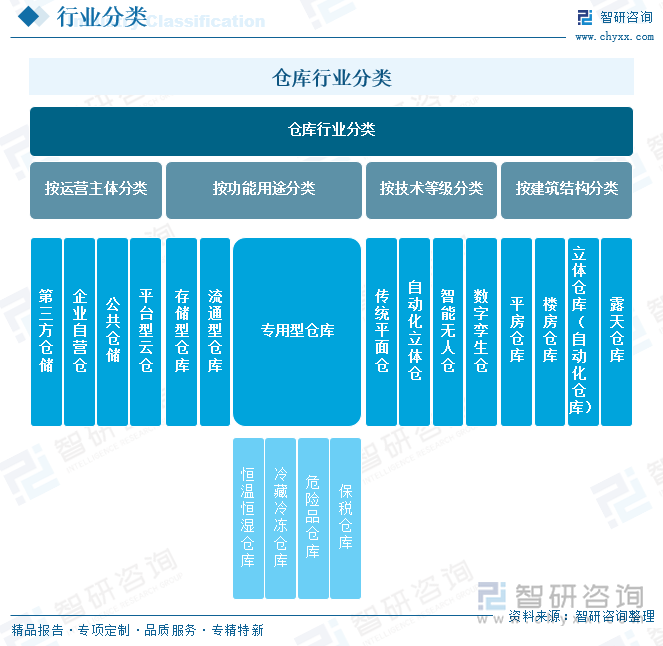
Core Insights - The warehouse industry is a crucial segment of modern supply chains, providing storage, management, sorting, and distribution services, which are essential for the efficient operation of the economy [3][5][11] - The industry is experiencing a transformation from "scale expansion" to "quality upgrade," driven by technological advancements and supply chain changes, with a focus on smart, green, and global operations [7][11] Industry Definition and Function - The warehouse industry encompasses logistics infrastructure operations that facilitate the storage, management, sorting, and distribution of goods, ensuring safety, efficiency, and cost reduction in supply chains [5][9] - Warehouses can be categorized by operational entities (third-party, self-operated, public, cloud-based), functionality (storage, circulation, specialized), technology level (traditional, automated, smart), and structural design (single-story, multi-story, automated, outdoor) [5][9][11] Industry Development Scale - The total warehouse area in China has seen significant growth, with 32.96 million m² completed in 2023, an increase of 4.17 million m² from 2022; however, a decline to 25.08 million m² is expected in 2024, a 24% decrease [6][11] - The total area of general warehouses is projected to reach approximately 1 billion m² in 2024, an increase of 517 million m² from 2023, with a rental area of 54.898 million m² and 1.722 million m² under construction [6][11] Warehouse Demand Distribution - By warehouse size, the largest demand in 2024 will be for warehouses sized 0-999 m², accounting for 33.33%, followed by those over 10,000 m² and those sized 1,000-1,999 m², each representing 19.3% [6][11] - Warehouse leasing constitutes 75.44% of the demand, with the eastern region accounting for 63.16% of warehouse leasing activity, while the northeastern region shows no leasing demand [6][11] Competitive Landscape - The warehouse industry in China features a multi-tiered competitive structure, with major players including national logistics giants, specialized logistics real estate firms, vertical operators, and regional small to medium-sized enterprises [7][11] - Leading companies like JD Logistics, SF Express, and Cainiao Network dominate the first tier, while firms like Prologis and Wanwei Logistics occupy the second tier, focusing on standardized assets and fund management [7][11]
趋势研判!2025年中国仓库行业产业链、发展现状、竞争格局、代表企业及行业发展趋势分析:仓库需求越来越大,智能化、绿色化、全球化为仓库的竞争核心[图]
Chan Ye Xin Xi Wang· 2025-07-30 01:30
Core Insights - The warehouse industry is a critical component of the modern logistics system, providing essential services such as storage, inventory management, sorting, packaging, and distribution, which are vital for the efficient operation of the real economy [1][4] - The demand for warehouses has significantly increased due to the rise of e-commerce and consumption upgrades, leading to a substantial growth in warehouse completion area in recent years [4][6] - In 2023, China's warehouse completion area reached 32.96 million m², an increase of 4.17 million m² compared to 2022, while a projected decrease of 24% is expected in 2024 with a completion area of 25.08 million m² [4][6] Warehouse Industry Definition and Classification - The warehouse industry encompasses the operation of logistics infrastructure that provides storage, custody, sorting, distribution, and related value-added services, forming a core part of the modern supply chain [2] - Warehouses can be classified based on operational entities (third-party, self-operated, public, and platform-based cloud warehouses), functional purposes (storage, circulation, and specialized warehouses), and technological levels (traditional, automated, intelligent, and digital twin warehouses) [2] Current Development Status - The general warehouse area in China has been on a growth trend, with the total area expected to reach approximately 1 billion m² by 2024, an increase of 517 million m² from 2023 [6] - The rental area of general warehouses is 54.898 million m², with 1.722 million m² currently under construction and a total of 40,274 warehouse parks [6][8] Industry Chain - The warehouse industry chain revolves around the core link of "goods storage and circulation," involving a wide range of upstream and downstream related industries [10] - Upstream includes suppliers of storage infrastructure and equipment, while midstream consists of warehouse service operations, and downstream includes demand from manufacturing, retail, e-commerce, and logistics sectors [10][11] Competitive Landscape - The warehouse market in China exhibits a multi-tiered differentiation structure, with major players including national logistics giants, specialized logistics real estate companies, and regional small to medium-sized storage enterprises [12] - National logistics giants like JD Logistics, SF Express, and Cainiao Network lead the first tier, while specialized logistics real estate firms like Prologis and Wanwei Logistics occupy the second tier [12] Future Development Trends - The warehouse industry is undergoing a transformation from "scale expansion" to "quality upgrade," with leading companies consolidating their advantages through technological investments and mergers [19] - Future competition in the warehouse industry will focus on intelligence, sustainability, and globalization [19]