
中国企业全球化

Search documents
中信证券朱烨辛:中国资产的全球吸引力持续上升
Xin Lang Cai Jing· 2026-03-20 03:26
Group 1 - The core viewpoint emphasizes the strong strategic resonance between Chinese enterprises going global and the internationalization of the Renminbi, which opens up vast imagination space for the systematic revaluation of Chinese assets [1] - The external environment is increasingly impacted by international economic and trade conflicts, geopolitical tensions, and a volatile financial environment, which collectively weaken the resilience and growth potential of the global economy [1] - China's economy is positioned as a stable anchor and main engine for global economic growth, with a projected GDP growth target of 4.5%-5% for 2026, reflecting a focus on economic quality and structural adjustments [1] Group 2 - The implementation of a more proactive fiscal policy and moderately loose monetary policy is expected to release strong signals for stable growth and reform, with a fiscal deficit target set at around 4% and plans to issue long-term special bonds totaling 1.3 trillion yuan [2] - The macroeconomic policy will emphasize collaboration between fiscal and financial measures, directing funds towards consumption, employment stability, and technological advancement [2] - The transformation of old and new growth drivers is anticipated to lead to a qualitative leap, reshaping the pricing logic of core Chinese assets through the construction of a modern industrial system and the globalization of Chinese enterprises [2] Group 3 - The capital market ecosystem is improving, enhancing the attractiveness of Chinese assets, with a focus on stabilizing the market and developing a long-term investment environment [3] - Regulatory measures are being strengthened to combat financial fraud and insider trading, alongside the enforcement of mandatory delisting rules, which purify the market environment [3] - The multi-tiered capital market system is becoming more inclusive, with reforms in the ChiNext board and optimized refinancing mechanisms to support new industries and technological innovation [3]

中信证券朱烨辛称更具韧性资本市场新生态成型
Zhong Guo Jing Ying Bao· 2026-03-19 06:04
Group 1 - The core viewpoint is that the A-share market is transitioning from stock game to incremental allocation, forming a more resilient and stable new ecosystem in the capital market driven by fundamental recovery and new capital inflows [1] - The current Chinese capital market ecosystem is significantly improving, with the attractiveness of Chinese assets continuously rising due to government measures aimed at stabilizing the market and promoting long-term investment [1] - Regulatory efforts are intensifying to combat financial fraud and insider trading, while a stricter delisting system is purifying the market environment [1] Group 2 - The construction of a modern industrial system and the strengthening of the real economy are prioritized in the "14th Five-Year Plan," emphasizing advanced manufacturing as the backbone [2] - New productive forces represented by artificial intelligence, commercial aerospace, and biotechnology are transitioning from conceptual exploration to industrial implementation, reshaping economic and market growth [2] - The internationalization of the renminbi and the globalization of Chinese enterprises are creating a strong strategic resonance, opening vast possibilities for the systematic revaluation of Chinese assets [2]


高毅、淡水泉、景林、复胜……私募巨头盯上了啥?
Shang Hai Zheng Quan Bao· 2026-02-23 03:05
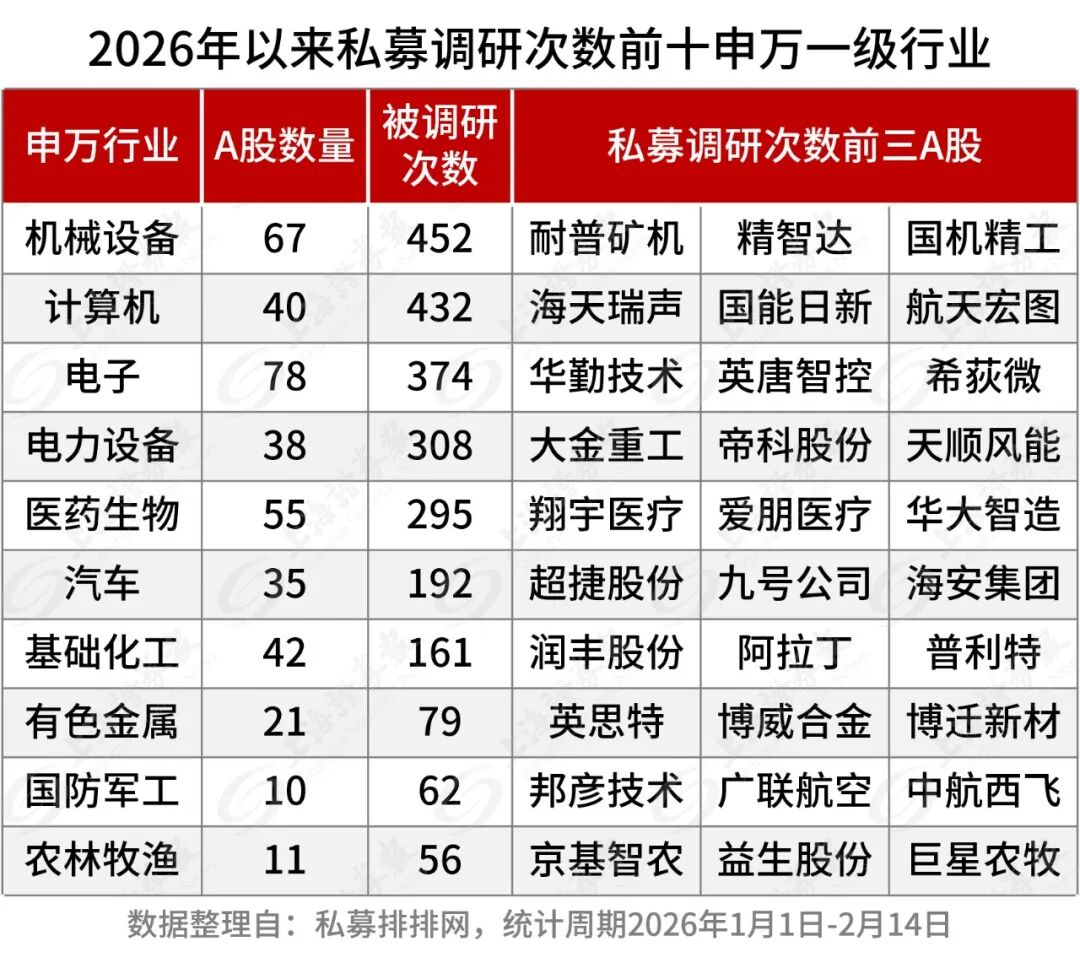
Group 1 - The core focus of private equity firms post-Spring Festival is revealed through pre-holiday research activities, with over 800 private equity firms participating in A-share research, totaling more than 2800 instances of research [1][2] - The most favored sectors for private equity research include machinery, computers, and electronics, with notable firms like Freshwater Spring, Jinglin Asset, and Gao Yi Asset heavily involved in these sectors [1][2] - The current economic cycle in China is seen as a support for the capital market, with expectations for a continuation of structural market trends post-holiday, emphasizing the importance of being present in the market rather than timing it [1][2] Group 2 - The machinery sector is the most favored by private equity, with 452 research instances covering 67 stocks, followed by the computer sector with 432 instances covering 40 stocks, and the electronics sector with 374 instances covering 78 stocks [2][3] - Other sectors receiving significant attention include power equipment, pharmaceuticals, automotive, and basic chemicals, each with over 100 research instances [2][3] - Specific stocks like Dajin Heavy Industry in the power equipment sector have received 64 research instances, indicating strong interest from major private equity firms [3][4] Group 3 - Notably, 61 private equity firms have conducted more than 10 research instances this year, with 20 of them being large-scale firms [5] - Major private equity firms are focusing on sectors such as electronics and machinery, indicating a strategic shift towards these areas [5][6] - The investment strategy is evolving to focus on technology and manufacturing, with an emphasis on AI and global market share growth for Chinese manufacturing companies [7][8]
“湾区智造‘新地标落地冬奥会!TCL米兰冬奥主题馆开馆
Nan Fang Du Shi Bao· 2026-02-06 10:34
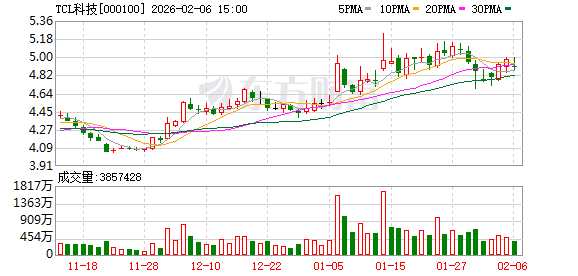
Group 1 - The Milan Winter Olympics will showcase TCL's advanced technologies, including the world's first printed OLED foldable portable display and a 4K 120Hz printed OLED display, highlighting China's manufacturing capabilities in global events [2] - TCL's CEO emphasized that these technological advancements will enhance the vibrancy and excitement of the Winter Olympics, showcasing the importance of display technology in making the events visually appealing [3] - Chinese brands, including Anta and Li Ning, are providing high-tech sports equipment for multiple national teams, indicating China's ability to offer core services in global sporting events [3] Group 2 - The founder of TCL stated that Chinese enterprises have entered the 3.0 era of globalization, shifting from mere product exports to the output of industrial capabilities, emphasizing the need for localized operations abroad [3] - The role of Chinese technology companies in the Winter Olympics reflects a trend of exporting "Chinese solutions" for large-scale event services through technological innovation and industry chain collaboration [3]

征程开启:跨越山海,纵见天地
Di Yi Cai Jing· 2026-02-06 09:04
Core Insights - The globalization of Chinese enterprises, particularly small and medium-sized enterprises (SMEs), has evolved from an optional strategy to a necessity for long-term survival and development [3] - Standard Chartered Bank and Yicai Media have launched the "Journey" column to document and analyze the structural changes in the globalization of Chinese SMEs, emphasizing the importance of cross-sector collaboration in a complex global environment [1][2] Group 1: Globalization Context - The global industrial chain is undergoing deep restructuring, with regional cooperation trends intensifying, placing Chinese enterprises in a new context within the global economic structure [3] - SMEs are transitioning from being mere components of the "world's factory" to becoming key nodes in the global value network, indicating a significant shift in their operational roles [3][5] Group 2: Types of Enterprises - Four distinct types of enterprises are identified in the context of globalization: - Cross-border trade SMEs focusing on ASEAN and Belt and Road markets, dealing with multi-currency settlements and managing exchange rate fluctuations [4] - Multi-market manufacturing enterprises that face challenges in supply chain coordination and compliance across different regions [4] - Enterprises seeking overseas investment and listing, requiring long-term partnerships for navigating complex capital market processes [4] - Leaders balancing entrepreneurial and family roles, emphasizing the need for long-term order in wealth planning and intergenerational responsibilities [5] Group 3: Evolving Support Roles - Financial institutions and media are shifting from being mere service providers to becoming integral parts of the globalization ecosystem, understanding and co-creating with enterprises [6] - Standard Chartered Bank emphasizes its role in building a robust support network by collaborating with various partners to help enterprises reduce information asymmetry and integrate into local business systems [6] Group 4: The "Journey" Initiative - The "Journey" initiative aims to provide a long-term record of the real business world, focusing on critical decision-making moments and the collaborative support from ecosystem partners [7] - This initiative seeks to present not just individual enterprise stories but a comprehensive ecological picture involving enterprises, financial institutions, media, and professional service partners [7] Group 5: Future Outlook - The globalization process is entering a new phase that tests resilience, wisdom, and collaborative capabilities, requiring clear judgment and reliable long-term partners [8] - The "Journey" initiative represents a starting point for ecological collaboration, aiming to observe, think, and explore the globalization of Chinese enterprises over time and space [8]
淡水泉投资:今年AI投资逻辑有望从总量向结构转变
Zheng Quan Ri Bao· 2026-02-05 07:56
Group 1 - The current market liquidity remains loose, with investor risk appetite at a high level, leading to a concentration of funds in growth-oriented sectors such as commercial aerospace, AI application supply chains, and energy-related industries [1] - There is a notable increase in market trading sentiment, reflecting a steady recovery in investor confidence towards Chinese assets, with expectations for a more sustainable upward trend in the market [1] - The market driving logic is expected to shift from valuation recovery to profit support, with a key investment window identified in the first half of the year, particularly before the end of April [1] Group 2 - Investment focus will primarily revolve around core assets related to technological innovation and the globalization of Chinese enterprises, with a structural shift anticipated in AI investment logic this year [1] - The company plans to pay close attention to sectors or assets characterized by supply constraints and underappreciated market recognition, particularly in domestic computing infrastructure amid advancements in process breakthroughs and supply chain autonomy [1]
王宁,宁王
3 6 Ke· 2026-01-29 00:30
Core Insights - The article discusses the contrasting yet complementary roles of two prominent figures in the Chinese market: Wang Ning of Pop Mart and Zeng Yuqun of CATL, highlighting their contributions to consumer culture and technology respectively [2][21]. Group 1: Company Overview - Pop Mart, founded by Wang Ning, specializes in emotional consumer products, particularly blind box toys that allow consumers to project their feelings onto unbranded characters [3][4]. - CATL, led by Zeng Yuqun, focuses on the production of electric vehicle batteries, emphasizing technical specifications such as energy density and charging speed [5][6]. Group 2: Business Models - CATL operates on a B2B model, primarily serving major automotive manufacturers and aligning its success with the broader trends in the electric vehicle industry [10][11]. - Pop Mart employs a D2C model, directly engaging with consumers and relying on their emotional responses to drive sales [11]. Group 3: Competitive Advantages - CATL's competitive edge lies in its technological advancements and significant investment in R&D, creating high barriers to entry for competitors [9][18]. - Pop Mart's strength is rooted in its cultural IP and community engagement, allowing it to create a unique brand identity that resonates with consumers [9][18]. Group 4: Market Trends and Future Outlook - Both companies are positioned to expand globally, with CATL establishing factories in Europe and Pop Mart opening stores in major international cities, reflecting their respective strengths in technology and cultural appeal [13][14]. - The article suggests that both companies have successfully identified and capitalized on emerging market trends, with Zeng Yuqun recognizing the potential of electric vehicles early on and Wang Ning tapping into the demand for emotional consumer products [20][21].


一封30年前“李华的信”为何让海外网友泪目?周汉民:中国企业全球化需“共鸣”破壁
Di Yi Cai Jing· 2026-01-19 04:34
Group 1 - The phenomenon of cultural resonance is crucial for global communication, as no country has a uniform cultural experience [2][3] - The 1995 English exam essay featuring the fictional character "Li Hua" has gained significant attention on platforms like Xiaohongshu and TikTok, leading to emotional responses from many foreign users who expressed regret for not replying to such sincere communication [3] - This case illustrates that transcending cultural barriers requires genuine interaction and human connection rather than one-way communication [3] Group 2 - Chinese enterprises are transitioning from a "going out" strategy to a "going in" approach, seeking symbiotic relationships within different cultural and institutional contexts, reflecting a new phase of globalization [4] - High-level openness for Chinese companies should focus on five key capabilities: institutional openness, supply chain governance, technological innovation, digital trade development, and participation in global governance [4] - The importance of management in driving technological innovation is emphasized, suggesting that without effective management, technological advancements may struggle to succeed [5]
全国政协常委周汉民:中国企业全球化正经历从“走出去”到“走进去”的新阶段
Zhong Guo Jing Ying Bao· 2026-01-18 15:36
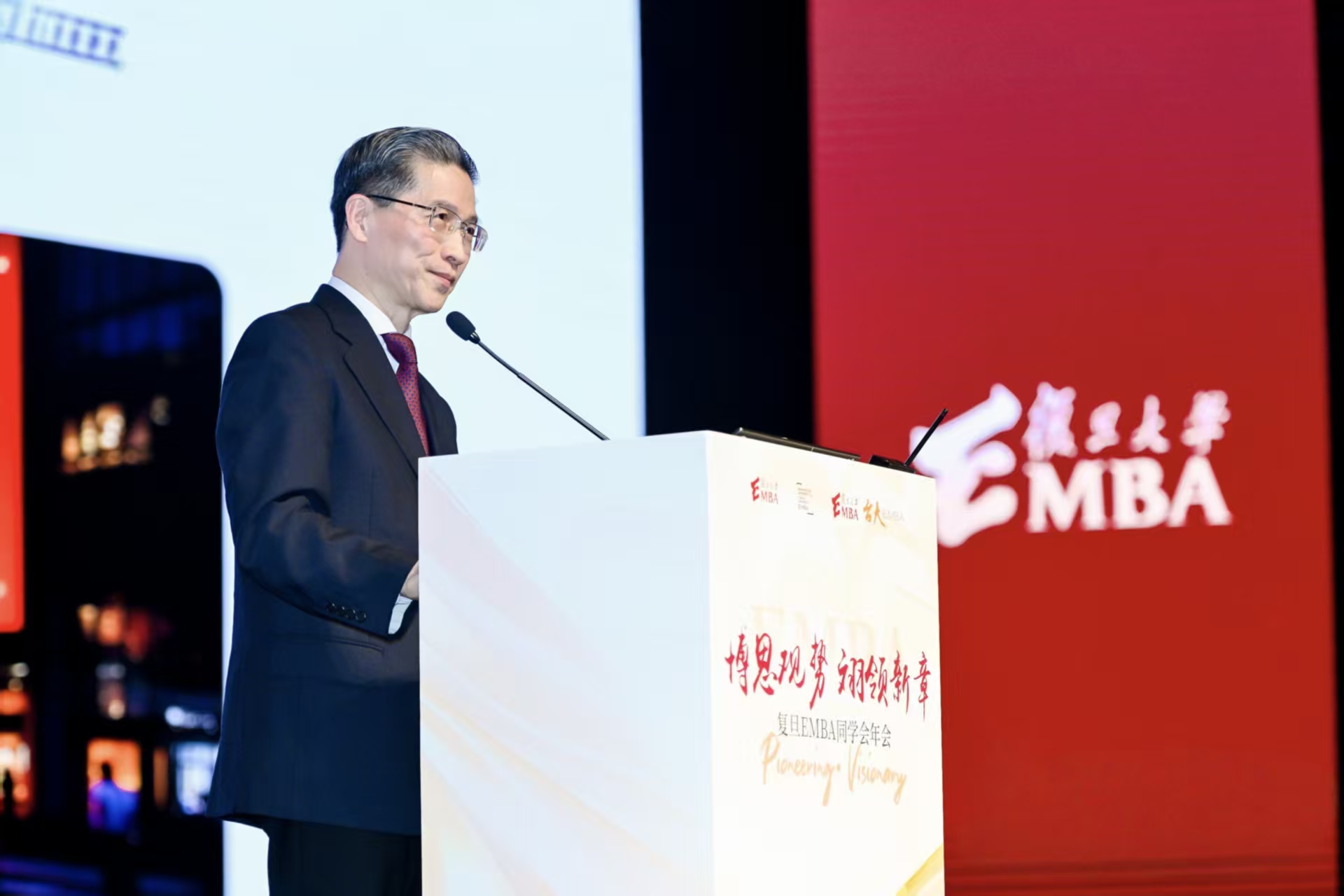
Group 1 - The annual meeting of Fudan University EMBA Alumni Association highlighted the theme "Economic Stability and Reform Breakthroughs" presented by Zhou Hanmin, emphasizing the development path for macroeconomics and technological innovation during the 14th Five-Year Plan [1] - Zhou pointed out that high-level openness should focus on five capabilities: institutional openness, supply chain governance, technological innovation openness, digital trade development, and participation in global governance [1] - Chinese enterprises are transitioning from "going out" to "going in," seeking symbiotic relationships in different civilizational and institutional contexts, reflecting China's institutional openness [1] Group 2 - Fudan University and the University of Washington's Foster School of Business EMBA program ranked first globally in the Financial Times 2025 EMBA rankings, while Fudan University's EMBA program ranked in the top eight globally and has maintained the top position among Chinese programs for four consecutive years [2]
淡水泉赵军展望2026:市场逻辑转向盈利驱动,捕捉“预期差”是核心机会
Xin Lang Cai Jing· 2026-01-16 09:31
Group 1: Market Outlook for 2026 - The market logic for 2026 is expected to shift from valuation recovery to profit-driven strategies, with capturing the "expectation gap" being the core opportunity for the year [1][5][20] - Investor sentiment is generally more optimistic, with three anticipated characteristics: increased preference for Chinese assets, a new narrative forming around "Chinese assets," and a focus on profit-driven logic rather than valuation recovery [5][21][22] Group 2: Liquidity and Policy Environment - Liquidity is identified as the most certain favorable factor for the stock market in 2026, with potential for increased stock allocation from both domestic and foreign investors [7][24] - The "anti-involution" policy is showing initial positive effects, with companies exhibiting a mindset change towards reduced competition, which could lead to operational improvements for leading firms [7][24] Group 3: Investment Opportunities - In the short to medium term (6-12 months), the focus should be on identifying "expectation gaps" in low-attention assets across various industries [8][25] - Over a longer horizon (three to five years), key opportunities are expected to arise from technological innovation empowering various sectors and the globalization of Chinese enterprises [8][25] Group 4: Technology Sector Insights - AI is viewed as a long-term positive technology rather than a bubble, with a focus on tracking capital expenditure from leading cloud vendors as a key variable [10][27] - China has advantages in the AI supply chain, particularly in power, manufacturing, and human resources, with significant opportunities in AI applications and integration across industries [10][27][28] Group 5: Consumer and Commodity Strategies - The approach to the "commodity bull market" is to focus on material substitution opportunities and post-cycle investments in mining and exploration, highlighting the competitiveness of Chinese firms [12][29] - In the consumer sector, "new consumption" represents structural opportunities, with a focus on demographic changes and the evolution of channels, emphasizing the need to identify sustainable structural opportunities [12][29] Group 6: Risk Management and Investment Evolution - Key risk management strategies include being cautious of crowded trades and adapting to new market pricing dynamics [15][31] - The company emphasizes the importance of proactive scenario planning to manage uncertainties and improve investment success rates through strategic timing and collaboration among teams [15][33]