多元化转型

Search documents
高瓴减持格力,赚了还是赔了?
Xin Lang Cai Jing· 2026-02-27 10:01
Core Viewpoint - Hillhouse Capital, after being a silent major shareholder for six years, is now reducing its stake in Gree Electric Appliances to repay bank loans, signaling a potential shift in their relationship with the company [4][39][48]. Group 1: Stake Reduction and Financial Implications - On February 25, Gree Electric announced that Hillhouse's Zhuhai Mingjun would reduce its holdings by 112 million shares, cashing out approximately 4.3 billion yuan at the opening price [4][35]. - This marks the first reduction by the largest shareholder, leading to a two-day decline in Gree's stock price [5][36]. - Hillhouse's stake reduction is reportedly aimed at repaying a bank loan of 20.83 billion yuan, with interest rates estimated between 5% and 9% [43][46]. Group 2: Gree's Performance and Market Position - Gree Electric's market value has decreased by 200 billion yuan over the past six years, with revenue stagnating around 200 billion yuan, while competitors have significantly increased their revenues and market valuations [5][36]. - Gree's revenue for the third quarter of 2025 was reported at 39.855 billion yuan, a 15% year-on-year decline, with net profit down 10% [19][54]. - In contrast, competitors like Midea have seen substantial growth, with Midea's revenue reaching 407.149 billion yuan by 2024, nearly tripling over 12 years [55]. Group 3: Leadership Changes and Future Outlook - Gree's CEO, Dong Mingzhu, has become less vocal and has recently stepped down from several key positions, including that of president, after 24 years in the role [28][64]. - The company has struggled to diversify beyond its core air conditioning business, which still accounts for over 78% of its revenue [59][61]. - There is a lack of visible succession planning, with no clear successor to Dong Mingzhu identified, raising concerns about the company's future direction [38][32].


时隔六年,格力电器第一大股东拟减持不超过2%
Guo Ji Jin Rong Bao· 2026-02-26 11:36
时隔六年,高瓴资本决定减持格力电器。 根据当时公告,"首个提款日后60个月,经全体贷款人同意后可延至84个月。其中,前36个月为宽 限期,宽限期内无需还本。" 随后在2021年4月,珠海明骏为偿还该笔贷款,又与三家银行签订了新的 贷款协议。贷款期限为60个月,可延长至72个月,前24个月为宽限期,无需还本。 也就是说,从时间线来看,随着宽限期已过,进入2026年,这笔贷款将进入本金偿还的阶段。 2月25日晚间,格力电器发布公告,公司于近日收到第一大股东珠海明骏投资合伙企业(有限合 伙)(简称"珠海明骏")的《上市公司股东股份减持计划告知函》,珠海明骏拟自公告披露之日起15个 交易日后的3个月内以大宗交易方式减持公司股份不超过1.12亿股(不超过公司剔除回购专用账户股份 后的总股本的2%)。 珠海明骏持有股份占格力电器总股本比例为16.11%,这部分股份的来源为2020年1月23日从格力集 团以协议转让方式受让的股份。 回顾过往,珠海明骏于六年前成为格力电器第一大股东。 2019年12月2日,珠海明骏与格力集团签署股份转让协议,前者以46.17元/股的价格受让后者持有 的格力电器9.02亿股股份,合计转让价款为 ...
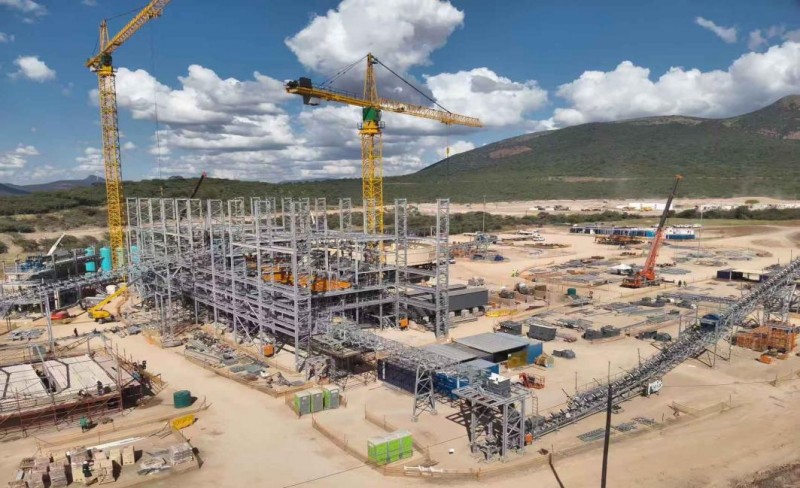
力量发展集团马卡度项目投产倒计时:51% 控股锁定优质焦煤,双轮驱动打开成长天花板
Sou Hu Wang· 2026-02-25 01:20
Core Viewpoint - The recent announcement by Power Development Group (01277.HK) highlights the nearing completion of the Makhado coking coal project in South Africa, which is expected to start joint trial operations in April 2026, marking a significant step in the company's diversification strategy and presenting a compelling investment opportunity with both certainty and growth potential [1][8]. Group 1: Project Development and Control - The Makhado project is a key asset in Power Development's overseas resource strategy, with the company gradually increasing its stake in MC Mining to 51% through a phased capital increase approach, currently holding approximately 44.01% of the expanded issued share capital [2]. - The Makhado project is anticipated to be the only large-scale hard coking coal production project in South Africa, with a resource reserve of 706 million tons, and its coking coal products are expected to be competitive in the international market [2]. - The project has progressed ahead of schedule, with significant milestones achieved, including the completion of over 5.04 million cubic meters of overburden stripping and the near completion of core facilities, which are set to be fully operational by the end of March 2026 [3][5]. Group 2: Financial Expectations and Revenue Potential - The Makhado project is projected to have an annual production capacity of approximately 1.5 million tons of premium coal, with plans to increase coking coal production to 2.2 million tons and thermal coal to 1.8 million tons within two years, representing an increase of over 160% [6]. - The pricing mechanism for the products will be linked to international indices, with estimated annual sales revenue of approximately $210 million at base capacity, potentially increasing to about $580 million upon reaching full production [6]. - The project has engaged with over 20 potential customers across various regions, ensuring a broad market for its products and providing a solid foundation for sales [6]. Group 3: Strategic Implications and Growth Trajectory - The anticipated annual sales revenue of $580 million (approximately 4 billion RMB) from the Makhado project is expected to significantly enhance the overall revenue scale of Power Development Group, supporting its goal of surpassing 10 billion RMB in annual revenue [7]. - The project will reinforce the company's dual strategy of "domestic coal stability + overseas mineral growth," effectively mitigating risks associated with single business cycles and facilitating the transition from a coal enterprise to a diversified resource platform [7]. - With a current price-to-earnings ratio of only 9 times, below the industry average, the commencement of joint trial operations in April 2026 is expected to lead to a release of performance, potentially elevating the company's valuation [7].
巨亏百亿、节节败退,康佳究竟犯了什么错?
Xin Lang Cai Jing· 2026-02-13 11:07
Core Viewpoint - The article discusses the decline of Konka, a once-prominent player in the Chinese television market, highlighting its significant financial losses and strategic missteps that have led to its current precarious position in the industry [5][11]. Financial Performance - Konka is expected to report a net profit loss of between 12.581 billion to 15.573 billion yuan for 2025, a staggering increase from a loss of 3.296 billion yuan the previous year, marking a year-on-year increase of 3.8 to 4.7 times [5][6]. - The company's revenue for 2025 is projected to be between 9 billion to 10.5 billion yuan, reflecting a decline of 5.53% to 19% compared to the previous year [5][6]. - As of the end of 2025, Konka's net assets are expected to turn negative, ranging from -5.334 billion to -8.001 billion yuan, which could trigger delisting risks under stock exchange regulations [10][11]. Business Strategy and Challenges - Konka's diversification strategy has led to a lack of focus on its core consumer electronics business, resulting in diminished market presence and competitiveness [5][17]. - The company has ventured into various sectors such as real estate, semiconductors, and environmental protection, but these efforts have not yielded profitable results and have instead strained its resources [17][18]. - The consumer electronics segment, which accounts for approximately 90% of Konka's revenue, has been underperforming, with a gross margin of only 3.23% and significant losses in its core television business [7][8]. Market Position - Once a leading brand in the television market, Konka has fallen to a position outside the top tier, with its brand recognition declining among younger consumers [8][11]. - The company's market share has diminished significantly, with its television shipments ranking it outside the top four in the industry [8][11]. Management Changes and Future Outlook - Following a change in control to China Resources Group, Konka's management has undergone significant restructuring, with hopes that the new leadership will stabilize the company and guide it through its financial difficulties [19][20]. - China Resources has provided financial support, including a low-interest loan of 3.97 billion yuan, aimed at alleviating Konka's cash flow issues and supporting its operational needs [22][24]. - The path to recovery for Konka involves focusing on its core consumer electronics business while also developing its semiconductor and PCB sectors, requiring time and strategic effort to regain market position [24].

广东芳源新材料集团股份有限公司2025年年度业绩预告
Xin Lang Cai Jing· 2026-01-29 20:54
Core Viewpoint - The company anticipates a significant reduction in losses for the year 2025 compared to the previous year, despite still reporting a net loss [1][5]. Group 1: Performance Forecast - The company expects a net loss attributable to shareholders of the parent company for 2025 to be between -120 million yuan and -80 million yuan [1]. - The forecasted net loss after deducting non-recurring gains and losses is estimated to be between -117 million yuan and -78 million yuan [1]. Group 2: Previous Year Performance - In the previous year, the total profit was -390.41 million yuan, with a net loss attributable to shareholders of the parent company at -426.77 million yuan [3]. - The net loss after deducting non-recurring gains and losses was -442.75 million yuan [3]. - The earnings per share for the previous year were -0.85 yuan per share [4]. Group 3: Reasons for Performance Changes - The company faced significant losses in the first half of 2025 due to diversification efforts and production line upgrades, leading to low capacity utilization and high unit costs [4]. - The company successfully scaled up a new recycling technology that improved production costs and recovery efficiency, contributing to a turnaround in the second half of 2025 [4]. - The sales volume of precursor products reached approximately 11,200 tons, while the total sales volume of nickel, cobalt, manganese, and lithium salt products was about 41,700 tons, both showing year-on-year growth [4].

万科郁亮被爆疑似失联
Xin Lang Cai Jing· 2026-01-28 05:00
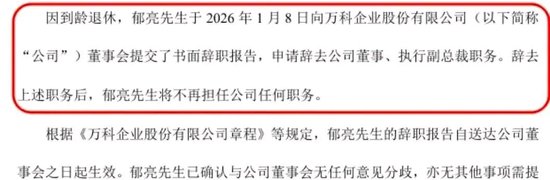
Core Viewpoint - The former chairman of Vanke Group, Yu Liang, has reportedly been missing for half a month following his resignation from all positions on January 8, 2025, amid significant changes in the company's management structure and financial challenges [1][10]. Group 1: Management Changes - Yu Liang resigned from all positions at Vanke Group on January 8, 2025, after a 36-year career with the company, with a smooth transition of his shares [2][11]. - On January 27, 2025, Zhu Jiasheng, the then-president and CEO, also resigned due to "health reasons," and was later confirmed to be under criminal investigation [2][11]. - Following these resignations, Vanke underwent a major management reshuffle, with Yu Liang demoted to executive vice president and new management taking over [7][12]. Group 2: Career Highlights of Yu Liang - Yu Liang joined Vanke in 1990 and quickly became a key executor of the strategic plans laid out by then-chairman Wang Shi [3][11]. - He played a significant role in Vanke's B-share listing in 1993, raising HKD 450 million, and was instrumental in the company's strategic decisions during the "Junwan War" in 1994 [4][11]. - After the "Baowan War" concluded in 2017, Yu Liang succeeded Wang Shi as chairman, marking a significant leadership transition [5][12]. Group 3: Company Performance and Challenges - Under Yu Liang's leadership, Vanke pursued a diversification strategy, but the company's high turnover model began to show weaknesses as industry adjustments exceeded expectations [7][12]. - By the time of Yu Liang's retirement, Vanke was facing a debt crisis, contrasting sharply with the stable conditions during Wang Shi's tenure [8][12].

建发股份首亏最高100亿:投资红星美凯龙“血亏”、联发业绩拖后腿
Xin Lang Cai Jing· 2026-01-27 03:20
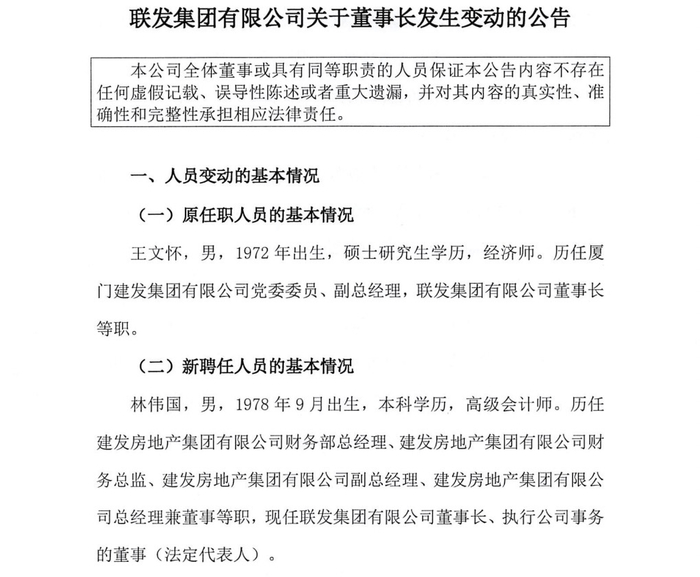
Core Viewpoint - Xiamen State-owned Enterprise Jianfa Co., Ltd. reported its first loss since its listing over twenty years ago, with projected net profit attributable to shareholders ranging from -10 billion to -5.2 billion yuan for 2025 [1][2]. Group 1: Financial Performance - Jianfa Co. expects a net profit attributable to shareholders for 2025 to be between -10 billion and -5.2 billion yuan, with a net profit after deducting non-recurring gains and losses estimated at -6.5 billion to -3.3 billion yuan [1][2]. - The company attributes the loss primarily to negative profit settlements from its real estate subsidiary, Lianfa Group, increased inventory impairment provisions, and losses from the fair value changes of investment properties held by its home furnishing subsidiary, Red Star Macalline [1][3]. Group 2: Subsidiary Performance - Lianfa Group is expected to report a negative net profit for 2025, with revenue from real estate projects declining year-on-year, leading to negative overall profit settlements [2][3]. - Red Star Macalline is also projected to incur a net loss for 2025, with ongoing weakness in the real estate market affecting demand in the home furnishing retail sector, resulting in significant declines in rental income and property values [3][5]. Group 3: Strategic Changes - Jianfa Co. has undergone significant organizational changes, including a leadership transition at Lianfa Group, with Wang Wenhuai replaced by Lin Weiguo as chairman, aiming to implement a new strategy focused on high-quality, competitive housing in first-tier cities [4][10]. - The company has faced challenges in transforming Lianfa Group, which has historically focused on third- and fourth-tier cities, leading to longer project turnover times and increased pressure during industry adjustments [5][14]. Group 4: Market Context - The real estate industry is experiencing deep adjustments, with Jianfa Co. facing growth pressures and difficulties in resource allocation between its two platforms, Lianfa Group and Jianfa Real Estate [14][15]. - Despite previous successes, Jianfa Real Estate's growth has slowed, with challenges in acquiring quality land in core cities and a decrease in profit margins due to market conditions [14][15].

芳源股份20260122
2026-01-23 15:35
Summary of Fangyuan Co., Ltd. Conference Call Company Overview - **Company**: Fangyuan Co., Ltd. - **Industry**: Nickel, Cobalt, Lithium, and NCM Precursor Production Key Points and Arguments Business Transformation and Financial Impact - Fangyuan has undergone significant transformation in recent years, diversifying into nickel-cobalt-manganese salts, lithium carbonate, and NCM precursor businesses due to the impact of the U.S. Inflation Reduction Act and a sharp decline in nickel-cobalt prices [3][2] - The company invested over 1.3 billion yuan in a project that became idle, leading to a continuous loss of approximately 1 billion yuan [3] - The diversification strategy aims to cover the entire supply chain from raw materials to product sales, with a goal to achieve profitability by the second half of 2025 [3] Production Capacity and Product Distribution - Total production capacity is approximately 96,000 tons, with 35,000 tons for precursors, 24,000-25,000 tons for lithium carbonate, and the remainder for nickel-cobalt-manganese salts [2][4] - The company is expanding capacity, including a new recycling line expected to process 43,000 tons of recycled powder annually, with production starting in the second half of next year [4][13] Future Product Goals and Market Dynamics - The company aims for monthly sales targets in 2026 of 1,500 tons each for nickel sulfate, lithium carbonate, and precursors, and 1,000-1,500 tons for cobalt sulfate [5][9] - Challenges include limited high-cobalt material supply affecting cobalt sulfate production [9] Monthly Production and Sales Performance - Current monthly production includes over 1,000 tons of cobalt sulfate, nearly 1,000 tons of lithium carbonate, and expected shipments of 1,000-1,200 tons of precursors [6][25] - The company has secured long-term agreements with major clients to ensure stable supply [6] Market Trends and Competitive Advantages - The cobalt sulfate market price is around 100,000 yuan/ton, with Fangyuan's products commanding a slight premium due to low impurity levels and use of recycled materials [10] - The company benefits from a low-cost inventory of nickel, which supports profitability in nickel sulfate production [9][19] Profitability Outlook - Expected net profit for cobalt sulfate is approximately 10,000 yuan per ton after accounting for taxes and costs, while nickel sulfate and lithium carbonate are also projected to maintain stable profitability [11][12] - The company anticipates significant performance improvement in Q1 2026 compared to Q4 2025, particularly driven by lithium carbonate sales [25] Expansion Plans and Collaborations - Fangyuan is in discussions with external partners to enhance processing capabilities and is exploring new raw material sources to improve production efficiency [20] - The company plans to complete new capacity construction in Q1 and begin operations in Q2, which is expected to positively impact future performance [26] Inventory Management - Current inventory includes over 100 tons of lithium carbonate, with plans to sell most in January, and maintaining safety stock of 2,000 tons of black powder [24] Conclusion - Overall, Fangyuan Co., Ltd. is positioned for growth through strategic diversification, capacity expansion, and market adaptation, with a focus on sustainable profitability and operational efficiency [12]
【百强透视】96%溢价豪礼!创维“一拆一退”,光伏独立上市引爆股价
Sou Hu Cai Jing· 2026-01-21 06:05
Core Viewpoint - Skyworth Group has announced a dual plan for privatization and the spin-off of its solar business, aiming to provide shareholders with a combination of cash and high-growth equity, while also signaling a strategic shift from traditional home appliances to renewable energy [2][3]. Summary by Sections Privatization and Spin-off Plan - The plan involves two main steps: first, Skyworth intends to independently list its solar business on the Hong Kong Stock Exchange, distributing shares to existing shareholders at a ratio of approximately 0.37 shares of solar business for each Skyworth share held, with a theoretical value of about HKD 6.13 per share [3][6]. - Simultaneously, the company will implement privatization, offering shareholders a choice between receiving HKD 4.03 in cash or one share of the newly privatized company [3][5]. Shareholder Returns - Shareholders opting for the cash option will receive a total return of approximately HKD 10.16, representing a premium of 96.15% over the last closing price of HKD 5.18 prior to the announcement [5][6]. Business Transition - The move reflects the necessity for traditional home appliance businesses to adapt amid pressures from declining demand and increased competition, with Skyworth's smart home appliance revenue facing growth limitations [9][11]. - The solar business has emerged as a key growth driver, with revenue from this segment reaching HKD 138.36 billion in the first half of 2025, a significant increase of 53.5% year-on-year, and accounting for over 38% of total revenue [11][13]. Future Strategic Plans - The spin-off of the solar business is seen as the first step in a broader strategy, with plans to eventually list other segments such as energy storage and automotive electronics, aiming to create a renewable energy industry cluster [13].
AMC申请上海老牌房企清盘获批,120套公寓强制拍卖
Xin Lang Cai Jing· 2026-01-17 04:21
Group 1 - The Hong Kong High Court has ruled for the liquidation of Shanghai-based real estate company Jingrui Holdings, marking the first successful liquidation case in the current real estate debt crisis initiated by an Asset Management Company (AMC) [2] - The liquidation application was filed by CITIC Financial Asset International Holdings due to Jingrui Holdings' inability to repay debts amounting to $160 million, stemming from a default on offshore loans by its wholly-owned subsidiary, Natural Apex Limited [2] - The court found that Jingrui Holdings failed to provide substantial defenses against the liquidation, leading to a standard liquidation order [2] Group 2 - Jingrui Holdings, founded in 1993, initially focused on real estate development in Shanghai but later diversified into various sectors, including long-term rental apartments and financial services, which ultimately led to missed opportunities during the real estate boom [3] - The company faced a debt crisis in 2021, with a debt-to-asset ratio reaching 386% and negative net assets by the end of 2024, indicating insolvency [4] - As of 2025, Jingrui Holdings had only 626 million yuan in cash and deposits against total liabilities of 29.8 billion yuan, with a land bank of only 1.291 million square meters [4]