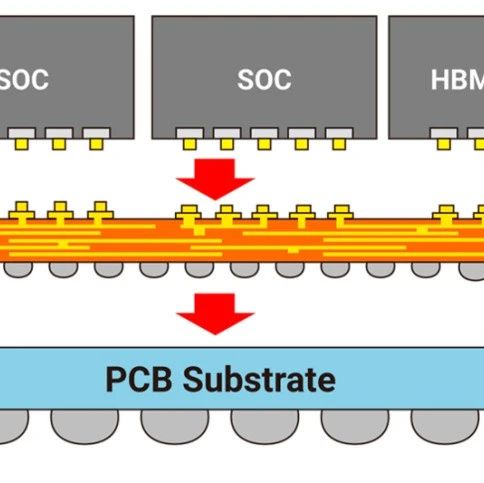
封装技术

Search documents
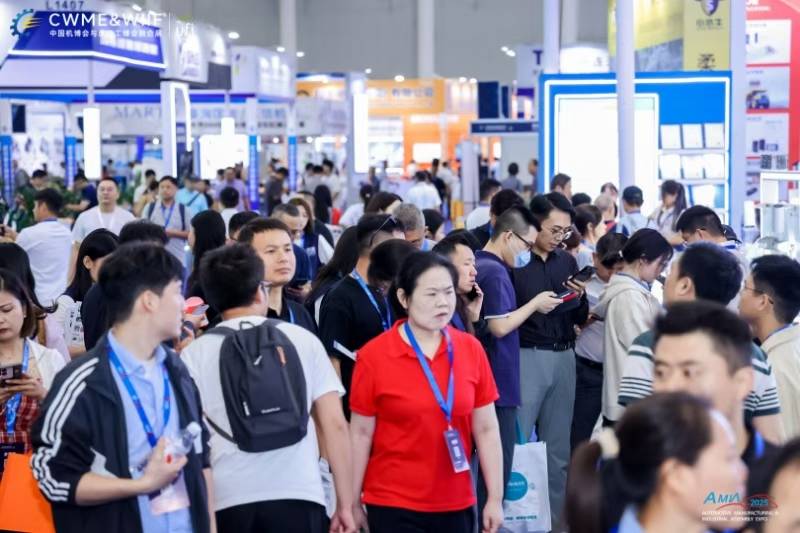
中国芯崛起之路2026武汉国际芯片及半导体产业展览会抢先看
Sou Hu Cai Jing· 2026-02-25 05:03
Core Insights - The 2026 Wuhan International Chip and Semiconductor Industry Exhibition is set to showcase cutting-edge technologies and signify a major shift in the global chip industry landscape [1][3][7] Industry Trends - The chip industry is undergoing a critical transformation characterized by three main trends: a surge in demand for high-performance chips driven by 5G technology, explosive growth in IoT devices leading to innovations in chip power consumption and integration, and an accelerated shift towards smart manufacturing due to semiconductor material replacements [3][5] - The exhibition will serve as an excellent window to observe the industry's direction amidst these changes [3] Exhibition Highlights - The exhibition will feature seven thematic areas covering the entire industry chain, including an IC design and manufacturing zone, a photonic devices section, and an innovation technology forum [3][5] - A dedicated area for industry-academia-research collaboration will facilitate the transformation of research outcomes into practical applications, highlighting the event's diverse layout [3][5] Technological Innovations - Several groundbreaking technologies will be unveiled during the exhibition, including a 3nm AI-specific chip with a 40% improvement in energy efficiency compared to its predecessor, new heterogeneous integration solutions enhancing the efficiency of storage and computing units, and breakthroughs in the application of new two-dimensional semiconductor materials [5][6] - These innovations not only demonstrate the industry's technical prowess but also indicate the development trajectory for the next decade [5] Regional Development - Wuhan is positioning itself as a new global semiconductor hub, with government plans to establish a national-level semiconductor industry base by 2025 [6] - The exhibition's location in Wuhan is strategic, leveraging the city's robust industrial chain and growth momentum, while also hosting investment matchmaking events to attract domestic and international capital [6] Future Outlook - The Chinese semiconductor industry is pursuing a path of independent innovation, with local companies showcasing high-end chip products that meet international standards [6] - The exhibition will also feature a green manufacturing zone, emphasizing the integration of eco-friendly materials and energy-saving processes into industry upgrades, which may become a mainstream direction for future development [6]

通富微电:公司紧跟行业技术发展趋势,抓住市场发展机遇
Zheng Quan Ri Bao Wang· 2025-11-17 11:20
Core Viewpoint - The company is actively developing advanced packaging technologies and expanding its production capacity to seize market opportunities and enhance its competitive edge in the semiconductor industry [1] Group 1: Technology Development - The company is focusing on high value-added products and market hotspots by developing advanced packaging technologies such as fan-out, wafer-level, and flip-chip packaging [1] - The company is also strategically positioning itself in cutting-edge packaging technologies like Chiplet and 2D+ to create a differentiated competitive advantage [1] Group 2: Market Strategy - The company is aligning its development efforts with industry technology trends to capture future market opportunities [1] - The emphasis on long-term planning and capacity expansion indicates a commitment to sustaining growth in a competitive landscape [1]

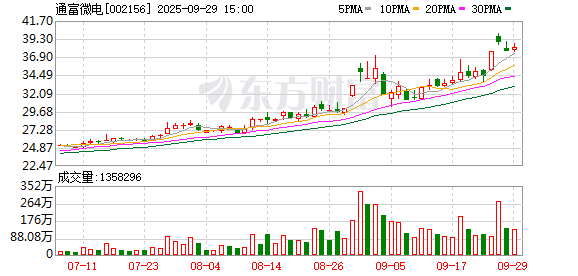
通富微电:公司暂无与英伟达的相关业务合作
Zheng Quan Ri Bao· 2025-09-29 08:09
Core Viewpoint - The company is actively developing advanced packaging technologies and expanding its production capacity to capture market opportunities in high-value products and trending market directions [2] Group 1: Company Strategy - The company is focusing on long-term development by enhancing its capabilities in fan-out, wafer-level, and flip-chip packaging technologies [2] - The company is also strategically positioning itself in cutting-edge packaging technologies such as Chiplet and 2D+ to create a differentiated competitive advantage [2] Group 2: Market Position - Currently, the company has no business cooperation with Nvidia, indicating a potential area for future growth or partnership opportunities [2]

台积电正在开发第二代“SoW”
半导体芯闻· 2025-07-31 10:23
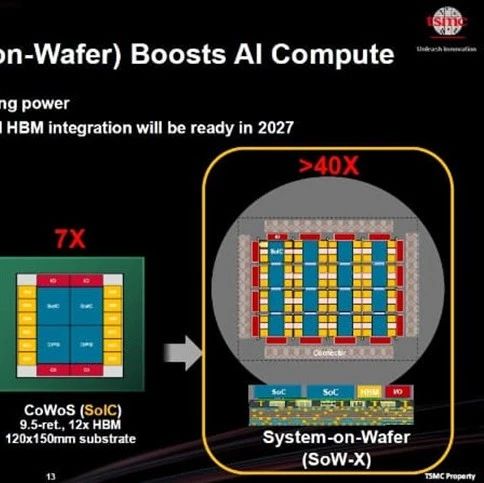
Core Viewpoint - TSMC is developing the second generation of its System on Wafer (SoW) technology, which integrates various components onto a large 300mm silicon wafer, enhancing performance and efficiency in semiconductor packaging [1][2]. Group 1: SoW Technology Overview - The SoW technology integrates chiplets, stacked chip modules, memory modules, power modules, I/O boards, and heat dissipation boards on both sides of a 300mm wafer [1]. - The first generation of SoW, named SoW-P, focuses on integrating System on Chip (SoC) as the main circuit, while the second generation, SoW-X, will combine SoC with High Bandwidth Memory (HBM) for heterogeneous integration [2]. Group 2: CoWoS Technology - The second generation of SoW is an upgrade of the CoWoS (Chip on Wafer on Substrate) technology, which uses an intermediate substrate to enhance data transmission speed and density [7]. - CoWoS technology has evolved since its introduction in 2012, with significant advancements in the size and efficiency of silicon interposers, particularly after 2016 [8][9]. Group 3: Future Developments and Roadmap - TSMC's roadmap includes expanding the size of the intermediate substrate in CoWoS technology, with plans for a substrate size 5.5 times larger than the photomask by 2025-2026 and 8 times larger by 2026-2027 [13]. - The SoW-X technology is expected to be implemented by 2027, with anticipated challenges related to high manufacturing costs and customer acceptance [24]. Group 4: Performance Metrics - The SoW-X module, arranged in a 4x4 matrix, is designed to achieve a performance per watt that is 65% higher than a PCIe cluster system, although it is 27% lower than a single CoWoS-L module [20]. - The total power consumption for SoW-X is projected to reach 17kW, with water cooling solutions being considered for heat dissipation [22].

HBM 8,最新展望
半导体行业观察· 2025-06-13 00:40
Core Viewpoint - The cooling technology will become a key competitive factor in the high bandwidth memory (HBM) market as HBM5 is expected to commercialize around 2029, shifting the focus from packaging to cooling solutions [1][2]. Summary by Sections HBM Technology Roadmap - The roadmap from HBM4 to HBM8 spans from 2025 to 2040, detailing advancements in HBM architecture, cooling methods, TSV density, and interposer layers [1]. - HBM4 is projected to be available in 2026, with a data rate of 8 Gbps, bandwidth of 2.0 TB/s, and a capacity of 36/48 GB per HBM [3]. - HBM5, expected in 2029, will double the bandwidth to 4 TB/s and increase capacity to 80 GB [3]. - HBM6, HBM7, and HBM8 will further enhance data rates and capacities, reaching up to 32 Gbps and 240 GB respectively by 2038 [3]. Cooling Technologies - HBM5 will utilize immersion cooling, where the substrate and package are submerged in cooling liquid, addressing limitations of current liquid cooling methods [2]. - HBM7 will require embedded cooling systems to inject coolant between DRAM chips, introducing fluid TSVs for enhanced thermal management [2]. - The introduction of new types of TSVs, such as thermal TSVs and power TSVs, will support the cooling needs of future HBM generations [2]. Performance Factors - Bonding techniques will also play a crucial role in HBM performance, with HBM6 introducing a hybrid interposer of glass and silicon [2]. - The integration of advanced packaging technologies will allow base chips to take on GPU workloads, necessitating improved cooling solutions due to increased temperatures [2].

台积电,颠覆传统中介层
半导体芯闻· 2025-06-12 10:04
Core Viewpoint - The article discusses the significant rise of TSMC's CoWoS packaging technology, driven by the increasing demand for GPUs in the AI sector, particularly through its partnership with NVIDIA, which has deepened over time [1][3]. Group 1: CoWoS Technology and NVIDIA Partnership - NVIDIA has emphasized its reliance on TSMC for CoWoS technology, stating that it has no alternative partners in this area [1]. - TSMC has reportedly surpassed ASE Group to become the largest player in the global packaging market, benefiting from the growing demand for advanced packaging solutions [1]. - NVIDIA's upcoming Blackwell series will utilize more CoWoS-L packaging, indicating a shift in production focus from CoWoS-S to CoWoS-L to meet the high bandwidth requirements of its GPUs [3]. Group 2: Challenges and Innovations in CoWoS - The increasing size of AI chips poses challenges for CoWoS packaging, as larger chips reduce the number of chips that can fit on a 12-inch wafer [4]. - TSMC is facing difficulties with the use of flux in CoWoS, which is essential for chip bonding but becomes problematic as the size of the interposer increases [4][5]. - TSMC is exploring flux-free bonding technologies to improve yield rates and address the challenges posed by flux residue [5]. Group 3: Future Developments and Alternatives - TSMC plans to introduce CoWoS-L with a mask size of 5.5 times larger by 2026 and aims for a record 9.5 times larger version by 2027 [8]. - The company is also developing CoPoS technology, which replaces traditional wafers with panel substrates, allowing for higher chip density and efficiency [9][10]. - CoPoS is positioned as a potential alternative to CoWoS-L, targeting high-performance applications in AI and HPC systems [12]. Group 4: Technical Comparisons - FOPLP and CoPoS both utilize large panel substrates but differ in architecture; FOPLP does not use an interposer, while CoPoS does, enhancing signal integrity for high-performance chips [11]. - CoPoS is transitioning to glass substrates, which offer better performance characteristics compared to traditional organic substrates [12]. - The shift from round wafers to square panels in CoPoS aims to improve yield and reduce costs, making it more competitive in the AI and 5G markets [12]. Group 5: Challenges Ahead - Transitioning to square panel technology requires significant investment in materials and equipment, along with overcoming technical challenges related to pattern precision [14]. - The demand for finer RDL line widths poses additional challenges for suppliers, necessitating breakthroughs in RDL layout technology [14]. Conclusion - The future of TSMC's packaging technologies appears promising, with ongoing innovations and adaptations to meet the evolving demands of the semiconductor industry [14].