战略资产配置

Search documents
德银200年数据验证:在低估时买入,长期回报更高
雪球· 2026-02-28 04:25
以下文章来源于六亿居士 ,作者六亿居士 六亿居士 . 雪球2024年度十大影响力用户。每周发布指数估值表,研究指数基金(ETF)与大类资产配置框架,关注认知、人性和纪律。 ↑点击上面图片 加雪球核心交流群 ↑ 风险提示:本文所提到的观点仅代表个人的意见,所涉及标的不作推荐,据此买卖,风险自负。 作者: 六亿居士 来源:雪球 春节期间看了不少文章 , 其中2025年10月27日 , 德意志银行发布的 《 长期资产回报研究 : 期投资的终极指南 》 很值得深思 。 ( 来源 : dbresearch.com , 作者 : Jim Reid 、 Henry Allen 、 Galina Pozdnyakova ) 该报告 , 基于对56个经济体跨越数百年的数据 ( 部分可追溯至18世纪 ) 进行深入分析 , 为投资者揭示了全球金融市场的长期运行规律 。 这份报告不仅回顾了股票 、 债券 、 黄金等主要资产类别的历史表现 , 更试图找出那些能够预测未来长期回报的关键变量 , 为战略资产配置提 供了坚实的历史依据 。 我们看文章的关键数据和内容 : 一 、 超长期视角下 , 股票一直是重要的收益贡献方 此外 , 货币因 ...


中泰资管天团 | 唐军:如何捕捉“预期差”?
中泰证券资管· 2026-02-05 11:31
Core Viewpoint - The article emphasizes the importance of capturing "expectation differences" as a tactical asset allocation strategy, which can provide opportunities for short to medium-term investments, despite skepticism from some professional investors regarding this framework [1][2]. Group 1: Importance of Capturing "Expectation Differences" - The macroeconomic fundamentals determine strategic asset allocation, while tactical asset allocation focuses on short-term opportunities, making the "expectation difference" framework reasonable [2]. - Short-term price fluctuations are more random and difficult to predict, but tactical allocations can enhance portfolio stability and improve investor experience [2]. - Even if capturing "expectation differences" is challenging, as long as the long-term win rate exceeds 50%, it can significantly contribute to reducing portfolio volatility and enhancing returns [2]. Group 2: How to Capture "Expectation Differences" - Capturing "expectation differences" involves tracking fundamental changes in specific asset classes and assessing market expectations [4]. - Fundamental tracking can utilize industry indicators such as inventory levels, supply-demand gaps, capacity utilization, and price differentials of products and raw materials [4]. - Market sentiment can be evaluated through metrics like trading volume, relative price changes, margin buying ratios, and fund allocation levels [4]. Group 3: Examples of Capturing "Expectation Differences" - In May 2025, the aluminum industry showed a significant profit increase, while analysts expected a growth rate around 0%, indicating a positive "expectation difference" [7]. - By June 2025, bank stocks were highly sought after, but analysts downgraded EPS expectations, creating a negative "expectation difference" that led to a notable market correction [11]. - In the agricultural sector, monitoring the breeding sow inventory can indicate future price movements, with historical data showing instances of both positive and negative "expectation differences" based on market sentiment [14].

现货黄金突破5100美元!黄金、白银还能狂飙多久?
Sou Hu Cai Jing· 2026-01-27 11:12
Group 1 - The core point of the article highlights the contrasting movements in the dollar and precious metals markets, with the dollar index dropping nearly 2% and gold achieving its best weekly performance in nearly six years, rising by 8.4% [1] - Gold prices have reached a historical high, surpassing $5,100 per ounce, with a daily increase of over 2%, showcasing the classic "see-saw" effect between the dollar and gold [1] - Silver prices also saw significant gains, reaching a peak of $109 per ounce, with both gold and silver experiencing increases of over 18% and 51% respectively within a month [1] Group 2 - The surge in the precious metals market is attributed to multiple factors, including geopolitical instability, shifts in monetary policy, and a decline in the dollar's credibility, signaling a deep transformation in the international monetary system [2] - By 2025, gold is expected to account for a larger share of global central bank foreign exchange reserves than U.S. Treasury bonds for the first time since 1996, with central banks projected to purchase an average of 60 tons of gold monthly this year, compared to about 17 tons before 2022 [2] - The ongoing high-level purchases of gold by central banks provide strong support for gold prices, as countries redefine asset safety boundaries and increase gold holdings to optimize reserve structures and hedge against systemic risks [2] Group 3 - The rising gold prices are quickly transmitting to consumer markets, with gold jewelry prices exceeding 1,575 yuan per gram, indicating a shift from traditional consumption to investment attributes in gold jewelry [3][4] - The high gold prices have suppressed some physical gold consumption demand, leading to increased interest in gold-related financial products such as structured deposits, gold ETFs, and paper gold [4] - There is a growing demand for secure storage of high-value physical gold, highlighting the preference of high-net-worth individuals for physical gold in asset allocation, driven by concerns over asset safety [5] Group 4 - The future of the gold market is uncertain, with long-term price influences stemming from changes in economic growth expectations and monetary policy, where any shifts in macroeconomic conditions or geopolitical factors could lead to significant price volatility [7] - Investors are advised to maintain sensitivity to macroeconomic environments when allocating gold assets and to diversify their portfolios, treating gold as a long-term strategic asset [7] - There is a trend among nations, institutions, and households to invest in gold as a relatively stable asset in an uncertain world, reflecting a collective vote of confidence in gold [8]

朋友圈刷屏!贵金属狂飙背后:狂欢与风险共舞?高位追涨,警惕“暴跌”!
Sou Hu Cai Jing· 2026-01-24 06:52
Core Viewpoint - The global precious metals market is experiencing a significant surge, with gold and silver reaching historical highs, prompting discussions about a potential structural bull market, while cautioning against the risks of high-level corrections [1][9]. Price Movements - Gold prices reached $4,964.81 per ounce, with a peak of $4,988.17, while February futures closed at $4,979.70, marking a 1.4% increase [3]. - Silver prices surpassed $100 per ounce for the first time, with a year-to-date increase exceeding 40% [3]. - Platinum and palladium also saw substantial gains, with platinum rising 5.20% to $2,774.73 per ounce and palladium increasing 5.85% to $2,024.61 per ounce [5]. Market Dynamics - The surge in precious metal prices is attributed to multiple factors, including macroeconomic risks, policy expectations, and supply-demand dynamics, with institutions generally optimistic about long-term trends [6]. - Goldman Sachs raised its 2026 gold price target from $4,900 to $5,400 per ounce, citing increased diversification in gold holdings as a hedge against global uncertainties [6]. Monetary Policy Impact - The market anticipates that the Federal Reserve will maintain interest rates during its upcoming meeting, with expectations of at least two rate cuts in the second half of 2026 [7]. - The low-interest-rate environment enhances the appeal of gold as a non-yielding asset, contributing to its price surge [7]. Historical Context and Caution - Historical precedents warn of the risks associated with high prices, as seen during the 2008 financial crisis and subsequent market corrections [9]. - Investors are advised to remain rational and avoid blindly chasing high prices, considering the potential for significant price corrections [9].
5000美元倒计时 黄金投资需警惕非理性繁荣
Jing Ji Guan Cha Wang· 2026-01-23 07:02
Core Viewpoint - The international spot gold price has surged past $4,900 per ounce, reaching a record high of $4,967.48, driven by geopolitical risks, concerns over U.S. fiscal sustainability, and strong demand from global central banks [1][2]. Group 1: Market Dynamics - Gold prices have shown strong continuity, crossing significant thresholds from $4,500 to $4,900 since 2026 [1]. - The recent surge in gold prices is attributed to rising geopolitical tensions, particularly related to the Middle East and global supply chain stability [1][2]. - The U.S. federal debt has surpassed $38 trillion, with a rising debt-to-GDP ratio, weakening the dollar's credit and prompting a shift towards gold as a safe asset [2]. Group 2: Central Bank Activity - Global central banks have maintained a strong appetite for gold, with net inflows into official gold reserves for six consecutive years, driven by strategic security and asset diversification [2]. - The expectation of continued interest rate cuts by the Federal Reserve in 2026, alongside a cooling labor market and manageable inflation risks, further supports gold's appeal as a non-yielding asset [2]. Group 3: Investment Strategies - Companies are increasingly shifting their financial strategies towards gold-linked assets, moving from traditional capital preservation to investments with potential for price appreciation [3]. - Investors are advised to adopt systematic and tiered allocation strategies rather than speculative short-term trading as gold approaches the $5,000 mark [3]. Group 4: Investment Vehicles - Individual investors are encouraged to avoid direct high-position purchases of physical gold or leveraged contracts, and instead consider gold ETFs, paper gold, or principal-protected gold structured deposits [4]. - Institutional investors can follow the practices of listed companies to hedge against currency fluctuations and geopolitical shocks by selecting structured products linked to gold prices [4]. Group 5: Long-term Outlook - Gold should be included in strategic asset allocation frameworks, with recommendations to maintain about 5% gold exposure in dollar asset portfolios as a hedge against fiscal deficits and geopolitical uncertainties [4]. - The ongoing global capital reallocation process, driven by deepening debt monetization and diversification of reserve assets, suggests that the current gold bull market may just be beginning [5].
金价破4400续刷新高 战略配置背后暗藏何动因
Jin Tou Wang· 2025-12-23 11:25
Core Insights - Gold prices have reached historical highs, surpassing the $4,400 mark, demonstrating strong resilience and attracting widespread market attention [1] - The recent rise in gold prices is attributed to a complex set of factors rather than panic buying due to geopolitical conflicts or economic crises, indicating a strategic shift in investment behavior [1] - Central banks have moved past aggressive interest rate hikes, and inflation expectations remain stable, which typically does not favor non-yielding assets like gold; however, demand for gold is transforming, positioning it as a stabilizer in investment portfolios [1] Market Trends - The trend of increasing gold prices is expected to continue until 2026, potentially becoming a central theme in asset allocation strategies [2] - As long as global policy adjustments remain uncertain and geopolitical dynamics are in flux, gold's value as a "strategic anchor asset" is unlikely to diminish [2] - Price corrections in gold are viewed as opportunities for positioning rather than endpoints in the upward trend, with the $4,400 level serving as a critical reference point for assessing trend continuity [2] Technical Analysis - Technically, gold prices have entered a consolidation phase after approaching the $4,500 region, without showing signs of a peak [2] - The key support level is identified at $4,400; maintaining prices above this level is essential for sustaining the overall upward structure [2]
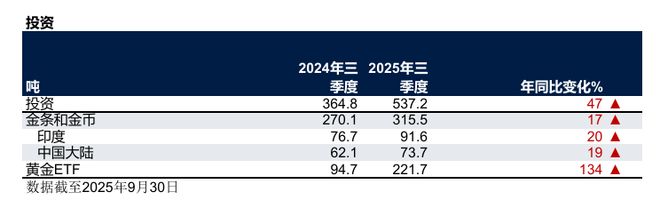
三季度黄金投资激增47%,中国投资者购入74吨金条金币
Zheng Quan Shi Bao· 2025-11-01 14:05
Core Insights - Recent significant pullback in gold prices has led to a reassessment of gold's investment value in the market [1] - The World Gold Council reported a surge in gold investment demand, reaching 537 tons in Q3, a 47% year-on-year increase [2][4] - Despite a decline in overall retail gold investment in China, demand for gold bars and coins remains strong, with a 19% increase to 74 tons in Q3 [4] Investment Demand Driving Growth - Global gold demand reached a record high of 1,313 tons in Q3, with a total value of $146 billion [2] - Investment demand accounted for 55% of total gold demand in Q3, driven by geopolitical uncertainties, a weakening dollar, and investor fear of missing out (FOMO) [2] - Gold ETFs have been a major driver, with a net inflow of 222 tons and $26 billion in Q3, totaling 619 tons for the year [2] Regional Insights - North America saw the highest inflow into gold ETFs, while China experienced a net outflow of 3.8 billion RMB (approximately $540 million) in Q3 [3] - Despite the outflow in ETFs, Chinese investors contributed significantly to gold bars and coins demand, with a total of 74 tons purchased in Q3 [3][4] Market Outlook - The World Gold Council maintains that the strategic value of gold remains solid, with further upside potential in the current market environment [5][6] - Analysts suggest that while short-term price volatility may occur, long-term prospects for gold remain positive due to factors like central bank purchases and a shift in global ETF positions [6] - Forecasts indicate that gold prices may stabilize in a high volatility range in the short term, but long-term projections suggest a potential rise to $4,814 per ounce by 2026 [6]
三季度黄金投资激增47%!中国投资者购入74吨金条金币
券商中国· 2025-11-01 07:55
Core Viewpoint - Recent significant pullback in gold prices has led to a reassessment of gold's investment value in the market [1] Investment Demand Supports Gold Demand Growth - In Q3, global gold demand reached 1313 tons, with a total value of $146 billion, marking the highest quarterly demand on record [3] - Investment demand surged to 537 tons, a 47% year-on-year increase, accounting for 55% of total net demand in Q3 [3] - Key drivers for this growth include geopolitical uncertainties, a weakening dollar, and investor fear of missing out (FOMO) [3] - Gold ETFs were the main growth driver, with investors adding 222 tons and $26 billion in inflows over three consecutive quarters [3] Regional Analysis of Gold Demand - North America saw the highest inflows into gold ETFs, while China experienced a net outflow of 3.8 billion RMB (approximately $540 million) in Q3 [4] - Despite the overall decline in China's gold demand, the demand for gold bars and coins increased by 19% to 74 tons in Q3 [6] Chinese Market Insights - In Q3, China's retail gold investment and consumption reached 152 tons, a 7% year-on-year decline but a 29% increase in value to 120.4 billion RMB, the highest for Q3 [5] - The overall decline in demand was primarily due to reduced demand for gold jewelry and ETF inflows, while investment demand remained strong [6] Strategic Value of Gold Investment - The World Gold Council maintains that the strategic value of gold remains solid, with expectations for further price increases due to a weak dollar and anticipated interest rate cuts [7] - Analysts suggest that while short-term price fluctuations may occur, the long-term outlook for gold remains positive, with projections indicating a price center of $4,814 per ounce by 2026 [8]
世界黄金协会:配置黄金的战略价值依然稳固
Guo Ji Jin Rong Bao· 2025-10-30 10:03
Core Insights - The World Gold Council's Q3 2025 Global Gold Demand Trends Report indicates that global gold demand reached a record high of 1,313 tons, with a total value of $146 billion, driven by strong investment demand and geopolitical uncertainties [1][2] Group 1: Investment Demand - Investment demand for gold surged to 537 tons in Q3 2025, a 47% year-on-year increase, accounting for 55% of total net demand [1] - Investors have significantly increased their holdings in physical gold ETFs for the third consecutive quarter, adding 222 tons and totaling $26 billion in inflows [2] - Central banks accelerated gold purchases, with net purchases totaling 220 tons in Q3, a 28% increase from Q2 and a 10% increase year-on-year [2] Group 2: Supply and Production - Global gold supply reached 1,313 tons in Q3, a 3% year-on-year increase, with mine production rising 2% to 977 tons and recycled gold supply increasing 6% to 344 tons [2] Group 3: Jewelry Demand - Global gold jewelry demand faced pressure, declining 19% year-on-year, despite seasonal increases in India and China [3] Group 4: Market Outlook - The outlook for the gold market remains optimistic, with expectations of continued support for gold investment demand due to a weakening dollar, anticipated rate cuts, and persistent stagflation risks [3]
投资需求推动黄金需求创纪录,投资大佬:不鼓励战术性押注
Nan Fang Du Shi Bao· 2025-10-30 09:52
Core Insights - The World Gold Council reported a record global gold demand of 1,313 tons in Q3 2025, with a total value of $146 billion, primarily driven by investment demand [1][2] - Investment demand surged to 537 tons, a 47% year-on-year increase, attributed to geopolitical uncertainties, a weakening dollar, and rising gold prices triggering a fear of missing out (FOMO) among investors [1][2] - Prominent investors, including Ray Dalio, emphasize the importance of gold as a strategic asset allocation rather than a tactical bet, suggesting a 15% allocation to gold for most investors [1] Investment Demand Analysis - In Q3 2025, gold investment demand reached 537.2 tons, up from 364.8 tons in Q3 2024, marking a 47% increase [3] - Gold bar and coin demand increased by 17% year-on-year, from 270.1 tons to 315.5 tons [3] - Gold ETF demand saw a significant rise of 134%, increasing from 94.7 tons to 221.7 tons [3] Central Bank Purchases - Central banks accelerated gold purchases, totaling 220 tons in Q3, a 28% increase from Q2 and a 10% increase year-on-year [2][4] - The Bank of Korea is considering its first gold purchase since 2013, indicating a long-term strategy for gold accumulation [3] - A survey indicated that 95% of central banks believe their gold reserves will increase in the next 12 months, highlighting gold's role as a crisis asset and a diversification tool [4]