
新能源汽车出口

Search documents
顺周期-冰火转换-时刻-策略对话汽车
2026-03-24 01:27
Summary of Key Points from the Conference Call Industry Overview - The overseas penetration rate of new energy vehicles (NEVs) is currently only 10%, with long-term potential expected to reach 50%-60%, allowing Chinese automakers to access a market capacity of approximately 40-50 million vehicles [1][4] - The global automotive market's annual sales volume is estimated to be between 80 million to 100 million vehicles, excluding the Chinese market of about 20-24 million and the U.S. market of approximately 15-16 million [3] Company-Specific Insights BYD - BYD's overseas sales are projected to reach 1.6 to 1.7 million units by 2026, contributing profits of 30-35 billion yuan, which will account for 60%-70% of the company's total profits [1][6] - The company is expected to further increase its overseas sales to 2.8 to 3.5 million units by 2027, indicating a strong growth trend [6] Geely - Geely's export volume is expected to grow from 420,000 units in 2025 to 750,000-800,000 units in 2026, with nearly 40% being NEVs [6] - The profit contribution from Geely's NEV exports is estimated to be between 6-8 billion yuan, with overall export business contributing over 50% to the company's profits [6] Chery - Chery's NEV exports are projected to exceed 600% year-on-year growth in 2025, with expected exports of 550,000-600,000 units by 2026 [1][6] Market Dynamics - The demand for NEVs in overseas markets has been positively impacted by the recent U.S.-Iran conflict, particularly in oil-sensitive regions like Europe and Singapore, where foot traffic in stores has increased by approximately 80%-90% year-on-year [2] - The penetration rate of NEVs in Europe is nearing 30% by 2025, indicating a high market acceptance compared to China's current rate of about 55% [2] Competitive Advantages - Chinese NEV manufacturers and their supply chains exhibit significant cost advantages, particularly in battery costs, with domestic battery costs at around 0.3 yuan/Wh compared to 0.8-1.0 yuan/Wh overseas [5] - The export gross margin for domestic NEV manufacturers is generally over 20%, with some regions approaching 30%, translating to a per-vehicle profit of around 20,000 yuan, which is 8-10 times higher than domestic profit levels [5] Supply Chain Beneficiaries - Companies like Fute Technology and Weimais are expected to benefit significantly from the growth in the European NEV market, with profit contributions projected at 35%-40% and over 30%, respectively [7] - Fute Technology's European NEV business is anticipated to account for 25%-30% of its total revenue [7] - Other suppliers such as United Power and Jingjin Electric are also expected to benefit from the trend of NEVs going overseas [7]


2月汽车销量短期调整,出口继续高增长
HONGTA SECURITIES· 2026-03-18 08:24
Investment Rating - The investment rating for the industry is "Outperform" [1] Core Insights - In February, China's automotive production and sales experienced a year-on-year decline due to factors such as holiday effects, subsidy policy adjustments, and high base comparisons. However, the commercial vehicle market continues to perform well, and automotive exports are growing rapidly. The government plans to implement more proactive fiscal policies and maintain moderately loose monetary policies to stabilize and boost automotive demand [4][12]. - In January and February 2026, automotive production and sales reached 412.2 million and 415.2 million units, respectively, with year-on-year declines of 9.5% and 8.8%. The commercial vehicle market showed a positive growth trend, while passenger vehicle production and sales saw significant declines [5][16]. - The global new energy vehicle (NEV) market saw a total of 1.18 million units sold in January 2026, a year-on-year decrease of 5.99%. In China, NEV production and sales in February were 694,000 and 765,000 units, respectively, with year-on-year declines of 21.8% and 14.2% [6][41]. Summary by Sections 1. Automotive Market - In February, China's automotive production and sales were 1.672 million and 1.805 million units, respectively, with month-on-month declines of 31.7% and 23.1%, and year-on-year declines of 20.5% and 15.2% [5][13]. - The government plans to support consumption through various financial measures, including a special bond issuance of 250 billion yuan for consumption upgrades and a 100 billion yuan fund to stimulate domestic demand [12]. - In February, automotive exports reached 672,000 units, a year-on-year increase of 52.4%, indicating strong global competitiveness [19][23]. 2. New Energy Vehicle Market - In February, NEV domestic sales were 483,000 units, a month-on-month decline of 24.9% and a year-on-year decline of 36.4%. Cumulatively, from January to February, NEV sales were 1.126 million units, down 27.5% year-on-year [53][58]. - NEV exports in February were 282,000 units, a month-on-month decline of 6.6% but a year-on-year increase of 110%. Cumulatively, NEV exports from January to February reached 583,000 units, up 106.9% year-on-year [53][58]. - The penetration rate of NEVs in February reached 42.4% of total new car sales, with a cumulative penetration rate of 41.2% from January to February [52][59]. 3. Lithium Battery Market - In February, the total production of power and energy storage batteries in China was 141.6 GWh, a month-on-month decline of 15.7% but a year-on-year increase of 41.3%. Cumulatively, from January to February, production reached 309.7 GWh, with a year-on-year growth of 48.8% [7]. - The export of power and energy storage batteries in February was 23.9 GWh, a year-on-year increase of 13.2%, accounting for 20.6% of the monthly sales [7].
全国人大代表、广汽集团董事长冯兴亚:农村新能源汽车市场潜力巨大
Qi Huo Ri Bao Wang· 2026-03-04 11:18
Group 1 - The core focus is on boosting the development of the rural electric vehicle (EV) market, promoting battery swapping for EVs, and enhancing the international competitiveness of China's EV exports [1] Group 2 - The disparity between the market share of EVs in rural and urban areas is significant, indicating a vast potential in the rural EV market. Recommendations include improving the rural charging network, enhancing after-sales service, and optimizing financial support to unlock rural EV consumption potential [1] Group 3 - Regarding the development of the battery swapping model, it is highlighted that this model offers efficient energy replenishment. Suggestions include establishing a unified national standard, enhancing operational subsidies, and coordinating the layout of the battery swapping network to support high-quality development of the industry [1] Group 4 - On the topic of EV exports, it is noted that China's automotive export scale remains globally leading and is entering a new phase of high-quality development. Recommendations include establishing a compliance service system for exports, aligning domestic standards with international ones, and fostering collaboration among domestic enterprises to enhance global competitiveness [1]

重点车企2月销量速览
数说新能源· 2026-03-03 03:04
Core Viewpoint - The article highlights the performance of various electric vehicle manufacturers in terms of sales growth and export figures for the first two months of the year, indicating a mixed but generally positive trend in the new energy vehicle market. Group 1: Sales Performance - NIO, Xiaomi, Leap Motor, and SAIC have shown significant year-on-year growth in sales for January and February [2] - BYD reported February sales of 190,000 units, down 41% year-on-year and 9% month-on-month, with cumulative sales of 400,000 units for the first two months, down 36% year-on-year [2] - Geely's February sales reached 206,000 units, up 1% year-on-year but down 24% month-on-month, with cumulative sales of 476,000 units for the first two months, also up 1% year-on-year [2] - Chery's February sales were 161,000 units, down 11% year-on-year and 20% month-on-month, with cumulative sales of 361,000 units for the first two months, down 11% year-on-year [3] - Great Wall Motors reported February sales of 73,000 units, down 7% year-on-year and 20% month-on-month, with cumulative sales of 163,000 units for the first two months, up 3% year-on-year [3] Group 2: Export Performance - BYD's export sales reached 101,000 units in February, up 50% year-on-year and stable month-on-month [2] - Geely's export sales were 61,000 units, up 138% year-on-year and 1% month-on-month [2] - Chery's exports totaled 12,500 units, up 42% year-on-year [3] - Great Wall Motors exported 43,000 units, up 37% year-on-year and 5% month-on-month [3] Group 3: New Product Launches - Li Auto plans to launch new models L9 and L9 Livis in Q2 2026 [5] - Zeekr's sales reached 24,000 units, up 70% year-on-year, with the new model expected to launch in Q2 2026 [2][5]





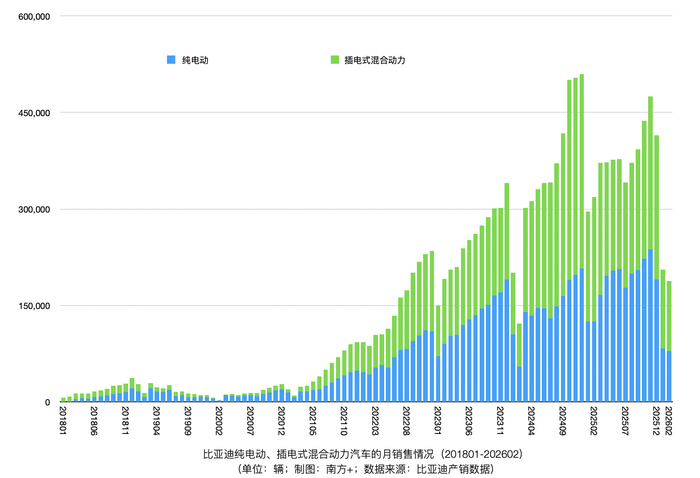
比亚迪汽车单月出口量占比首次过半,股价暴涨超8%
2 1 Shi Ji Jing Ji Bao Dao· 2026-03-02 11:28
Core Insights - BYD's February 2026 production and sales data for new energy vehicles showed significant declines compared to the same period last year, with production down 47.54% and sales down 41.09% [1] - Despite the overall decline in production and sales, BYD's export volume and battery installation capacity demonstrated strong performance, with exports exceeding 100,600 units in February [1][3] - The company's stock price surged over 8% following the announcement of a disruptive technology conference scheduled for March 5, 2026 [5] Production and Sales Data - In February 2026, BYD produced 175,280 new energy vehicles, down from 334,124 units in February 2025, marking a 47.54% year-on-year decrease [1] - Cumulative production for the year reached 407,638 units, a decline of 38.4% compared to 661,988 units in the same period last year [1] - February sales totaled 190,190 units, down from 322,846 units in February 2025, reflecting a 41.09% year-on-year drop [1] - Year-to-date sales reached 400,241 units, a decrease of 35.8% compared to 623,384 units last year [1] Segment Performance - Passenger vehicles remained the mainstay of production and sales, with February production at 172,525 units and cumulative production at 400,360 units, both down approximately 38.7% year-on-year [3] - Sales of passenger vehicles in February were 187,782 units, with cumulative sales of 393,300 units, reflecting a 36.0% year-on-year decline [3] - Electric passenger vehicles produced in February totaled 77,018 units, with cumulative production at 165,089 units, both down 37.3% year-on-year [3] - Plug-in hybrid passenger vehicles saw February production of 95,507 units, with cumulative production at 235,271 units, down 39.6% year-on-year [3] - Commercial vehicle production and sales also declined, with February production at 2,755 units and cumulative production at 7,278 units, down 18.8% year-on-year [3] Export and Battery Performance - BYD's export volume in February 2026 reached 100,600 units, with the export sales ratio surpassing 50% for the first time [5] - The total installed capacity of power batteries and energy storage batteries in February was approximately 18.773 GWh, with a cumulative total of about 38.960 GWh for the year [3]
加拿大将发放首批中国产电动车进口配额
Dong Zheng Qi Huo· 2026-03-01 13:12
1. Report Industry Investment Rating No information provided in the given content. 2. Core View of the Report - China's new energy vehicle market penetration has rapidly increased in the past few years, breaking through 50% in 2025. Since the second half of 2025, as the domestic market shifts to "anti - involution", exports have gradually become a new growth point. The trade environment in overseas markets shows that trade protectionism in Europe and the United States is relatively severe, while the development space in countries along the Belt and Road and the Middle East is promising. Overall, the development space of new energy vehicles in non - American regions is optimistic. In the competition pattern, the market share of independent brands continues to expand, and companies with strong product strength, smooth overseas expansion, and high supply stability will be the core beneficiaries [2][119]. 3. Summary According to Relevant Catalogs 3.1 Financial Market Tracking - The report presents the weekly price changes of relevant sectors and listed companies. For example, among listed companies, BYD's closing price on February 27 was 89.32 yuan, with a weekly decline of 1.05%; SAIC Group's closing price was 14.33 yuan, with a weekly increase of 0.07% [12][16]. 3.2 Industry Chain Data Tracking 3.2.1 China New Energy Vehicle Market Tracking - **Sales**: It includes data on China's new energy vehicle sales, penetration rate, domestic sales, exports, as well as sales of pure - electric (EV) and plug - in hybrid (PHV) vehicles [17][21][25]. - **Inventory Changes**: Data on the monthly new additions of new energy passenger vehicle channel inventory and manufacturer inventory are provided [26][27]. - **Delivery Volume of Chinese New Energy Vehicle Enterprises**: It shows the monthly delivery volumes of companies such as Leapmotor, Li Auto, XPeng, NIO, Zeekr, Aion, Voyah, and Deepal [29][30][36]. 3.2.2 Global and Overseas New Energy Vehicle Market Tracking - **Global Market**: Data on global new energy vehicle sales, penetration rate, and sales of EV and PHV vehicles are presented [42][43][46]. - **European Market**: It includes data on European new energy vehicle sales, penetration rate, and sales of EV and PHV vehicles in different countries such as the UK, Germany, and France [48][49][53]. - **North American Market**: Data on North American new energy vehicle sales, penetration rate, and sales of EV and PHV vehicles are provided [61][62][64]. - **Other Regions**: Data on new energy vehicle sales, penetration rate, and sales of EV and PHV vehicles in regions such as Japan, South Korea, and Thailand are presented [65][66][69]. 3.2.3 Power Battery Industry Chain - It includes data on power battery loading volume (by material), export volume (by material), weekly average price of battery cells, cell material cost, and the operating rates and prices of various battery materials such as ternary materials, phosphoric acid iron lithium, and negative electrode materials [82][84][87]. 3.2.4 Other Upstream Raw Materials - Data on the daily prices of rubber, glass, steel, and aluminum are provided [104][105][106]. 3.3 Hot News Summaries 3.3.1 Industry Dynamics: China - The Ministry of Commerce announced that Chinese and German companies reached more than ten business agreements during the visit of the German Chancellor to China, covering industries such as automobiles, machinery, energy, logistics, and finance. - The Passenger Car Association reported that in 2025, the installation rate of L2 - level and above assisted driving functions in new energy passenger vehicles reached 87.0%, the overall installation rate of AEB in passenger vehicles was 68.2%, and the installation rate in the new energy passenger vehicle market was 76.4%. The installation rate of full - speed ACC adaptive cruise function in the overall passenger vehicle market was 64%, and in the new energy passenger vehicle market was 72.8% [110][111]. 3.3.2 Industry Dynamics: Overseas - Canada will issue import permits for Chinese - made electric vehicles starting from March 1. The quota for the first phase (until August 31) is 24,500 vehicles, with a 6.1% tariff, much lower than the previous 106.1% punitive tariff. The annual total quota is 49,000 vehicles, covering pure - electric, plug - in hybrid, and hybrid models, and it is planned to increase to 70,000 vehicles by 2030. - Brazil will gradually restore the import tariffs on CKD and SKD auto parts to 35%. The import tariff on SKD parts will be restored to 35% in July 2026, and the import tariff on CKD parts will be restored to 35% in January 2027. - Indonesia's incentive measures for the import of fully assembled electric vehicles expired on December 31, 2025. The government plans to shift budget support to the national automobile project to revitalize the local automobile industry and attract long - term investment [112][113][114]. 3.3.3 Enterprise Dynamics - Leapmotor delivered 28,067 vehicles in February, and its new small SUV, Leapmotor A10, will start mass - delivery in the first half of 2026. - Li Auto delivered 26,421 vehicles in February. - Xiaomi Auto's delivery volume in February exceeded 20,000 vehicles. - Tesla China launched a new car - purchase financial incentive policy. Orders placed before March 31 can enjoy a 7 - year ultra - low - interest loan, and three main models (Model 3, Model Y, and Model Y L) can additionally choose a 5 - year 0 - interest plan [117]. 3.4 Industry Viewpoint - In the domestic market, the growth rate in January was low. Besides seasonal factors, the main reason might be the withdrawal of the new energy vehicle purchase tax incentive. The tax - exemption policy, which started in September 2014, ended in December 2025, bringing significant fluctuations to the retail of new energy passenger vehicles. Since the beginning of the year, luxury brands have led a wave of price cuts, and this trend has intensified after the Spring Festival, with different strategies: fuel vehicles mainly use direct price cuts, while new energy vehicles mainly use financial incentives. - In the overseas market, Canada will issue import permits for Chinese - made electric vehicles starting from March 1. The quota for the first phase (until August 31) is 24,500 vehicles, with a 6.1% tariff, much lower than the previous 106.1% punitive tariff. The annual total quota is 49,000 vehicles, covering pure - electric, plug - in hybrid, and hybrid models, and it is planned to increase to 70,000 vehicles by 2030 [1][118]. 3.5 Investment Advice - China's new energy vehicle market penetration has rapidly increased in the past few years, breaking through 50% in 2025. Since the second half of 2025, as the domestic market shifts to "anti - involution", exports have gradually become a new growth point. The trade environment in overseas markets shows that trade protectionism in Europe and the United States is relatively severe, while the development space in countries along the Belt and Road and the Middle East is promising. Overall, the development space of new energy vehicles in non - American regions is optimistic. In the competition pattern, the market share of independent brands continues to expand, and companies with strong product strength, smooth overseas expansion, and high supply stability will be the core beneficiaries [2][119].
新能源汽车出口保持高速增长
Ren Min Ri Bao· 2026-02-12 21:39
Core Insights - In January 2026, China's automobile exports reached 681,000 units, marking a year-on-year increase of 44.9% [1] - The export of new energy vehicles (NEVs) saw significant growth, with 302,000 units exported, representing a year-on-year increase of 100% [1] Production and Sales Data - In January, the total production and sales of automobiles in China were 2.45 million and 2.346 million units, respectively, with production increasing by 0.01% year-on-year and sales decreasing by 3.2% [1] - The NEV market remained stable, with production and sales of 1.041 million and 945,000 units, respectively, showing year-on-year growth of 2.5% and 0.1% [1] - NEVs accounted for 40.3% of total new car sales in January [1] Policy Impact - The Chinese government has introduced a series of policies aimed at benefiting consumers and businesses, which are expected to support the automotive industry [1] - The "Two New" policies are being implemented in an orderly manner, and the vehicle trade-in program is progressing smoothly [1] - The "Accelerating the Cultivation of New Growth Points for Service Consumption Work Plan" focuses on key areas such as the automotive aftermarket, which is expected to stimulate market vitality [1]
乘联分会:1月新能源乘用车出口28.6万辆,同比增长103.6%
Xin Lang Cai Jing· 2026-02-12 06:19
Core Insights - In January, China's new energy passenger car exports reached 286,000 units, marking a year-on-year increase of 103.6% [1] - New energy vehicles accounted for 49.6% of total passenger car exports, an increase of 12.5 percentage points compared to the same period last year [1] - Pure electric vehicles made up 65% of new energy exports, slightly down from 67% last year, with A00 and A0 class pure electric cars representing 50% of pure electric exports, up from 41% last year [1] - Plug-in hybrids constituted 33% of new energy exports, a slight increase from 32% last year, with strong growth in developing countries despite some external challenges [1] Company Performance - Leading companies in new energy vehicle exports for January include: - BYD Auto: 96,859 units - Tesla China: 50,644 units - Geely Auto: 32,117 units - Chery Auto: 27,033 units - Leap Motor: 14,523 units - SAIC Passenger Cars: 13,071 units - SAIC-GM-Wuling: 11,097 units - Dongfeng Motor: 6,745 units - Great Wall Motors: 6,102 units - Changan Auto: 4,952 units - Other companies also showed significant export volumes [2]
历史性时刻!出口乘用车中,新能源占比首次超一半
第一财经· 2026-02-12 02:07
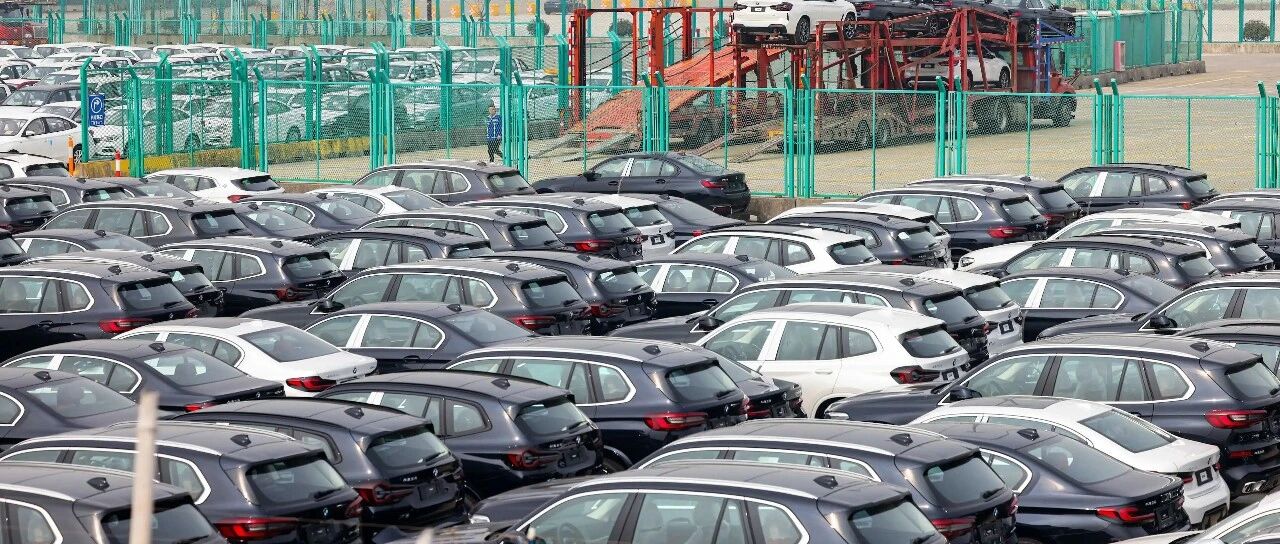
Core Viewpoint - In January 2026, China's automobile exports continued to grow rapidly, with a total of 681,000 vehicles exported, marking a year-on-year increase of 44.9% [3] Group 1: Export Performance - Passenger car exports reached 589,000 units in January, up 48.9% year-on-year [3] - Commercial vehicle exports totaled 93,000 units, reflecting a year-on-year increase of 23.6% [3] - The export of new energy vehicles (NEVs) significantly contributed to this growth, with 302,000 units exported in January, a year-on-year increase of 100% [3] Group 2: New Energy Vehicle Insights - Among the NEVs, 295,000 were passenger vehicles, which accounted for over 50% of total passenger car exports for the first time, representing a year-on-year growth of 110% [3] - The export of pure electric vehicles reached 202,000 units, also doubling year-on-year, while plug-in hybrid vehicle exports were 99,000 units, up 97.3% [4] Group 3: Market Dynamics - The growth in plug-in hybrid vehicle exports has been notable, with these vehicles becoming a new growth point for exports, particularly in the pickup segment [4] - Despite previous challenges due to EU tariffs on electric vehicles, plug-in hybrids remain competitive in the European market due to a lower tariff rate [4] - The overall export performance is expected to remain strong, with a projected total of 8.32 million vehicles exported in 2025, a 30% increase year-on-year [5] Group 4: Leading Companies - In January, the top ten exporting companies included Chery (119,000 units), BYD (100,000 units), SAIC (97,000 units), Geely (77,000 units), and Tesla (51,000 units), all exceeding 50,000 units [5] - Nine out of the top ten companies experienced positive growth in exports, with only Changan showing a decline [5] Group 5: Future Outlook - The export markets are shifting towards regions like the Middle East and developed countries, indicating a trend of high-quality development in exports [4][6] - As long as the international market environment remains stable, there is significant potential for further growth in China's automobile exports [6]
历史性时刻!出口乘用车中新能源占比首次超一半
Di Yi Cai Jing· 2026-02-12 01:03
Group 1 - In January 2026, China's automobile exports reached 681,000 units, marking a year-on-year increase of 44.9% [1] - Passenger car exports accounted for 589,000 units, with a year-on-year growth of 48.9%, while commercial vehicle exports were 93,000 units, up 23.6% [1] - The export of new energy vehicles (NEVs) significantly contributed to this growth, with 302,000 units exported, representing a year-on-year increase of 100% [1] Group 2 - The structure of NEV exports showed that pure electric vehicle exports were 202,000 units, doubling year-on-year, while plug-in hybrid vehicle exports reached 99,000 units, up 97.3% [1] - The shift in the export landscape indicates a historic change, with NEVs now dominating over traditional fuel vehicles in terms of export volume [1] - The report from the China Passenger Car Association highlighted that plug-in hybrid vehicles are becoming a new growth point for exports, particularly in the pickup segment [2] Group 3 - Among the top ten automobile exporters in January, nine companies reported positive growth, with Chery leading at 119,000 units, followed by BYD (100,000 units) and SAIC (97,000 units) [3] - The overall export volume for Chinese automobiles is projected to reach 8.32 million units in 2025, reflecting a year-on-year increase of 30% [3] - The growth is attributed to enhanced overseas market presence and brand investment by Chinese automakers, alongside improvements in the domestic supply chain [3] Group 4 - Recent trends indicate strong performance in automobile exports to regions such as Central and South America, Southeast Asia, and the Middle East, with expectations for continued growth as international market conditions stabilize [4]