
红利

Search documents
午评:沪指震荡微跌,半导体等板块走低,算力概念爆发
Sou Hu Cai Jing· 2026-02-27 04:18
27日早盘,沪指盘中窄幅震荡,创业板指弱势下探,失守3300点;A股市场超2900股飘绿。 东莞证券表示,进入2026年,宏观政策围绕"十五五"规划开局部署,以财政金融协同扩大内需为主线, 在货币政策、财政政策、进出口调控与房地产市场等领域精准协同、综合发力,统筹短期稳增长与长期 育动能。随着结构性货币政策工具落地、财政补贴直达与地方细则实施,内需潜力有望持续释放, 为"十五五"起步之年实现经济质的有效提升与量的合理增长奠定坚实基础。板块选择方面,建议重点关 注红利、TMT、电力设备等板块。 截至午间收盘,沪指跌0.17%报4139.53点,深证成指跌0.68%,创业板指跌1.46%,沪深北三市合计成交 约1.6万亿元。 盘面上看,造纸、半导体、建材等板块走低,电力、煤炭、有色、钢铁、农业等板块拉升,算力、AI 应用、稀土概念等活跃。 ...
市场全天高开高走,创业板指、深成指均涨超1%
Dongguan Securities· 2026-02-25 23:38
Market Overview - The market opened high and closed strong, with the ChiNext Index and Shenzhen Component Index both rising over 1% [2][3] - Major indices showed positive performance, with the Shanghai Composite Index closing at 4147.23, up 0.72%, and the Shenzhen Component Index at 14475.87, up 1.29% [2] Sector Performance - The top-performing sectors included Steel (up 4.69%), Non-ferrous Metals (up 3.48%), and Building Materials (up 2.75%) [2] - Conversely, sectors such as Media (down 1.15%) and Banking (down 0.46%) lagged behind [2] Concept Indices - Concept indices that performed well included Zinc Metals, Titanium Dioxide, and Phosphate Chemicals, with gains of 4.94%, 4.85%, and 4.51% respectively [2][3] - Underperforming concepts included Sora Concept (down 0.91%) and Military Restructuring Concept (down 0.89%) [2] Future Outlook - The market is expected to enter a high-probability window for upward movement post-holiday, supported by macro policies and industry catalysts [4] - The anticipated return of capital from pre-holiday cashing out is expected to provide ongoing momentum for future increases [4] - Key sectors to focus on include Dividends, TMT (Technology, Media, and Telecommunications), and Power Equipment [4]
A股市场大势研判:A股马年开门红
Dongguan Securities· 2026-02-24 23:30
Market Performance - The A-share market opened positively in the Year of the Horse, with major indices showing significant gains, including the Shanghai Composite Index rising by 0.87% to close at 4117.41 points and the Shenzhen Component Index increasing by 1.36% to 14291.57 points [2][4] - The trading volume in the Shanghai and Shenzhen markets reached 2.2 trillion yuan, an increase of 219.4 billion yuan compared to the previous trading day, indicating a strong market sentiment [6] Sector Analysis - The top-performing sectors included Oil & Petrochemicals, which rose by 5.53%, and Building Materials, which increased by 3.71% [3] - Conversely, sectors such as Media and Computer experienced declines, with the Media sector dropping by 3.20% [3] - Notable concept stocks included Combustible Ice and Cultivated Diamonds, which saw significant gains, while MLOps and AI Corpus concepts faced declines [4][3] Future Outlook - The report indicates a positive outlook for the A-share market, supported by strong performance in oil and gas stocks, chemical sectors, and precious metals [4] - The market is expected to benefit from favorable macroeconomic policies and the upcoming Two Sessions, which historically lead to a high probability of index increases post-Spring Festival [6] - Analysts suggest focusing on sectors such as dividends, TMT (Technology, Media, and Telecommunications), and power equipment for potential investment opportunities [6]
港股三大指数全线跳水,恒生科技跌超2%,科技巨头齐跌!中国中免跌超10%,智谱逆势大涨12%|港股收盘
Mei Ri Jing Ji Xin Wen· 2026-02-24 09:05
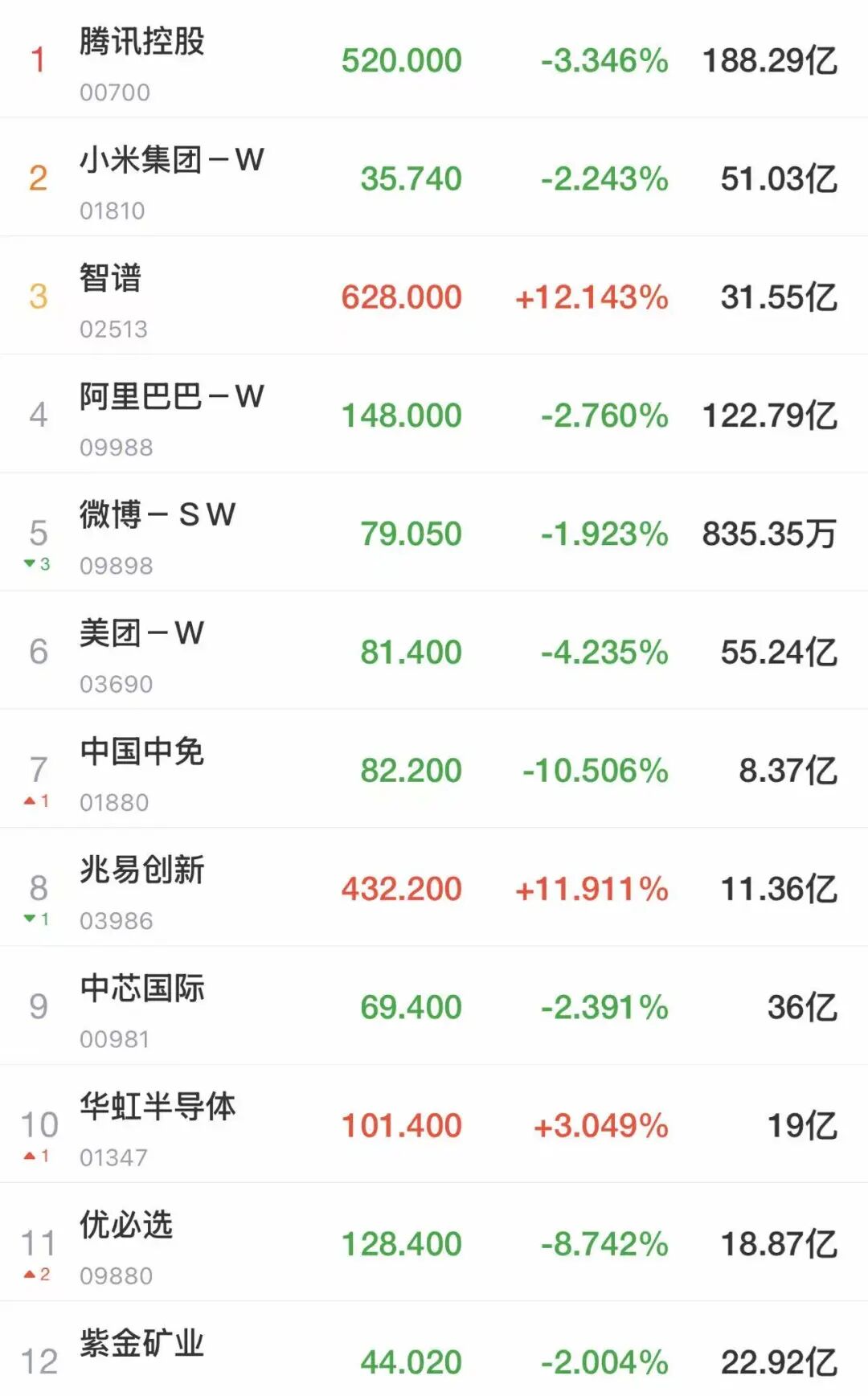
Market Overview - The Hong Kong stock market experienced a decline across all major indices, with the Hang Seng Index falling by 1.82%, the Hang Seng Tech Index down by 2.13%, and the National Enterprises Index decreasing by 2.06% [1] - Major internet technology stocks also saw significant drops, including Tencent Holdings down nearly 3.3%, Alibaba down 2.7%, and Kingsoft Cloud down 5% [1] Stock Performance - Tencent Holdings closed at 188.29 billion, down 3.346% [2] - Xiaomi Group fell by 2.243%, closing at 51.03 billion [2] - Alibaba's stock decreased by 2.760%, ending at 148.00 billion [2] - Meituan saw a decline of 4.235%, closing at 55.24 billion [2] - China Duty Free Group experienced a significant drop of over 10.506%, closing at 8.37 billion [3] Sector Analysis - The robotics, pharmaceuticals, and duty-free sectors all faced declines, with China Duty Free Group dropping over 10%, and other companies like Tigermed and Zhaoyan New Drug falling by more than 3.6% and 7.3% respectively [3] - Conversely, Zhizhu saw a notable increase of over 12%, marking a rise of over 440% since its listing in January [3] Future Outlook - According to Liu Gang, a managing director at CICC, the credit cycle will determine index space, while industry trends will influence structural strength [3] - Short-term market adjustments may occur, but there is potential for upward correction after a pullback [3] - The mid-term outlook suggests a projected earnings growth of 3% to 4% for Hong Kong stocks, with the Hang Seng Index potentially rising to around 28,000 to 29,000 points [3] - The influx of capital from the south post-Chinese New Year is expected to provide liquidity support for the Hong Kong market [3] - Recommendations include focusing on technology (AI computing and applications), non-bank financials (insurance), and dividend stocks, with an emphasis on the need to confirm earnings and liquidity turning points for the Hang Seng Tech Index [3]





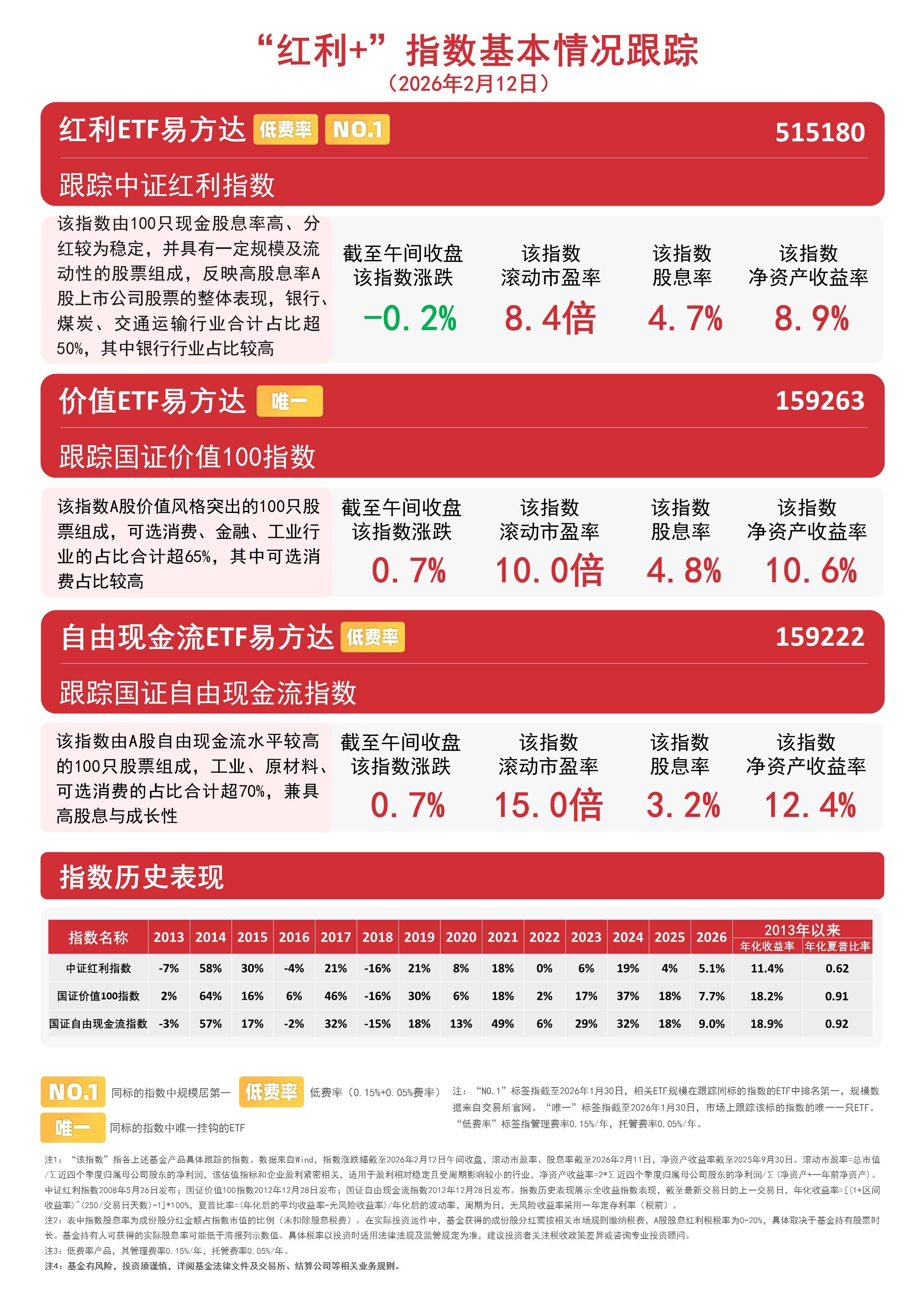
“红利+”指数震荡分化,价值ETF易方达(159263)、自由现金流ETF易方达(159222)早盘获资金加仓
Sou Hu Cai Jing· 2026-02-12 05:00
Group 1 - The core viewpoint of the articles indicates that the low interest rate environment is fostering a stable compounding effect of free cash flow, which is becoming a cornerstone for a long-term bull market [1] - The market is shifting its focus from front-end expansion to back-end prudent management of cash flow accumulation, which will support long-term valuations [1] - The value ETF and free cash flow ETF from E Fund have seen significant net subscriptions, with 22 million and 10 million units respectively in the morning session [1] Group 2 - The National Index of Free Cash Flow consists of 100 stocks with high free cash flow levels, with over 70% of its composition in industrials, materials, and consumer discretionary sectors, combining high dividends and growth potential [4] - Historical performance data shows that the National Value 100 Index and the National Free Cash Flow Index have had varying returns over the years, with the latter showing a 57% increase in 2014 and a 32% increase in 2017 [4] - The free cash flow ETF has a low fee rate of 0.15% plus an additional 0.05%, making it the only ETF linked to this specific index [4]
2月11日持仓过节的资金在买入哪些ETF?
Mei Ri Jing Ji Xin Wen· 2026-02-12 02:10
Group 1 - The Shanghai Composite Index experienced a seven-day rise, but trading volume continued to shrink, leading to a significant "seesaw" effect in capital allocation and accelerated sector rotation [1] - Ahead of the Spring Festival holiday, funds are divided into two camps: one showing cautious sentiment favoring dividend and free cash flow ETFs, while the other is positioning for a rebound after the holiday [1] - Major ETFs that received significant net subscriptions from external funds include the ChiNext ETF and the CSI 1000 ETF, with industry-specific ETFs like satellite, robotics, AI, semiconductor equipment, and chemical ETFs also seeing strong inflows [1] Group 2 - According to Wang Bo from Huaxia Fund, the reduction in trading volume before the holiday is normal, and there is a general optimistic expectation for the February market, although a short-term recovery in market sentiment will take time [2] - The investment strategy suggested includes maintaining a balanced allocation across technology, cyclical, and consumer sectors through broad-based ETFs like the Hu-Shen 300 ETF [2] - The recent increase in January PPI by 0.4% month-on-month has catalyzed price increases in the chemical sector, while positive developments in robotics and AI models are also emerging [1][2]
港股投资策略报告:冰火两重天的港股如何配置?-20260210
INDUSTRIAL SECURITIES· 2026-02-10 14:04
Group 1 - The report highlights a significant divergence in the Hong Kong stock market, with technology and telecommunications sectors dragging down the Hang Seng Index, while other industries have shown positive returns. The Hang Seng High Dividend Yield Total Return Index has reached a historical high, and the relatively balanced Hong Kong Stock Connect Index has outperformed the A-share CSI 800 Index [2][13]. - The Hang Seng Technology Index has faced pressure from short sellers, exacerbated by multiple narratives, including concerns over tax policy adjustments and the potential disruption of AI on traditional business models, leading to a negative sentiment in the market [2][13]. Group 2 - The outlook suggests that the Hong Kong market may see an influx of foreign capital in 2026 due to the ongoing loose liquidity environment and the potential for the Federal Reserve to continue lowering interest rates. Recent trends indicate a significant increase in net inflows from the Stock Connect program, particularly into technology stocks that have experienced substantial declines [3][24]. - Domestic investors are also accelerating their investments in Hong Kong stocks, taking advantage of market adjustments. The average daily net inflow from the Stock Connect has rebounded to a high level not seen since 2024, indicating renewed interest in the market [3][24]. Group 3 - The report recommends a strategy of combining "technology as a core holding + cyclical recovery + beta opportunities in dividends" to embrace the upcoming spring market. Current market sentiment is at a relatively low point, suggesting potential for a short-term rebound [4][31]. - Technology remains a long-term focus, with AI expected to be a key driver. The report notes that leading internet and application companies have already priced in pessimistic expectations, making them attractive for investment as they are near historical valuation lows [4][31]. Group 4 - The cyclical leaders in the Hong Kong market are expected to see improvements as the Chinese economy transitions towards "slower growth + increased efficiency." This shift is anticipated to enhance the competitive landscape and gradually restore profitability for leading companies in sectors such as chemicals, real estate, and machinery [4][34]. - The report emphasizes the importance of consumer data during the Spring Festival as a potential catalyst for market performance, particularly for consumer service leaders in sectors like gaming, dining, and travel [4][34]. Group 5 - The report identifies that the ongoing geopolitical landscape in 2026 is more favorable for Chinese assets, with the risk premium of the Hang Seng Index relative to 10-year U.S. Treasury yields being significantly higher than that of developed markets. This situation is expected to attract more foreign capital to Hong Kong stocks [5][22]. - A stable RMB is projected to enhance the attractiveness of RMB-denominated assets, with historical trends indicating that significant RMB appreciation often correlates with rising Hong Kong stock prices [5][22].
——W135市场观察:哪些行业风格处于低拥挤状态?
Changjiang Securities· 2026-02-10 08:12
Market Overview - The A-share market exhibited a pattern of reduced volume and mixed fluctuations, with essential consumer and industrial sectors leading weekly gains[1] - The growth style's congestion level has decreased over the past two weeks, but remains lower than that of high-quality and growth stocks in absolute terms[1] Industry Insights - Congestion levels for agricultural products and banks have increased, while transportation and telecommunications sectors lag behind in weekly trading congestion[1] - Essential consumer and industrial sectors showed strong weekly performance, indicating a potential shift in market focus[4] Investment Trends - Institutional funds generally experienced a pullback as growth stocks declined, reflecting a broader trend of profit-taking among funds[4] - The Longjiang Manufacturing Champions and Low-Carbon Leaders indices performed well, highlighting specific thematic investment opportunities[4] Performance Metrics - The growth style indices showed a notable decline, with the Longjiang Growth Index down by 4.08% and the Longjiang High Valuation Index down by 6.20%[21] - In contrast, the Longjiang Low Valuation Index recorded a modest gain of 0.56%, indicating a preference for value-oriented investments during this period[31]

权益类基金引领春节前后公募发行市场
Zheng Quan Ri Bao· 2026-02-09 16:15
Group 1 - The issuance of public funds is actively continuing ahead of the Spring Festival, with 29 funds set to be launched in the next three weeks, including 10 equity mixed funds and 8 passive index funds [1] - 21 out of the 29 funds belong to equity categories, indicating that equity funds are leading the issuance trend before and after the Spring Festival [1] - The reasons for the active layout of equity funds include attractive market valuations, seasonal inflow of resident funds, and regulatory encouragement for long-term capital to enter the market [1] Group 2 - The equity market in February is expected to continue a rotation pattern, with a potential for upward movement despite a lack of clear catalysts before the Spring Festival [2] - The focus on technology sectors, particularly overseas computing-related areas, is seen as a favorable strategy, with expectations for the "AI+" sector to become more active [2] - The issuance of funds during the Spring Festival has both advantages and disadvantages, with increased investor attention during the holiday but potential delays in the fundraising process due to market closures [3] Group 3 - The public fund industry is projected to develop towards higher quality, tool-oriented, and long-term investment strategies by 2026, with equity products remaining mainstream [3] - The total issuance of fund products is expected to steadily increase, with a continued optimization of structure and a balanced development of actively managed funds and index investment tools [3] - The market share of leading institutions is likely to expand, focusing on new productivity and dividend themes [3]
2025年四季度公募基金持仓分析:慢牛格局下资金再平衡,周期板块配置逐步回暖
Changjiang Securities· 2026-01-27 14:17
Group 1 - The overall fund position decreased marginally in Q4 2025, with a significant increase in the allocation to the CSI 300 index [6][14][23] - The allocation to the ChiNext board increased by 1.35 percentage points to 20.49%, while the allocation to the main board decreased by 1.17 percentage points to 65.64% [14][21] - The allocation to cyclical sectors increased, while technology, consumer, and manufacturing sectors saw a decrease in allocation [7][27] Group 2 - In Q4 2025, public funds increased their allocation to cyclical sectors and reduced their allocation to technology, consumer, and manufacturing sectors [7][24] - The allocation to materials and mining sectors increased by 3.11 percentage points to 13.51%, while the allocation to information technology and hardware decreased by 2.45 percentage points to 26.23% [27][32] - The telecommunications sector saw an increase in allocation, while the electronics, healthcare, and media sectors experienced a significant decline [7][32] Group 3 - The allocation to high-dividend sectors increased, with the high-dividend industry holding rising by 1.18 percentage points to 5.88% [7] - The allocation to export-related sectors showed mixed results, with an increase in home appliances by 0.18 percentage points to 2.73% and a decrease in semiconductors by 0.39 percentage points to 12.52% [7] - The allocation to core assets decreased, particularly in the power and new energy equipment and food and beverage sectors [7][24] Group 4 - The concentration of holdings among the top five stocks increased to 15.61%, up by 2 percentage points from Q3 2025 [23] - The allocation to the telecommunications sector was notably increased, while the allocation to AI applications and quantum technology sectors was reduced [7][32]