货币政策适度宽松

Search documents
东兴证券晨报-20260331
Dongxing Securities· 2026-03-31 07:09
Core Insights - The report highlights a rebound in China's economic indicators, with the manufacturing PMI at 50.4%, non-manufacturing PMI at 50.1%, and composite PMI at 50.5%, indicating a recovery in economic sentiment [2] - The ongoing geopolitical tensions, particularly the conflict involving Iran, are expected to sustain high oil prices, impacting global supply chains and market sentiment [7][8] - The report suggests a potential shift in market dynamics towards value and defensive stocks due to the uncertainty surrounding the conflict, with a possible return to growth stocks if negotiations progress positively [9] Economic Indicators - In March, China's manufacturing PMI rose by 1.4 percentage points, non-manufacturing PMI by 0.6 percentage points, and composite PMI by 1.0 percentage points, indicating a return to expansion [2] - The People's Bank of China reported that M2 money supply reached 349.22 trillion yuan, growing by 9% year-on-year, while the social financing scale increased by 8.2% [2] Company Insights - China Bank reported a revenue of 659.87 billion yuan for 2025, a 4.28% increase year-on-year, with a net profit of 243.02 billion yuan, up 2.18% [3] - ZTE Corporation's computing business saw a 150% revenue increase, contributing nearly 25% to overall revenue, with significant growth in server and storage sales [3] - Huayu Automotive achieved a revenue of 183.99 billion yuan in 2025, an 8.49% increase, with a net profit of 7.21 billion yuan, up 7.51% [4] - Mengniu Dairy reported a revenue of 82.25 billion yuan, with a net profit of 1.55 billion yuan, marking a 1379% increase year-on-year [4] Industry Trends - The new energy storage industry is experiencing steady growth, with the Ministry of Industry and Information Technology focusing on top-level design and regulatory measures to enhance industry standards and prevent low-level competition [3] - The logistics and express delivery sector is seeing a recovery in market share for Zhongtong Express, with a business volume of 38.52 billion pieces in 2025, a 13.3% increase [15][16] - The airline industry is facing short-term challenges due to rising fuel prices, with China National Airlines reporting a significant loss attributed to increased tax expenses [11][12][14]
金融行业周报:货币政策适度宽松,提升跨境融资便利度-20260322
Ping An Securities· 2026-03-22 14:26
Investment Rating - Industry investment rating: Outperform the market (expected to outperform the CSI 300 index by more than 5% within 6 months) [35] Core Views - The central bank emphasizes a moderately loose monetary policy to maintain ample liquidity, guide down financing costs, and stabilize the RMB exchange rate while enhancing financial support for technology innovation, small and micro enterprises, and domestic demand [4][14] - The introduction of a unified management mechanism for overseas lending significantly improves the convenience of cross-border financing for enterprises, aligning with the "going out" strategy [5][18] - The release of the draft Financial Law aims to establish a foundational legal framework for the financial sector, enhancing regulatory consistency and risk prevention while supporting the development of a robust financial system [19] Summary by Sections Key Focus - The central bank's meeting on March 18 outlines priorities for 2026 financial work, focusing on stable growth, risk prevention, and reform [12][14] - The new management measures for overseas lending were announced on March 20, enhancing cross-border financing convenience [16][18] - The draft Financial Law was released on March 20, aiming to create a comprehensive legal framework for the financial sector [19] Industry Data - Banking, securities, insurance, and fintech indices changed by +0.32%, -2.80%, -1.94%, and -4.86% respectively, with the CSI 300 index down by 2.19% [21] - The central bank's open market operations resulted in a net injection of 65.8 billion RMB, with SHIBOR rates declining [27] - Weekly average trading volume in the stock market was 28.5 trillion RMB, a decrease of 9.9% from the previous week [29]
中信证券明明:权益资产偏高的估值指向股市波动可能放大,这客观上加大了市场赚钱的难度
Xin Lang Cai Jing· 2026-03-08 09:40
Group 1: Economic Policies and Market Expectations - The necessity for a second round of domestic growth stabilization policies is highlighted, indicating that current fiscal policy may not be sufficient to stimulate demand effectively [2][10] - The expectation of the U.S. Federal Reserve's delayed interest rate cuts is influenced by persistent inflation and labor market conditions, creating a complex scenario for monetary policy [3][11] - The anticipated performance of the A-share market in 2025 suggests a favorable earning effect, although high valuations may increase market volatility and complicate profit generation [4][11] Group 2: Bond Market Outlook - Historical trends indicate that bond bear markets are typically triggered by economic rebounds, increased risk appetite, or central bank liquidity tightening; however, the current environment suggests no imminent bear market for bonds [5][12] - The central bank's commitment to a moderately loose monetary policy is expected to support a slight decline in bond yields throughout the year, with a significant interest rate cut window anticipated in the first half of the year [5][12] Group 3: Commodity Market Dynamics - Gold has been leading the commodity market in 2023, driven by a loose liquidity environment and its strong financial attributes; however, the end of rapid global liquidity expansion may hinder gold's continued leadership in the commodity space [6][12]

2月政策跟踪观察:全国“两会”如何跟踪?
Shenwan Hongyuan Securities· 2026-03-03 11:26
Agenda Focus - The key agenda for the upcoming "Two Sessions" includes the review of core reports such as the government work report and budget report, with significant dates being March 5 for the government work report and March 11 for the closing session[1] - Discussions on the "14th Five-Year Plan" will be a major focus, with the government work report referencing its implementation on March 5 and further deliberations scheduled for March 11[2] Economic Indicators - The weighted GDP growth target for 2026 across 31 provinces is set at 5%, slightly lower than the 5.3% target for 2025, reflecting a pragmatic approach to economic work[3] - The national CPI target for 2026 is expected to remain around 2%, aligning with current economic conditions and aiming for moderate inflation[4] Policy Focus - Fiscal policy is anticipated to emphasize efficiency, with a projected deficit rate maintained at around 4% and special local government bonds expected to increase to CNY 5.5 trillion[5] - The primary task remains to expand domestic demand and promote consumption, with various departments focusing on service consumption and financial support for innovation[6]
热点思考 | 全国“两会”如何跟踪?(申万宏观·赵伟团队)
申万宏源宏观· 2026-03-03 11:24
Group 1 - The key agenda items for the upcoming "Two Sessions" include the review of core reports such as the government work report, economic work plan, and budget report, with significant discussions expected around the "14th Five-Year Plan" [3][12][49] - The "Two Sessions" will also feature important news conferences that provide insights into policy deployments, with specific sessions scheduled for economic, diplomatic, and livelihood themes [3][11][49] - The discussions surrounding the "14th Five-Year Plan" will be a focal point, with the government work report expected to reference its implementation and subsequent deliberations by representatives [3][12][50] Group 2 - The national GDP growth target for 2026 is anticipated to be set at around 5%, slightly lower than the 5.3% target for 2025, reflecting a pragmatic approach to economic work [4][14][51] - The 2026 national CPI target is likely to remain around 2%, aligning with current economic conditions and aiming for moderate inflation [5][19][52] - The setting of economic growth targets may adopt a range approach, similar to previous years, to maintain basic growth while aligning with the correct performance outlook [4][17][51] Group 3 - Fiscal policy is expected to focus on enhancing efficiency, with a projected budget deficit rate of around 4% and an increase in local government special bond issuance to approximately 5.5 trillion yuan [6][24][52] - Monetary policy is likely to maintain a moderately accommodative stance, emphasizing liquidity support and precise structural assistance, while also focusing on fiscal coordination and expectation management [6][33][39] - Expanding domestic demand and promoting consumption will remain a primary task, with various departments implementing measures to stimulate service consumption and support innovation [7][45][52]


万联证券:结构性工具降息 宽信用渠道拓展
Zheng Quan Ri Bao Wang· 2026-01-16 07:41
Group 1 - The core viewpoint of the articles is that China's monetary policy will remain moderately accommodative in 2026, focusing on counter-cyclical and cross-cyclical adjustments to support high-quality economic development and structural transformation [1][2] - Starting from January 19, the People's Bank of China will lower the re-lending and rediscount rates by 0.25 percentage points, which is expected to enhance banks' willingness to lend in key areas and reduce credit costs [1] - The structural policy adjustment includes targeted interest rate reductions for key supported sectors and an increase in the quota for structural tools, broadening the coverage of credit support to include sectors like technology innovation, small and medium-sized enterprises, green projects, and employment [1] Group 2 - There is still room for further interest rate cuts and reserve requirement ratio reductions this year, with structural tools being prioritized initially, while total tools may be used more moderately later [2] - The average statutory reserve requirement ratio is at 6.3%, with a safe distance from the historical low of 5%, indicating potential for further easing [2] - The focus on prices is increasing, with expectations that macro policy coordination and initiatives to boost consumption will improve supply-demand matching, leading to a limited rise in inflation in 2026 compared to 2025 [2]
央行出台一批重磅政策,解读来了
Sou Hu Cai Jing· 2026-01-15 10:04
Core Viewpoint - The People's Bank of China (PBOC) is implementing targeted monetary policy measures to support high-quality development of the real economy, including a 0.25 percentage point reduction in various structural monetary policy tool rates [1][2]. Group 1: Monetary Policy Measures - The PBOC has lowered the one-year re-lending rate from 1.5% to 1.25%, marking the second reduction of this rate since May 2025 [2]. - The reduction in re-lending rates is expected to lower the cost of funds for commercial banks, potentially leading to lower loan rates for enterprises and individuals, particularly in sectors like small and micro enterprises and agriculture [2][3]. - The PBOC aims to enhance the efficiency of financial services to the real economy by using structural monetary policy tools to direct credit resources to weak links and key areas [3]. Group 2: Additional Support Measures - The PBOC plans to increase the quota for re-lending to support agriculture and small enterprises by 500 billion yuan, with a separate quota of 1 trillion yuan specifically for private enterprises [8]. - The quota for re-lending aimed at technological innovation and transformation has been increased from 800 billion yuan to 1.2 trillion yuan, expanding support to high R&D investment private small and medium enterprises [8]. - The PBOC is merging existing bond financing support tools for private enterprises and technological innovation, providing a total re-lending quota of 200 billion yuan [8]. Group 3: Broader Economic Implications - The PBOC has indicated that there is still approximately 1.3 percentage points of room for further reductions in the reserve requirement ratio, suggesting ongoing flexibility in monetary policy [6]. - The central bank emphasizes a cautious approach to monetary policy, avoiding excessive liquidity to prevent future inflation and debt issues, while focusing on targeted support for economic transformation [7]. - The PBOC's measures are designed to work in conjunction with fiscal policies to enhance the effectiveness of monetary policy and stimulate effective domestic demand [9].
央行1月15日将开展9000亿元买断式逆回购操作;多家银行发行挂钩黄金的结构性存款 | 金融早参
Sou Hu Cai Jing· 2026-01-14 23:41
Group 1 - The People's Bank of China will conduct a 900 billion yuan reverse repurchase operation on January 15, 2026, with a term of 6 months, to maintain ample liquidity in the banking system [1] - Several banks, including China Merchants Bank and Industrial Bank, are launching gold-linked structured deposit products in response to declining deposit rates and rising gold prices, appealing to risk-averse investors [2] - Commercial banks are intensifying capital replenishment, with 39 banks receiving regulatory approval for capital changes as of January 13, 2026, primarily through targeted stock issuance and perpetual bonds [3] Group 2 - CITIC Bank reported a net profit of 70.618 billion yuan for 2025, a year-on-year increase of 2.98%, despite a slight decline in total operating revenue, indicating pressure on profitability amid economic challenges [4] - CITIC Securities anticipates that the Federal Reserve will pause interest rate cuts in January 2026 and will implement two rate cuts of 25 basis points each throughout the year, influenced by moderate inflation trends [5]

加量3000亿元,央行明日开展9000亿元买断式逆回购操作|快讯
Sou Hu Cai Jing· 2026-01-14 10:41
Group 1 - The People's Bank of China (PBOC) will conduct a 900 billion yuan reverse repo operation on January 15, 2026, to maintain ample liquidity in the banking system, marking the fifth consecutive month of increased reverse repo operations [1] - The operation will involve a fixed amount and interest rate bidding, with a term of six months (181 days), and is an increase of 300 billion yuan compared to the previous month, which aligns with market expectations [1] - In January, the total increase in reverse repo operations for both six-month and three-month terms is 300 billion yuan, with the three-month reverse repo being a rollover of 11 trillion yuan [1] Group 2 - Analysts suggest that the PBOC will continue to use reverse repos and Medium-term Lending Facility (MLF) tools to inject medium-term liquidity into the market, reflecting a continuation of the 'moderately loose' monetary policy in 2026 [2] - There is an expectation that the demand for counter-cyclical adjustment policies may decrease in the short term due to the effectiveness of growth-stabilizing policies and strong external demand, which could delay expectations for a reserve requirement ratio (RRR) cut [2]
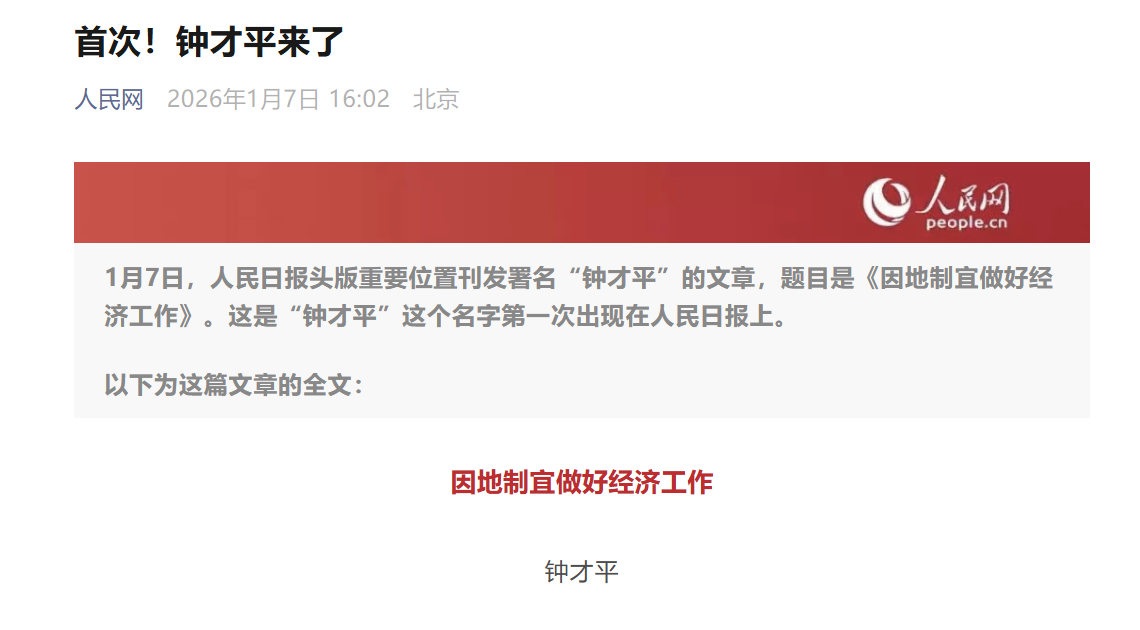
“钟才平”首次亮相人民日报,连发重磅文章有何深意
2 1 Shi Ji Jing Ji Bao Dao· 2026-01-12 14:01
Core Viewpoint - The series of articles by "Zhong Caiping" published in the People's Daily starting January 7 serves as a significant indicator of the government's economic strategy for 2026, emphasizing practical guidance for economic work and addressing key areas of focus [1][4]. Group 1: Articles Overview - The "Zhong Caiping" series consists of six articles covering themes such as tailored economic work, development towards new and superior standards, enhancing macroeconomic governance, promoting consumption and investment, improving livelihoods, and expanding openness [5]. - The articles aim to clarify the central government's strategic framework for the upcoming period, particularly in light of the recent Central Economic Work Conference's focus on 2026's key tasks [5][6]. Group 2: Economic Policy Insights - The article titled "Enhancing Policy Integration Effects" highlights a new emphasis on stabilizing economic growth and reasonable price recovery as key considerations for monetary policy, reflecting a shift in approach [8]. - The 2026 monetary policy is expected to maintain a moderately loose stance, focusing on high-quality economic development and reasonable price recovery, with a combination of total and structural policy tools to support demand and stabilize market expectations [9]. Group 3: Investment and Consumption Dynamics - The article "Coordinating Consumption and Investment" argues that investment and consumption are not mutually exclusive but rather mutually reinforcing, essential for achieving a growth target of around 5% in 2026 [10]. - Recent measures include the early release of a project list and central budget investment plan totaling 295 billion yuan, aimed at stabilizing investment and ensuring continuity in project execution [11]. Group 4: Real Estate Sector Outlook - The article "Promoting High-Quality Development in Real Estate" indicates that there remains significant potential in the real estate sector, with unmet housing demand among urban residents, suggesting a continued role as a pillar industry [12]. - The focus on improving livelihoods through real estate development is expected to stimulate substantial investment, with initiatives like affordable housing and urban infrastructure projects projected to generate nearly 2 trillion yuan in annual investment [12].