长期债务周期

Search documents
达利欧:美伊在霍尔木兹海峡的“决战”,将改变世界
财联社· 2026-03-17 02:44
Core Viewpoint - Ray Dalio warns that the ongoing struggle between the U.S. and Iran in the Strait of Hormuz could lead to a "final showdown" that will not only affect oil prices but also reshape global dynamics [1][2]. Group 1: Impact of the Strait of Hormuz Conflict - The control of the Strait of Hormuz is crucial, as losing it to Iran could have catastrophic consequences for the U.S., its allies, and the global economy [3][4]. - Dalio emphasizes that the U.S. must assert its strength by securing control over the Strait to maintain confidence in its global power [3][4]. - If the U.S. fails to secure the Strait, it risks a scenario similar to the British experience during the Suez Crisis, leading to a loss of confidence among allies and a potential decline in the dollar's status as a reserve currency [4]. Group 2: Nature of the Conflict - The battle for control over the Strait is expected to be the most challenging phase of the conflict, with any agreements likely to be ineffective [5]. - The outcome of this "final showdown" will have far-reaching implications for global trade, capital flows, and geopolitical relations with countries like Russia, North Korea, and those in Europe and Asia [5]. Group 3: Historical Context and Future Considerations - Dalio outlines five interconnected forces that drive changes in monetary, political, and geopolitical orders, including long-term debt cycles and domestic political chaos [6][7]. - The current events in the Middle East are part of a larger historical cycle, and understanding these forces can help gauge the health and progress of this "big cycle" [6].


达利欧:经济看起来很复杂,但实际上它像一台简单的机器一样运转……6大章节看懂!如何在周期中不被淘汰?
雪球· 2026-03-01 13:00
Group 1 - The core idea of the article is that understanding the economy as a machine driven by credit and transactions can help individuals navigate investment opportunities and risks [4][6][7] - Transactions are the fundamental unit of the economy, where buyers exchange money or credit for goods, services, or financial assets, representing the total activity of an economic system [6] - Credit, rather than money, is identified as the primary driver of economic activity, with a significant disparity between total credit in the U.S. (approximately $50 trillion) and actual money (around $3 trillion) [7][8] Group 2 - The article outlines three main forces driving economic fluctuations: productivity growth, short-term debt cycles, and long-term debt cycles [12] - Productivity growth is a slow but essential factor that influences long-term living standards, despite being less noticeable in daily life [13][14] - Short-term debt cycles, occurring every 5-8 years, are characterized by phases of expansion, overheating, tightening, and recovery, primarily controlled by central banks [16][20] Group 3 - Long-term debt cycles, which last 75-100 years, result from the accumulation of short-term cycles and can lead to systemic crises when debt levels become unsustainable [21][22] - The article emphasizes the importance of recognizing the difference between recession and deleveraging, with the latter being a more severe and systemic issue [29][30] Group 4 - The deleveraging process involves reducing debt burdens through various methods, including austerity, debt restructuring, wealth redistribution, and printing money [30][33] - Beautiful deleveraging occurs when debt relative to income decreases while maintaining positive economic growth, whereas ugly deleveraging leads to severe economic pain and instability [35][36] Group 5 - Investment principles outlined include valuing assets based on future cash flows, understanding market dynamics through total spending and supply, and the importance of diversification to mitigate risk [44][48] - The article stresses the need for systematic decision-making and the importance of recognizing the current position within economic cycles to avoid significant errors in investment strategies [64][66]

全球秩序重构下的“慢牛”与配置主线 | 策马点金
Qi Huo Ri Bao· 2026-02-17 23:45
Core Viewpoint - The global financial market is at a critical juncture, with the long-term debt cycle under pressure and a restructuring of global order and reserve assets expected to influence market trends in 2026 [1][2]. Macro Context - The current global economy is at the tail end of a long-term debt cycle, with government debt as a percentage of GDP at historically high levels and diminishing marginal effects of traditional monetary policy [2][3]. - The international monetary system dominated by the US dollar faces challenges, with international trade shifting from globalization to regionalization and increased protectionism of key technologies and resources [2]. Commodity Market Outlook - The downward pressure on the commodity market is expected to ease, with prices gradually rising, although sector differentiation will continue [2][4]. - Gold is anticipated to maintain a strong oscillating pattern due to ongoing diversified purchases by central banks and geopolitical uncertainties [4]. - Copper and aluminum are seen as leading indicators of structural market trends, driven by demand from infrastructure upgrades related to electric grids and new energy vehicles [4]. - The oversupply pressure in the oil market is gradually being digested, with OPEC's production increase slowing down, which may push oil prices higher [4]. Agricultural Products - Agricultural prices are likely to continue a pattern of oscillation, with current prices at low levels and cost support gradually emerging [5]. A-Share Market - The A-share market is expected to exhibit a "low volatility, slow bull" characteristic in 2026, with opportunities arising from three main lines: upstream resource companies benefiting from fiscal expansion, companies achieving breakthroughs in key technologies, and undervalued defensive sectors [6][8]. Investment Strategy - The asset allocation strategy for 2026 should focus on flexibility and structure, moving from traditional balanced approaches to more aggressive strategies [10]. - Long-term opportunities in the commodity market, particularly in gold, copper, and aluminum, are highlighted as core investment options [10]. Differentiated Investment Strategies - Conservative investors should focus on high-grade bonds, deposits, and money market funds, with limited exposure to equities and commodities [12]. - Moderate investors are advised to balance their portfolios with a tilt towards equities, while aggressive investors should increase their allocations to stocks and commodities [12].

全球秩序重构下的“慢牛”与配置主线
Qi Huo Ri Bao· 2026-02-17 23:41
Macro Background: Debt Cycle and Order Reconstruction - The global market is currently at the tail end of a long-term debt cycle, with government debt as a percentage of GDP at historically high levels, and the marginal effectiveness of traditional monetary policy is diminishing [4] - The international monetary system dominated by the US dollar is facing multiple challenges, with international trade shifting from globalization to regionalization, and increased protection of key technologies and resources [4] - The reconstruction of global order and reserve assets will be a key backdrop for financial market trends in 2026 [4] Commodity Market: Downward Pressure Easing - The downward pressure on the commodity market is expected to ease, with prices gradually rising, although sector differentiation will continue [6] - Gold is anticipated to maintain a strong oscillating pattern due to ongoing diversified purchases by central banks and geopolitical uncertainties, enhancing its status as a long-term currency [6] - Copper and aluminum are seen as leading indicators of structural market trends, driven by rigid demand from infrastructure upgrades related to electric grids, electric vehicles, and AI data centers [6] - The oversupply pressure in crude oil is gradually being digested, with OPEC's production increase pace slowing, which may push oil prices higher [6] Agricultural Products: Price Stabilization - Agricultural product prices are likely to continue a pattern of oscillation, with current prices at low levels and cost support gradually emerging [7] - The supply-demand balance is expected to improve, with attention needed on weather factors and trade policies during peak demand periods [7] A-Share Market: "Low Volatility, Slow Bull" and Structural Opportunities - In the context of high global debt and rising inflation, the long-term downward space for government bond yields is limited, leading to a "strong stocks, weak bonds" scenario [8] - The A-share market in 2026 is expected to exhibit characteristics of "low volatility, slow bull," with three main investment themes: upstream resource companies benefiting from fiscal expansion and rising resource prices, companies achieving breakthroughs in key technologies, and undervalued defensive sectors [9] Investment Strategy: From Balanced to Proactive - The asset allocation logic for 2026 should focus more on flexibility and structure, moving from traditional balanced stock-bond strategies to more proactive approaches [10] - Real assets and equity assets are favored in the current inflation and growth environment, while the safe-haven function of bonds is relatively weak [10] - Long-term opportunities in the commodity market, particularly in gold, copper, and aluminum, as well as price recovery in undervalued chemical products, are worth attention [10] Differentiated Investment Strategies - Conservative investors should focus on high-grade bonds, deposits, and money market funds, maintaining high liquidity, with a limited allocation to equities and commodities [11] - Moderate investors should balance stock and bond allocations, with a tilt towards equities, while considering commodity investments through thematic funds or resource stocks [11] - Aggressive investors may overweight stocks and commodities, with a significant allocation to equities and direct participation in the futures market or high-volatility commodity stocks [11]

有色钢铁行业周观点(2026年第4周):金银比突破50,贵金属有望带领工业金属加速上涨
Orient Securities· 2026-01-26 00:45
Investment Rating - The report maintains a "Positive" outlook on the non-ferrous metals industry [5] Core Viewpoints - The gold-silver ratio has broken through 50, indicating that precious metals are likely to lead industrial metals in accelerating price increases. Recent significant price increases in silver reflect a broader trend of rising physical metal prices as a response to the weakening trust in fiat currency systems [7][12] - The long-term debt cycle is entering its late stage, with rising physical metal prices signaling a loss of confidence in existing fiat currency systems. This trend is expected to continue, with precious metals likely to set new historical price records in 2026 [12] - Zinc is viewed as an overlooked foundational material in the context of de-globalization, with favorable supply-demand dynamics suggesting continued price increases. The report highlights the potential for increased demand from re-industrialization efforts in Asia, Africa, and Latin America [13] - The aluminum sector is expected to benefit from geopolitical concerns, with China's electrolytic aluminum industry poised to enjoy valuation premiums due to its supply chain security and competitive advantages [13] Summary by Sections Precious Metals - The report emphasizes the potential for precious metals to lead industrial metals in price increases, driven by a breakdown in the gold-silver ratio and a late-stage long-term debt cycle [7][12] - Specific investment opportunities include companies like Chifeng Jilong Gold Mining (600988) and others in the precious metals sector [7] Zinc Sector - The report identifies zinc as a critical material in the context of re-industrialization, with supply constraints and increasing demand expected to drive prices higher [13] Aluminum Sector - The report highlights the competitive advantages of China's electrolytic aluminum industry, which is expected to benefit from geopolitical tensions and supply chain security [13] Steel Sector - The steel industry is currently facing weak fundamentals as it approaches the seasonal low period before the Spring Festival, with expectations for policy measures to support the industry [14] - Steel production and consumption metrics indicate a slight increase in iron output but a decrease in rebar demand, reflecting a mixed outlook for the sector [19][26] New Energy Metals - The report notes significant increases in lithium and cobalt prices, with production metrics showing substantial year-on-year growth in lithium carbonate output [37][46] - The demand for new energy vehicles remains strong, with production and sales figures indicating continued growth in the sector [41] Industrial Metals - The report discusses the overall upward trend in industrial metal prices, driven by political policy risks and supply reduction expectations [56] - Specific metrics indicate rising copper production and declining refining fees, suggesting a tightening supply environment [57]





有色钢铁行业周观点(2026年第4周):金银比突破50,贵金属有望带领工业金属加速上涨-20260126
Orient Securities· 2026-01-26 00:15
Investment Rating - The report maintains a "Positive" outlook on the non-ferrous metals industry [5] Core Insights - The gold-silver ratio has broken through 50, indicating that precious metals are likely to lead industrial metals in accelerating price increases. Recent significant price increases in silver reflect a broader trend of rising physical metal prices as a response to the weakening trust in fiat currency systems [7][12] - The long-term debt cycle is entering its late stage, with rising physical metal prices signaling a loss of confidence in existing fiat currency systems. This trend is expected to continue into 2026, with precious metals likely to set new historical price records [12] - Zinc is identified as an overlooked material in the context of de-globalization, with favorable supply-demand dynamics suggesting continued price increases. The report highlights the potential for increased demand from re-industrialization efforts in Asia, Africa, and Latin America [13] - The aluminum sector is expected to benefit from geopolitical concerns, with China's electrolytic aluminum industry poised to enjoy valuation premiums due to its supply chain security and competitive advantages [13] Summary by Sections Precious Metals - The report emphasizes the importance of precious metals in preserving wealth amid a declining trust in fiat currencies, recommending active investment in this sector [12] Zinc Sector - The report suggests that zinc, as a fundamental material for de-globalization, will see increased demand driven by infrastructure needs in emerging markets, despite current market skepticism [13] Aluminum Sector - The electrolytic aluminum industry in China is expected to benefit from enhanced supply chain security and competitive advantages, with a positive outlook for profitability and valuation [13] Steel Industry - The steel sector is currently facing weak fundamentals as it approaches the seasonal low around the Spring Festival, with expectations for policy measures to support the industry [14] - Steel production has seen a slight increase, but demand for rebar is weakening, indicating a mixed outlook for the sector [19] New Energy Metals - Lithium and carbonate prices have shown significant increases, with production levels rising sharply, indicating strong demand in the new energy vehicle sector [37][41] - The report notes a substantial increase in the production of lithium carbonate and hydroxide, reflecting the growing demand for electric vehicles [37] Industrial Metals - The report indicates that political risks and supply constraints are contributing to an overall increase in industrial metal prices, with copper production expected to rise despite declining refining fees [56][57]
有色钢铁行业周观点(2026年第2周):金属商品大涨的启示-20260111
Orient Securities· 2026-01-11 12:29
Investment Rating - The report maintains a "Positive" investment rating for the non-ferrous and steel industry in China [5] Core Insights - The report emphasizes that investing in resource stocks is not only about bullish metal prices but also serves as a hedge against rising inflation. The recent surge in metal prices, including gold, silver, copper, and aluminum, is attributed to a significant drop in market expectations for a Federal Reserve rate cut, alongside rising inflation expectations [8][13] - The aluminum sector is expected to benefit from geopolitical events, with China's electrolytic aluminum industry poised to enjoy valuation premiums due to its supply chain security and competitive advantages. The report highlights the increasing domestic supply of bauxite and alumina, which enhances the industry's resource security [14] - The precious metals sector is viewed positively as the long-term debt cycle enters its late stage, with rising physical prices reflecting a loss of trust in fiat currency systems. The report anticipates that precious metal prices will continue to reach historical highs in 2026 [15] - The copper sector faces supply chain vulnerabilities, with recent labor disputes leading to production cuts. The report suggests that the basic fundamentals support the equity side of copper investments, which are expected to rise alongside copper prices [16] Summary by Sections Non-Ferrous Metals - The report indicates that the recent collective rise in metal prices is a response to inflationary pressures and a re-evaluation of physical asset values as the dollar debt cycle matures [8][13] - The aluminum sector is highlighted for its strong supply chain capabilities, with domestic production of bauxite and alumina expected to increase, providing a competitive edge [14] - The precious metals market is projected to see continued price increases, driven by a shift in investor sentiment towards physical assets as a safeguard against debt risks [15] Steel Industry - The steel industry is currently experiencing a weak fundamental outlook as it approaches the year-end off-season, with a slight increase in iron and steel production but a decrease in demand [17][22] - Inventory levels for both social and steel mill stocks have increased, indicating a potential oversupply situation [24] - Steel prices have shown a slight overall increase, with specific products like hot-rolled steel experiencing marginal price rises [36][37] New Energy Metals - The report notes a significant year-on-year increase in lithium carbonate production, with December 2025 figures showing a 69.09% rise [40] - The demand for new energy vehicles remains strong, with production and sales figures for November 2025 reflecting substantial growth [44] - Prices for lithium and cobalt have risen sharply, indicating a robust market for new energy metals [49][50]




7年翻倍!美国未偿国债规模首次突破30万亿美元!美债会违约吗?
Sou Hu Cai Jing· 2025-12-05 04:37
Group 1 - The core point of the article is that the U.S. national debt has surpassed $30 trillion for the first time in history, which translates to nearly $90,000 per American citizen [1][3] - The U.S. Treasury reported that the interest payments on the debt are approaching $2.7 billion daily, with interest expenditures projected to exceed defense spending by the fiscal year 2025, becoming the third-largest item in the federal budget [3][8] - The Congressional Budget Office (CBO) had originally predicted that the debt would reach $30 trillion by 2030, but it was reached five years earlier than expected [3][5] Group 2 - The primary reason for the high debt level is excessive spending, with the federal budget deficit for fiscal year 2025 projected at $1.775 trillion, while expenditures are expected to surpass $7 trillion [7][8] - The U.S. government is caught in a vicious cycle of borrowing, where it takes only three months to accumulate an additional $1 trillion in debt, relying on new debt issuance to pay off old debt [9] - Internal policy conflicts are undermining the ability to manage debt, with significant disagreements between the Federal Reserve and the White House, and Congress struggling to reach consensus on spending cuts [10] Group 3 - The likelihood of a short-term default on U.S. debt is very low, but long-term risks are increasing [12] - The U.S. has two main strategies to manage its debt: leveraging the dollar's dominance to print money and pressuring allies to buy more debt, although these methods may lead to long-term consequences [12] - The founder of Bridgewater Associates, Ray Dalio, has warned that the U.S. is nearing the end of its long-term debt cycle, and the rising interest costs exceeding defense spending is a dangerous signal [12][14]
私募掘金之路兴起!中欧瑞博、盛麒资产、持赢、观理等如何看?
Sou Hu Cai Jing· 2025-10-11 08:47
Core Viewpoint - The international gold price has significantly increased during the National Day and Mid-Autumn Festival holiday, reaching a historical high of over $4000 per ounce, with a cumulative increase of 4.72% during the holiday period [1][3]. Group 1: Market Performance - On October 8, the London spot gold price broke through $4000 per ounce, with a peak price of $4049.64 per ounce, while COMEX gold reached a maximum of $4081 per ounce, marking a new historical high [1]. - Year-to-date, international gold prices have risen by 52.94%, making it one of the best-performing asset classes this year [3][14]. Group 2: Investment Insights from Private Equity Managers - Various private equity managers, including Zhongou Ruibo, Guoyuan Xinda, and Hainan Sirui, have successfully captured the gold market trend through in-depth fundamental research, achieving impressive performance [1]. - Long-term views from private equity firms suggest that the current gold market is not a short-term trend but possesses long-cycle attributes, indicating substantial room for further growth [2][9][11]. Group 3: Economic and Geopolitical Factors - Factors driving the gold price increase include geopolitical tensions, central banks' increased gold holdings, distrust in the dollar's status as a reserve currency, and a global trend of interest rate cuts [14][19]. - The ongoing geopolitical conflicts and economic uncertainties are expected to further enhance gold's appeal as a safe-haven asset [10][15]. Group 4: Future Outlook - Private equity managers maintain a bullish long-term outlook on gold, with expectations of continued price increases, particularly in light of potential economic downturns and ongoing geopolitical tensions [7][19]. - The consensus among various fund managers is that the current gold price surge is likely to persist, with some predicting that the peak may occur in the coming months [10][11].
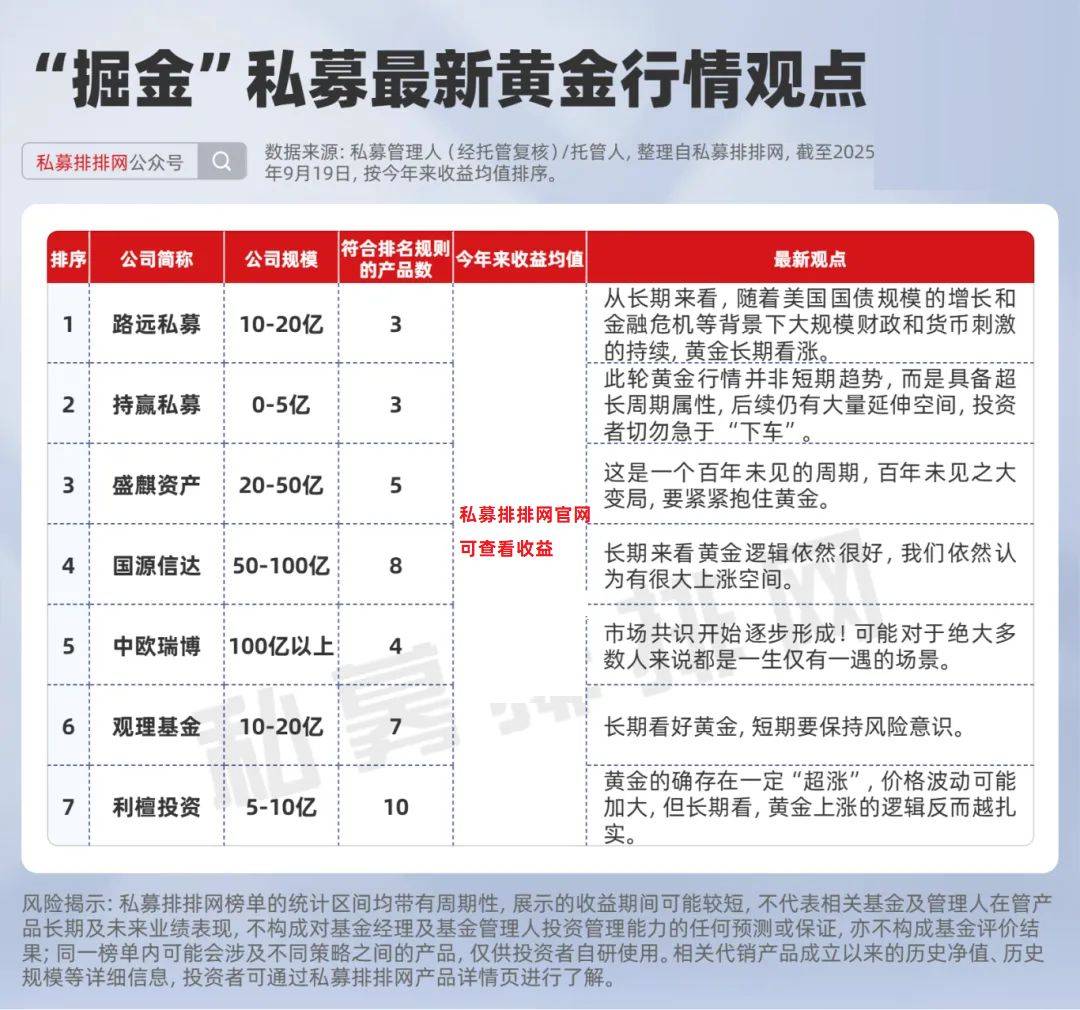
当黄金闪耀,私募“掘金”之路兴起!中欧瑞博、盛麒资产、持赢私募、观理基金等如何看?
私募排排网· 2025-10-10 00:00
Core Viewpoint - The article highlights the significant rise in international gold prices during the National Day and Mid-Autumn Festival holiday, with spot gold prices surpassing $4000 per ounce, marking a historical high. The increase is attributed to various macroeconomic factors and a growing consensus among investors regarding the long-term bullish outlook for gold [1][3]. Group 1: Market Performance - During the holiday period from October 1 to October 8, gold prices increased by 4.72%, with the highest price reaching $4049.64 per ounce [1]. - Year-to-date, international gold prices have risen by 52.94%, outperforming other asset classes [3]. Group 2: Investment Strategies - Several private equity managers, including Zhongou Ruibo and Guoyuan Xinda, have successfully positioned themselves to capitalize on the gold market trend through in-depth fundamental research [1]. - Long-term bullish views on gold are prevalent among private equity firms, with many suggesting that the current gold market is not a short-term trend but rather has long-cycle attributes, indicating further potential for price increases [2][12]. Group 3: Expert Opinions - Wu Weizhi from Zhongou Ruibo emphasizes that the market's perception of gold has shifted positively, with increasing recognition of the factors driving gold prices higher [4]. - Guoyuan Xinda's manager, Shi Jianghui, predicts that further interest rate cuts by the Federal Reserve will lead to increased investment in gold, as funds flow out of the bond market [7]. - Li Tan Investment highlights the long-term collapse of the dollar's credit system as a fundamental driver for gold's price increase, suggesting that geopolitical tensions and economic instability will continue to support gold prices [19][21]. Group 4: Future Outlook - The article suggests that the current gold price surge is part of a larger, unprecedented cycle, with many experts believing that this is a once-in-a-lifetime opportunity for investors [22]. - The ongoing geopolitical conflicts and economic uncertainties are expected to further enhance gold's appeal as a safe-haven asset, with predictions of continued price increases into late 2023 and beyond [10][12].