
黄金ETF

Search documents
金十数据全球财经早餐 | 2026年2月6日
Jin Shi Shu Ju· 2026-02-05 23:02
Group 1 - CME Group raised margin requirements for gold and silver futures, with new gold margin set at 9% and silver at 18%, effective after market close on February 6 [11] - In January, planned layoffs in the U.S. surged by 118% year-over-year to 108,435, marking the highest level for January in 17 years [11] - The World Gold Council reported a record inflow of $18.7 billion into global gold ETFs in January [13] Group 2 - Meituan plans to acquire Dingdong Maicai, a leading fresh e-commerce company in mainland China, for $717 million [14] - The European Central Bank maintained its three key interest rates unchanged, aligning with market expectations [13] - The Bank of England voted narrowly to keep interest rates steady while lowering economic growth forecasts [13] Group 3 - U.S. stock indices experienced declines, with the Dow Jones down 1.2%, S&P 500 down 1.23%, and Nasdaq down 1.59%, marking three consecutive days of losses for the latter two [4] - The Hang Seng Index closed up 0.14%, while the Shanghai Composite Index fell by 0.64% [5][6] - The precious metals market faced significant declines, with gold dropping 3.73% to $4,779.41 per ounce and silver falling 19.68% to $70.79 per ounce [8]


黄金ETF走弱
Jing Ji Guan Cha Wang· 2026-02-02 03:28
Group 1 - The gold stock ETFs, specifically ETF (517520), experienced a decline of 10% [1] - Shanghai Gold ETF (518600) and Gold ETF (518880) both fell by over 7% [1]
机构看好黄金后市表现
Ge Long Hui· 2026-01-25 23:19
Core Viewpoint - The recent significant decline in the US dollar index has led to a substantial increase in precious metals, with gold rising by 8.4% and silver by 14.4% [1] Group 1: Market Trends - The previously unattainable price level of $5000 per ounce for gold is now within reach, prompting various institutions to raise their gold price targets [1] - Goldman Sachs has revised its gold price forecast for the end of 2026 from $4900 per ounce to $5400 per ounce, citing increasing demand from private investors and central banks [1] Group 2: Demand Factors - Goldman Sachs anticipates that central banks will increase their gold holdings by 60 tons per month in 2026, which will contribute to the rising demand for gold [1] - The expectation of interest rate cuts by the Federal Reserve is expected to further enhance the allocation of gold ETFs, driving up gold valuations [1]
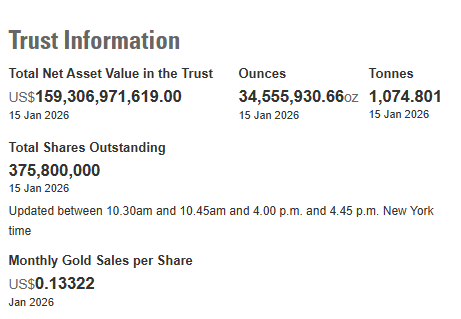
截至1月15日 全球最大的黄金ETF——SPDR Gold Trust的黄金持仓量为1074.8吨
Xin Hua Cai Jing· 2026-01-15 22:55
Group 1 - The SPDR Gold Trust, the world's largest gold ETF, reported a gold holding of 1,074.8 tonnes as of January 15, with an increase of 0.57 tonnes from the previous trading day [1][2]
国内首只!千亿级黄金ETF
财联社· 2026-01-15 06:23
Core Viewpoint - The article highlights the emergence of China's first gold ETF with a scale exceeding 100 billion yuan, driven by rising gold prices and capital inflows [1] Group 1: ETF Growth - The Huaan Gold ETF has surpassed 100.76 billion yuan, with a recent increase of 1.413 billion yuan, bringing the total fund shares to 10.162 billion [1] - Since the beginning of 2025, the fund's scale has increased by 72.106 billion yuan, representing a growth rate of over 200% [1] Group 2: Market Comparison - The total scale of seven ETFs tracking SGE Gold 9999 has reached 231.151 billion yuan [1] - Other notable ETFs include E Fund Gold ETF, Bosera Gold ETF, and Guotai Gold ETF, each exceeding 30 billion yuan, with respective scales of 38.71 billion yuan, 37.147 billion yuan, and 32.584 billion yuan [1]

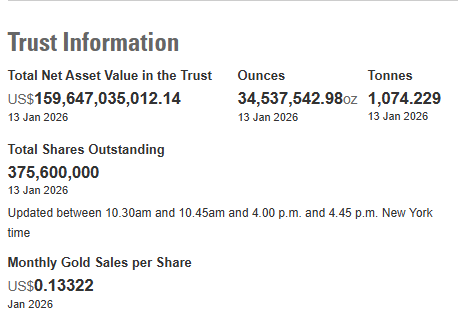
截至1月13日 全球最大的黄金ETF——SPDR Gold Trust的黄金持仓量为1074.23吨 较上一交易日增加3.43吨
Xin Hua Cai Jing· 2026-01-13 22:57
Group 1 - The core point of the article highlights that as of January 13, the SPDR Gold Trust, the world's largest gold ETF, has a gold holding of 1,074.23 tons, which represents an increase of 3.43 tons compared to the previous trading day [1] Group 2 - The increase in gold holdings may indicate a growing interest in gold as a safe-haven asset amid market uncertainties [1] - The SPDR Gold Trust's performance is closely monitored by investors as it reflects broader trends in the gold market [1] - The data suggests a potential shift in investment strategies, with more capital flowing into gold-related assets [1]
VIX指数跌破14!黄金却飙破4500,市场正在酝酿一场无声风暴?
Sou Hu Cai Jing· 2026-01-06 08:38
Core Viewpoint - The current financial market is characterized by a paradox where low VIX levels suggest calmness, while rising gold prices indicate underlying systemic risks [1][3][12]. Group 1: VIX Index and Market Dynamics - The VIX index has dropped to 13.6, a five-year low, indicating a seemingly stable market and high investor confidence [3][5]. - However, this low VIX does not reflect a lack of risk; rather, it suggests that risks are being artificially suppressed by institutions engaging in strategies like shorting volatility and high-frequency trading [7][9]. - The market's apparent calmness is fragile, as historical precedents show that low VIX levels can quickly lead to significant volatility spikes [9][11]. Group 2: Gold Prices and Systemic Risks - Gold prices have surged to over $4,500, reflecting skepticism towards the VIX and signaling growing systemic risks in the financial system [12][14]. - Key indicators, such as the rising interest payments on U.S. debt and the expansion of the Federal Reserve's balance sheet, suggest that systemic risks are accumulating [14][16]. - The demand for gold, including ETFs and physical gold, has increased among central banks and investors, indicating a shift towards tangible assets as a hedge against financial instability [18][20]. Group 3: Future Outlook and Market Sentiment - The outlook for 2026 suggests a facade of geopolitical stability, but real risks lie within the financial system, including potential AI bubble bursts and unsustainable debt levels [22][24]. - The divergence between the narratives of a tech-driven market and the reality of unsustainable debt is becoming more pronounced, with investors increasingly favoring the latter perspective [20][24]. - The current market conditions may not lead to an immediate crisis, but they are likely to prompt a reevaluation of risks and investment strategies as the underlying vulnerabilities become more apparent [26].
东吴证券:港股进入震荡上行期 把握上半年的科技成长行情
智通财经网· 2026-01-06 00:03
Core Viewpoint - Hong Kong stocks are showing strong performance at the beginning of the year, making them attractive for medium to long-term investment allocation. The expectation is that southbound funds will continue to increase their allocation to Hong Kong stocks, primarily driven by insurance and fixed income investments. The performance of Hong Kong technology stocks will be influenced by the pace of interest rate cuts overseas and the performance of US technology stocks, necessitating dynamic observation [1][2][3]. Group 1: Market Performance - In the week of December 29, 2025, to January 2, 2026, emerging markets rose by 2.3%, while developed markets fell by 0.6%. The Hang Seng Technology Index increased by 4.3%, the Hang Seng Index rose by 2.0%, and the Hang Seng Stock Connect gained 1.5%. The energy sector led the gains, with southbound funds primarily flowing into the financial sector and out of telecommunications [2]. - The report indicates that the current position of Hong Kong stocks is attractive for medium to long-term allocation, largely due to factors such as new year positioning and short covering [2][3]. Group 2: Investment Strategy - Short-term positioning in Hong Kong stocks should be controlled, with expectations for better performance around the Chinese New Year. Concerns exist regarding potential pullbacks in US technology stocks in January, which could indirectly affect Hong Kong stocks. Investors are cautious about upcoming earnings reports from US technology companies, focusing on capital expenditures and return on investment [2][3]. - The report emphasizes the importance of maintaining dividends as a base while capitalizing on the technology growth trend in the first half of the year. Southbound funds are expected to continue increasing their allocation to value dividends [3]. Group 3: Economic Indicators - The US manufacturing and services PMIs showed a slowdown, with the December Markit Composite PMI falling to 53, the lowest in six months, and both manufacturing and services PMIs below market expectations. This indicates a weakening economic growth momentum [3][4]. - The US job market remains resilient, with initial jobless claims dropping to 199,000, the lowest level in a year, and continuing claims also decreasing. The housing market is recovering, with a 3.3% month-on-month increase in the pending home sales index for November [4]. Group 4: Global Investment Trends - Global stock ETFs saw a net inflow of $30.976 billion, with a marginal inflow of $4.844 billion, while bond ETFs experienced a net inflow of $5.337 billion. The US stock ETFs had the highest net inflow at $19.64 billion, while Chinese stock ETFs led among emerging markets with a net inflow of $1.46 billion [7]. - The report highlights that institutional investors are reducing their gold holdings, while retail investors are slightly increasing theirs, indicating a shift in investment preferences [6][7].

世界黄金协会首席专家解读:四大关键驱动力将决定2026年金价走势
Jin Shi Shu Ju· 2025-12-31 02:20
Core Insights - Gold is expected to be the best-performing asset class in 2025, driven by four key factors that will also influence its price movements in 2026 [1] Group 1: Key Drivers of Gold Price - The two main macro drivers for gold's success in 2025 are geopolitical tensions and a generally weak US dollar along with moderate interest rate declines [2] - Central banks continue to be strong and stable net buyers of gold, although their purchasing pace has slowed compared to the past two years [2] - A balanced contribution from four main factors—economic expansion, risk and uncertainty, opportunity cost, and momentum—each accounting for approximately 10% of gold's performance [2] Group 2: Future Expectations and Economic Conditions - If the US economy shows a mild decline, it could lead to Federal Reserve rate cuts and further dollar weakness, potentially supporting gold prices by 5% to 15% [3] - In the event of significant economic deterioration, investment demand for gold could surge, with potential prices exceeding $5,000 per ounce [3] - The risk premium associated with gold may decrease if US economic policies yield positive results, potentially leading to a price drop of 5% to 20% [3] Group 3: Central Bank Demand and Recycling Risks - Strong central bank demand is influenced by macro and policy decisions, with continued buying expected to support gold prices [4] - A decline in central bank demand below 600 to 700 tons could exert pressure on future gold prices [4] - In India, gold jewelry is being used as collateral for loans, and an economic downturn could lead to forced liquidations, increasing supply and suppressing gold prices [5]

ETF主力榜 | 黄金ETF华夏(518850)主力资金净流入4127.28万元,居可比基金前2-20251229
Xin Lang Cai Jing· 2025-12-29 08:55
Core Viewpoint - The China Gold ETF (518850.SH) experienced a decline of 0.87% on December 29, 2025, while attracting significant net inflows of 41.27 million yuan from major investors, ranking it among the top two comparable funds [1] Group 1 - The latest trading volume for the China Gold ETF reached 95.78 million shares, with a total transaction value exceeding 920 million yuan, placing it in the top tier of the entire market [1]