
五年规划

Search documents
240秒解码五年规划时间密码 在“时间的棋局”中走出自己的节奏
Yang Shi Wang· 2025-10-14 03:37
央视网消息:2025年是"十四五"的收官之年。五年间,中国的发展不仅写在宏观数据里,更体现在我们的日常生活中。从五年规划 的时间密码出发,看看国家如何用"五年"走稳脚步、走向未来,也启发我们每个人,学会用正确的节奏走好自己的路。 我们用数据和代码,梳理出了三条时间线,想从中看看,国家是怎样在"时间的棋局"中走出自己的节奏。第一条时间线,是把每一 轮规划放在国际大事的坐标上。这样一比对就发现,中国的许多政策从来不是临时应对,而是提前布局。 五年为周期,既能稳住脚步,也能早早着眼未来。前五个五年计划集中力量进行工业化建设;"八五"计划纲要中对贸易和开放的强 调,让国家更好适应世贸组织成立后的国际规则;"十一五"规划纲要也提前为全球金融海啸打下应对的基础。 2021年发布的"十四五"规划纲要直指世界正面临"百年未有之大变局",当时大家不解其意。但随后,地缘冲突、全球供应链震荡接 踵而来,规划早已为此预设了方案,那就是促进"国内国际双循环"。 进入了新时代,外部环境更加错综复杂,世界经济增长乏力,国际博弈加剧。此时,"十三五"强调的"创新、协调、绿色、开放、共 享"五大发展理念,让中国走上了高质量发展的道路。 "十三 ...


早盘直击|今日行情关注
申万宏源证券上海北京西路营业部· 2025-10-13 02:25
Group 1 - The focus of the market is on the new five-year plan and the expectation of interest rate cuts by the Federal Reserve, which will guide China's economic direction and provide investment clues for the capital market [1] - The five-year plan emphasizes the importance of technological innovation and R&D investment, shifting from a focus on the ratio of the three industries to transformation and upgrading, as well as the development of the service industry [1] - The Federal Reserve is expected to have two interest rate meetings this year, with a high probability of two rate cuts, which is generally favorable for the performance of risk assets [1] Group 2 - The market experienced a volatile rebound this week, with the Shanghai Composite Index showing an upward shift, breaking through the previous resistance level established since late August [2] - The Shenzhen Component Index lagged slightly due to significant profit-taking on Friday, while trading volume increased compared to the previous week [2] - Market hotspots are concentrated in upstream resource products and cyclical industries, with small and mid-cap stocks leading in gains, while technology stocks underperformed [2]

华金证券:十月慢牛趋势不变,风格难改
Sou Hu Cai Jing· 2025-10-12 03:45
Core Viewpoint - The main factors influencing the A-share market in October are policies and external events, liquidity, and fundamentals, with historical data indicating a tendency for the market to be volatile during this month [1][2]. Group 1: Historical Performance - Since 2010, the Shanghai Composite Index has shown an upward trend in October during years when the "Five-Year Plan" was implemented, such as in 2010, 2015, and 2020 [2][3]. - Out of the last 15 years, the index has risen in 8 instances during October [2]. Group 2: Influencing Factors - Policies and external events are the core influencing factors; positive developments may lead to market gains, while tightening policies or negative external shocks could weaken the market [2][3]. - Liquidity conditions are also crucial; a loose liquidity environment can boost the market, as seen in 2010 with the anticipation of QE2, in 2015 with interest rate cuts, and in 2019 with Fed rate cuts [2][3]. - The performance of the third-quarter reports is expected to significantly impact the market in October, with potential structural recovery in earnings [2][3]. Group 3: October Outlook - The A-share market is likely to continue a slow bullish trend in October, supported by positive policy expectations and a potentially loose liquidity environment [3]. - The upcoming Fourth Plenary Session may enhance positive policy expectations, while geopolitical tensions could remain a concern, particularly regarding U.S.-China trade relations [3]. - Economic conditions are expected to show weak recovery, with third-quarter earnings reports indicating a structural rebound in sectors like technology and cyclical industries [3]. Group 4: Sector Allocation - The technology and growth sectors are expected to outperform in October, particularly those related to the "14th Five-Year Plan," which emphasizes technological innovation and domestic demand [4]. - Historical data suggests that industries with strong earnings reports during the third-quarter disclosure period tend to perform well, with high growth expected in technology and cyclical sectors [4]. - The current Fed rate cut cycle may favor technology and certain cyclical industries, with a higher likelihood of leading performance from sectors like computing, automotive, and electronics [4]. - Recommendations include accumulating positions in sectors benefiting from policy support and improving fundamentals, such as communication, machinery, electronics, and renewable energy [4].
美国学者:中国依托自身模式取得非凡成就,美国不得不正视现实丨世界观
Zhong Guo Xin Wen Wang· 2025-10-10 05:58
Core Viewpoint - The Chinese development model is highly stable and has achieved remarkable success, which the United States must acknowledge [2][6]. Group 1: Chinese Development Model - The Chinese model is characterized by a strong central government that enables coordinated national efforts to withstand crises [2][3]. - China's execution mechanism includes a merit-based system for selecting officials, long-term performance evaluations, and the implementation of five-year plans that align national and local goals [3][5]. - The ultimate strategic advantage of China lies in its industrial policy, which effectively mobilizes top talent and resources across various sectors to achieve national objectives [5][6]. Group 2: Cultural and Strategic Advantages - Confucian values play a crucial role in China's collective mindset, emphasizing self-improvement for the benefit of family and society rather than individual gain [5][6]. - The strategic philosophy of "winning without fighting," as articulated in Sun Tzu's Art of War, reflects China's approach to conflict and competition, contrasting with Western military strategies [6][10]. Group 3: U.S.-China Relations - The U.S. policy of "containing China" is deemed unrealistic, especially as China's technological advancements and talent pool continue to grow [7][10]. - The upcoming U.S. midterm elections are critical, with potential implications for domestic policy and the perception of China's rise [8][9]. - There is significant potential for cooperation between the U.S. and China on global issues such as climate change, public health, and poverty alleviation, which requires a shift in U.S. understanding of China's role [10].
140万亿!中国经济的“大逻辑”
Sou Hu Cai Jing· 2025-10-01 04:52
Core Viewpoint - China's GDP is expected to exceed 140 trillion yuan, reflecting a consistent and strategic economic growth rather than mere luck [1] Group 1: Strategic Determinants - The development strategy in China is characterized by long-term planning, including five-year plans and counter-cyclical adjustments, which contribute to stable economic acceleration [1] - The focus on theoretical innovation has evolved from "development is the hard truth" to "new development concepts" and "new quality productivity," impacting various sectors such as robotics and digital agriculture [1] Group 2: Societal Contributions - The significant reduction in poverty, with 100 million people lifted out, and the emergence of 400 million middle-income individuals, highlight the alignment between national goals and individual aspirations [1] - The establishment of the world's largest social security system enhances the overall productivity driven by the people's creativity [1] Group 3: Institutional Advantages - The dual-driven model of proactive government and effective market mechanisms fosters continuous vitality in the economy [1] - With a population of 1.4 billion, China's vast market facilitates rapid iteration of emerging industries, providing a broad stage for economic activities [1] Group 4: Future Outlook - The achievement of 140 trillion yuan is viewed not as a peak but as a new starting point for further economic development, emphasizing clarity in direction, innovation in theory, precision in regulation, strength in the populace, and expansiveness in the market [1]

“十四五”重大项目复盘与“十五五”展望|宏观经济
清华金融评论· 2025-09-26 09:14
Core Viewpoint - The upcoming 14th National Congress will discuss the "14th Five-Year Plan" and its major projects, which will reflect the strategic intentions and medium-to-long-term goals of the country, guiding future policies and resource allocations [4][5][6]. Summary by Sections Major Project Positioning and Classification - Major projects in the Five-Year Plans are essential for reflecting national strategic intentions and medium-to-long-term goals, serving as the core direction for policy resources and funding [6][8]. - There is no unified standard for defining major projects, but they generally need to align with high-quality development and national industrial policies [6][7]. - Major projects are categorized into infrastructure, industrial, livelihood, and ecological projects, with local adaptations based on regional development plans [6][7]. Historical Review of Major Projects - Since the first Five-Year Plan in 1953, major projects have evolved from focusing on heavy industry to encompassing infrastructure, technology, and ecological initiatives [11][12]. - The "14th Five-Year Plan" emphasizes high-quality development, green low-carbon initiatives, and technological innovation, reflecting a shift in national strategic focus [12][15]. Implementation Mechanisms - The implementation of major projects is supported by a series of policies to ensure smooth execution, including streamlined approval processes and enhanced funding mechanisms [8][9][10]. - The "13th Five-Year Plan" introduced a systematic approach to major projects, emphasizing a "list-style" method for effective implementation [15]. Upcoming "15th Five-Year Plan" Major Projects - The "15th Five-Year Plan" is expected to continue the focus on livelihood, technology, infrastructure, ecological construction, and security projects, building on the previous plan's objectives [20][21]. - Local governments are actively planning major projects that align with national strategies while addressing regional needs, particularly in infrastructure and technology innovation [21][23]. Specific Project Examples - Significant projects under the "14th Five-Year Plan" include major water conservancy projects, transportation infrastructure, and initiatives in artificial intelligence and green energy [16][19][22]. - Local plans for the "15th Five-Year Plan" include substantial investments in waterway construction and technology-driven projects, with some regions planning over 500 major projects with total investments exceeding 180 billion [22][24].

中国下一个赢家:复刻阿尔法策略-China Next Winners_ Repeating the Alpha Playbook
2025-09-25 05:58
Asia Quantitative Strategy China Next Winners: Repeating the Alpha Playbook Rupal Agarwal +65 6326 7641 rupal.agarwal@bernsteinsg.com Cheng Zhang, CFA, CQF +852 2123 2636 cheng.zhang@bernsteinsg.com This report is part of a series on China Next Winners in which we identify the next generation of industries and corporate winners in China. We present an alpha playbook deriving systematic insights from the past for the future. Five-year plan, a useful guide: In the run-up to the 15th five-year plan to be annou ...
方颖:把坚持问计于民落到实处
Jing Ji Ri Bao· 2025-09-23 00:04
Core Points - The year marks the conclusion of the "14th Five-Year Plan" and the planning for the "15th Five-Year Plan," emphasizing the importance of scientific planning in governance and modernization of the governance system [1][2] - The "15th Five-Year Plan" is crucial for implementing the strategic deployments of the 20th National Congress of the Communist Party and advancing Chinese-style modernization [1][2] - Historical evidence shows that long-term planning has significantly contributed to China's economic development and social stability, transitioning from basic needs to overall well-being [2] Group 1 - The importance of scientific decision-making, democratic decision-making, and legal decision-making in the planning process is highlighted, ensuring that top-level design and public consultation are integrated [3][4] - The "14th Five-Year Plan" involved extensive public engagement, with over 311.3 million suggestions collected online, setting a precedent for public participation in planning [3][4] - The need for a systematic approach in planning is emphasized, focusing on the interconnections between micro and macro, local and overall, and current and long-term relationships [6] Group 2 - The establishment of effective channels for public consultation is necessary to gather genuine public opinion and enhance understanding of strategies and plans [4] - Utilizing digital technology can improve data collection and analysis, allowing for better understanding of public needs and governance challenges [5][6] - A systematic view is essential for integrating top-level design with public input, ensuring that societal concerns are embedded in the overall planning framework [6]
国新办9月22日将举行发布会!三分钟看完周末发生了什么
Sou Hu Cai Jing· 2025-09-22 01:05
Market Performance - Global indices showed mixed performance, with the Hang Seng Tech Index leading with a gain of 5.09% [1] - The A-share market experienced a downward trend, particularly in the banking and non-bank financial sectors, which saw declines of 4.21% and 3.66% respectively [2][3] - The overall equity market in China faced volatility, with the Shanghai Composite Index dropping by 1.30% [2] Industry Performance - The coal industry led the weekly gains with a rise of 3.5%, followed closely by electric power equipment at 3.1% and electronics at 3.0% [3] - Conversely, the banking sector faced significant losses, declining by 4.2%, while non-bank financials and non-ferrous metals also saw declines of 3.7% and 4.0% respectively [3] - Year-to-date performance highlights include the electronics sector up 44.3% and electric power equipment up 32.0% [3] Investment Strategies - The upcoming "14th Five-Year Plan" is expected to create investment opportunities, with significant trading activity anticipated around key announcements [5][6] - Historical data suggests that the market tends to react positively during the trading periods surrounding the release of the "Five-Year Plan" documents, with an average increase of 7.02% [6] Sector Highlights - The robotics sector is gaining traction, driven by expectations of recovering T-chain orders and recent positive developments from key industry players [4] - The banking sector has been under pressure due to a shift in market sentiment and capital flow towards higher-risk sectors, leading to a notable decline in stock prices [4]

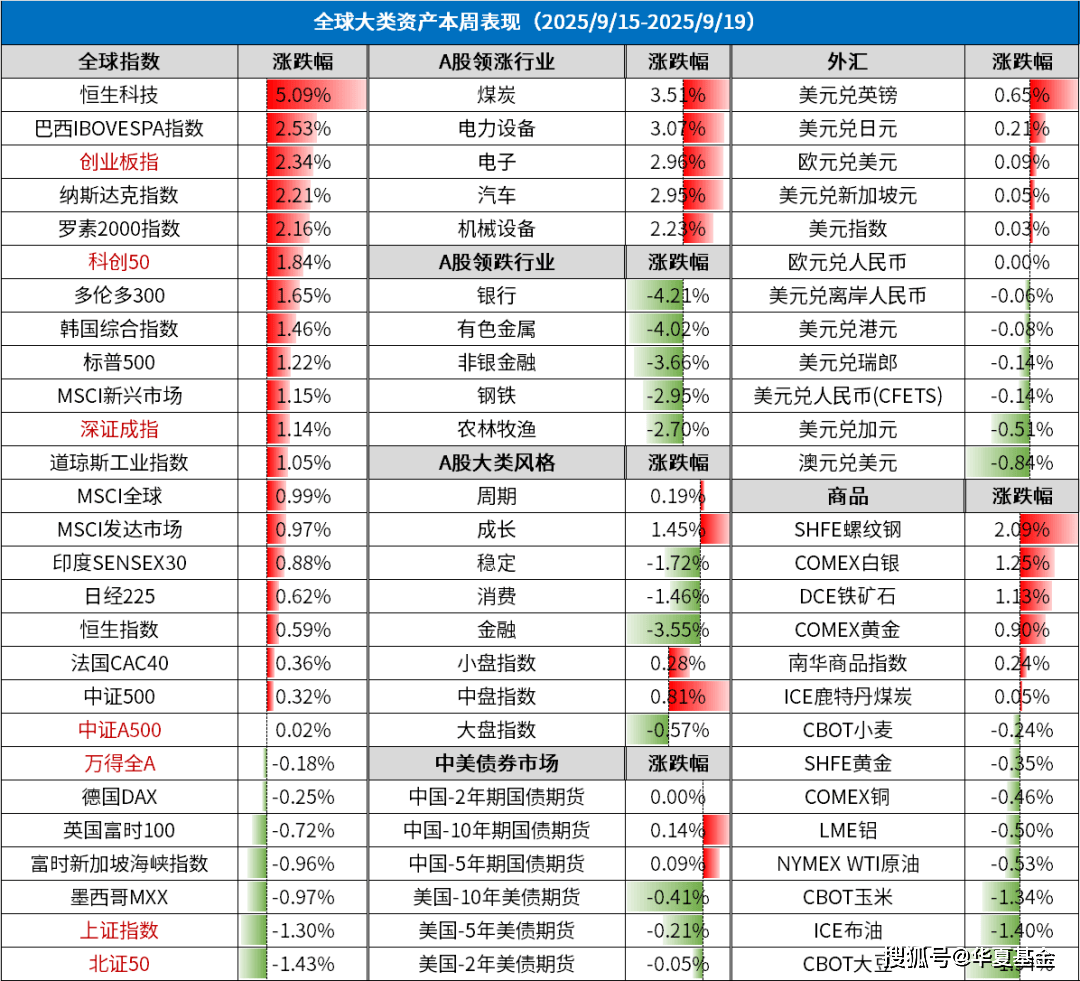
一文看懂,五年规划是如何影响我们普通人的财富和命运的?
Hu Xiu· 2025-09-17 11:01
为什么说五年规划的本质根本不是求稳,而是一场又一场国运级别的豪赌?看懂今天这个视频,你就看 明白了这个赌局的真相,以及我们普通人的财富和命运是如何被这场豪赌给彻底改变的。 ...