债务上限

Search documents
反驳小摩CEO“崩溃论”!贝森特“嘴硬”:美国绝不会违约
凤凰网财经· 2025-06-02 13:49
Core Viewpoint - The U.S. Treasury Secretary, Yellen, asserts that the U.S. will never default on its debt, aiming to alleviate concerns from Wall Street regarding the country's fiscal situation, especially in light of warnings from JPMorgan CEO Jamie Dimon about a potential collapse in the U.S. bond market [1][2]. Group 1: Treasury Secretary's Statements - Yellen emphasizes that the U.S. will not hit a fiscal wall and will remain vigilant regarding its debt obligations [1]. - She refrains from disclosing the "X date," which refers to when the Treasury will exhaust its cash and special accounting measures to meet federal obligations under the debt ceiling [1]. - Yellen predicts that if the debt ceiling is not raised or suspended, the U.S. could run out of borrowing authority before August [1]. Group 2: Response to Wall Street Concerns - Yellen counters Dimon's warning about a potential collapse in the U.S. bond market, stating that such predictions have not materialized in the past [2]. - The Congressional Budget Office has warned that without new budget legislation, the U.S. debt-to-GDP ratio will exceed levels not seen since the 1940s [2]. - Moody's has recently downgraded the U.S. sovereign credit rating, following similar actions by other major rating agencies [2]. Group 3: Fiscal Policy and Projections - Yellen argues that many forecasts do not account for significant revenue increases from Trump's new import tariffs, which could generate trillions in government revenue [3]. - She claims that the government's budget deficit this year will be lower than last year's, with further reductions expected in two years [3].


(财经天下)国际金融机构警示美债风险,到期压力有多大?
Zhong Guo Xin Wen Wang· 2025-06-01 11:46
Group 1 - Moody's has downgraded the U.S. sovereign credit rating from Aaa to Aa1, marking the loss of the last "AAA" rating among major international rating agencies, primarily due to the increasing scale of U.S. government debt and its interest payment ratio [1] - Ray Dalio, founder of Bridgewater Associates, predicts that U.S. debt could reach $50 trillion by 2035, suggesting that Moody's has underestimated the risks associated with U.S. Treasury bonds [1] - Goldman Sachs' president John Waldron indicates that the focus in the bond market is shifting from tariff disputes to the rising U.S. government debt, which is pushing up long-term interest rates, particularly the 30-year Treasury yield, to its highest level in nearly two decades [1] Group 2 - Concerns among foreign investors regarding U.S. Treasury bonds are rising due to high inflation and a weakening dollar, which could diminish the actual value of their holdings [2] - The Federal Reserve's FOMC meeting minutes highlighted that the volatility in the U.S. bond market poses risks to financial stability, with potential long-term impacts on the U.S. economy if the dollar's safe-haven status changes [2] - The U.S. national debt has surpassed $34 trillion, with the government caught in a vicious cycle of fiscal deficits, borrowing, and high-interest repayments [2] Group 3 - The pressure from maturing U.S. debt is described as "rolling," with a significant increase in the monthly maturity scale since the Fed's interest rate hikes began in 2022 [3] - The U.S. national debt reached its statutory limit at the beginning of the year, restricting new debt issuance, which could lead to increased maturity pressure if Congress does not raise or suspend the debt ceiling before August [3] - The U.S. debt crisis reflects broader concerns about government credit and is fundamentally a monetary crisis, emphasizing the need for balance in domestic inflation control and external dollar confidence [3]
期指:或有所回稳,整体震荡格局不变
Guo Tai Jun An Qi Huo· 2025-05-28 02:19
期指:或有所回稳,整体震荡格局不变 金 融 期 货 研 究 2025 年 5 月 28 日 | | | 毛磊 | | | 投资咨询从业资格号:Z0011222 | | maolei@gtht.com | | | --- | --- | --- | --- | --- | --- | --- | --- | --- | | 【期指期现数据跟踪】 | | | | | | | | | | 期指数据 | | | | | | | | | | | 收盘价 | 涨跌幅% | 基 差 | 成交额-亿 | 成交量 | 变 动 | 持仓量 | 变 动 | | 沪深300 | 3839.4 | ↓0.54 | | 1784.7 | | | | | | IF2506 | 3809.2 | ↓0.51 | -30.2 | 624.4 | 54529 | ↓8334 | 140116 | ↑1334 | | IF2507 | 3771.4 | ↓0.48 | -68 | 41.4 | 3656 | ↑632 | 8864 | ↑1710 | | IF2509 | 3740 | ↓0.48 | -99.4 | 157.8 | 14045 ...
早餐 | 2025年5月28日
news flash· 2025-05-27 23:24
标普500涨超2%创逾两周最大涨幅,美债、日债走高,美元指数反弹,原油期货跌1%,黄金期货 大跌近2%。 美国5月消费者信心创四年来最大增幅。 特朗普罕见赞赏欧盟:对加快贸易谈判感到鼓舞。 报道:特朗普政府拟审查留学生社交媒体,美国暂停学生新签证面试。 被债务上限"卡脖子",美国财政部削减短债发行规模。 日本财政部罕见"摸底"债市,考虑削减超长债发行,日债暴力反弹。 特朗普怒喷苹果,报道称导火索可能是库克没跟着去中东。 报道称日本新日铁将以每股55美元收购美国钢铁,"黄金股"确保美方控制权。 拼多多Q1净利润下滑47%, 营销费用激增43%,生态投资牺牲短期盈利;电话会:增长放缓不可 避免,面对竞争和不确定性,平台牺牲是必须的。 小米Q1收入及净利润均创新高,智能大家电收入同比暴增113.8%;电话会:完全不担心YU7对 SU7销量的影响,SU7无需降价,未来YU7销量可参考Model Y。 快手Q1营收增长10.9%,可灵AI收入超过1.5亿元。 提醒:新西兰联储周三将公布利率决议,料降息25个基点。 ...
被债务上限“卡脖子”,美国财政部削减短债发行规模
Hua Er Jie Jian Wen· 2025-05-27 21:26
Group 1 - The U.S. Treasury is reducing the issuance of short-term Treasury bills due to the ongoing debt ceiling impasse, with a planned issuance of $75 billion for four-week bills, down $10 billion from the previous issuance [1] - The Treasury's reduction in short-term debt issuance marks the beginning of a prolonged government financing tightening, with money market funds reducing their allocation to U.S. Treasuries by $278 billion since the beginning of the year [1] - The allocation of money market funds to U.S. Treasuries has decreased from nearly 41% at the end of 2024 to below 38%, while repo agreements have surged by $231 billion, increasing their share from 36% to nearly 39% [1] Group 2 - Treasury Secretary Yellen warned that without raising or suspending the debt ceiling before August, the Treasury could exhaust all means to avoid hitting the borrowing limit [2] - As of May 21, the Treasury had only $67 billion left from "extraordinary measures" to maintain government operations, a decrease from approximately $82 billion on May 14, indicating that about 82% of the available funds have been utilized [2] - The Treasury has net repaid approximately $183 billion in short-term debt supply as of May 29, and further delays in the debt ceiling resolution will necessitate more supply reductions [2] Group 3 - The current debt ceiling stalemate has disrupted the usual rhythm of debt issuance, which typically sees an increase after the tax season [3] - Congressional Republicans are working on a legislative plan to raise the debt ceiling by about $5 trillion, primarily aimed at extending and expanding tax cuts implemented in 2017 [3] - Treasury Secretary Yellen emphasized the importance of raising or suspending the debt ceiling before the mid-July recess to maintain the U.S. government's creditworthiness [3] Group 4 - The shift in fund flows within money market funds is a direct response to the political deadlock in Washington, indicating market participants' reactions to the ongoing situation [4]
中金:特朗普2.0“大财政”再进一步 美国大概率不具备有效削减赤字的客观条件
news flash· 2025-05-26 23:51
Core Viewpoint - The "one big beautiful bill" passed in the House on May 22, with a potential Senate vote in June, aims to significantly increase the U.S. fiscal deficit over the next decade, addressing structural issues like income inequality and re-industrialization, while also facing global geopolitical competition [1] Group 1: Legislative Impact - The bill includes tax cuts, spending reductions, an increase in the debt ceiling, and policies related to defense and immigration [1] - A combined version of the bill is expected to be completed by July 4, aligning with Trump's expectations [1] Group 2: Fiscal Implications - The legislation is likely to lead to a substantial increase in the U.S. fiscal deficit over the next ten years [1] - The U.S. may not have the objective conditions to effectively reduce the deficit in the medium to long term due to structural issues [1] Group 3: Market Reactions - Following the increase in the debt ceiling, a wave of U.S. debt issuance is anticipated between July and September [1] - This situation may compel the U.S. to accelerate monetary and financial policy adjustments, such as initiating quantitative easing (QE) and expediting SLR exemptions to provide liquidity to the U.S. debt market [1]
债务上限上演“生死时速”!参议院税改拉锯战或引爆违约危机
贝塔投资智库· 2025-05-26 04:09
Core Viewpoint - The U.S. Senate is facing unprecedented challenges regarding the fiscal capacity of the government as it works on a multi-trillion dollar tax reform and spending plan proposed by President Trump, with the debt ceiling increase tied to this significant economic legislation [1][2] Group 1: Legislative Challenges - The tax reform bill is undergoing lengthy scrutiny in the Senate, with Republican lawmakers indicating substantial modifications will be made before passage [1][2] - The House version of the bill narrowly passed, suggesting potential turbulence when the revised bill returns for approval [1][2] Group 2: Market Reactions - As the potential default deadline approaches, political maneuvering may incite market panic, with Treasury Secretary warning of exhausting borrowing capacity by August if the debt ceiling is not raised [2] - Short-term Treasury bond prices have declined, with yields on bonds maturing in August reaching 4.34% [2] Group 3: Internal Republican Dynamics - The ability to raise the debt ceiling hinges on whether Republicans can reach consensus on the tax reform proposal, with Senate leaders acknowledging the difficulty of securing majority votes by July 4 [3] - There are conflicting views within the party regarding tax cuts and spending reductions, complicating the legislative process [3][4] Group 4: Proposed Modifications - Some senators are advocating for the permanent extension of certain tax cuts, while others are pushing for increased tax credits, which could heighten fiscal pressure and lead to more stringent spending cuts [4] - The debate includes contentious issues such as state and local tax deductions, with some lawmakers threatening to withdraw support unless their demands are met [4] Group 5: Democratic Opposition - Although Democrats are excluded from the budget reconciliation process, they can challenge non-fiscal provisions in the bill, potentially prolonging the legislative review [5] - Democratic senators are actively opposing the bill, citing numerous policy contents that do not comply with Senate rules [5]
债市早报:今年首只50年期特别国债加权平均中标利率为2.1%;债市延续震荡走势
Sou Hu Cai Jing· 2025-05-26 03:46
Domestic News - The Ministry of Finance issued the first 50-year special government bond this year with a weighted average bid rate of 2.1%, which is 19 basis points higher than the low point in February for the same maturity [2] - The People's Bank of China and the State Administration of Foreign Exchange announced revisions to foreign currency management policies to better support domestic enterprises in efficient financing in international financial markets [2] - The Financial Regulatory Bureau proposed to strengthen the information disclosure management of asset management products in banking and insurance institutions, aiming to create a unified regulatory framework [3] International News - The U.S. Senate is set to review the Trump tax reform bill, with increasing risks of a debt default as the issue of raising the debt ceiling remains unresolved [4] - Japan's core consumer price index (CPI) rose by 3.5% year-on-year in April, the highest since January 2023, indicating persistent inflationary pressures [5][6] Market Dynamics - The bond market continued its volatile trend, with the 10-year government bond yield rising by 0.30 basis points to 1.6890% and the 10-year policy bank bond yield falling by 0.40 basis points to 1.7360% [10] - The convertible bond market saw a collective decline, with major indices down by 0.31% to 0.36% on May 23, reflecting a broader downturn in the equity market [17] Credit Bonds - Several industrial bonds experienced significant price deviations, with "H1 Yangcheng 01" dropping over 96% and "18 Chuying Agriculture SCP002" falling over 95% [11] - Country Garden announced an extension of the deadline for its major overseas debt restructuring support agreement, with over 70% of bondholders participating [12] Overseas Bond Market - U.S. Treasury yields generally declined, with the 10-year yield down by 3 basis points to 4.51% [19] - Major European economies also saw a decrease in 10-year government bond yields, with Germany's yield down by 7 basis points to 2.57% [22]
债务上限上演“生死时速”!参议院税改拉锯战或引爆违约危机
智通财经网· 2025-05-23 12:31
Core Viewpoint - The U.S. Senate is engaged in lengthy revisions of President Trump's multi-trillion dollar tax reform and spending plan, putting unprecedented pressure on the country's fiscal capacity [1] Group 1: Legislative Process - The Republican leadership has tied the debt ceiling increase to this significant economic legislation, which accelerates the legislative process but complicates the avoidance of a debt default [1] - The tax reform bill faces a long review in the Senate, with Republican lawmakers indicating substantial modifications will be made before passage [1] - The House version of the bill narrowly passed, and any revisions sent back to the House may lead to further contention [1] Group 2: Market Reactions - As the potential default deadline approaches, the political standoff may trigger market panic, with Treasury Secretary warning that the U.S. could exhaust its borrowing capacity by August if the debt ceiling is not raised [2] - Prices of short-term Treasury bonds have dropped significantly, with yields on bonds maturing in August reaching 4.34% [2] Group 3: Internal Republican Dynamics - The ability to raise the debt ceiling hinges on whether Republicans can reach a consensus on the tax reform proposal [3] - Senate Republican leaders face challenges in securing the necessary votes, with some senators insisting on rewriting parts of the bill [3] - The process of revising the $4 trillion tax cut proposal is fraught with tension, as some Republicans demand permanent corporate tax cuts while fiscal hawks push for increased spending cuts [3] Group 4: Proposed Modifications - Senators are advocating for various amendments, including increasing child tax credits and imposing taxes on private equity and venture capital [4] - Wisconsin Senator Johnson is prepared to challenge House colleagues from high-tax states regarding state and local tax deductions, which are critical for the bill's passage [5] - Democrats, although excluded from the budget reconciliation process, can still invoke Senate rules to remove non-fiscal provisions from the bill, potentially prolonging the review process [5]
为什么担心信用评级下调没有被市场过于担心?
Sou Hu Cai Jing· 2025-05-22 14:45
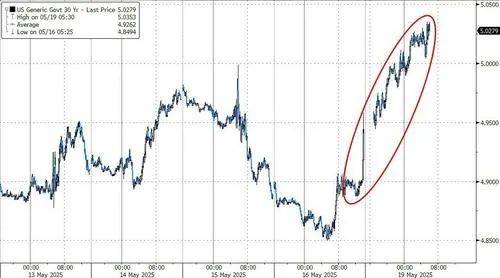
Group 1 - The core issue highlighted is the downgrade of the US credit rating, which has led to a decline in US stock index futures and a rise in 30-year Treasury yields testing 5% and 10-year yields surpassing 4.5% [1] - There is a debate on whether debt holders will still demand at least a AAA rating for their holdings, with many commentators suggesting that such standards can be adjusted [2] - The primary reason for the downgrade is identified as ongoing fiscal imbalances, with expectations that higher interest rates will exert downward pressure on government spending [4][7] Group 2 - It is noted that Moody's downgrade is seen as lagging behind other rating agencies, which had already downgraded the US sovereign credit rating from AAA years ago [5] - Concerns are raised about the market's defensive positioning, with institutional long positions in bonds and US Treasury futures, amidst a backdrop of expanding structural deficits [7] - The potential impact of the downgrade on the political process regarding raising the debt ceiling is emphasized, as the Treasury is currently using "extraordinary measures" to continue paying bills without exceeding the $36.1 trillion debt limit [7][8] Group 3 - Historical responses of the bond market to previous rating downgrades in 2011 and 2023 are discussed, indicating inconsistent outcomes, with 2011 seeing a rebound and 2023 experiencing a sell-off [8][10] - The trend in bond prices before the downgrades continued post-event, with the current fiscal policies leaning towards expansion potentially leading to a sustained decline in Treasury prices [13]