消费者信心

Search documents
深夜突发!美股大跳水 英伟达、特斯拉等集体暴跌 比特币大跌 金价拉升!特朗普 最新宣布
Mei Ri Jing Ji Xin Wen· 2025-11-07 18:21
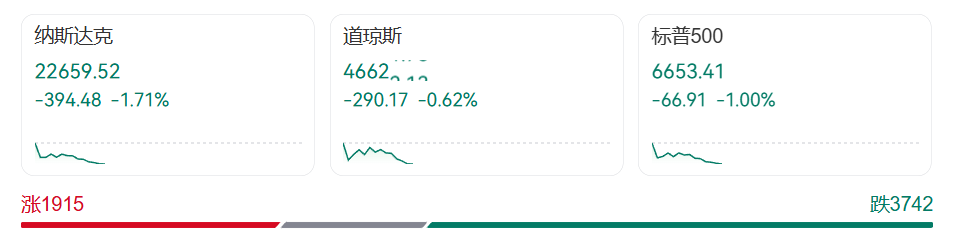
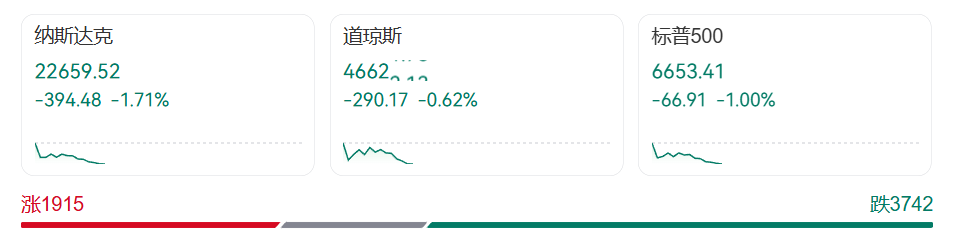
Market Overview - Major US stock indices opened lower and subsequently declined, with the Dow Jones down 0.62%, Nasdaq down 1.71%, and S&P 500 down 1% [1] - Large tech stocks experienced significant drops, with Nvidia and Tesla falling over 4%, while Google and Meta dropped over 2%, and Amazon fell over 1% [2] Chinese Stocks Performance - Most popular Chinese stocks declined, with Xpeng Motors down over 7%, Alibaba, NIO, and Bilibili down over 3%, and Weibo and iQIYI down over 2% [4][5] Cryptocurrency Market - The cryptocurrency market saw a significant downturn, with nearly 240,000 people liquidated in the last 24 hours. Bitcoin fell 2.74%, dropping below the $100,000 mark [5][6] Consumer Confidence - The University of Michigan's preliminary report for November indicated that US consumer confidence hit a three-year low at 50.3, below expectations of 53 and the previous value of 53.6 [8] - The current economic conditions index dropped 6.3 points to 52.3, marking a historical low, while the consumer expectations index fell to a six-month low of 49 [8][9] - Concerns about rising unemployment have increased, with 71% of respondents expecting the unemployment rate to rise in the next year, more than double from the previous year [10] Government Shutdown Impact - The ongoing government shutdown has raised concerns about its impact on the economy, particularly affecting consumer sentiment across various demographics [8][11] - The Supplemental Nutrition Assistance Program (SNAP) has suspended benefits due to funding exhaustion, affecting approximately 42 million people, marking the first time in 60 years that benefits have been halted during a government shutdown [12]


美股走低 比特币大跌!特朗普最新发声
Mei Ri Jing Ji Xin Wen· 2025-11-07 16:50
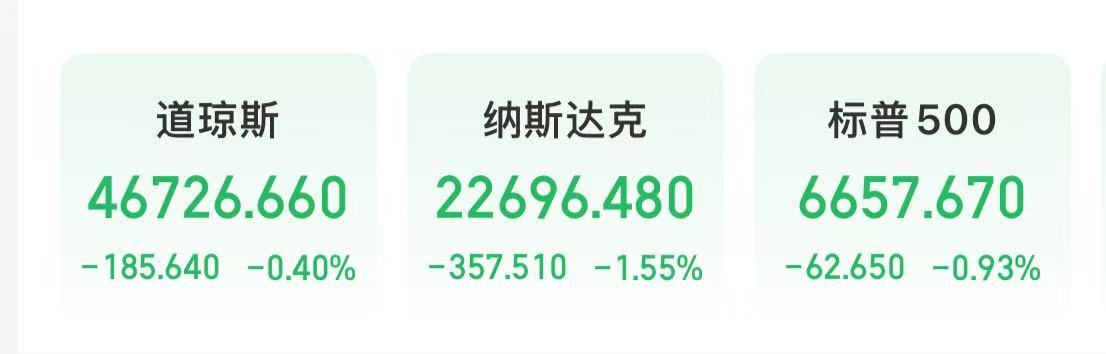
北京时间11月7日晚,美股三大指数集体低开,截至发稿前,道指下跌0.40%,纳指下跌1.55%,标普500指数下跌0.93%。 | 唯品会 | -0.27% | -0.050 | 0.029 | | --- | --- | --- | --- | | us VIPS | -1.31% | -0.240 | | | 微博 | -2.11% | -0.223 | 0.079 | | us WB | -0.76% | -0.080 | | | 阿里巴巴 | -3.48% | -5.839 | 0.149 | | US BABA | -2.92% | -4.900 | | | 京东 | -1.99% | -0.635 | 0.039 | | us JD | -1.81% | -0.580 | | | 腾讯音乐 | -4.82% | -1.075 | -0.199 | | US TME | -2.38% | -0.530 | | | 小鹏汽车 | -7.16% | -1.710 | 0.059 | | US XPEV | -3.18% | -0.760 | | | 理想汽车 | | -1.91% -0.385 | 0. ...
深夜突发!美股大跳水,英伟达、特斯拉等集体暴跌,比特币大跌,金价拉升!特朗普,最新宣布
Mei Ri Jing Ji Xin Wen· 2025-11-07 16:46
Market Overview - The US stock market opened lower, with the Dow Jones down 0.62%, Nasdaq down 1.71%, and S&P 500 down 1% as of the report [1] - Major tech stocks experienced significant declines, with Nvidia and Tesla dropping over 4%, while Google and Meta fell over 2% [1] Cryptocurrency Market - The cryptocurrency market saw a sharp decline, with Bitcoin dropping 2.74% and falling below the $100,000 mark, resulting in nearly 240,000 liquidations globally within 24 hours [5][6] - Other cryptocurrencies also faced losses, with Ethereum down 3.86% and Solana down 4.77% [6] Chinese Stocks - Most popular Chinese stocks declined, with Xpeng Motors down over 7%, Alibaba, NIO, and Bilibili down over 3%, and JD.com and Li Auto down over 1% [4][5] Consumer Confidence - The University of Michigan's consumer confidence index for November fell to 50.3, the lowest level since June 2022, primarily due to concerns over government shutdowns and high prices affecting personal finances [8][9] - The current economic conditions index dropped significantly by 6.3 points to 52.3, marking a historical low [9] Political Developments - Former President Trump urged Republicans to end lengthy debates to address the government shutdown, emphasizing its impact on food assistance programs and the stock market [10][12] - The Trump administration filed an emergency request to pause a federal judge's ruling requiring full payment of the Supplemental Nutrition Assistance Program (SNAP) benefits [13]

November preliminary consumer sentiment comes in light
Youtube· 2025-11-07 16:10
Group 1 - The preliminary University of Michigan sentiment index for November is reported at 50.3%, significantly lower than the expected 53 and the previous final reading of 53.6% [1] - The current conditions index is at 52.3%, marking a notable decline and approaching historical lows not seen since the late 1970s [2] - One-year inflation expectations have increased from 4.6% to 4.7%, the highest since August, while the 5 to 10-year inflation expectations have decreased from 3.9% [2] Group 2 - The market reaction to the soft sentiment and inflation numbers has been muted, indicating that investors may not be as responsive to these indicators as in the past [3] - The interest rate complex shows slight changes, with the 2-year yield at 3.55% and the 10-year yield at 4.09%, reflecting minimal movement from previous weeks [4]

美国消费者信心骤降至三年多来最低水平 对未来一年通胀预期略有上升
智通财经网· 2025-11-07 15:51
Group 1 - The core viewpoint of the articles highlights a significant decline in U.S. consumer confidence, reaching its lowest level in over three years due to economic uncertainties stemming from government shutdowns and persistent high prices affecting household finances [1][2] - The University of Michigan's preliminary consumer confidence index dropped from 53.6 in October to 50.3 in November, marking a new low since June 2022 and falling short of most economists' expectations [1] - The index measuring current economic conditions fell by 6.3 points to 52.3, the lowest recorded level, indicating rising public concern over the potential impact of government shutdowns on economic activity [1] Group 2 - A continuous increase in the number of consumers reporting rising living costs and high prices has been observed for five consecutive months, underscoring the ongoing inflationary pressures on household spending [1] - Long-term inflation expectations have eased slightly, with consumers anticipating an average inflation rate of 3.6% over the next 5 to 10 years, which is the lowest in three months; however, short-term inflation expectations have risen slightly [1] - In November, 71% of consumers expect the unemployment rate to rise in the next year, double the proportion from a year ago, reflecting heightened concerns about job security [2] Group 3 - The index reflecting personal financial conditions has dropped to its lowest level in six years, while the purchasing conditions for commodities have worsened to the worst level since mid-2022 [1] - The index measuring future expectations has fallen to 49, a six-month low, indicating a pessimistic outlook among consumers regarding the economy [2] - The ongoing government shutdown is causing delays in the release of key economic data, leading to a lack of clarity about the true state of the economy, making consumer confidence surveys a limited reference point [2]
美国消费者信心创下逾三年最低水平
Sou Hu Cai Jing· 2025-11-07 15:47
Core Insights - US consumer confidence dropped to its lowest level in over three years in early November, primarily due to concerns over the economic outlook exacerbated by government shutdowns and high prices [1] Group 1: Consumer Confidence Index - The preliminary consumer confidence index for November fell from 53.6 in October to 50.3, marking the lowest level since June 2022 [1] - The current economic conditions index decreased by 6.3 points to a record low of 52.3, reflecting growing concerns about the impact of government shutdowns [1] Group 2: Demographic Trends - Confidence declined across various age, income, and political groups, indicating a widespread sentiment of pessimism among consumers [1] Group 3: Inflation Expectations - Consumers have mentioned rising prices for the fifth consecutive month, although long-term inflation expectations have decreased, with a projected average inflation rate of 3.6% over the next five to ten years, the lowest in three months [1] - There was a slight increase in expectations for inflation over the next year [1] Group 4: Financial Pressures - Consumers are feeling financial pressure from multiple sources and anticipate a continued weakening of the labor market, which they believe will affect their personal financial situations [1]
美国10年期国债收益率短线走低,在美国消费者信心创逾三年新低之际回落至4.0850%下方,完全回吐日内稍早涨幅。两年期美债收益
Sou Hu Cai Jing· 2025-11-07 15:28
Group 1 - The yield on the 10-year U.S. Treasury bond has decreased to below 4.0850%, fully reversing earlier gains as U.S. consumer confidence hits a three-year low [1] - The yield on the 2-year U.S. Treasury bond has fallen below 3.55% [1] - The yield on the 10-year TIPS has retreated to below 1.8150%, while the 2-year TIPS yield remains temporarily above 1.02% [1] Group 2 - The Bloomberg Dollar Index has reached a new daily low [1] - The S&P 500 index has narrowed its decline to 0.54%, while the Nasdaq Composite index initially dropped by 1.53% but has since reduced its loss to less than 1% [1] - Spot gold remains steady above $3990, with an intraday gain of nearly 0.4% [1] - Bitcoin has turned positive, returning above $101,000 [1]
纳指跌幅扩大至1.5% 美国11月密歇根大学消费者信心创逾三年新低
Mei Ri Jing Ji Xin Wen· 2025-11-07 15:16
Group 1 - The U.S. stock market has experienced a decline, with the Dow Jones Industrial Average down by 0.43%, the S&P 500 down by 0.87%, and the Nasdaq Composite down by 1.53% [1] - The decline in the stock market coincides with a significant drop in consumer confidence, as indicated by the University of Michigan's consumer sentiment index reaching its lowest level in over three years [1]
Worries about the prolonged government shutdown push consumer sentiment down near record low levels
MarketWatch· 2025-11-07 15:11
Core Insights - Consumer sentiment declined in November as the government shutdown continued, indicating a negative impact on consumer confidence [1] Group 1 - The ongoing government shutdown has contributed to a darker mood among consumers [1]

美国政府停摆刷新历史纪录,每周损失超百亿美元
第一财经· 2025-11-06 13:39
Core Viewpoint - The ongoing U.S. government shutdown, now in its 37th day, is projected to cause significant economic damage, with estimates of weekly losses ranging from $10 billion to $30 billion, potentially impacting the fourth-quarter economic growth rate by up to 2 percentage points [3][5][6]. Economic Impact - Historically, government shutdowns have had temporary effects, with furloughed employees receiving back pay. However, this shutdown is expected to have more severe consequences due to its prolonged duration and the current economic fragility, with many Americans concerned about inflation and job prospects [5][6]. - The shutdown is affecting millions, particularly as many will lose access to food assistance during the holiday season. This contrasts with previous shutdowns, where the impact was more localized to federal employees [5][6]. - The Federal Aviation Administration (FAA) has announced a 10% reduction in flight volumes at 40 major airports due to air traffic controller shortages caused by the shutdown [6]. Broader Economic Consequences - The shutdown's repercussions extend beyond federal employees, with significant wage losses reported across the U.S. For instance, the unemployment rate could rise from 4.3% to 4.7% due to furloughed federal workers being counted in unemployment statistics [8]. - An estimated $24 billion in federal goods and services spending has been paused, affecting contractors and suppliers reliant on these funds [8][9]. - Small businesses are also facing challenges, with approximately 4,800 businesses having $2.5 billion in loans frozen due to the shutdown, impacting their daily operations and expansion plans [9][10]. Consumer Confidence and Future Outlook - The shutdown is expected to further erode consumer confidence, particularly if it extends into the critical holiday shopping season. Previous shutdowns have shown a tendency to negatively impact consumer sentiment, and current economic indicators may not mitigate this effect [10].