财政赤字

Search documents
外资行美债&汇率2026展望汇总
2025-12-31 16:02
Summary of Key Points from the Conference Call Records Industry Overview - The conference call records focus on the U.S. Treasury market and interest rate outlook for 2026, with insights from various financial institutions including Barclays, HSBC, Morgan Stanley, Deutsche Bank, and Bank of America Merrill Lynch. Core Insights and Arguments U.S. Treasury Market Outlook 1. **Yield Curve Dynamics**: - Barclays predicts a steepening of the yield curve, with 2-year yields expected to drop to 3.1% and 30-year yields remaining around 4.7%, resulting in a 2s30s spread of 160 basis points [6][10]. - HSBC anticipates a bear steepening of the yield curve, projecting a 10-year yield of 4.30% by the end of 2026 [15][19]. - Morgan Stanley suggests that the Fed's rate cuts may be less than market expectations, with a forecast of only 50 basis points of cuts [25][26]. 2. **Federal Reserve Policy**: - The new leadership at the Federal Reserve is expected to adopt a more dovish stance, potentially lowering rates below neutral levels [6][7]. - The Fed is projected to end quantitative tightening (QT) and begin purchasing T-bills to maintain adequate reserves, with an estimated purchase of $330 billion in T-bills in 2026 [10][31]. 3. **Fiscal Deficit and Inflation**: - The fiscal deficit is expected to remain around 6% of GDP, approximately $1.9 trillion, with inflation projected to stabilize around 2% [6][10][25]. - Concerns about inflation resurgence due to fiscal expansion and tariff impacts are highlighted, with core PCE inflation expected to remain above 2% [41][48]. Supply and Demand Dynamics 1. **Net Supply Projections**: - A significant reduction in net supply of U.S. Treasuries is anticipated, with a decrease of approximately $470 billion to $1.2 trillion in 2026 [6][58]. - Investment-grade corporate bonds are expected to see an increase in net supply, driven by mergers and acquisitions [58]. 2. **Market Demand**: - Bank demand for mid-term Treasuries is expected to rebound due to regulatory changes [9]. - Continuous inflows into bond funds are supporting demand, particularly for MBS, which are favored due to their attractive spreads [58][62]. Investment Recommendations 1. **Asset Recommendations**: - Barclays recommends going long on 2-year Treasuries to capitalize on anticipated rate cuts [10]. - HSBC suggests positioning in the belly of the curve (5-year Treasuries) for lower structural risk and positive carry [21]. - Deutsche Bank advises a cautious approach to long-dated Treasuries, predicting underperformance relative to swaps [39]. 2. **Strategic Themes**: - "Carry is king" is emphasized as a core investment strategy, focusing on high-yield bonds and leveraged loans due to their attractive coupon rates in a stable interest rate environment [41][47]. - The potential for a bear steepening of the yield curve is noted, with strategies to exploit this dynamic [21][47]. Other Important Insights - The reports highlight a complex economic landscape characterized by resilient growth, sticky inflation, and the dual risks of fiscal deterioration and inflation rebound [7][17]. - The impact of AI-driven capital expenditures and fiscal stimulus from legislation like the One Big Beautiful Bill Act (OBBBA) is noted as a potential growth driver [41][48]. - The need for caution regarding economic recession risks and policy uncertainties is emphasized, particularly in relation to tariffs and Fed independence [26][37]. This summary encapsulates the key points from the conference call records, providing a comprehensive overview of the U.S. Treasury market outlook and associated investment strategies for 2026.
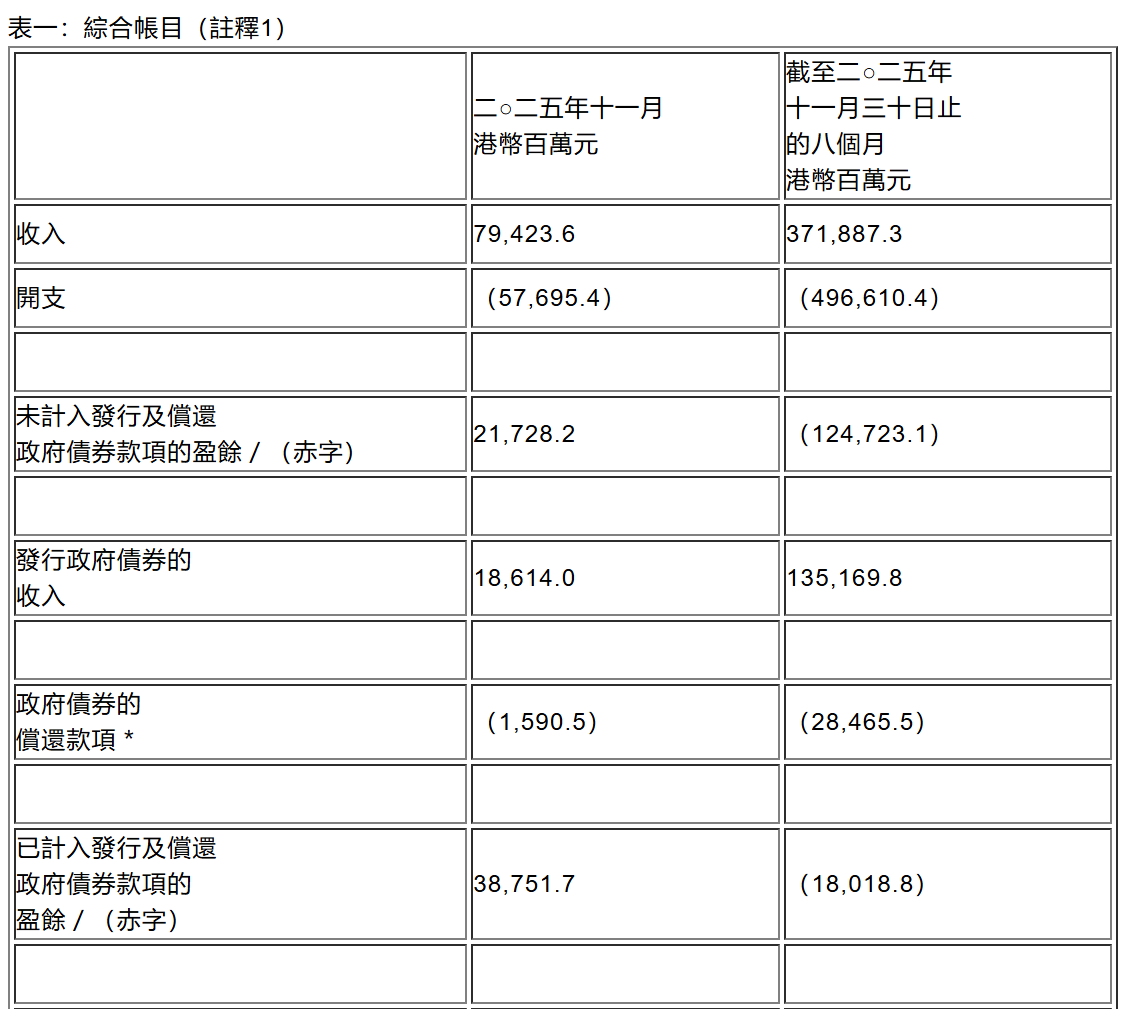
香港特区政府:本财政年度首八个月录得180亿港元赤字
智通财经网· 2025-12-31 12:01
Core Insights - The Hong Kong government reported a fiscal deficit of HKD 18 billion for the first eight months of the fiscal year ending November 30, 2025, with total expenditures of HKD 496.6 billion and total revenues of HKD 371.9 billion [1][2]. Financial Overview - Total expenditures for the first eight months amounted to HKD 496.6 billion, while total revenues were HKD 371.9 billion [1][2]. - The deficit was influenced by the issuance of government bonds, which generated HKD 135.2 billion in revenue and involved the repayment of HKD 28.5 billion in principal [1][2]. - The fiscal reserve as of November 30, 2025, stood at HKD 636.3 billion [1][3]. Revenue and Expenditure Breakdown - Major sources of revenue, such as salaries tax and profits tax, are primarily collected later in the fiscal year, contributing to a reduction in the deficit compared to October [1]. - The revised budget for the fiscal year will be announced alongside the 2026-27 budget [1].

肯财政部预计新财年预算赤字将扩大至GDP的5.3%
Shang Wu Bu Wang Zhan· 2025-12-30 17:31
Core Viewpoint - The Kenyan Ministry of Finance projects that the budget deficit for the fiscal year 2026/27 will expand to 5.3% of GDP, an increase from approximately 4.7% in the fiscal year 2025/26 [1] Group 1: Budget Deficit Projections - The budget deficit is expected to rise based on updated assessments of government revenue and expenditure forecasts [1] - The projected deficit for 2026/27 is estimated at 5.3% of GDP, compared to 4.7% for 2025/26 [1] Group 2: Financing Measures - To address the deficit, the government plans to secure approximately 99.5 billion Kenyan Shillings in net external financing and about 101 billion Kenyan Shillings in domestic financing [1] Group 3: Economic Implications - Economists believe that the increase in the deficit may exert pressure on Kenyan bond yields and the domestic investment environment [1] - However, if accompanied by fiscal reform measures, it may help maintain economic stability [1]
偿债额三年涨百亿!乌克兰外债利率超欧美两倍,经济要绷不住了?
Sou Hu Cai Jing· 2025-12-30 06:46
专家指出,该国公共债务至少到2028年都将超过GDP总量,且由于四分之三债务以外币计价,汇率波动 可能加剧偿债压力。 财政赤字问题同样严峻。乌克兰最高拉达近期通过的2026年国家预算显示,赤字规模将达GDP的 18.4%。 乌克兰债务压力与财政困境引发国际关注。 该国近期宣布,将在2028年前每年投入相当于国内生产总值GDP10%的资金用于债务减免。 这一数字源自乌克兰财政部制定的2026-2028年债务战略,经政府批准后正式实施。 根据战略文件,乌克兰债务偿还额在未来几年将保持高位。 预计到2025年底,偿还总额达约250亿美元,2026年增至约270亿美元,2027年约300亿美元,2028年进 一步升至约305亿美元。 平均每年偿债金额约占预算支出的24%,支出占GDP比例将从2025年的11.7%逐步降至2028年的9.5%。 国际货币基金组织预测,乌克兰公共债务将持续攀升。 2025年债务占GDP比例预计达109%,2026年升至110.4%,使乌克兰跻身全球主要债务国第16位。 德国、法国和意大利预计将承担主要份额。欧盟还提出,若俄罗斯未来支付战争赔款,将用于偿还乌克 兰债务。 贷款附带多项条件, ...

汇丰银行刘晶:预计2026年中国将降准50BP
Zhong Guo Jing Ying Bao· 2025-12-30 03:32
Core Viewpoint - HSBC forecasts stable global economic growth by 2026, with a slowdown in trade export growth, while strong investments in artificial intelligence will support investment and trade growth in the next two years [1] Group 1: Economic Outlook - HSBC's Chief Economist for Greater China, Liu Jing, indicates that a series of easing policies implemented since Q4 2024 will support economic activity, allowing China to achieve a target economic growth of around 5% for the full year of 2025 [1] - The year 2026 marks the beginning of the "14th Five-Year Plan," during which China's economy is expected to continue structural transformation and maintain reasonable growth, with domestic demand, including consumption and investment, becoming the main driver of growth [1] Group 2: Fiscal Policy - The Central Economic Work Conference has proposed to maintain a necessary fiscal deficit, with HSBC estimating that China's fiscal deficit target for 2026 may remain at a relatively high level of 4% [1] - The issuance scale of local government special bonds and special treasury bonds is expected to be comparable to that of 2025 to support consumption and major project investments [1] - New policy financial tools are likely to continue playing a "quasi-fiscal" role [1] Group 3: Monetary Policy - There may still be room for a further interest rate cut of 20 basis points in 2026, along with a potential reserve requirement ratio cut of 50 basis points [1]

世界银行预测马2026年经济增长率为3.9%
Shang Wu Bu Wang Zhan· 2025-12-28 17:03
Group 1 - The World Bank forecasts Malaysia's economic growth rate to be 3.9% in 2026 [1] - The estimated economic growth rate for Malaysia this year is 4.2%, but a slowdown is expected next year due to declining growth in most economic sectors, excluding tourism [1] - The World Bank predicts that Malaysia's inflation rate will reach 4.2% in 2026, and the fiscal deficit is expected to widen to 13% of GDP [1]
周观:如何看待2026年1月的流动性情况?(2025年第50期)
Soochow Securities· 2025-12-28 11:35
1. Report Industry Investment Rating No information provided in the content. 2. Core Views of the Report 2.1 Liquidity in January 2026 - The yield of the active 10 - year Treasury bond rose 0.05bp to 1.8355% from 1.835% last Friday. The yield fluctuated during the week due to various factors such as LPR expectations, government bond issuance concerns, and policy news [1][11]. - Five factors affect the super - reserve ratio. In January 2026, foreign exchange funds are expected to decrease by about 63 billion yuan; the central bank is expected to maintain reasonable and sufficient liquidity through various means and there is a possibility of a reserve requirement ratio cut; fiscal deposits are expected to increase by about 62 billion yuan; M0 is expected to increase by about 78 billion yuan; and required deposit reserves are expected to increase by about 50 billion yuan. The liquidity gap is about 190 billion yuan, which can be adjusted through open - market operations and reserve requirement ratio cuts [15][16][21]. - In the bond market, institutions may pay more attention to institutional behavior. It is expected that the allocation power of banks and insurance will strengthen at the beginning of next year, and interest rates may decline [21]. 2.2 US Economic Data and Fed Policy - Spot gold prices exceeded $4,500 per ounce, and it is expected to continue to play an important role in different asset portfolios. The RMB - US dollar exchange rate once exceeded 7. The long - term RMB value is systematically undervalued, but in the medium - term, the role of macro - policies in the transition from exogenous to endogenous growth needs to be considered [22][23]. - US economic data shows that inflation pressure is easing, economic expansion momentum is weakening, the labor market is stable, and the Fed is in a "data - dependent" mode. It is likely to keep interest rates unchanged in the short term, but if economic data weakens, it may resume gradual interest rate cuts from January to April [23][26]. 3. Summary by Relevant Catalogs 3.1 One - Week Views 3.1.1 Liquidity in January 2026 - **Weekly review**: The yield of the 10 - year Treasury bond fluctuated during the week. The reasons included LPR non - adjustment, concerns about government bond issuance, and policy news [12]. - **Weekly thinking**: Analyze the five factors affecting the super - reserve ratio and predict the liquidity situation in January 2026. The overall liquidity gap is about 190 billion yuan, and the central bank may use various means to maintain liquidity [15][16][21]. 3.1.2 US Economic Data and Fed Policy - **Gold and exchange rate**: Gold prices are expected to continue to rise. The RMB - US dollar exchange rate is affected by fiscal deficit and fiscal monetization [22][23]. - **US economic data**: The December PMI initial values were lower than expected, the November CPI and core CPI were lower than expected, the unemployment rate rose to 4.6%, and the labor participation rate was stable. The Fed's policy is focused on "liquidity guarantee and prudent policy balance" [23][24][26]. 3.2 Domestic and Overseas Data Summaries 3.2.1 Liquidity Tracking - **Open - market operations**: From December 22 - 26, 2025, the central bank's open - market operations had a net investment of 6.52 billion yuan [38]. - **Interest rates**: Various interest rates such as money market rates, bond yields, and futures prices are presented in figures and tables, showing their trends and changes [39][40][42] 3.2.2 Domestic and Overseas Macroeconomic Data Tracking - **Commodity prices**: Steel prices declined, and LME non - ferrous metal futures prices increased. The prices of other commodities such as coal, oil, and vegetables also had corresponding changes [59][61]. - **Financial market data**: Data on various financial market indicators such as stock indices, bond yields, and exchange rates in the US and other countries are presented [71][73][76] 3.3 Local Bond One - Week Review 3.3.1 Primary Market Issuance Overview - This week, 6 local bonds were issued with an amount of 2.037 billion yuan, a repayment of 5.211 billion yuan, and a net financing of - 3.174 billion yuan. The bonds were mainly issued by Shenzhen, Hunan, and Inner Mongolia [85][87]. - No local special refinancing bonds for replacing hidden debts were issued this week. Since January 1, 2025, a total of 2.199521 trillion yuan of such bonds have been issued [90]. 3.3.2 Secondary Market Overview - The local bond stock was 54.6 trillion yuan, the trading volume was 362.073 billion yuan, and the turnover rate was 0.66%. The top three active trading provinces were Guangdong, Xinjiang, and Jiangsu, and the top three active trading terms were 30Y, 10Y, and 15Y [101]. 3.3.3 This Month's Local Bond Issuance Plan The issuance plan of Beijing from December 29, 2025, to January 2, 2026, is presented in a figure [106]. 3.4 Credit Bond Market One - Week Review 3.4.1 Primary Market Issuance Overview - This week, 211 credit bonds were issued with a total issuance of 254.432 billion yuan, a total repayment of 213.649 billion yuan, and a net financing of 40.783 billion yuan, which decreased by 16.672 billion yuan compared with last week [108]. - Specifically, the net financing of urban investment bonds was - 261 million yuan, and that of industrial bonds was 4.1044 billion yuan. By bond type, short - term financing had a net financing of - 4.4152 billion yuan, medium - term notes had 8.0004 billion yuan, enterprise bonds had - 719 million yuan, corporate bonds had 1.5045 billion yuan, and private placement notes had - 292 million yuan [109][112]. 3.4.2 Issuance Interest Rates The actual issuance interest rates and their changes of various bond types such as short - term financing, medium - term notes, and corporate bonds are presented in a table [119]. 3.4.3 Secondary Market Transaction Overview The trading volume data of credit bonds in different ratings and types are presented in a table, with a total trading volume of 626.442 billion yuan [120]. 3.4.4 Yield to Maturity The yield to maturity and its changes of various bonds such as government - backed development bonds, short - term financing, medium - term notes, enterprise bonds, and urban investment bonds are presented in tables [120][121][122] 3.4.5 Credit Spreads The credit spreads of short - term financing, medium - term notes, enterprise bonds, and urban investment bonds showed a differentiated trend, and their changes are presented in tables and figures [124][125][128] 3.4.6 Rating Spreads The rating spreads of short - term financing, medium - term notes, enterprise bonds, and urban investment bonds generally widened, and their changes are presented in tables and figures [135][137][139] 3.4.7 Trading Activity The top five most actively traded bonds of each type are presented in a table, and the industrial sector had the largest weekly trading volume of bonds [143][144] 3.4.8 Issuer Rating Changes The issuer rating or outlook improvement information of two companies, Wenzhou Transportation Development Group Co., Ltd. and Guangxi Energy Group Co., Ltd., is presented in a table [146]
金银狂飙!“牛市”刚刚开始?
Sou Hu Cai Jing· 2025-12-28 03:13
Core Viewpoint - The article discusses the significant rise in gold and silver prices, attributing it to a profound shift in global financial order and the erosion of trust in the US dollar as a stable asset [1][2]. Group 1: Dollar Credibility - The dollar's credibility has been compromised since certain foreign exchange reserves were "frozen" in 2022, leading to a strategic shift where gold has become a core asset rather than a backup [1]. - Central banks are increasingly purchasing gold and repatriating it, indicating a long-term asset migration driven by national security concerns and a move towards "de-dollarization" [2]. Group 2: US Fiscal Policy and Federal Reserve Actions - The US government is projected to increase its deficit by $4.1 trillion over the next decade, flooding the market with US debt, which diminishes the value of the dollar [3]. - The Federal Reserve's independence is under threat, with its potential shift from controlling inflation to financing fiscal deficits, further enhancing gold's appeal as a safe-haven asset [3]. Group 3: Supply Chain and Industrial Demand - Global trade uncertainties and tariff wars are increasing demand for safe-haven assets like gold, while simultaneously disrupting supply chains, particularly affecting silver, which is crucial for green technologies [4]. - The mismatch between soaring demand for silver in industries and supply chain disruptions has created a narrative of "industrial shortage," driving up silver prices significantly [4]. Group 4: Future Outlook - The current market dynamics suggest that the rise in gold and silver prices may not be a cyclical peak but rather the beginning of a new, larger cycle driven by long-term structural trends such as "de-dollarization" and geopolitical fragmentation [5]. - The nature of market participation is shifting from speculative buying to a consensus-driven allocation of global funds, indicating a transition from a "slow bull" to a "crazy bull" market [5]. - Silver is gaining recognition for its independent industrial demand, moving beyond its traditional role as a shadow of gold [6].
美债如烫手山芋,中国果断撤离,加拿大背刺,美国危机进入倒计时
Sou Hu Cai Jing· 2025-12-27 04:29
Group 1 - Canada sold $56.7 billion in U.S. Treasury bonds in October 2025, a more aggressive move than China's $11.8 billion reduction, indicating a significant shift in ally dynamics [1] - The total U.S. national debt has surged to $37 trillion, increasing by $1 trillion every five months, a record-breaking pace [3] - The liquidity of the U.S. Treasury market has declined, with turnover rates dropping from 12.6% in 2007 to 3.2% in 2024, leading to increased price volatility during market disruptions [4] Group 2 - The "Big and Beautiful" Act signed in July 2025 is projected to increase the fiscal deficit by approximately $3.4 trillion over the next decade, raising concerns about the U.S. government's debt repayment capacity [6] - The U.S. federal government is facing a fiscal deficit of $1.83 trillion for the 2024 fiscal year, creating a vicious cycle of increasing debt and interest payments [7] - Political pressure from the Trump administration to influence the Federal Reserve's independence poses risks to the credibility of the U.S. dollar and investor confidence in U.S. Treasuries [9] Group 3 - The erosion of the U.S. Treasury's "safety premium" is exacerbated by actions such as financial sanctions and proposals to alter the structure of U.S. debt, leading to increased market concerns [11] - Global capital is reassessing the value of dollar assets, with countries like China diversifying their reserves away from U.S. Treasuries and Canada aggressively selling them [12] - Asian countries, as the largest official holders of U.S. Treasuries, are considering adjustments to their foreign exchange reserve structures to reduce reliance on U.S. debt and strengthen regional financial cooperation [14]

前11个月广义财政支出超收入近10万亿
第一财经· 2025-12-26 02:25
Core Viewpoint - The article discusses the performance of China's broad fiscal revenue and expenditure in the first 11 months of the year, highlighting a slight decline in revenue and an increase in expenditure, reflecting a proactive fiscal policy aimed at stabilizing economic growth and expanding domestic demand [3][5]. Fiscal Revenue - In the first 11 months, broad fiscal revenue reached 24,079 billion yuan, showing a year-on-year decline of approximately 0.2% [3]. - The national general public budget revenue increased by 0.8% year-on-year, slightly better than the initial forecast of 0.1%, driven by stable economic performance and active capital markets [5]. - Government fund revenue decreased by 4.9% year-on-year, falling short of the initial forecast of 0.7%, primarily due to a sluggish real estate market and lower land transfer income [5]. Fiscal Expenditure - Broad fiscal expenditure amounted to 34,066 billion yuan, with a year-on-year increase of about 4.5%, which is lower than the expected growth rate of 9.3% for the year [6]. - The government allowed local governments to issue an additional 500 billion yuan in bonds in the fourth quarter to support local financial capacity and major project construction [6][7]. - The fiscal expenditure structure has been optimized, with increased focus on social welfare and public services, such as social security and education, which grew faster than average expenditure growth [9]. Government Debt - Net financing of government bonds reached 1.315 trillion yuan in the first 11 months, an increase of 361 billion yuan year-on-year [8]. - Experts anticipate that the fiscal deficit rate for 2026 will be set around 4%, with total government debt expected to exceed 12 trillion yuan, potentially reaching between 13 trillion and 16 trillion yuan [9].