
避险情绪

Search documents
避险情绪升温推动金价走高 国际金价突破每盎司4200美元
Jing Ji Ri Bao· 2025-10-16 22:16
Group 1 - The core viewpoint is that international gold prices continue to rise, having surpassed $4200 per ounce for the first time, with a year-to-date increase of over 50%, making it one of the best-performing assets globally [1][2] - The rapid increase in gold prices began in late August, with a rise of over 25% from August 21 to October 15, driven by increased global risk aversion and declining confidence in the US dollar [1][2] - The Federal Reserve's interest rate cuts are identified as a triggering factor for the gold price surge, with multiple risk factors contributing to heightened market anxiety and increased demand for gold [1][2] Group 2 - Central banks around the world have been key drivers of rising gold prices, with a reported increase of 166 tons in global official gold reserves in Q2 of this year, maintaining a historical high [2] - It is expected that central banks and investors will continue to increase their gold holdings due to ongoing geopolitical uncertainties and weakening confidence in the dollar system, providing ongoing support for gold prices [2] - Long-term predictions suggest that gold will maintain its unique advantages in risk aversion and inflation protection, with Goldman Sachs raising its forecast for gold prices to $4900 per ounce by December 2026 [2] Group 3 - Short-term gold price increases may be driven by various risk sentiments, but underlying factors such as worsening US federal debt and ongoing central bank gold purchases provide strong support for the gold market [3] - Despite current favorable conditions, there is a cautionary note regarding potential profit-taking and demand exhaustion that could lead to price corrections [3] - Investors are advised to be aware of potential negative factors, such as competition from other metals and the rise of digital currencies, which may challenge gold's status as a safe-haven asset [3]
避险情绪升温推动金价走高
Jing Ji Ri Bao· 2025-10-16 21:57
Group 1 - The international gold price has surged, breaking the $4200 per ounce mark for the first time, with a year-to-date increase of over 50%, making it one of the best-performing assets globally [1] - The rapid rise in gold prices began in late August, with a more than 25% increase from August 21 to October 15, driven by rising global risk aversion and declining confidence in the US dollar [1] - The Federal Reserve's interest rate cuts are identified as a triggering factor for the gold price increase, with multiple risk factors contributing to heightened market anxiety and increased demand for gold [1] Group 2 - Central banks around the world have been key drivers of the rising gold prices, with a reported increase of 166 tons in global official gold reserves in Q2, maintaining a historical high [2] - It is expected that central banks and investors will continue to increase their gold holdings due to ongoing geopolitical uncertainties and weakening confidence in the dollar system, providing ongoing support for gold prices [2] - Long-term projections indicate that gold will continue to be favored for its unique attributes in risk aversion and inflation protection, with Goldman Sachs raising its gold price forecast for December 2026 from $4300 to $4900 per ounce [2] Group 3 - Short-term gold price increases may be driven by various risk sentiments, but underlying factors such as the worsening US debt situation and central bank gold purchases provide strong support for the gold market [3] - Despite favorable conditions, the rapid rise in gold prices may lead to profit-taking and potential downward pressure, necessitating caution among investors [3] - Potential challenges to gold's long-term high prices include competition from other low-priced metals and the rise of digital currencies, which may affect gold's appeal as a safe-haven asset [3]
39只个股“飘红”! 银行股本周连涨4日,“大象起舞”背后:避险情绪升温、中期分红落地、险资重仓布局
Mei Ri Jing Ji Xin Wen· 2025-10-16 14:12
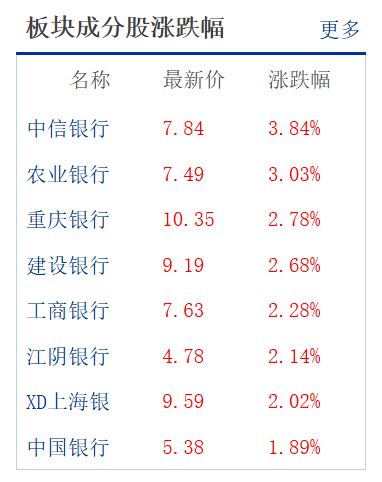
Core Viewpoint - The A-share banking sector has regained market attention after several months of correction, with a notable increase in stock prices driven by rising risk aversion and the commencement of mid-term dividends [1][2]. Group 1: Market Performance - The banking sector has shown a continuous upward trend, with a 1.3% increase this week and 39 out of 42 stocks closing in the green [2]. - Major banks such as CITIC Bank and Agricultural Bank led the gains, with increases of 3.84% and 3.03% respectively [3][2]. - The banking sector's performance in the first half of the year was strong, with a 13% increase, but faced a 10.2% decline in the third quarter [1]. Group 2: Investment Drivers - The recent rally in bank stocks is attributed to heightened market risk aversion and the attractive dividend yields as banks begin their mid-term dividend distributions [5][6]. - The average dividend yield for listed banks has risen to 4.4%, which is 64 basis points higher than the low in July, enhancing their appeal to long-term investors [7]. - Insurance capital has shown a preference for bank stocks, with banks representing approximately 37% of the total market value of A-share stocks held by insurance funds [8]. Group 3: Future Outlook - Analysts suggest that the banking sector is likely to benefit from policy support and positive performance signals, indicating a stabilization trend [8]. - The long-term performance of bank stocks is closely tied to macroeconomic conditions, with potential for significant growth if the economy continues to improve [8].


万家基金贺方舟:金价长期有支撑
Zhong Zheng Wang· 2025-10-16 13:53
Group 1 - The core viewpoint of the article highlights that gold price fluctuations are primarily influenced by real interest rates, the US dollar index, and risk aversion sentiment [1] - The article notes that the increase in gold prices this year is attributed to multiple factors, including heightened global uncertainty, rising recession expectations in the US, and ongoing market volatility prompting investors to seek more stable asset allocations [1] - The article emphasizes that the persistent US debt issues and increasing "credit cracks" further contribute to the demand for gold as a safe-haven asset [1] Group 2 - Looking ahead, the article suggests that central bank gold purchases and the trend of "de-dollarization" provide long-term support for gold prices [1] - It also mentions that unresolved geopolitical risks and the ongoing direction of monetary easing will continue to underpin gold prices in the long term [1]
金价今年狂飙 60%,还能上车么?
天天基金网· 2025-10-16 13:25
2025年以来 4,500 60% 2019 2024 18.63% 27.39% 4.000 2017 2023 12-72% 13.45% 3.500 2020 2016 25.22% 8.70% 3.000 2021 2022 2,500 2015 -3.41% 2018 0.08% -1.88% -10.50% 2,000 1,500 1.000 2019-01-05 202101-05 30pp01-05 201701-05 2018-01-05 2020-01-05 近10年COMEX黄金年度涨跌幅 黄金近10年行情 金价还能涨多少? 在多重因素助推下,黄金价格一路"高歌猛进",接连突破历史高位。 即使今年以来涨幅达60%,华尔街巨头却并未因此"恐高",纷纷上调 黄金价格展望。 = 天具具 | 链接您与财富 历史新高不代表不会回调。当前价位情 绪驱动成分较大,切勿因害怕错过而盲 目重仓追入。 未来金价还能涨多少? 人人十女 マモン町 L 2日本 1400000 将2020年更显价格]则工同主母 5000美元。 美国银行 预测金价将在2026年下半年达到4500 美元/盎司。 摩根士丹利 将2026 ...

做多贵金属窗口开启 降息与避险构成双重逻辑支撑
Jin Tou Wang· 2025-10-16 07:34
Group 1 - Gold prices have experienced a strong five-day rally, reaching record highs during the Asian session on October 16, driven by increased risk aversion due to U.S. government shutdown and escalating U.S.-China trade tensions [1] - Silver prices adjusted to $53.10 after a spike, attributed to profit-taking, but remain resilient due to expectations of further interest rate cuts by the Federal Reserve [1] - Forecasts suggest gold prices could reach $4,400 by the end of 2025 and peak at $4,600 by June 2026, while silver is expected to rise to $57.50 in the same timeframe [1] Group 2 - Federal Reserve Governor Michelle Bowman has called for a faster pace of interest rate cuts, supporting two more cuts within the year, while the Beige Book indicates a decline in consumer spending and weak labor demand, reinforcing expectations for monetary easing [2] - Geopolitical risks are escalating, with multiple flashpoints including U.S. actions in Venezuela, instability in the Middle East, and a nationwide blackout in Ukraine, contributing to increased market demand for safe-haven assets [2] - Despite a ceasefire agreement between Pakistan and Afghanistan providing some localized relief, global risk premiums continue to rise [2] Group 3 - The long-term outlook for precious metals is expected to continue a pattern of oscillating upward movement, supported by both Federal Reserve rate cut expectations and geopolitical risks [3] - Gold's safe-haven and financial attributes are likely to remain prominent, while silver is anticipated to have greater elastic potential due to its industrial demand and investment characteristics [3] - Technically, gold is expected to face resistance around $4,400 after breaking and stabilizing above $4,200, while silver may test the $54 mark after surpassing $52 [3]
广州期货:多因素构筑贵金属强势格局 价格中期上行走势依然明朗
Sou Hu Cai Jing· 2025-10-16 05:56
Core Viewpoint - The report from Guangzhou Futures highlights that ongoing uncertainties in international trade, the recent U.S. government shutdown, recession fears, and the Federal Reserve's shift to a rate-cutting cycle have collectively fueled strong market risk aversion, leading to rising prices for gold and silver [1][2] Group 1: Market Conditions - The market is experiencing heightened risk aversion due to multiple factors, including international trade uncertainties and the U.S. government shutdown [1] - The Federal Reserve is expected to enter a rate-cutting cycle, with a 95.67% probability of a 25 basis point cut in October and a 94.64% probability of a total 50 basis point cut by December [1] Group 2: Support for Precious Metals - Multiple positive factors are contributing to the strong performance of precious metals, including persistent geopolitical and policy uncertainties that drive demand for safe-haven assets [2] - The Federal Reserve's clear shift to a rate-cutting cycle is expected to continue throughout the year, improving the holding environment for precious metals [2] - Continuous accumulation by global central banks, particularly the People's Bank of China, provides long-term structural support for rising gold prices [2] Group 3: Future Outlook - Despite potential technical pullback risks, the medium-term upward trend for precious metal prices remains clear, necessitating close monitoring of core driving factors [2]
铜冠金源期货商品日报-20251016
Tong Guan Jin Yuan Qi Huo· 2025-10-16 03:43
1. Report Industry Investment Rating No relevant content provided. 2. Core Views of the Report - Overseas, the US has shown signs of easing tensions, with the US dollar index falling and US stocks rising. The Fed is considering accelerating interest - rate cuts. Domestically, the economy shows weak recovery, with A - shares rebounding on low volume. In the short term, the stock market is expected to be volatile and weak, while in the long term, there is value in bargain - hunting. The bond market is slightly adjusted [2][3]. - Precious metals are supported by safe - haven sentiment, and their prices are expected to continue rising due to factors such as the US government shutdown, Fed's dovish remarks, and Sino - US trade tensions [4][5]. - Copper prices are expected to oscillate at a high level due to increased macro - disturbances and a tight supply at the mine end [6][7]. - Aluminum prices are expected to maintain an oscillating and favorable pattern as inventory is likely to be reduced again [8]. - Alumina prices are under pressure in the short term due to high domestic production capacity and expected arrival of imported alumina [9]. - Zinc prices are expected to oscillate weakly due to tense trade situations, weak downstream consumption, and a cooling export expectation [10]. - Lead prices face increasing pressure as LME inventories rise, domestic supply eases, and consumption shows limited improvement [11]. - Tin prices are expected to oscillate at a high level and show strong resilience due to limited improvement in the raw - material end and low LME inventories [12][13]. - Industrial silicon prices are expected to oscillate at a low level due to a loose supply pattern and insufficient downstream demand [14][15]. - Lithium prices are expected to oscillate as there is a game between bulls and bears, with inventory pressure and uncertain technical signals [16][17]. - Steel and iron ore prices are expected to oscillate weakly due to weak market sentiment, high supply pressure, and uncertain demand [18][19]. - Bean and rapeseed meal prices are expected to oscillate weakly due to the repeated Sino - US game sentiment and other factors [20][21]. - Palm oil prices are expected to oscillate widely due to trade uncertainties, changes in import and export volumes, and Indonesia's plan to increase export taxes [23][24]. 3. Summary by Related Catalogs 3.1 Macro - Overseas: US officials responded to China's expanded rare - earth export control, and the Fed's Milan called for accelerating interest - rate cuts. US stocks rose, the dollar index fell to 98.6, the 10Y US Treasury yield dropped to 4.0%, gold prices exceeded $4200 per ounce, copper prices rose, and oil prices fell [2]. - Domestic: In September, CPI's year - on - year decline narrowed to 0.3%, core CPI returned to 1% for the first time in 19 months, and PPI's year - on - year decline narrowed to 2.3%. New social financing in September was 3.53 trillion yuan, new RMB loans were 1.29 trillion yuan, and the M2 - M1 gap narrowed to the lowest point of the year. A - shares rebounded on low volume, and the bond market was slightly adjusted [3]. 3.2 Precious Metals - On Wednesday, international precious - metal futures prices rose. COMEX gold futures rose 1.48% to $4224.90 per ounce, and COMEX silver futures rose 3.76% to $52.53 per ounce. Factors such as the extended US government shutdown, dovish remarks from the Fed, and Sino - US trade tensions supported the price increase. The market expects interest - rate cuts in October and December. It is expected that precious - metal prices will continue to rise [4][5]. 3.3 Copper - On Wednesday, the main contract of Shanghai copper stopped falling and stabilized, and LME copper oscillated at night. The domestic near - month contract turned to a B structure, and the spot market trading improved. After the holiday, it entered a new restocking cycle. The LME inventory dropped to 138,000 tons. Due to macro - disturbances and a tight supply at the mine end, copper prices are expected to oscillate at a high level [6][7]. 3.4 Aluminum - On Wednesday, the main contract of Shanghai aluminum closed at 20,910 yuan per ton, down 0.1%. After the holiday, the arrival of aluminum ingots was less, and restocking was active. It is expected that the inventory will be reduced again this week, and aluminum prices will maintain an oscillating and favorable pattern [8]. 3.5 Alumina - On Wednesday, the main contract of alumina futures closed at 2797 yuan per ton, down 0.36%. Due to high domestic production capacity and expected arrival of imported alumina, alumina prices are under pressure in the short term [9]. 3.6 Zinc - On Wednesday, the main contract of Shanghai zinc oscillated narrowly during the day and moved horizontally at night. Due to tense trade situations, weak downstream consumption, and a cooling export expectation, zinc prices are expected to oscillate weakly [10]. 3.7 Lead - On Wednesday, the main contract of Shanghai lead oscillated strongly during the day and horizontally at night. With the continuous increase in LME inventories, the easing of domestic supply, and limited improvement in consumption, lead prices face increasing pressure [11]. 3.8 Tin - On Wednesday, the main contract of Shanghai tin oscillated narrowly during the day and its center of gravity moved down at night. Due to limited improvement in the raw - material end and low LME inventories, tin prices are expected to oscillate at a high level and show strong resilience [12][13]. 3.9 Industrial Silicon - On Wednesday, industrial silicon oscillated strongly. Due to a loose supply pattern and insufficient downstream demand, industrial silicon prices are expected to oscillate at a low level [14][15]. 3.10 Carbonate Lithium - On Wednesday, carbonate - lithium prices oscillated weakly. There is a game between bulls and bears in the market, with inventory pressure and uncertain technical signals. Lithium prices are expected to oscillate [16][17]. 3.11 Steel and Iron Ore - On Wednesday, steel futures were weak. Spot trading was at a low level, and terminal demand was weak. Supply pressure increased, and steel prices are expected to oscillate weakly. Iron - ore futures oscillated. The supply increased, and the demand had limited upward space. Iron - ore prices are expected to oscillate and adjust [18][19]. 3.12 Bean and Rapeseed Meal - On Wednesday, the bean - meal 01 contract rose 0.17% to 2917 yuan per ton, and the rapeseed - meal 01 contract fell 0.51% to 2357 yuan per ton. Due to the repeated Sino - US game sentiment, bean and rapeseed meal prices are expected to oscillate weakly [20][21]. 3.13 Palm Oil - On Wednesday, the palm - oil 01 contract fell 0.47% to 9322 yuan per ton. India's palm - oil imports in September dropped to the lowest level since May, while Malaysia's palm - oil exports in the first half of October increased. Indonesia plans to increase the export tax on crude palm oil from 10% to 15%. Palm - oil prices are expected to oscillate widely [23][24].
贵金属日报:美国政府继续停摆,贵金属维持强势-20251016
Hua Tai Qi Huo· 2025-10-16 03:22
贵金属日报 | 2025-10-16 美国政府继续停摆 贵金属维持强势 市场分析 IMF发布最新一期《财政监测报告》指出,到2029年,全球公共债务规模预计将首次突破GDP的100%;IMF警告 称如果当前财政支出与债务增长趋势得不到遏制,全球金融稳定性可能面临严重威胁。美国政府方面,美国参议 院以51票对44票的投票结果,再次未能推进共和党的临时拨款法案;据悉,需要60票才能推进这项将为政府提供 资金直至11月底的法案。美联储方面,美联储理事斯蒂芬·米兰最新表示,近期的贸易紧张局势加大了经济增长前 景的不确定性,因此决策者更有必要尽快降息。 2025-10-15,沪金主力合约开于937.50元/克,收于960.34元/克,较前一交易日收盘变动2.27%。当日成交量为41087 手,持仓量为129725手。昨日夜盘沪金主力合约开于958.00元/克,收于962.08元/克,较昨日午后收盘上涨0.18%。 2025-10-15,沪银主力合约开于11430.00元/千克,收于11966.00元/千克,较前一交易日收盘变动3.75%。当日成交 量为2033514手,持仓量为477807手。昨日夜盘沪银主力合约开于1 ...
全球不确定性升温,稀缺与确定性资产受追捧
Sou Hu Cai Jing· 2025-10-16 03:16
Group 1 - The global uncertainty is increasing, leading to a rise in demand for scarce and certain assets, with gold prices surpassing $4,000 per ounce [1] - The Hong Kong stock market's non-ferrous sector is leading gains, reflecting heightened risk aversion [1] - Many countries are planning to increase defense spending, which is expected to boost demand for capital goods [1] Group 2 - The US dollar continues to weaken, accelerating capital flow into emerging markets [1] - Hong Kong, as an offshore RMB center, is positioned to become a core platform for international capital diversification due to its connection with Chinese capital and low correlation with US stocks [1] Group 3 - Although there is a short-term adjustment in the Hong Kong stock market, the upward trend remains intact with a solid bottom [1] - Following the Federal Reserve's interest rate cuts, global capital is expected to flow further into the stock market, with Hong Kong stocks likely to rise in tandem, particularly benefiting the technology growth sector [1] Group 4 - The current upward momentum in the Hong Kong stock market is driven by favorable industry conditions, necessitating ongoing attention to the prosperous sectors and global industrial chain resonance [1] - Investors are awaiting more fundamental signals, with the upcoming Fourth Plenary Session's "14th Five-Year Plan" expected to influence market risk appetite [1] Group 5 - Despite potential disruptions from US tech giants affecting the trading rhythm of AI technology in Hong Kong, the acceleration of China's AI progress suggests that Hong Kong's tech leaders still have room for recovery [1]