
通用人工智能(AGI)

Search documents
最新民调显示,中美地位互换,美国的一个称号被剥夺,并授予中国
Sou Hu Cai Jing· 2025-07-21 03:09
Group 1 - A recent Pew Research Center report indicates that 41% of adults globally now view China as the world's leading economy, while only 39% still consider the U.S. to hold that title, marking a significant shift from two years ago when a larger majority favored the U.S. [1] - In high-income countries, the median positive perception of China has risen to 32%, the highest in six years, while the U.S. favorability has dropped to 35%, the lowest since 2017 [1][3] - The shift in perception is attributed to contrasting policy trajectories between the U.S. and China, with the U.S. adopting a unilateral approach under the Trump administration, while China has expanded its global influence through initiatives like the Belt and Road [1][3] Group 2 - The report highlights that the U.S. inflation, exacerbated by tariffs, has led to an average annual expenditure increase of $1,600 for low-income households, while China has effectively countered U.S. hegemony by rallying support from multiple countries [3] - The competition between the two nations is characterized by a contrast between "reliability" and "disorder," with the U.S. experiencing political polarization and declining global favorability, while China is perceived as stable and trustworthy [3][5] - Despite the U.S. GDP still being projected to lead by nominal terms in 2025, China's economy is already recognized as stronger in terms of purchasing power parity, exceeding the U.S. by 20% [3][5] Group 3 - The report suggests that 41% of the global population now recognizes China as the economic leader, reflecting a broader acceptance of its development model [5] - The U.S. has seen a decline in consistency ratings among allies, dropping from 80% to 68%, contrasting with China's growing trade relations in Southeast Asia [5] - Future developments are expected to focus on two main areas: accelerated "de-dollarization" and a technological race, with China making significant strides in research and development, particularly in areas like 5G and quantum computing [5][6]


OpenAI会杀死Manus们吗?
虎嗅APP· 2025-07-20 03:02
Core Viewpoint - OpenAI's release of ChatGPT Agent marks a significant advancement in AI capabilities, allowing for complex task execution and planning, which poses challenges for existing AI startups in the agent space [3][7][39]. Group 1: OpenAI's ChatGPT Agent - ChatGPT Agent can autonomously plan and execute tasks, utilizing various tools for functions such as data retrieval and travel planning [3][8]. - OpenAI describes ChatGPT Agent as the strongest AI agent model to date, emphasizing its ability to integrate task planning and execution within a single system [7][8]. - The model is part of the o3 series but has not been individually named yet [8]. Group 2: Competitive Landscape - Startups like Manus and Genspark are responding aggressively to OpenAI's release, claiming superior performance in various tasks compared to ChatGPT Agent [10][19]. - Manus has released multiple comparison tests showcasing faster response times and higher task completion quality than OpenAI's offering [10][18]. - Genspark's founder claims their AI agent outperforms ChatGPT Agent in speed, cost, and output quality [19]. Group 3: Market Implications - The AI agent market is projected to grow from $5.1 billion in 2024 to $47.1 billion by 2030, with a CAGR of 44.8% [38]. - Major companies like Microsoft and Amazon are already experiencing workforce reductions due to AI integration, indicating a shift in job dynamics [38]. - OpenAI's ChatGPT Agent is expected to significantly impact various industries by automating complex tasks, which could lead to further job displacement [39]. Group 4: Technical Aspects - ChatGPT Agent has achieved high performance in academic tests, outperforming previous models like GPT-4o in specific tasks [25][26]. - The model's capabilities are likened to those of a junior investment banking analyst, showcasing its advanced analytical skills [26]. - Startups are focusing on application innovation, while OpenAI emphasizes foundational model capabilities, leading to differing strategies in the AI agent space [24][36].

AI算力成“大国博弈”难以避免的一环:美国担心芯片外流 阿联酋巨额英伟达订单被搁置
智通财经网· 2025-07-17 12:46
Core Viewpoint - The U.S. government is delaying a significant agreement that would allow UAE tech companies to purchase advanced AI chips from NVIDIA due to national security concerns, particularly regarding potential access by competitors like China [1][2][4]. Group 1: Agreement Details - The initial agreement announced by President Trump during his Middle East visit in May aimed for UAE companies to invest hundreds of billions in NVIDIA's advanced Blackwell architecture AI chips [1]. - UAE's G42 was expected to receive about 20% of NVIDIA's AI chip allocation under the original plan [1][3]. - The U.S. Department of Commerce currently does not plan to approve the supply of AI chips to G42, although future approvals remain a possibility [1][3]. Group 2: National Security Concerns - U.S. officials are worried that Chinese companies might exploit the delay to gain market share in the Middle East for AI chips [2][4]. - The core debate centers around whether G42 can directly access NVIDIA's advanced AI chips and NVL server clusters, which are crucial for large-scale AI data centers [2][3]. Group 3: Industry Implications - The ongoing delays have caused frustration among tech executives looking to expand AI-related operations overseas [2]. - The demand for AI computing power is surging globally, with significant investments being made in AI data centers, such as the $92 billion investment in Pennsylvania for a "super AI center" [5][6]. - Major tech companies like Meta are planning to invest hundreds of billions in large data centers to support AI development, indicating strong ongoing demand for NVIDIA's AI GPUs [6][7]. Group 4: Market Dynamics - TSMC reported a 61% increase in net profit due to rising AI chip demand, projecting a 30% sales growth by 2025, driven by advanced AI chip orders [7]. - The AI infrastructure market is expected to see exponential growth, with predictions that AI models will automate nearly all white-collar jobs by 2027, further driving demand for AI computing resources [6][7].

OpenAI正式引入谷歌云作为战略供应商,强化ChatGPT全球算力部署
Sou Hu Cai Jing· 2025-07-17 07:11
Core Insights - OpenAI has added Google Cloud to its core infrastructure suppliers to support ChatGPT, API services, and future AI model training [1] - The collaboration aims to address the computational bottleneck due to the surge in global user demand for OpenAI's services [1][3] - Google Cloud's partnership is seen as a significant win for its AI business, despite its market share lagging behind AWS and Microsoft Azure [1][2] Company Strategies - OpenAI's multi-cloud strategy includes partnerships with Microsoft Azure, CoreWeave, Oracle, and now Google Cloud, each serving different roles in model training and service delivery [1] - The CEO of OpenAI emphasized that a diversified cloud ecosystem is crucial for the development of AGI [1] - Google Cloud's TPU architecture is highly compatible with OpenAI's models, enhancing its competitive edge [1][2] Market Dynamics - The partnership is expected to intensify competition among tech giants in the AI space, with Microsoft viewing OpenAI as a direct competitor [2] - Analysts suggest that OpenAI's strategy creates a "technology bidding" environment among cloud providers, leading to more favorable collaboration terms [3] - The AI arms race is projected to see top companies invest over $200 billion in computational resources over the next three years [3] Financial Implications - OpenAI's annual revenue has surpassed $1.3 billion, but high training costs keep it in a loss-making position [3] - The recent employee stock sale plan, valued at $86 billion, requires expanded computational capacity to support its growth [3] - The addition of Google Cloud is expected to enhance OpenAI's technological credibility in ongoing funding negotiations with investors like SoftBank and Saudi PIF [3]


扎克伯格的帖子“信息量巨大”,AI“烧钱大战”远未结束
Hua Er Jie Jian Wen· 2025-07-16 03:32
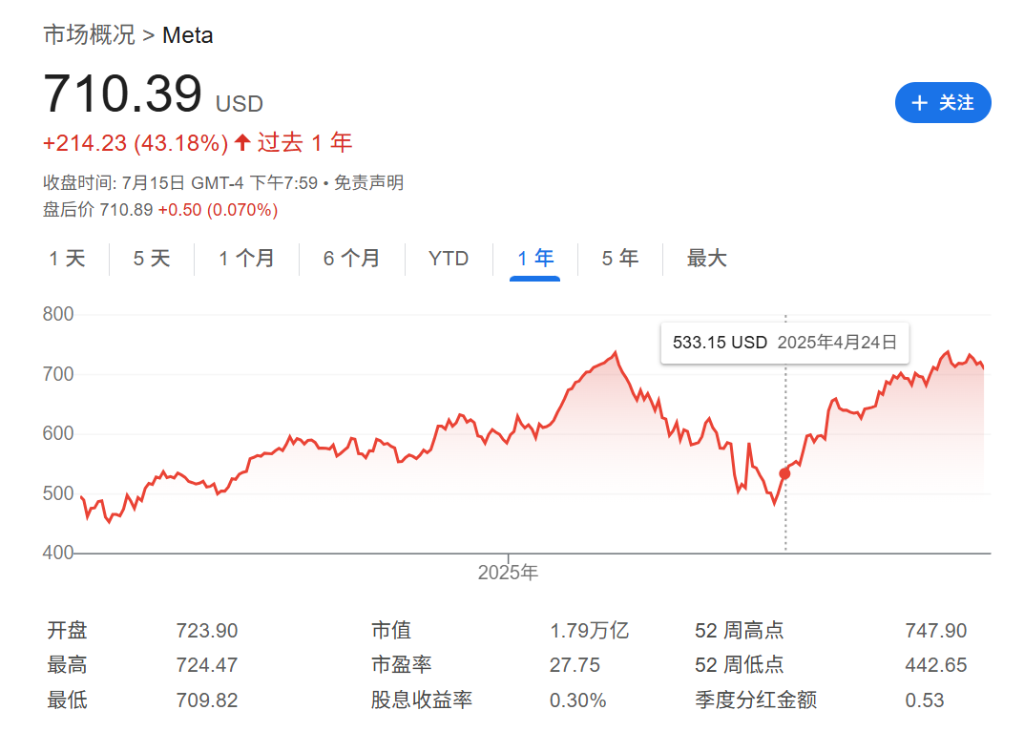
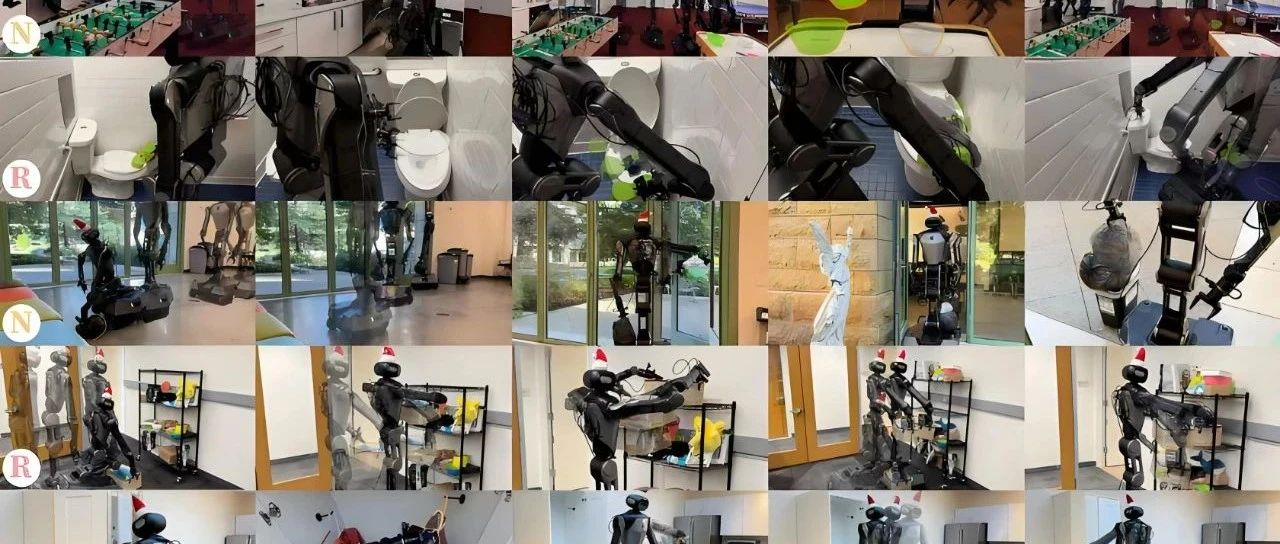
Core Viewpoint - Meta Platforms is committing to invest "hundreds of billions" in building large data centers to support its artificial intelligence (AI) development, aiming for artificial general intelligence (AGI) with the first data center expected to be operational by 2026 [1][2] Group 1: Investment and Revenue Expectations - The announcement reflects confidence in Meta's mid-term revenue trajectory, leading to an upward revision of second-quarter revenue expectations and higher projections for the third quarter and 2026 compared to Wall Street consensus [5][6] - Meta's capital expenditure is expected to increase significantly, with a projected total capital expenditure of $229 billion from 2025 to 2027, and a $6 billion increase in 2026 capital expenditure expectations [5][7] - Revenue forecasts for Meta have been raised, with 2025 revenue expected to reach $190 billion (up 15% year-over-year) and 2026 revenue projected at $217 billion, exceeding Wall Street's consensus of $213 billion [7][8] Group 2: AI Talent and Innovation - The post serves as a recruitment signal for AI talent, positioning Meta as a company focused on AI innovation and resource allocation [5][6] - There is an expectation that Meta will increasingly incorporate AI service components into its business, including marketing services around messaging and subscription models [5][6] Group 3: Valuation and Market Dynamics - The need for Meta to demonstrate strong returns from its AI investments is emphasized, as this will be crucial for expanding its valuation multiples, currently trading at 25 times the expected earnings per share (EPS) for 2026 [2][5] - The competitive landscape for AI investments among tech giants is intensifying, with a warning that CEOs are recognizing both the growing opportunities and the risks of missing out [8][9]

物理模拟器与世界模型驱动的机器人具身智能综述
具身智能之心· 2025-07-15 13:49
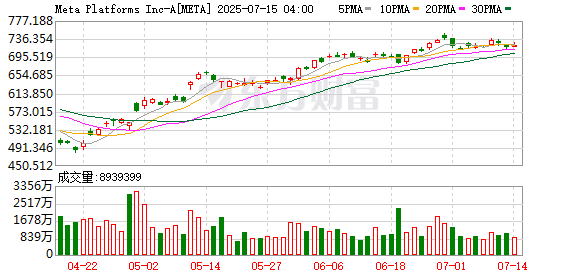
Core Insights - The article emphasizes the significance of "Embodied Intelligence" in the pursuit of General Artificial Intelligence (AGI), highlighting the need for intelligent agents to perceive, reason, and act in the physical world [3][5] - The integration of physical simulators and world models is identified as a promising pathway to enhance the capabilities of robots, enabling them to transition from merely "doing" to "thinking" [3][5] Summary by Sections 1. Introduction to Embodied Intelligence - Embodied Intelligence focuses on intelligent agents that can autonomously perceive, predict, and execute actions in complex environments, which is essential for achieving AGI [5] 2. Key Technologies - Two foundational technologies, physical simulators and world models, are crucial for developing robust embodied intelligence. Physical simulators provide safe and efficient environments for training, while world models enable internal representations of the environment for predictive planning and adaptive decision-making [5] 3. Research Contributions - The article reviews recent advancements in learning embodied intelligence through the fusion of physical simulators and world models, analyzing their complementary roles in enhancing agent autonomy, adaptability, and generalization capabilities [5] 4. Robot Capability Classification - A five-level capability classification system for intelligent robots is proposed, ranging from IR-L0 (basic execution) to IR-L4 (fully autonomous), covering dimensions such as autonomy, task handling, environmental adaptability, and social cognition [8][15] 5. Core Technology Review - The article systematically reviews the latest technological advancements in legged locomotion, manipulation control, and human-robot interaction, emphasizing the importance of these capabilities in the development of intelligent robots [8] 6. Physical Simulator Comparison - A comparative analysis of mainstream simulation platforms (Webots, Gazebo, MuJoCo, Isaac Gym/Sim) is provided, focusing on their physics engine accuracy, rendering quality, and sensor component support, along with future optimization directions [13][19] 7. World Model Architecture and Applications - The article discusses representative structures of world models, including predictive networks and generative models, and their applications in embodied intelligence, particularly in autonomous driving and articulated robots [14][20]
天价“抢人”的Meta被曝弥漫“恐惧文化”!在职员工:近两年竞争压力明显加剧,淘汰率很高
Mei Ri Jing Ji Xin Wen· 2025-07-15 11:09
Core Insights - Meta is facing significant internal cultural issues, described as a "culture of fear," where employees are under constant pressure from performance evaluations and the threat of layoffs [2][3][5] - The competitive atmosphere within Meta has intensified over the past two years, leading to a high turnover rate and a low tolerance for mistakes among employees [2][5] - The rapid development of AI technology is reshaping the job market, creating a demand for interdisciplinary talent while simultaneously increasing pressure on software engineers [2][10][13] Group 1: Internal Culture and Employee Sentiment - A former Meta researcher highlighted that no one in the generative AI department genuinely enjoys working there, indicating a lack of long-term commitment among employees [3][5] - Employees report a significant change in the work atmosphere compared to previous years, with increased competition and a fast-paced work environment leading to heightened stress levels [5][6] - The implementation of a performance-based layoff system has contributed to a sense of insecurity among employees, damaging team morale and collaboration [6][8] Group 2: Market Dynamics and Employment Trends - The tech industry, particularly in Silicon Valley, is experiencing a dual effect from AI advancements: rising salaries for top AI talent while traditional roles face potential obsolescence [10][13] - Senior AI researchers can earn between $3 million to $7 million annually, with some exceeding $10 million, contrasting sharply with the salaries of traditional software engineers [10] - The unemployment rates for computer science and computer engineering graduates are higher than the national average, indicating a growing concern within the tech job market [11][12] Group 3: Future Talent Needs - The current job market is increasingly favoring candidates with interdisciplinary skills, suggesting that those with backgrounds in both technology and other fields will be more competitive [13][14] - Soft skills, such as communication and emotional intelligence, are becoming critical differentiators in the job market as hard skills become more standardized [14]
又一集成灶企业净利润“腰斩”,头部企业扎堆转型新赛道
Nan Fang Du Shi Bao· 2025-07-15 10:02
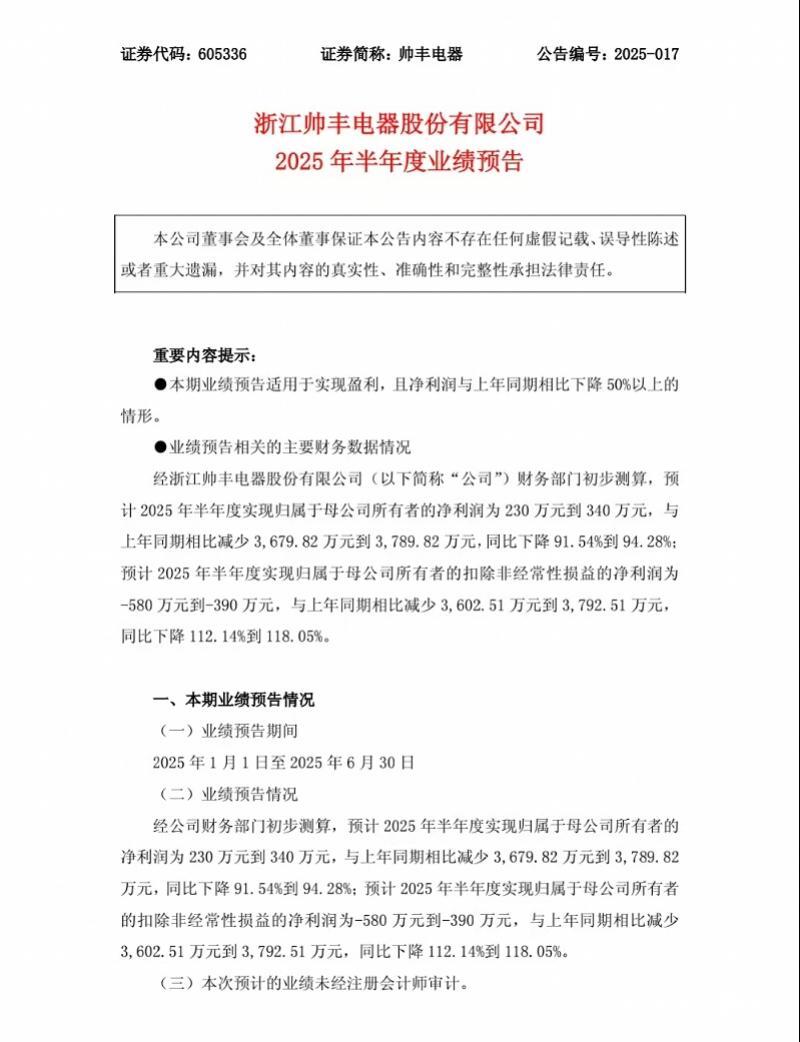
Core Viewpoint - The company Shuaifeng Electric is forecasting a significant decline in its net profit for the first half of 2025, with expectations of a profit between 2.3 million to 3.4 million yuan, representing a year-on-year decrease of 91.54% to 94.28% [1][3][4]. Financial Performance Summary - The projected net profit attributable to the parent company for the first half of 2025 is estimated to be between 2.3 million to 3.4 million yuan, a decrease of 36.8 million to 37.9 million yuan compared to the same period last year [3][4]. - The net profit after deducting non-recurring gains and losses is expected to be between -580,000 to -390,000 yuan, marking a decline of 3.6 million to 3.8 million yuan year-on-year [3][4]. Reasons for Performance Decline - The decline in performance is attributed to several factors: a slowdown in market demand for integrated stoves, intensified industry competition, and a reduction in sales orders compared to the previous year [5]. - Changes in consumer structure have led to adjustments in product offerings, resulting in a decrease in average product prices [5]. - Despite efforts to control operational costs, the reduction in revenue has led to an increase in expense ratios, further impacting net profit [5]. Industry Context - The integrated stove market has seen a downturn since the second half of 2023, with a reported 34.5% decrease in sales revenue and a 29.0% drop in sales volume in the first quarter of 2025 [7]. - Competitors in the integrated stove industry, such as Zhejiang Meida, are also experiencing significant declines in profits, with expected net profits down by 84.11% to 88.21% year-on-year [8]. Strategic Adjustments - The company is actively expanding into new product categories, such as integrated cooking centers and integrated washing products, while also pursuing a full kitchen customization strategy [5]. - Shuaifeng Electric has established a new subsidiary focused on new metal materials and photovoltaic equipment sales, indicating a shift towards new business areas [8].

上海交大/上海AI Lab翟广涛:当评测不再重要,AGI就实现了
机器之心· 2025-07-15 03:20
Core Viewpoint - The article discusses the challenges and limitations of current AI evaluation systems, emphasizing that a perfect evaluation system would equate to achieving Artificial General Intelligence (AGI) [3][20]. Evaluation System Challenges - The primary issue with evaluation systems is "data contamination," where publicly available benchmark tests are often included in the training data of subsequent models, undermining the diagnostic value of evaluations [5][6]. - The "atomization of capabilities" in evaluations leads to a fragmented understanding of intelligence, as complex skills are broken down into isolated tasks, which may not reflect a model's true capabilities in real-world applications [7][8]. - There is a significant disconnect in embodied intelligence, where models perform well in simulated environments but poorly in real-world scenarios, highlighting the need for more realistic evaluation frameworks [9]. Evaluation Framework and Methodology - The article proposes a "Human-Centered Evaluation" approach, focusing on how models enhance human task efficiency and experience rather than merely comparing model performance against benchmarks [12][13]. - The "EDGE" framework is introduced, which stands for Evolving, Dynamic, Granular, and Ecosystem, aiming to create a responsive evaluation system that adapts to AI advancements [13]. - The team is developing a high-quality internal question bank to mitigate data contamination, planning to gradually open-source questions to ensure reproducibility [15]. Future Directions and Goals - The concept of "training-evaluation integration" is emphasized, where evaluations inform training processes, creating a feedback loop that aligns model development with human preferences [16][17]. - The ultimate goal is to establish a comprehensive evaluation framework that encompasses various aspects of AI, guiding the industry towards a more value-driven and human-centered development path [22][23]. - The article concludes that the success of AI evaluation systems lies in their eventual obsolescence, as achieving AGI would mean that self-evaluation capabilities become inherent to the AI itself [24].

继“机器人谷”后 深圳又一人工智能产业新地标诞生 深圳西部崛起“具身智能港”
Shen Zhen Shang Bao· 2025-07-14 16:21
Core Insights - The year 2025 is anticipated to be a milestone for the embodied intelligence robot industry, marking the beginning of mass production [1] - Shenzhen is positioning itself as a leader in the embodied intelligence sector, with significant investments and initiatives aimed at creating a robust ecosystem [2][3] Industry Developments - The establishment of the Huawei Cloud Embodied Intelligence Industry Innovation Center in Shenzhen's Bao'an district is a key development, attracting major companies and startups in the AI and robotics fields [1][4] - The market for embodied intelligence is projected to exceed 1 trillion yuan by 2026, with significant growth expected over the next five years [2] - Shenzhen's action plan for embodied intelligence aims to create a leading innovation ecosystem and attract major industry players [2][3] Investment Landscape - The embodied intelligence sector has seen a surge in investment, with 101 financing events recorded since March 2025, indicating strong market interest [5] - Notable companies in the sector have secured significant funding, reflecting the growing confidence in the industry's potential [5] Technological Integration - The integration of embodied intelligence with traditional manufacturing is seen as a natural advantage for Bao'an, supported by strong hardware foundations and technological advancements from companies like Huawei [6] - A comprehensive ecosystem is forming in the region, with key players and startups collaborating across the entire supply chain of embodied intelligence [6]

