
AI大模型

Search documents
别瞎投!炒黄金路堵死,比亚迪爆单、巴菲特囤钱,风向要变了?
Sou Hu Cai Jing· 2025-11-04 13:16
Group 1: Gold Market Changes - The recent tax adjustment on gold investments has significantly impacted the "gold speculation" market by eliminating the VAT deduction for physical gold, increasing the cost of trading gold [3] - The Shanghai Gold Exchange reported a nearly 10% decrease in physical gold trading volume, while gold ETFs saw a 5% increase, indicating a shift towards more regulated financial products [5] - The policy change encourages investment in gold ETFs, which are more accessible and cost-effective compared to physical gold, aligning with the goal of returning gold to its original role as a safe-haven asset rather than a speculative tool [6] Group 2: Automotive Industry Performance - The electric vehicle sector, particularly BYD, is experiencing significant growth, with sales reaching 441,700 units in October, marking a new high for the year [7] - In contrast, traditional fuel vehicle sales are declining, highlighting a clear divide in the automotive market, with the shift towards electric vehicles becoming increasingly evident [8] Group 3: Technology Sector Challenges - OpenAI reported a staggering loss of $11.5 billion in a single quarter, projecting an annual loss of nearly $50 billion, raising concerns about the sustainability of its aggressive investment strategy [10] - Microsoft continues to support OpenAI with a $10 billion investment, indicating the importance of financial backing for technology companies, especially in capital-intensive sectors like AI [10] Group 4: Investment Strategies of Major Players - Warren Buffett's Berkshire Hathaway has increased its cash reserves to a record $381.7 billion, reflecting a cautious investment approach amid perceived market uncertainties [12] - The company has sold $10.4 billion in assets, including previously held stocks, suggesting a strategy to hold cash for future investment opportunities when market conditions improve [12] - The recent volatility in the Japanese stock market serves as a reminder of the importance of cautious investment strategies, as rapid price increases can lead to significant corrections [15]



新能源汽车推广居全球城市首位,上海前三季度三大先导产业增长8.5%
Ke Ji Ri Bao· 2025-11-04 12:22
Core Insights - Shanghai's industrial economy shows a positive trend with steady growth in the first three quarters of the year, highlighted by significant achievements in various sectors [1][3] Industrial Performance - In September, the industrial added value of Shanghai grew by 8%, with a cumulative growth of 5.3%, contributing 1.1 percentage points to the city's GDP [3] - Among 35 industrial sectors, nine, including automotive manufacturing and electronic equipment manufacturing, outpaced the national average growth rate [3] - The three leading industries in Shanghai experienced an 8.5% growth, with their manufacturing output accounting for 12.3% of the city's industrial total, an increase of 0.6 percentage points compared to 2024 [3] Automotive Industry - The automotive industry in Shanghai achieved an output value of 522.5 billion yuan, a year-on-year increase of 11.8%, representing 17.7% of the city's total industrial output [4] - In the first nine months, the production of complete vehicles reached 1.236 million units, with new energy vehicles (NEVs) accounting for 64.5% of total production [4] - Cumulative promotion of NEVs exceeded 220,000 units, marking a 25.4% year-on-year increase, with a total of 1.87 million units promoted historically, leading globally [4] Major Equipment Industry - The major equipment industry in Shanghai continued to show robust growth, with key enterprises completing 3.555 million deadweight tons in the first three quarters [4] - The industry is undergoing a green transformation and digital enhancement, exemplified by the delivery of the world's first wind-assisted oil tanker and the use of RPA technology to streamline design processes [4] Software and Information Services - The software and information services sector contributed 527.743 billion yuan in added value, growing by 15.5%, surpassing the national growth rate of 11.2% [5] - This sector accounted for 13% of the city's GDP, contributing 1.7 percentage points to the overall GDP [5] - The sector's revenue reached 1.37081 trillion yuan, a 24.1% increase year-on-year, marking the fastest growth during the 14th Five-Year Plan period [5] Export Performance - Shanghai's industrial export delivery value grew by 7.1% in the first three quarters, outperforming the national average of 3.8% [5] - The three leading industries collectively exported 193.67 billion yuan, reflecting a growth of 10.3%, with significant increases in exports of industrial robots, aerospace equipment, and high-end machine tools [5]

“蔚小理”集体变阵,人事调整下的AI大模型之争
Zhong Guo Qi Che Bao Wang· 2025-11-04 11:39
Core Insights - The recent rapid executive changes at Xiaopeng, NIO, and Li Auto reflect an urgent shift towards AI large models in the autonomous driving sector, indicating a fierce competition among these companies [2][3][4] Group 1: Executive Changes and Organizational Restructuring - Xiaopeng Motors has appointed Liu Xianming, previously from Meta and Cruise, to lead its autonomous driving center, signaling a strong commitment to AI large models [3] - NIO has seen the departure of key figures in its AI team, including Bai Yuli and Huang Xin, and is restructuring to focus on "World Model 2.0" [3][4] - Li Auto has restructured its autonomous driving department, splitting its teams into 11 sub-departments to enhance flexibility and focus on AI [4] Group 2: Shift in Technology Strategy - The automotive industry is witnessing a fundamental shift from traditional modular architectures to end-to-end large models, with VLA and WA being the two main technical routes [6][7] - The VLA route emphasizes converting visual information into language semantics before decision-making, while the WA route focuses on generating driving behavior directly from perception [6][7] Group 3: Competitive Landscape and Market Dynamics - The competition in autonomous driving is intensifying, with companies needing to adapt quickly to avoid being left behind [10][11] - The shift towards AI large models is seen as essential for maintaining competitiveness, as traditional methods are proving inadequate in complex driving scenarios [3][10] Group 4: Investment and Financial Implications - Companies are significantly increasing their R&D investments in autonomous driving, with Xiaopeng, NIO, and Li Auto allocating a substantial portion of their budgets to this area [11] - Xiaopeng's R&D expenditure for the first half of the year reached approximately 4.19 billion yuan, a notable increase from 2.82 billion yuan in the same period last year [11] Group 5: Future Outlook - The ongoing competition in AI large models is expected to reshape the automotive industry's competitive landscape, with companies recognizing the critical importance of this technology for future success [12]

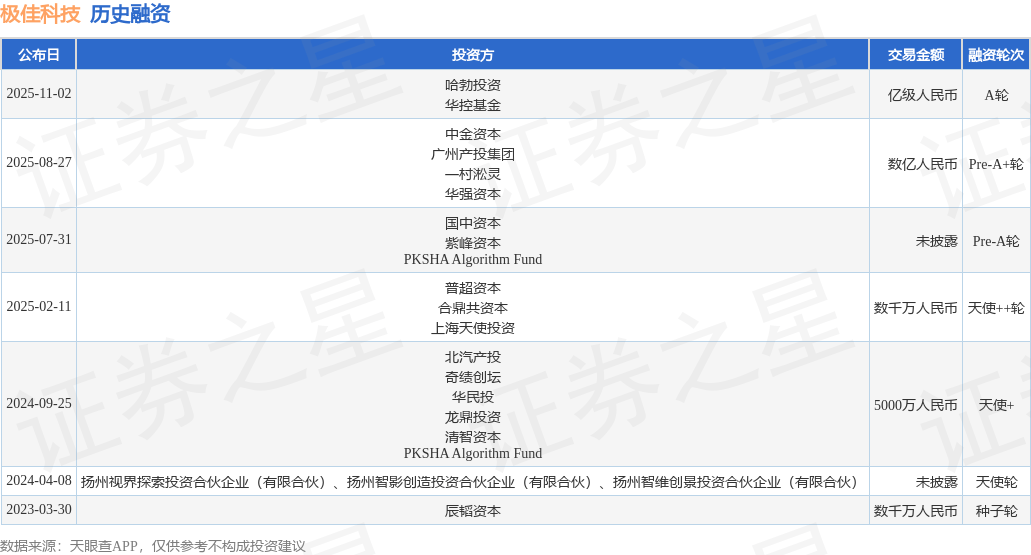
【投融资动态】极佳科技A轮融资,融资额亿级人民币,投资方为哈勃投资、华控基金等
Sou Hu Cai Jing· 2025-11-04 11:32
Group 1 - The core point of the news is that Beijing Jijiashijie Technology Co., Ltd. has completed its Series A financing round, raising a significant amount in RMB, with investors including Hubble Investment and Huakong Fund [1][2]. - The company specializes in AI large models and has a team composed of members from prestigious institutions such as Tsinghua University and the Chinese Academy of Sciences, as well as experienced professionals from Microsoft, Alibaba, and Baidu [2]. - The financing round is part of a series of investments the company has received, including a Pre-A+ round in August 2025 and several earlier funding rounds, indicating a growing interest in the company's technology and potential [2]. Group 2 - The investment details show that Hubble Investment participated in the A round with an amount classified as "hundreds of millions" in RMB, reflecting strong investor confidence in the company's future [2]. - The company has a history of securing funding, with previous rounds including a Pre-A+ round raising hundreds of millions in RMB and an angel round that raised tens of millions in RMB, showcasing its ability to attract capital [2]. - The involvement of notable investors and the company's strong technical background suggest a promising outlook for its growth in the AI sector [2].
烽火通信(600498):光网技术引领突破,算力业务加速释放
Changjiang Securities· 2025-11-04 10:15
Investment Rating - The investment rating for the company is "Buy" and is maintained [9]. Core Insights - The company has a strong foundation in marine communication technology, which is expected to drive continuous expansion in overseas markets and improve the quality of its main business operations. The subsidiary, Changjiang Computing, is rapidly generating revenue amidst the domestic computing power construction wave, potentially becoming the key growth engine for the company in the coming years [2][12]. Financial Performance - In the third quarter of 2025, the company achieved a total revenue of 17.072 billion yuan, a year-on-year decrease of 19.30%. However, the net profit attributable to shareholders increased by 30.28% to 513 million yuan [6][12]. - The company is projected to have net profits of 920 million, 1.15 billion, and 1.38 billion yuan for 2025, 2026, and 2027 respectively, reflecting year-on-year growth rates of 31%, 25%, and 20% [12]. Business Development - The company is advancing its optical network construction towards ultra-high speed, large capacity, low latency, and intelligent directions, while maintaining rapid development in computing power infrastructure. Despite a slight decline in revenue due to reduced capital expenditures from domestic operators, the company has optimized its revenue structure [12]. - The company has made significant strides in international markets, achieving breakthroughs in Southeast Asia, the Americas, and Africa, and has secured substantial market shares in optical network and broadband products [12]. - The computing power business is accelerating, focusing on building a soft and hard integrated, domestically produced computing power platform to meet the needs of key sectors and the digital transformation of various industries [12]. Research and Development - The company has consistently invested heavily in R&D, maintaining global competitiveness in OTN and broadband access products. It is recognized as a major supplier in the global market and a source of original technology [12]. - The company has developed core technologies in marine communication, being the only high-tech enterprise globally that integrates chip devices, shore-based and underwater equipment, and marine engineering equipment [12].

AI“盆景”已成“风景”?大模型的规模复制让工业长出数智生产力!
Sou Hu Cai Jing· 2025-11-04 08:23
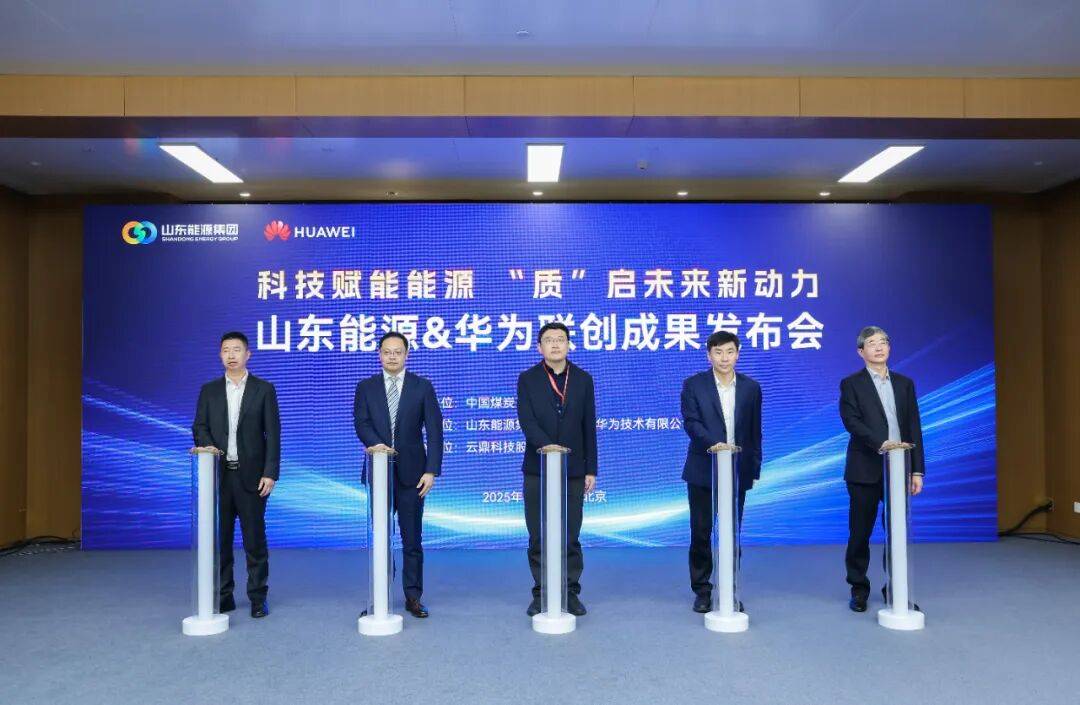
Core Insights - The AI revolution is transitioning from a "workshop" model to a "factory" model, enabling the replication of industrial wisdom from deep mines to broader industrial applications [1][3] - A joint release of six innovative results by Shandong Energy Group, Yunding Technology, and Huawei marks a pivotal moment in the intelligent transformation of traditional industries [1][3] Group 1: AI Development Model - The "Pangu Model" aims to overcome the fragmented and high-cost nature of AI applications in mining, moving towards a standardized "factory-style" AI development pipeline [3][4] - The new AI production line consists of "1 AI development platform + 4 core capabilities (vision, prediction, natural language processing, multi-modal) + N high-value scenarios," enhancing scalability and efficiency [3][4] - The implementation of the Pangu model has already been successful in over 100 scenarios across various coal mines, demonstrating significant improvements in operational efficiency and cost reduction [3][4] Group 2: Standardization and Modularization - Standardization of architecture addresses the challenges of implementing AI across different industrial sectors, allowing for a unified approach to data collection and application [4][5] - Modular capabilities provided by the Pangu model, such as visual and predictive functions, can be reused across different industries, significantly lowering the barriers to new scenario development [5][7] - The collaborative ecosystem between Huawei and industry leaders ensures that AI solutions are both technologically advanced and closely aligned with industry needs [7] Group 3: Cross-Industry Applications - The AI model is being applied to optimize critical processes in steel and chemical industries, transforming traditional practices into precise, replicable data models [8][9] - Predictive maintenance models are enhancing operational efficiency in heavy asset industries, with significant improvements in equipment reliability and reduced downtime [10][12] - Cost control through global optimization algorithms is being implemented in raw material management, leading to substantial cost savings across various sectors [14][16] Group 4: Future Implications - The shift from isolated AI applications to a comprehensive, interconnected approach signifies a major turning point in industrial intelligence, with the potential for widespread economic benefits [17] - The anticipated growth in the deployment of autonomous mining vehicles and AI models across the entire production process indicates a significant move towards large-scale intelligent operations [17]
特斯拉憋大招?家庭人形机器人还有多久?
新财富· 2025-11-04 08:03
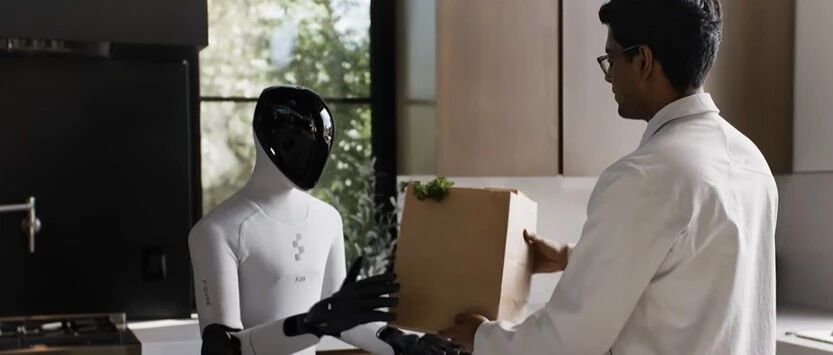
Core Viewpoint - The article discusses the delays in the production and release of Tesla's Optimus Gen3 humanoid robot, highlighting the challenges faced by the company in the competitive landscape of humanoid robotics, particularly in relation to its competitors like Figure AI and 1X [3][6][27]. Group 1: Tesla's Optimus Gen3 - The release of Optimus Gen3 has been postponed to Q1 2026, with mass production now expected to start in late 2026, contrary to earlier plans for 2025 [3][6]. - Tesla's ambitious production targets included 5,000 units in 2025 and 50,000 units in 2026, but these are now deemed unattainable due to design optimization needs and supply chain issues [3][6]. - The main technical challenge cited is the insufficient lifespan of the dexterous hand, which is critical for the robot's functionality [4][5]. Group 2: Competitors' Developments - Figure AI launched its third-generation humanoid robot, Figure 03, which is designed for household tasks and features significant improvements in safety and functionality [9][10]. - Figure 03's AI model, Helix, has shown promising results in household tasks, with the company planning to start alpha testing for home use earlier than expected [14][16]. - 1X introduced its humanoid robot, Neo, which operates under remote control and is positioned as a consumer product, with a focus on safety and privacy [21][22]. Group 3: Market Dynamics and Future Outlook - The competition in the humanoid robot market is intensifying, with companies like Figure AI and 1X making strides in product development and market readiness [6][19][24]. - Tesla's current technological advantage is not as pronounced as it once was, and the company faces increasing pressure to innovate and catch up with competitors [7][27]. - The article suggests that the path to successful humanoid robots involves overcoming significant technical challenges and that the timeline for widespread adoption may extend beyond current expectations [27].

中信证券:基金投顾有望成为券商财富管理业务的新增长引擎
智通财经网· 2025-11-04 00:55
Core Insights - The report from CITIC Securities indicates that fund advisory services are expected to become a new growth engine for brokerage wealth management, with more resilient income and reduced reliance on transaction volumes [1][5] - The wealth management brokerage income is projected to reach approximately 110 billion yuan, with net income from investment consulting expected to approach 60 billion yuan, becoming a key pillar of wealth management [1][5] Business Status - The scale of fund advisory services is anticipated to overcome bottlenecks, with investor satisfaction relatively high [2] - Since the pilot launch in 2019, 60 institutions have been included, with continuous growth in scale and clientele, although there was a noticeable slowdown from 2022 to 2023, with effective recovery expected by the first half of 2025 [2] - Fund advisory users have shown significantly better "sense of gain" compared to direct investment in single products, although issues such as fee sensitivity and drawdown management still need optimization [2] Overseas Market Trends - The U.S. advisory industry has maintained long-term growth, establishing a second growth curve for brokerage businesses [3] - From 2015 to 2024, investment consulting revenue from "fee-based advisory relationships" is projected to grow from 150 billion USD to 260 billion USD, with a compound annual growth rate of 6.4% [3] - Retail clients and international business are experiencing rapid growth, with retail client numbers and AUM growth rates leading the market [3] - The asset allocation capabilities are becoming more diversified, with increased use of stocks, bonds, and funds [3] Domestic Observations - The development of fund advisory services is driven by policies, demand, and supply factors [4] - Regulatory bodies are expected to introduce new management measures for investment consulting services by 2025, alongside reforms in personal pensions and public fund fee structures [4] - There is a shift in resident asset allocation from housing and deposits to diversified financial assets, driven by housing price adjustments and declining deposit rates [4] - The supply side is facing challenges with declining transaction commission rates and increased competition among financial institutions [4] Summary - Fund advisory services are poised to become a new growth engine for securities companies, supported by a combination of policy, demand, and supply factors [5][6] - Following a downturn in 2022-2023, the fund advisory sector is showing signs of recovery, aided by improved market sentiment and regulatory reforms [5][6] - The deployment of AI models is expected to enhance the overall capabilities of financial institutions, positioning those with comprehensive service offerings to benefit from this growth wave [6]

萤石网络20251103
2025-11-03 15:48
Summary of the Conference Call for Yingstone Network Company Overview - **Company**: Yingstone Network - **Industry**: Smart Home and IoT (Internet of Things) Key Financial Performance - **Revenue**: In the first three quarters of 2025, Yingstone Network achieved revenue of 48.29 billion, a year-on-year increase of 12.68% [2][3] - **Q3 Revenue**: Q3 revenue reached 14.65 billion, showing a year-on-year growth of 6.25% and a quarter-on-quarter increase of 1.25% [2][3] - **Profit**: Total profit for the first three quarters was 1.2 billion, up 23.21% year-on-year, with net profit attributable to shareholders also at 1.2 billion, reflecting a 28.73% increase [2][3] - **Gross Margin**: The overall gross margin for the first three quarters was 43.76%, a 1 percentage point increase year-on-year, with Q3 gross margin at 43.79% [2][5] Expense Analysis - **Sales Expenses**: Sales expenses totaled 7.03 billion, a 17% increase year-on-year, with the sales expense ratio rising to 16% [2][5] - **R&D Expenses**: R&D expenses were 6.48 billion, up 4% year-on-year, with a slight decrease in the R&D expense ratio [2][5] - **Management Expenses**: Management expenses reached 1 billion, an 18% increase year-on-year [2][5] Product Development and Market Trends - **Smart Home Products**: The launch of the Qiming AI facial recognition lock received positive user feedback, with online channels showing growth while offline channels faced pressure [2][6] - **Camera Business**: The smart home camera business turned profitable in the first half of 2025, with growth exceeding 10% when excluding operator impacts [2][7] - **4G Battery-Powered Cameras**: Rapid development in the domestic market for 4G battery-powered cameras is driving overall camera revenue growth [4][11] International Market Expansion - **Overseas Growth**: The overseas business is growing rapidly, with Q3 overseas hardware revenue nearing domestic levels. The company plans to increase investment in overseas products and marketing resources [2][8][13] Cloud Services and AI Development - **Cloud Services**: The introduction of new 4G battery-powered products is impacting cloud service revenue recognition, but long-term contributions are expected to increase [4][9] - **AI Capabilities**: Daily calls to cloud AI capabilities have significantly increased, indicating a scale-up in operations [10] Robotics and Future Outlook - **Robotics Business**: Q3 adjustments in the robotics business, including inventory clearance, negatively impacted revenue growth and gross margins. Focus will shift to cleaning robots, with new models expected in 2026 [4][17] - **Future Revenue Growth**: The company anticipates steady growth across all major product lines, with a focus on smart locks and service robots, while maintaining a balanced profit management strategy [18] Strategic Insights - **Market Differentiation**: The overseas market, particularly in Europe and the Americas, shows higher acceptance and conversion rates for AI value-added services compared to domestic markets [16] - **Investment Opportunities**: The sub-brand "Jin Xiaodou" is performing well, indicating potential investment opportunities in niche markets [12] This summary encapsulates the key points from the conference call, highlighting the financial performance, product developments, market trends, and strategic insights of Yingstone Network.

比亚迪等百家上市公司发布ESG委员会细则 | ESG热搜榜
2 1 Shi Ji Jing Ji Bao Dao· 2025-11-03 14:00
Group 1 - Li Auto announced a recall of 11,411 units of the MEGA 2024 model due to insufficient corrosion resistance of the coolant, which could lead to safety hazards such as battery thermal runaway [1] - The recall affects vehicles produced between February 18, 2024, and December 27, 2024, and will begin on November 7, 2025 [1] - Li Auto's chairman emphasized the proactive nature of the recall, stating that the company cannot wait for the investigation results given the potential risks [1] Group 2 - A total of 99 A-share listed companies, including BYD and Yili, have released ESG committee work guidelines from October 24 to 31 [2] - Some companies have rebranded their strategic committees to ESG committees, integrating ESG considerations into core decision-making processes [2] - Companies like Jinling Mining have revised their guidelines to clarify the responsibilities of the chairman in convening ESG committee meetings [2] Group 3 - Five banks, including China Bank and Agricultural Bank of China, received fines for various management failures, totaling millions in penalties [3] - The fines were primarily due to imprudent management in areas such as corporate governance, loan management, and asset quality [3] Group 4 - China's Ministry of Ecology and Environment called for a financing roadmap of $1.3 trillion ahead of COP30, highlighting dissatisfaction with the current funding targets set for developed countries [5] - The report emphasizes the need for substantial progress on financing commitments to support global adaptation goals [5] Group 5 - Zhejiang Securities reported a significant divergence in ESG investment trends between the US and Europe, with large-scale withdrawals from passive ESG funds in Europe [6] - BlackRock has transformed approximately $48 billion of institutional client index products into "ESG dedicated accounts" to meet specific ESG requirements [6] Group 6 - An interview with Zhong Hongwu highlighted that China's ESG evaluation system is transitioning from a follower to a leader, focusing on value creation rather than just risk avoidance [7] - The emphasis is on aligning ESG efforts with national strategic goals, providing a new inclusive development option for global ESG governance [7] Group 7 - Roland Berger's senior partner emphasized the need for businesses to integrate ESG and green transformation into product development systems [7] - The current phase of green low-carbon transformation requires overcoming challenges in standards and collaboration, with CCUS technology being crucial for achieving net-zero goals [7]