
新型工业化

Search documents
金融支持新型工业化!七部门:完善期货产品体系,推动大宗商品保供稳价
Qi Huo Ri Bao· 2025-08-05 22:41
Core Viewpoint - The People's Bank of China and six other departments have jointly issued guidelines to enhance financial support for new-type industrialization, aiming to accelerate the construction of a financial and manufacturing powerhouse by 2027 [1][4]. Group 1: Financial Support for Industrialization - The guidelines emphasize the importance of financial services to the real economy and risk prevention, focusing on major strategic tasks of new-type industrialization [4]. - The financial system is expected to mature by 2027, supporting the high-end, intelligent, and green development of the manufacturing industry [4]. Group 2: Specific Measures - The guidelines propose 18 specific measures across five areas, including enhancing technological innovation capabilities and supply chain resilience, building a modern industrial system, and improving financial support capabilities [4][5]. - Financial policies will be optimized to support key technology products and facilitate the transformation of scientific achievements into capital [5]. Group 3: Financial Services for Key Enterprises - Financial institutions are encouraged to provide comprehensive financial services to key enterprises in the industrial chain, including loans, bonds, and insurance [6]. - Support will be given to private enterprises to participate in the construction of a self-controlled industrial chain [6]. Group 4: Cross-Border Financial Services - The guidelines aim to enhance the convenience of cross-border financial services and expand high-level bilateral open development space [7]. - Measures include optimizing foreign trade financial products and services, promoting the use of RMB in cross-border trade settlements, and expanding pilot programs for cross-border financing [7]. Group 5: Long-term Mechanism and Capacity Building - The guidelines call for strengthening the internal mechanisms of financial institutions to serve the manufacturing sector and developing a talent pool for financial services in technology industries [8]. - A collaborative approach involving multiple departments will be established to enhance the effectiveness of financial support for new-type industrialization [8].

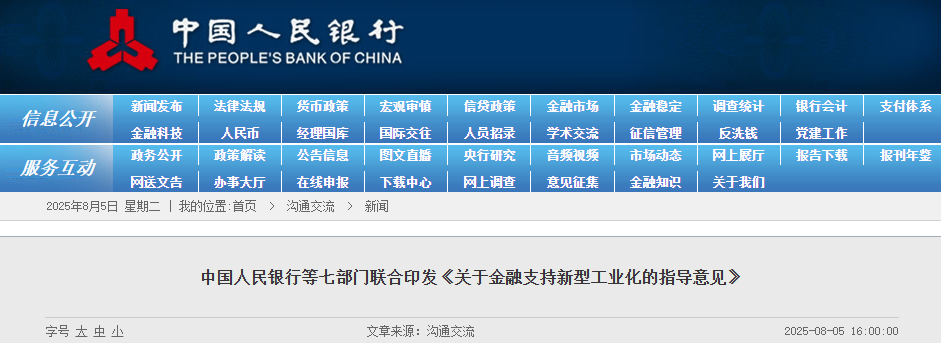
每日债市速递 | 央行等7部门官宣金融支持新型工业化
Wind万得· 2025-08-05 22:37
Group 1: Open Market Operations - The central bank conducted a 7-day reverse repurchase operation on August 5, with a fixed rate and a total amount of 160.7 billion yuan, at an interest rate of 1.40% [1] - On the same day, 449.2 billion yuan of reverse repos matured, resulting in a net withdrawal of 288.5 billion yuan [1] Group 2: Funding Conditions - Following an unexpected net injection the previous day, the central bank returned to a net withdrawal, but the interbank market remains well-supplied [3] - The overnight repo weighted average rate (DR001) slightly decreased, hovering around 1.31% [3] - The latest overnight financing rate in the U.S. is 4.34% [3] Group 3: Interbank Certificates of Deposit - The latest transaction rate for one-year interbank certificates of deposit among major banks is at 1.63%, showing a slight increase from the previous day [6] Group 4: Government Bond Futures - The closing prices for government bond futures showed a slight increase: 30-year main contract up 0.06%, 10-year up 0.05%, 5-year up 0.04%, and 2-year down 0.01% [12] Group 5: Financial Support for New Industrialization - A joint guideline was issued by several government bodies, aiming for a mature financial system supporting high-end, intelligent, and green development in manufacturing by 2027 [13] - The guideline emphasizes the need for a variety of financial tools to meet the effective credit demand of manufacturing enterprises [13] Group 6: Real Estate Sector Support - The China Real Estate Association has initiated a recommendation for small and medium-sized real estate developers to receive financial services, establishing a financing connection mechanism [14] Group 7: Global Macro Insights - The Bank of Japan's meeting minutes indicate a consensus on continuing interest rate hikes if economic and price trends align with expectations [16] - Japanese Prime Minister emphasized the need for swift action to implement the U.S. trade agreement, highlighting a win-win scenario for both countries [16]

为推进新型工业化提供高质量金融服务
Ren Min Ri Bao· 2025-08-05 22:21
Core Viewpoint - The People's Bank of China and several government departments have jointly issued guidelines to enhance financial support for new industrialization, aiming to deepen financial supply-side structural reforms and promote high-quality financial services for the development of new productive forces by 2027 [1][2][3]. Group 1: Financial Support Measures - The guidelines propose targeted support measures for key technology products and breakthroughs, enhancing financial services for key enterprises in the industrial chain, and improving the resilience of supply chains [2][3]. - Development of technology finance, green finance, and digital finance is emphasized, with a focus on supporting traditional industries' transformation and nurturing emerging industries [2][3]. Group 2: Structural Reforms - The guidelines aim to optimize the funding supply structure, providing loans, bonds, and equity financing to support new industrialization [3]. - A comprehensive, differentiated, and specialized financial service system is to be established, with a focus on supporting core technology breakthroughs and the development of emerging industries [3]. Group 3: Regional and Cross-Border Financial Services - The guidelines include mechanisms for credit management and financial products to support the transfer of industries to central and western regions, promoting the aggregation of financial resources towards industrial clusters [2][3]. - Initiatives to facilitate cross-border financial services, including trade settlement and fund management, are also outlined to support reasonable industrial layout and expansion [2].

百强县挑大梁作用明显
Jing Ji Ri Bao· 2025-08-05 22:16
Core Insights - The 2025 County Economic Innovation Development Forum released a report indicating that the top 100 counties in China occupy about 2% of the land area and 7% of the population, yet contribute over 10% of the national GDP [1] - The economic scale of the top 100 counties increased from 7.4 trillion yuan in 2015 to 12.6 trillion yuan in 2023, nearly doubling [1] - The report highlights that county economies are crucial for new industrialization and rural revitalization, contributing approximately 40% of the national GDP and over 40% of the secondary industry value added [2] Economic Performance - The top 100 counties accounted for 26.5% of county-level GDP with only 5% of the county count, showcasing their significant economic impact [1] - The number of counties with GDP exceeding 1 billion yuan is projected to increase to 62 in 2024, with 21 counties nearing this threshold [1] - The eastern region dominates with 67 of the top 100 counties, while the northeastern region has only 3, indicating a clear regional disparity [2] Industrial Development - The report emphasizes the importance of new industrialization as a core driver for high-quality county economic development, with a focus on upgrading traditional industries and fostering emerging sectors [3] - The creation of green factories and the acceleration of industrial development infrastructure are highlighted as significant trends [2] - Counties near large cities, coastal areas, and border regions are identified as having strong development potential due to their unique geographical advantages [2][3] Strategic Recommendations - Counties are encouraged to tailor their development strategies based on local conditions, leveraging their specific advantages for high-quality growth [3] - There is a call for integrating technological and industrial innovation to enhance county economic development [3] - Border counties should transition from being "open ends" to "dual circulation nodes," while coastal counties should focus on high-tech and high-quality industries [3]
七部门印发指导意见 为推进新型工业化提供高质量金融服务
Ren Min Ri Bao· 2025-08-05 22:07
对照新型工业化重点领域,《意见》提出针对性支持举措,优化金融政策工具支持关键技术产品和攻 关,多渠道为科技成果转化引入耐心资本,强化产业链重点企业综合金融服务,提升产业科技创新能力 和产业链供应链韧性;发展科技金融、绿色金融、数字金融等五篇大文章,深化基于"数据信用"和"物 的信用"的产业链金融服务模式,支持传统产业转型升级和培育壮大新兴产业;健全中西部承接产业转 移有关授信管理机制和金融产品服务,推动金融资源向产业集群聚集和专业化发展,推进贸易结算、资 金管理、投融资等一系列跨境金融服务便利化举措,支持产业合理布局和拓展发展空间,促进做强国内 大循环。 中国人民银行有关部门负责人介绍,此次发布的《意见》坚持以产业需求牵引深化金融供给侧结构性改 革,构建全覆盖、差异化、专业性金融服务体系,形成金融支持新型工业化的清晰路径。一是在宏观层 面要优化资金供给结构,为新型工业化提供贷款、债券、股权等融资支持。二是完善科技金融服务体 系,支持核心技术攻关、新兴产业培育发展和传统产业改造升级。三是优化供应链金融和区域、外贸金 融服务,支持重点产业链和先进制造业集群发展。四是推进绿色金融和转型金融,支持新能源产业和传 统工 ...
持续上涨!白银价格创近13年来新高丨今日财讯
Sou Hu Cai Jing· 2025-08-05 21:35
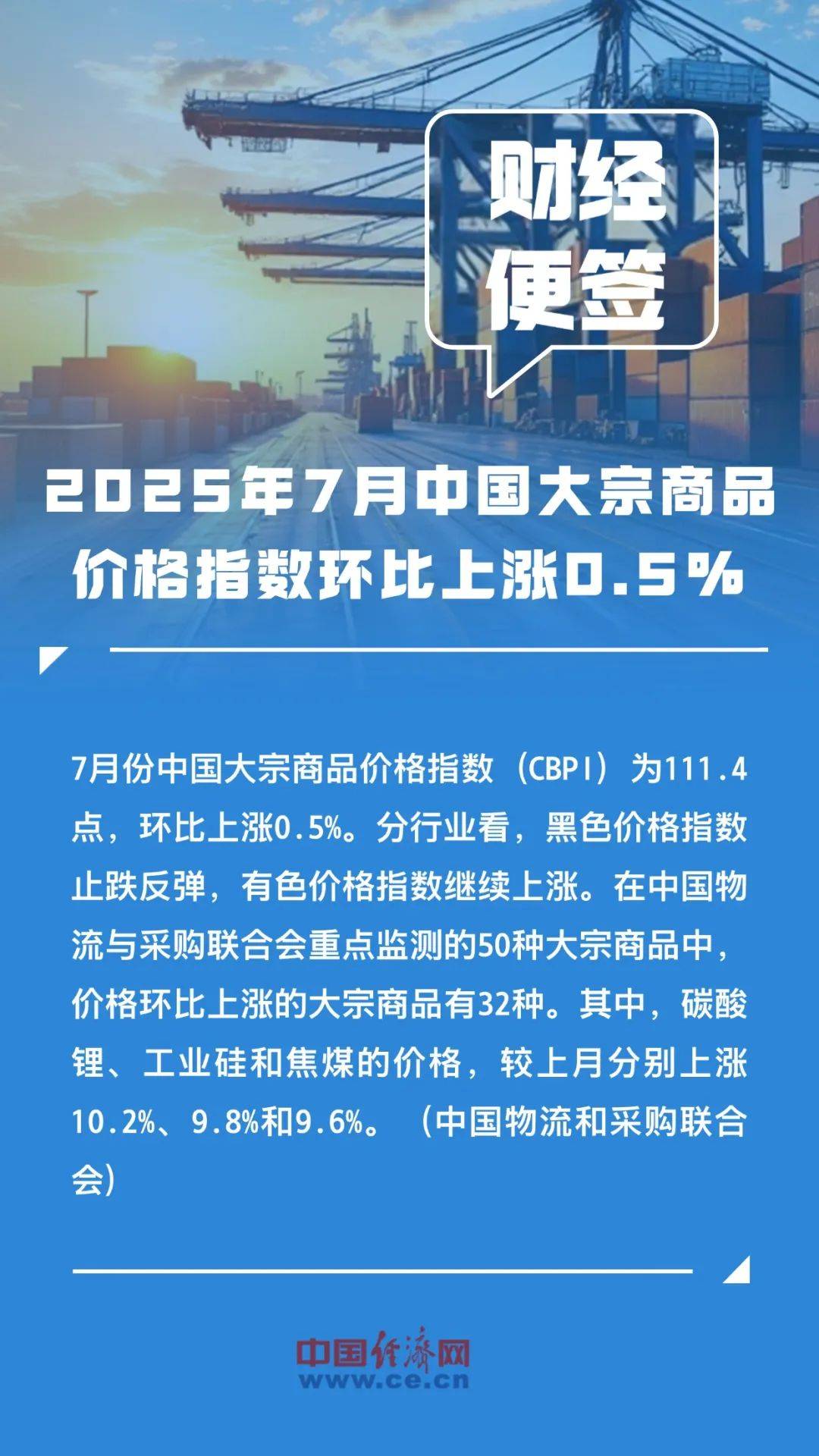
Group 1 - The State Council issued an opinion to gradually promote free preschool education, starting from the fall semester of 2025, which will exempt public kindergartens from charging care and education fees for the last year of preschool [2] - Seven departments, including the People's Bank of China, released guidelines to support new industrialization, proposing 18 targeted support measures, aiming for sufficient credit demand for manufacturing enterprises by 2027 [2] - In 2024, Chinese courts resolved 1,156 cases of medical insurance fraud, recovering over 402 million yuan in losses, with a year-on-year increase of 131.2% in case resolution [2] Group 2 - The effective client base in the futures market exceeded 2.6 million, marking a historical high, with a year-on-year growth of 12% [2] - In July, China's Commodity Price Index (CBPI) rose by 0.5% month-on-month, reaching 111.4 points [3] Group 3 - Silver prices have surged to a nearly 13-year high, driven by rising gold prices and increased industrial demand in sectors like photovoltaics and electronics [8] - The domestic gaming market generated actual sales revenue of 168 billion yuan in the first half of the year, reflecting a year-on-year growth of 14.08%, with the user base nearing 679 million [9] Group 4 - In Nanjing, unemployed women can apply for a one-time additional unemployment benefit equivalent to three times their monthly unemployment insurance during childbirth, without affecting their original unemployment benefit duration [9] - The U.S. government announced a new pilot program requiring some tourists to pay a deposit ranging from $5,000 to $15,000 to enter the country, aimed at combating visa overstays [9] - Elon Musk was granted 96 million shares of stock as a reward, valued at approximately $29 billion, with an exercise price of $23.34 per share [10]

七部门出台金融支持新型工业化指导意见
Zhong Guo Zheng Quan Bao· 2025-08-05 21:07
Group 1 - The People's Bank of China and other regulatory bodies have issued guidelines to support new industrialization through financial integration and targeted investment initiatives [1][2] - The guidelines emphasize the importance of enhancing technological innovation capabilities and supply chain resilience in key industries, with a focus on long-term financing for critical technologies [1][3] - There is a push for increased financial support for emerging industries such as information technology, industrial software, and biotechnology, with specific measures to facilitate financing in these sectors [1][2] Group 2 - The guidelines propose the implementation of a "Technology-Industry Financial Integration" initiative, which includes monthly investment roadshows and support for specialized small and medium enterprises [2] - Financial institutions are encouraged to expand technology loan offerings and enhance the underwriting of technology innovation bonds to support the growth of new industries [2] - The guidelines also call for improved coordination between financial and industrial policies, with a focus on monitoring credit to the manufacturing sector and ensuring compliance with policy requirements [3]
禾川科技股价微涨0.52% 人形机器人概念受关注
Jin Rong Jie· 2025-08-05 19:06
Group 1 - The latest stock price of Hechuan Technology is 48.70 yuan, an increase of 0.25 yuan from the previous trading day [1] - The stock reached a maximum of 49.46 yuan and a minimum of 48.01 yuan during the trading session, with a total transaction amount of 202 million yuan [1] - Hechuan Technology's main business includes the research, production, and sales of industrial automation control products, which are widely used in fields such as industrial robots and CNC machine tools [1] Group 2 - Hechuan Technology is categorized under the instrumentation industry and is also involved in humanoid robots and new industrialization concept sectors [1] - The net outflow of main funds for Hechuan Technology on that day was 2.55 million yuan, with a cumulative net outflow of 76.33 million yuan over the past five trading days [1]

金融支持新型工业化“路线图”发布 突破关键核心技术的科技企业适用上市融资、并购重组、债券发行“绿色通道”
Zheng Quan Shi Bao· 2025-08-05 18:55
Core Viewpoint - The People's Bank of China and six other departments issued guidelines to support new industrialization, aiming to enhance financial services for high-quality development and prevent excessive competition in the manufacturing sector [1]. Group 1: Financial Support Structure - The guidelines focus on optimizing the funding supply structure, providing loans, bonds, and equity financing to meet the effective credit demand of manufacturing enterprises by 2027 [2]. - The guidelines emphasize the use of structural monetary policy tools to encourage banks to provide long-term financing for key manufacturing sectors such as integrated circuits and advanced materials [2]. - The total quota for re-lending for technological innovation and technological transformation was increased to 800 billion yuan, indicating a need for further optimization of these tools [2]. Group 2: Direct Financing and Technology Enterprises - The guidelines establish a "green channel" for technology enterprises to access public financing, mergers and acquisitions, and bond issuance [3]. - There is a focus on introducing long-term capital and developing patient capital to support diverse financing service models for technology research and development [3]. - The implementation of a "technology-industry-finance integration" initiative aims to enhance the evaluation system for hard technology attributes [3]. Group 3: Credit Policy Optimization - The guidelines propose targeted support measures for traditional manufacturing, encouraging banks to optimize credit policies based on a "support and control" principle [4]. - Financial support will be directed towards high-end, intelligent, and green development in traditional manufacturing, as well as industry consolidation through various financial instruments [4]. - The guidelines advocate for deepening supply chain financial services, providing financing based on data and physical credit for small and medium-sized enterprises [4]. Group 4: Cross-Border Financial Services - The guidelines aim to enhance the convenience of cross-border financial services, including trade settlement and investment management [5]. - There is a proposal to expand the pilot scope for foreign investment reinvestment without registration [5]. Group 5: Long-term Financial Service Mechanisms - The guidelines call for establishing a one-on-one mentoring mechanism for major industrial financing projects to address issues like information asymmetry [6]. - A collaborative approach among departments is encouraged to create a supportive environment for financing projects, with a focus on risk prevention and management [6]. - The guidelines highlight the importance of preventing excessive competition in the financial sector while supporting industrial mergers and acquisitions to promote industry consolidation [6].
构建全覆盖、差异化、专业性金融服务体系 七部门明确金融支持新型工业化路径
Shang Hai Zheng Quan Bao· 2025-08-05 18:16
Core Viewpoint - The document outlines a series of financial policy measures aimed at supporting new industrialization, emphasizing the need for optimized funding structures and enhanced financial services for key industries and technological innovation [1][2][3]. Group 1: Financial Support for Key Technologies - The document highlights the importance of optimizing the funding supply structure to provide loans, bonds, and equity financing for new industrialization [1]. - It emphasizes the need for a comprehensive financial service system to support core technology breakthroughs, the development of emerging industries, and the transformation of traditional industries [1][2]. - Specific measures include the introduction of long-term capital and patient capital to accelerate the transformation of technological achievements [2]. Group 2: Strengthening Financial Services for Key Enterprises - Financial institutions are encouraged to use diverse tools such as loans, bonds, equity, and insurance to provide comprehensive financial services to key enterprises in the industrial chain [2][3]. - The document calls for the development of a financial service model based on "data credit" and "material credit" to enhance the flexibility of financial services for industrial transfers [3]. - It also stresses the importance of supporting listed companies in industry consolidation through various financial mechanisms [3]. Group 3: Coordination of Financial and Industrial Policies - The document emphasizes the need for a coordinated approach between financial policies and industrial policies to enhance support for new industrialization [4][5]. - It calls for the establishment of internal mechanisms within financial institutions to better serve the manufacturing sector and to adjust operational directions based on national development needs [4]. - The document advocates for the cultivation of a talent pool skilled in technology and industrial finance to improve service capabilities [5].