
光伏

Search documents
2月3日A股市场点评:三大指数午后走强
Zhongshan Securities· 2026-02-03 12:07
Market Performance - The three major indices in the A-share market showed a collective rebound, with the Shanghai Composite Index rising by 1.29% and the Shenzhen Component Index increasing by 2.19%[3] - The Northbound 50 index led the gains with a rise of 3.27%, while the CSI 300 index increased by 1.18%[3] Sector Performance - The top-performing sectors included Comprehensive (5.63%), Defense and Military Industry (4.42%), and Machinery Equipment (3.98%) while the Banking sector lagged with a decline of 0.85%[3] - The leading concept indices were the Photovoltaic Selected Index (8.05%) and the TOPcon Battery Index (8.01%), contrasting with the Central Enterprise Bank Index which fell by 1.63%[3] Economic Indicators - The US ISM Manufacturing PMI unexpectedly rose from 47.9 to 52.6 in January, marking the first expansion in nearly a year and the fastest growth since 2022, driven by strong new orders and production[5] - The New Orders Index surged to 57.1, up nearly 10 points from the previous month, indicating robust demand[5] International Developments - A trade agreement between the US and India was confirmed, with India agreeing to stop purchasing Russian oil and the US reducing tariffs on Indian goods from 25% to 18%[6] - SpaceX announced a merger with xAI, aiming to raise $50 billion through an IPO, with a projected valuation of $1.5 trillion[7] Market Outlook - The market is expected to remain optimistic due to loose policy expectations and ample liquidity, although caution is advised as the Spring Festival approaches, potentially leading to reduced trading volumes[10] - The upcoming earnings report period may reveal performance pressures on high-valuation stocks, necessitating careful monitoring[10]
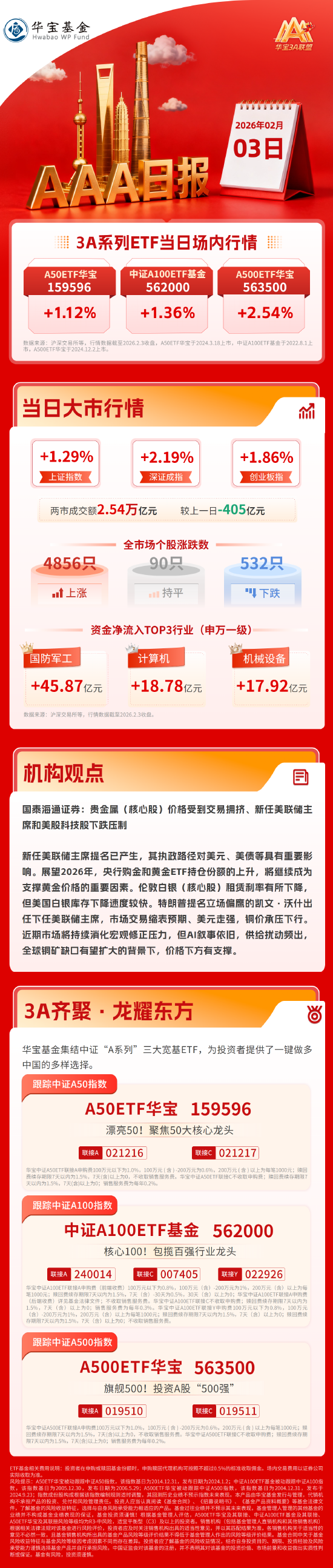
3A指数反弹涨超1%,商业航天、光伏概念集体走强 | 华宝3A日报(2026.2.3)
Xin Lang Cai Jing· 2026-02-03 09:11
Market Overview - The market saw a total trading volume of 2.54 trillion yuan, a decrease of 405 billion yuan from the previous day [6] - The number of stocks that rose was 532, while 4856 stocks fell, indicating a bearish sentiment in the market [6] ETF Performance - The A50 ETF from Huabao increased by 1.12%, the A100 ETF rose by 1.36%, and the A500 ETF saw a gain of 2.54% [1] - The A50 ETF was launched on March 18, 2024, while the A100 ETF was launched on August 1, 2022 [1][6] Industry Insights - The precious metals sector is facing pressure due to trading congestion and the recent nomination of a hawkish Federal Reserve chairman, which may impact the dollar and U.S. Treasury yields [2][7] - The rise in central bank gold purchases and the increase in gold ETF holdings are expected to support gold prices in 2026 [2] - The rental rates for London silver have decreased, but the U.S. silver inventory is declining rapidly [7] Investment Opportunities - The computer, defense, and machinery sectors are seeing significant net inflows, with 18.78 billion yuan, 45.87 billion yuan, and 17.92 billion yuan respectively [6]

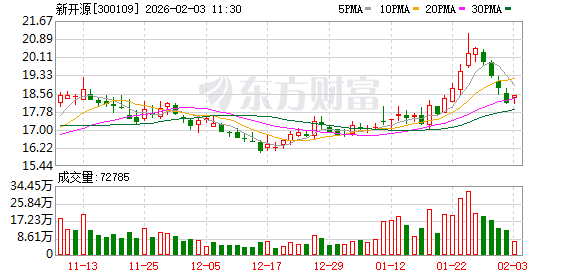
新开源:公司不直接生产光伏银浆,但公司PVP(聚乙烯吡咯烷酮)产品是光伏银浆生产制造中的重要添加剂
Mei Ri Jing Ji Xin Wen· 2026-02-03 04:52
Group 1 - The company does not directly produce photovoltaic silver paste but offers PVP (polyvinylpyrrolidone) products that are important additives in the production of silver paste [2] - PVP is primarily used to optimize the morphology of silver powder and enhance the dispersion of silver paste, aiding in the production processes of photovoltaic cells across different technological routes [2]

今日锡价:宏观压顶供需转松,拐点何时显现?
Xin Lang Cai Jing· 2026-02-03 04:22
锡价行情拐点的出现需结合短期情绪与中期供需综合判断,短期1-4周内若想迎来拐点,需同时满足三 大条件,即美联储政策预期明朗化、宏观情绪企稳回落,缅甸复产遇阻、印尼配额调整等供应端扰动重 现,以及春节后下游企业复工复产、PCB、光伏等行业进入传统旺季带动现货成交改善;中期2-4个月 来看,拐点核心取决于供需再平衡节奏,二季度后缅甸、印尼新增产能将集中释放,预计全球锡矿供应 增加8%,供应紧张格局有望缓解,而AI服务器、光伏、新能源汽车三大新兴领域需求持续增长,将对 锡价形成长期支撑,若库存累库速度慢于预期或下游需求超预期爆发,锡价有望在二季度末迎来中期拐 点,结合市场分析共识,短期锡价调整或持续1-2个月,在35-38万元/吨区间震荡,中期二季度后有望重 新回归上行通道。 今日长江现货1#锡报价375250-379250元/吨,均价377250元/吨,较昨日暴跌15000,跌幅超10%,延续2 月2日以来的大幅下行态势;核心结论明确,锡价下跌系宏观流动性收紧、供应修复、技术破位与多头 踩踏共振所致,本交易日暴跌趋缓但下行未改,37万关口承压,短期3-4周、中期二季度有望迎来拐 点,供需呈现供应提速、需求淡季格局 ...

午评:沪指涨0.38%、创业板指涨0.76%,商业航天概念股爆发,光伏及AI应用概念股活跃,贵金属及有色金属板块普跌
Jin Rong Jie· 2026-02-03 04:10
2月3日,A股三大股指早盘高开低走触底反弹,截止午盘,沪指涨0.38%报4031.07点,深成指涨0.93%报13952.38点,创业 板指涨0.76%报3289.03点,科创50指数跌0.27%报1446.93点。沪深两市半日成交额1.6万亿,较上个交易日缩量385亿。全市场 超4400只个股上涨。 盘面热点较为杂乱,商业航天(核心股)概念爆发,十余只成分股涨停,巨力索具、通宇通讯、神剑股份、中超控股涨 停。光伏(核心股)概念持续走强,双良节能、奥特维涨停。化工(核心股)板块拉升,红宝丽3天2板,万丰股份4连板。AI 应用概念反复活跃,下跌方面,有色金属板块再度下挫,贵金属概念领跌,四川黄金、招金黄金等多股跌停。 热门板块 CPO等算力(核心股)硬件股继续走强 CPO等算力(核心股)硬件股继续走强,罗博特科、天孚通信涨超10%,股价均创历史新高,太辰光、炬光科技、光库科 技、天通股份等跟涨。 消息面上,国盛证券表示,算力(核心股)产业链高景气周期背景下,光模块头部厂商在大陆和泰国加速扩产,预计光模 块行业2026年一季度将迎来产能集中释放,驱动业绩进入新一轮爬坡期。 太空光伏(核心股)概念拉升 太空光伏(核 ...


商业航天概念,大爆发
财联社· 2026-02-03 03:43
从板块来看, 商业航天概念爆发, 十余只成分股涨停,巨力索具、通宇通讯、神剑股份、中超控股涨停。光伏概念持续走强,双良节能、 奥特维涨停。化工板块拉升,红宝丽3天2板,万丰股份4连板。AI应用概念反复活跃,浙文互联11天5板。 今日早盘,A股市场冲高回落后,又再度震荡拉升。三大指数盘中翻绿,创业板指此前一度涨超2%。沪深两市半日成交额1.6万亿,较上个 交易日缩量385亿。盘面上热点较为杂乱, 全市场超4400只个股上涨。 准确 快速 权威 专业 7x24h电报 头条新闻 VIP资讯 实时盯盘 下跌方面, 有色金属板块再度下挫, 贵金属概念领跌,四川黄金、招金黄金等多股跌停。截至收盘,沪指涨0.38%,深成指涨0.93%,创 业板指涨0.76%。 下载财联社APP获取更多资讯 ...

华光环能:公司主要有三大业务板块
Zheng Quan Ri Bao Wang· 2026-02-02 13:16
Core Viewpoint - Huaguang Huaneng (600475) has three main business segments: Equipment Manufacturing, Engineering and Services, and Operations Management [1] Group 1: Equipment Manufacturing - The Equipment Manufacturing segment is divided into energy-efficient power generation equipment and environmental new energy power generation equipment [1] - Energy-efficient power generation equipment includes circulating fluidized bed boilers and pulverized coal boilers, while environmental new energy power generation equipment includes gas turbine waste heat boilers, waste incineration boilers, biomass boilers, and solid waste boilers [1] - The company has a strong foundation in manufacturing large and medium-sized boilers, which supports the development and implementation of innovative products [1] - New businesses in the hydrogen energy sector, such as alkaline electrolyzers for hydrogen production and flexible transformation of boiler thermal power, will be incubated within the Equipment Manufacturing segment [1] Group 2: Engineering and Services - The Engineering and Services segment is divided into power station engineering and municipal engineering [1] - Power station engineering includes EPC for power stations and photovoltaic projects, while municipal engineering focuses on municipal environmental projects such as sewage and solid waste disposal [1] - Subsidiary Huaxin Design Group holds first-class design qualifications in municipal and environmental engineering, ranking among the top ten in Jiangsu Province [1] - Huaguang Power Station and its subsidiary Huaguang (Xi'an) Design Institute possess second-class qualifications in the power industry, with a strong talent pool [1] Group 3: Operations Management - The Operations Management segment includes local thermal power and new energy operation services, as well as environmental operation services [1] - Local thermal power and new energy operation services involve combined heat and power generation and photovoltaic operation, with the company operating the longest domestic heating distance and a large-scale centralized steam heating system [1] - Subsidiary Zhongshe Guolian has capabilities in photovoltaic development and operation, managing 37 mature photovoltaic operation projects across multiple provinces [1] - In environmental operations, the company has capabilities for collaborative development and comprehensive disposal in the solid waste industry, covering household waste disposal, kitchen waste treatment, oil resource utilization, and sludge disposal [1] - The company has established a "City Comprehensive Solid Waste Disposal Center" in Wuxi Huishan District, achieving 100% collaborative treatment and efficient resource utilization of solid waste projects [1]

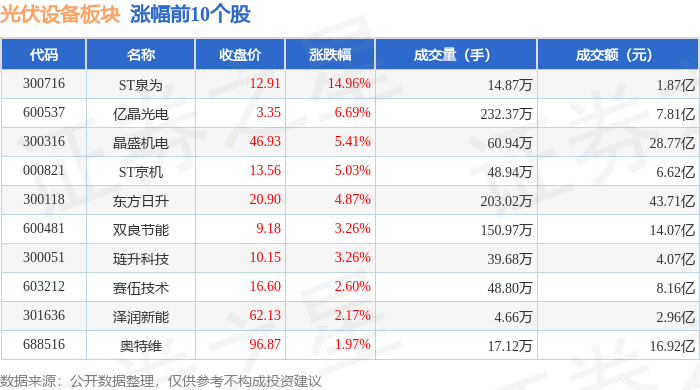
光伏设备板块2月2日跌1.5%,微导纳米领跌,主力资金净流出9515.49万元
Zheng Xing Xing Ye Ri Bao· 2026-02-02 09:15
证券之星消息,2月2日光伏设备板块较上一交易日下跌1.5%,微导纳米领跌。当日上证指数报收于 4015.75,下跌2.48%。深证成指报收于13824.35,下跌2.69%。光伏设备板块个股涨跌见下表: 从资金流向上来看,当日光伏设备板块主力资金净流出9515.49万元,游资资金净流入8.01亿元,散户资 金净流出7.06亿元。光伏设备板块个股资金流向见下表: | 代码 | 名称 | 主力净流入(元) | 主力净占比 游资净流入 (元) | | 游资净占比 散户净流入(元) | | 散户净占比 | | --- | --- | --- | --- | --- | --- | --- | --- | | 600537 亿晶光电 | | 1.71 Z | 21.86% | -5353.12万 | -6.86% | -1.17 Z | -15.01% | | 600481 | 双良节能 | 1.39亿 | 9.88% | -2418.45万 | -1.72% | -1.15 Z | -8.16% | | 300274 阳光电源 | | 1.39 Z | 1.50% | 5569.08万 | - 0.60% | -1. ...

隆华科技:在半导体相关领域主要围绕金属靶材和ITO靶材两大产品线展开布局
Zheng Quan Ri Bao Zhi Sheng· 2026-02-01 13:12
Core Viewpoint - Longhua Technology is focusing on the semiconductor sector, particularly in metal and ITO target materials, with an emphasis on semiconductor display and photovoltaic applications [1] Group 1: Product Focus - The company is strategically positioning itself in the metal target material sector to meet the diverse needs of semiconductor display technologies, which are evolving rapidly due to advancements like foldable screens and high-end automotive displays [1] - There is a growing demand for reflective layer materials, large-size molybdenum targets, and molybdenum alloy targets suitable for 4K/8K ultra-high-definition displays, indicating a trend towards highly specialized target materials [1] - Longhua Technology has completed its layout for metal targets in emerging display technologies such as Micro LED and Mini LED, aiming to seize market opportunities [1] Group 2: Future Plans - In the integrated circuit sector, the company plans to focus on storage-related target materials and is currently in discussions with partners to advance this initiative [1] - Leveraging existing production equipment and technical foundations, the company has developed a certain level of technical reserves in this area, although it has not yet established a significant competitive advantage in specialized equipment and market channel development [1] - By 2025, the company intends to increase investments in the semiconductor field, particularly in the research and industrialization of storage target materials like molybdenum and copper [1] Group 3: Current Capabilities - The company has accumulated relevant technology in high-purity copper targets and has established a certain industrial chain foundation, although this business segment is currently smaller compared to display target materials, indicating substantial growth potential in the future [1]

隆华科技(300263) - 隆华科技投资者关系活动记录表
2026-02-01 09:56
证券代码:300263 证券简称:隆华科技 答:公司于近期发布 2025 年业绩预告,预计全年业绩同比增长 40%-80%, 这一数据充分反映出公司第四季度经营状况实现显著改善。过去公司业绩 出现波动,一定程度上受计提减值等因素影响,2025 年公司重点推进财务 结构优化调整,取得了明显成效:公司此前存续的 8 亿元规模可转债已全 部完成转股,有效化解了大额未来财务费用压力。该笔财务费用虽不影响 公司现金流,但对合并报表利润存在一定影响,此次可转债全部转股,显 著优化了公司财务表现。目前,公司资产负债率已降至较低水平,整体财 务结构趋于稳健,财务健康度得到大幅提升。 未来,公司将持续加强财务管理工作,努力使经营业绩更贴合市场预期, 着力减少业绩大幅波动情况。例如,针对计提减值相关事项,公司将进一 步强化过程管理,在发现相关减值迹象时,及时开展评估工作,并将减值 金额适度分摊至各报告期,确保业绩表现的平稳性,这也是公司财务工作 后续持续努力的核心方向。 隆华科技集团(洛阳)股份有限公司 投资者关系活动记录表 1 编号:2026-001 投资者关系活动 类别 √特定对象调研 □分析师会议 □媒体采访 □业绩说明会 ...