数字经济

Search documents
超1200亿元!开年公募发行“春意盎然”,权益基金成主力
2 1 Shi Ji Jing Ji Bao Dao· 2026-02-27 12:53
Core Insights - The public fund issuance market in 2026 shows significant growth, with 230 new funds established and a total issuance scale of 210.28 billion yuan, representing a year-on-year increase of over 41% in both quantity and scale [1][2] Fund Structure Changes - The structure of new funds has shifted, with equity funds dominating, while FOF and fixed income+ products are emerging strongly [2][5] - In the first two months of 2026, 74 new mixed funds were established, totaling 79.64 billion yuan, accounting for approximately 38% of the total new fund issuance [3] - New stock funds primarily consist of ETF products, with 91 new stock funds launched, totaling 47.06 billion yuan, representing about 22% of the total [4] Equity Fund Dominance - The total issuance scale of newly established equity funds (stock funds + equity mixed funds) reached 120.84 billion yuan in the first two months of 2026 [4] - The trend indicates a strong willingness for new capital to enter the market, improving liquidity and enhancing institutional pricing power [2][11] Fixed Income Fund Trends - The issuance scale of newly established bond funds has significantly declined, with a total of 28 new bond funds launched, totaling 33.47 billion yuan, compared to 73.64 billion yuan in the same period of 2025 [6][7] - The decline in bond fund issuance reflects a shift in investor preference towards equity assets [11] Market Outlook - The hot issuance of equity funds is expected to attract significant incremental capital into the A-share market, potentially leading to a positive impact on liquidity and pricing power [8][11] - There are 58 new funds scheduled for issuance in March, indicating continued interest in equity investments [10] Investment Themes - Newly established equity funds cover various themes, including technology, consumption, and resource sectors, reflecting a diverse investment strategy [9] - The focus for 2026 is expected to be on performance realization and domestic production, particularly in AI and semiconductor sectors [12][13]
2025年迪拜商会中国企业数量再创新高
Zheng Quan Ri Bao Wang· 2026-02-27 10:50
Core Insights - The Dubai Chamber of Commerce has reported a record increase in the number of Chinese enterprises, with 1,583 new members added in 2025, representing a 7% year-on-year growth [1] - By the end of 2025, over 6,400 Chinese companies are expected to be active members of the chamber, spanning sectors such as wholesale and retail, real estate, construction, and logistics [1] - The professional capabilities of Chinese enterprises align well with Dubai's economic agenda (D33), creating significant opportunities for collaboration in fields like artificial intelligence, advanced manufacturing, and clean technology [1] Industry Summary - The Dubai Digital Economy Chamber, one of the three main chambers under the Dubai Chamber, reported that 1,690 digital startups successfully established and expanded in Dubai over the past year, marking a 39.7% increase [1] - Among these startups, 15% are in artificial intelligence and 12% in fintech, indicating a strong match between Dubai's digital economy demands and the advantages of Chinese enterprises [1] - The 2025 "North Star Expansion" conference hosted by the Dubai Digital Chamber will feature several Chinese startups presenting projects in areas such as artificial intelligence, healthcare technology, industrial manufacturing, and green energy [1]
南兴股份:公司子公司唯一网络定位于领先的数字经济基础设施服务提供商
Zheng Quan Ri Bao Wang· 2026-02-27 10:47
Core Viewpoint - Naxing Co., Ltd. (002757) emphasizes its position as a leading provider of digital economy infrastructure services, focusing on data centers, cloud computing, cloud interconnection, and digital solutions [1] Group 1: Company Overview - The company’s subsidiary, Yiwang Network, is dedicated to providing essential services in the digital economy [1] - Data centers are identified as critical infrastructure for the development of the digital economy, serving as the physical carrier of computing power [1] Group 2: Business Strategy - The company plans to closely monitor industry trends and technological advancements [1] - Naxing Co. aims to actively seek multi-faceted collaborations with enterprises that have demands for IDC and cloud computing services [1] - The company is committed to advancing the construction and operational promotion of its cloud computing and data center digital infrastructure [1]

解码铜市:资源在外,加工在内
Xin Lang Cai Jing· 2026-02-27 09:08
Core Viewpoint - Copper is a critical industrial metal with dual attributes as a commodity and financial asset, reflecting global economic conditions and trends in demand and supply [4][24][48] Group 1: Basic Attributes and Contract Rules - Copper (chemical symbol CU) has an atomic weight of 63.54 and a specific gravity of 8.92, with excellent electrical and thermal conductivity, making it indispensable in various industries [4][30] - The Shanghai copper futures contract was launched in March 1993, with the main contract closing at 103,920 yuan/ton on February 27, 2026, requiring a margin of approximately 62,352 yuan [29][30] - The trading unit is 5 tons per contract, with a minimum price fluctuation of 10 yuan/ton [30] Group 2: Global and Chinese Copper Resource Landscape - As of 2024, global copper reserves are approximately 980 million tons, with the top five countries (Chile, Peru, Australia, Congo, and Russia) controlling 56% of the total reserves [5][31] - China's proven copper reserves are only 41 million tons, accounting for 4.1% of global reserves, with a heavy reliance on imported copper concentrate [5][31] - In 2024, China is expected to import over 30 million tons of copper concentrate, maintaining an import dependency of over 80% [5][31] Group 3: Supply and Demand Analysis - The global copper supply is entering a "low growth, high disturbance" phase, with annual increments expected to be less than 500,000 tons from 2024 to 2026 [41][42] - Factors constraining supply include declining ore grades, long development cycles, and increasing disturbances such as strikes and environmental regulations [41][42] - The demand for copper is shifting towards new energy sectors, with electric power remaining the primary consumer, while new energy applications like electric vehicles and photovoltaics are emerging as significant growth drivers [19][43] Group 4: Price Formation Mechanism and Volatility Patterns - Copper prices exhibit clear bull and bear cycles, with historical price movements influenced by macroeconomic factors, supply-demand dynamics, and speculative trading [20][44] - The price of copper is expected to rise due to a persistent supply-demand gap and increasing demand from the new energy sector [20][45] - The correlation between the US dollar index and copper prices is negative, with a projected decline in the dollar supporting higher copper prices [20][44] Group 5: Future Trends - From 2026 to 2030, the supply side is expected to grow at an annual rate of only 1-1.5%, while demand is projected to grow at 2-3%, leading to an expanding supply-demand gap [45][46] - The demand structure is evolving, with new energy and digital economy sectors becoming core drivers, positioning copper as a "strategic scarce resource" [45][46] - Chinese companies are accelerating overseas copper mining investments, and advancements in recycling technology are expected to enhance the domestic copper market's influence [45][46]


指数方向有变化,机构蠢蠢欲动!题材分化,还有哪些投资机会?
Sou Hu Cai Jing· 2026-02-27 08:29
Economic Outlook - In February, high-performing sectors included certain resource products, utilities, and information technology, with industrial metals and chemical prices rising [1] - The midstream manufacturing sector saw an increase in the photovoltaic price index, while automotive production and sales slowed down [1] - The consumer services sector experienced improved profitability in pig farming, and the decline in retail sales of major appliances narrowed year-on-year [1] - The financial and real estate sectors continued to face sluggish sales of commercial housing, while gas prices in the utilities sector increased [1] Investment Trends - The top five sectors with net inflows included non-ferrous metals, domestic software, photovoltaics, rare earth magnetic materials, and lithium batteries [1] - The leading five concept sectors with net inflows were artificial intelligence, state-owned enterprise reform, big data, digital economy, and the Belt and Road Initiative [1] - The top ten individual stocks with net inflows included Baogang Co., Yunnan Zhiyuan, Xiamen Tungsten, Yongtai Energy, Cambrian, Haiguang Information, BOE Technology Group, China Tungsten High-Tech, Northern Rare Earth, and Kunlun Wanwei [1] Technology Development - Tsinghua University's research team introduced the FLEXI chip, a flexible AI chip designed for edge intelligence, which fills a gap in flexible electronics technology [3] - The global flexible electronics market is projected to grow from $85 billion to over $173 billion between 2025 and 2030, with China's flexible chip industry expected to rise from 50 billion yuan to 150 billion yuan, reflecting a compound annual growth rate of over 25% [3] Semiconductor Demand - NVIDIA's AI inference context storage platform significantly increased eSSD capacity requirements, with demand for H100 GPUs estimated at 4TB and B100/200 at 8TB, potentially reaching 24TB for Rubin [5] - The NAND capacity demand is expected to grow substantially, with a forecast of approximately 336 exabytes if VR200 shipments reach 14 million units [5] Market Sentiment - The overall market trend is currently strong, with no significant increase in incremental capital entering the market [7] - The Shanghai Composite Index showed signs of weakness, and attention is needed for movements in early March, with expectations of preemptive capital entry [11] - The A-share market has seen strong performance from major indices since last year, driven by a combination of capital inflow and external investment [11]

海南官员:进一步加强与国际成熟自贸港的合作
Zhong Guo Xin Wen Wang· 2026-02-27 07:22
Core Viewpoint - The Hainan Free Trade Port is enhancing cooperation with international mature free trade ports such as Hong Kong, Singapore, and Dubai, aiming for mutual benefits and shared development [1][2]. Group 1: Cooperation and Agreements - Hainan has made significant progress in cooperation with international free trade ports, including signing a memorandum with Hong Kong focusing on five key areas: economic and trade investment, finance, data security, tourism, and talent exchange [2]. - Haikou Meilan Airport and Singapore Changi Airport have signed a joint venture agreement to collaboratively build a "Two Oceans" aviation regional hub [2]. - Yangpu Port has established a sister port relationship with Abu Dhabi Port to deepen cooperation in port construction, trade exchanges, and green energy [2]. Group 2: Future Plans and Strategies - Hainan plans to continue learning from the advanced experiences of internationally recognized free trade ports and align with high-standard international economic and trade rules [2]. - The focus will be on exploring an open institutional system with international competitiveness and strengthening cooperation in technology innovation, digital economy, and green development [2].
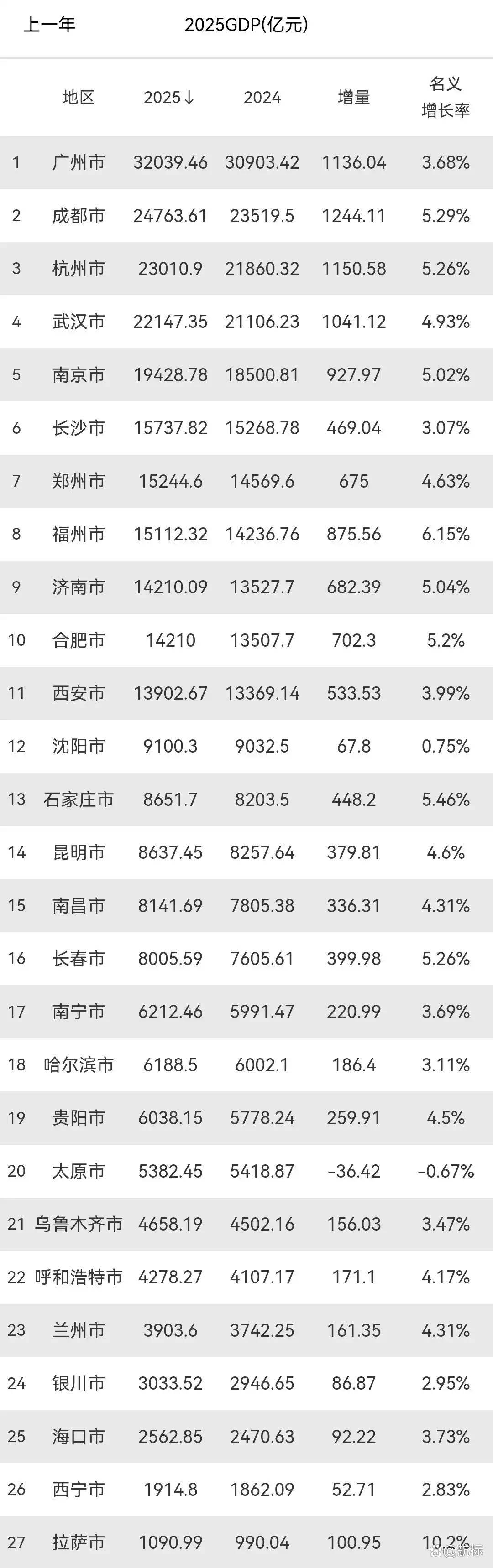
27个省会城市2025年GDP洗牌:成都增速增量领先广州,福州力压济南,南宁低于4%!
Sou Hu Cai Jing· 2026-02-27 06:29
Core Insights - In 2025, China's urban economy is experiencing a subtle reshuffle, with Guangzhou maintaining its top position and Chengdu following closely, reflecting both numerical growth and development momentum [1] Economic Performance - Guangzhou's GDP reached 32,039.46 billion yuan, showing a nominal growth rate of 3.68% compared to the previous year [2] - Chengdu's GDP hit 24,763.61 billion yuan, with a notable increase of 1,244.11 billion yuan and a growth rate of 5.29%, surpassing Guangzhou's growth in terms of increment [2][4] - Hangzhou and Wuhan also showed strong performances, with GDPs of 23,010.9 billion yuan and 22,147.35 billion yuan, respectively, and growth rates of 5.26% and 4.93% [2][4] Investment Trends - Chengdu's industrial investment growth reached 19.7%, significantly higher than the national average, indicating a robust investment climate [4] - In contrast, Guangzhou faces challenges in transitioning its traditional commerce and automotive industries, particularly in the shift from gasoline to electric vehicles [4] Competitive Dynamics - Fuzhou narrowly surpassed Jinan with a GDP of 14,210.09 billion yuan, leveraging its "Maritime Fuzhou" strategy and benefiting from infrastructure development and the digital economy [6] - Nanning's GDP reached 6,212.46 billion yuan, becoming the first city in Guangxi to exceed 6,000 billion yuan, but its growth rate was hampered by a significant decline in fixed asset investment [8] Notable Exceptions - Taiyuan was the only city among the 27 provincial capitals to experience negative growth at -0.67%, attributed to pressures from the coal cycle [10] - Lhasa, despite a GDP just over 1,000 billion yuan, achieved a rapid growth rate of 10.2% [10] - Shenyang's GDP of 9,100.3 billion yuan reflects ongoing challenges in revitalizing old industrial bases, with a low growth rate of 0.75% [10] Conclusion - The era of merely competing on total GDP is over, with cities like Chengdu and Fuzhou demonstrating that strategic investments and economic diversification are key to future growth [11]
新春走基层·驻外记者回乡手记丨这座西南小城何以吸引世界目光
Xin Hua Wang· 2026-02-27 02:51
Group 1 - Yibin is transforming its economy from traditional industries like liquor and coal to new engines represented by digital economy and green energy, specifically in the battery industry [6] - The battery industry in Yibin has become a significant sector, with the city hosting major companies like CATL and Kaiyi Auto, contributing to the local economy's upgrade [6] - Yibin is recognized globally for its battery production, with one in ten batteries worldwide produced in the city, highlighting its importance in the global supply chain [6][7] Group 2 - The logistics infrastructure in Yibin has improved significantly, with highways, high-speed rail, and expanded airport routes facilitating the distribution of local agricultural products [4] - The local economy is benefiting from increased visibility and business opportunities, particularly in the new energy vehicle sector, which has seen a surge in demand and investment [6] - The rise of the battery industry in Yibin reflects broader trends in China's economic development, showcasing the integration of inland cities into the global economy [7]

东华软件涨2.21%,成交额3.69亿元,主力资金净流入3258.25万元
Xin Lang Zheng Quan· 2026-02-27 02:48
Group 1 - The stock price of Donghua Software increased by 2.21% on February 27, reaching 9.70 CNY per share, with a trading volume of 369 million CNY and a turnover rate of 1.32%, resulting in a total market capitalization of 31.093 billion CNY [1] - Year-to-date, Donghua Software's stock price has risen by 6.01%, but it has seen a decline of 0.41% over the last five trading days, 2.90% over the last twenty days, and 8.32% over the last sixty days [1] - The company reported a revenue of 8.488 billion CNY for the first nine months of 2025, representing a year-on-year growth of 3.69%, while the net profit attributable to shareholders decreased by 28.45% to 350 million CNY [2] Group 2 - Donghua Software has distributed a total of 2.826 billion CNY in dividends since its A-share listing, with 481 million CNY distributed over the past three years [3] - As of September 30, 2025, the number of shareholders for Donghua Software was 315,200, a decrease of 2.68% from the previous period, while the average number of circulating shares per person increased by 2.76% to 9,226 shares [2] - The top ten circulating shareholders include notable ETFs, with Huabao Zhongzheng Financial Technology Theme ETF holding 36.935 million shares, an increase of 18.136 million shares from the previous period [3]

赵一德赵刚与中兴通讯董事长方榕一行座谈
Shan Xi Ri Bao· 2026-02-27 00:44
Core Insights - The meeting between Shaanxi provincial leaders and ZTE Corporation's chairman emphasizes the importance of digital transformation and collaboration in advancing the digital economy in Shaanxi [1] Group 1: Government Initiatives - Shaanxi is seizing opportunities in digitalization, networking, and intelligence as part of the implementation of the 20th National Congress of the Communist Party of China [1] - The provincial government aims to enhance digital technology innovation and accelerate the digital transformation of industries [1] - There is a commitment to optimize the business environment to facilitate corporate development in Shaanxi [1] Group 2: ZTE Corporation's Role - ZTE views Shaanxi as a core area for its strategic layout and is willing to leverage local advantages in education, industry, location, and application scenarios [1] - The company plans to expand high-end projects focusing on computing power, digital infrastructure, industry empowerment, and ecosystem co-construction [1] - ZTE aims to inject new momentum into Shaanxi's high-quality modern development [1]