
流动性投放

Search documents
市场主流观点汇总-20250805
Guo Tou Qi Huo· 2025-08-05 10:04
Market Data Summary - The report presents the closing prices and weekly price changes of various assets as of August 1, 2025, compared to July 28, 2025. Commodities like crude oil had a 2.92% increase, while most others, such as palm oil, soybean meal, and copper, experienced declines. A - shares, overseas stocks, and bonds also mostly saw negative changes, with exceptions like the US dollar index and US dollar mid - price showing increases [2]. Commodity Views Summary Macro - Financial Sector Stock Index Futures - The report collected views from 8 institutions, with 3 bullish, 2 bearish, and 3 expecting a sideways trend. Bullish factors include the upcoming full - scale opening of childcare subsidy applications, the World Artificial Intelligence Conference boosting the tech sector, central bank liquidity injection, and the extension of the tariff buffer period. Bearish factors involve the lack of new policy surprises in the Politburo meeting, reduced A - share trading volume, the Fed's unchanged interest rate, a decrease in ETF shares tracking the CSI 300, and a decline in the July manufacturing PMI [4]. Treasury Bond Futures - Seven institutions' views were collected, with 0 bullish, 1 bearish, and 6 expecting a sideways trend. Bullish factors are the increasing expectation of Fed rate cuts, the unchanged expectation of loose monetary policy, stable - growth policies not exceeding expectations, and the tax - free advantage of existing bonds. Bearish factors include the taxation of new bonds reducing their attractiveness, positive market risk appetite diverting funds to stocks, and low short - term chasing value [4]. Energy Sector - For crude oil, 8 institutions' views were gathered, with 2 bullish, 3 bearish, and 3 expecting a sideways trend. Bullish factors are high US refinery operating rates, increased US sanctions on Russian oil, OPEC +'s lower - than - expected production increase, and improved macro sentiment due to a tariff agreement. Bearish factors include lower - than - expected US gasoline consumption, OPEC +'s decision to accelerate production in September, a shift in global oil demand from strong to weak, and a significant downward revision of US non - farm payroll data [5]. Agricultural Products Sector - Regarding live hogs, 8 institutions' views were collected, with 1 bullish, 3 bearish, and 4 expecting a sideways trend. Bullish factors are strong expectations of policy - driven capacity reduction, farmers' resistance to price cuts, a slower slaughter pace, and a potential decrease in August supply after an increase in July. Bearish factors are the large supply of heavy hogs, an expected increase in piglet supply from September to the end of the year, high hog inventories, and suppressed demand due to summer and high temperatures [5]. Non - Ferrous Metals Sector Aluminum - Eight institutions' views were gathered, with 0 bullish, 5 bearish, and 3 expecting a sideways trend. Bullish factors are low domestic aluminum ingot inventories, increased weekly production of aluminum strips and foils, improved downstream profits, and moderate inventory accumulation. Bearish factors are weakening macro sentiment, tariff - affected exports to the US, weakening production and orders of aluminum profiles, and supply pressure during the inventory accumulation phase [6]. Chemicals - Soda Ash - Eight institutions' views were collected, with 0 bullish, 5 bearish, and 3 expecting a sideways trend. Bullish factors are stable downstream demand, downstream inventory reduction and subsequent replenishment needs, and potential short - covering rallies. Bearish factors are long - term over - capacity issues, a return to fundamental trading due to weakening macro sentiment, reduced demand expectations for photovoltaic glass, and low motivation for producers to cut production [6]. Precious Metals - Gold - Seven institutions' views were collected, with 4 bullish, 0 bearish, and 3 expecting a sideways trend. Bullish factors are concerns about economic recession due to revised US non - farm payroll data, concerns about monetary policy independence from White House personnel changes, increased safe - haven demand due to a falling US dollar index and a slumping stock market, a technical breakthrough, and the potential for further upward movement after a long consolidation. Bearish factors are reduced uncertainty from US - Japan and US - EU tariff agreements, a hawkish stance from Powell, and potential further rebounds in the US dollar index [7]. Black Metals - Iron Ore - Eight institutions' views were gathered, with 0 bullish, 3 bearish, and 5 expecting a sideways trend. Bullish factors are high steel mill profit margins, a decline in overseas ore shipments, a decrease in port iron ore inventories, and high hot metal production. Bearish factors are an increase in domestic port arrivals, the fading of anti - cut - throat competition trading, lower - than - expected policy strength from the Politburo meeting, an increase in non - Australian and non - Brazilian ore shipments, and a decrease in daily hot metal production due to adverse weather [7].
中国人民银行公布7月各项工具流动性投放情况
Xin Hua She· 2025-08-05 07:28
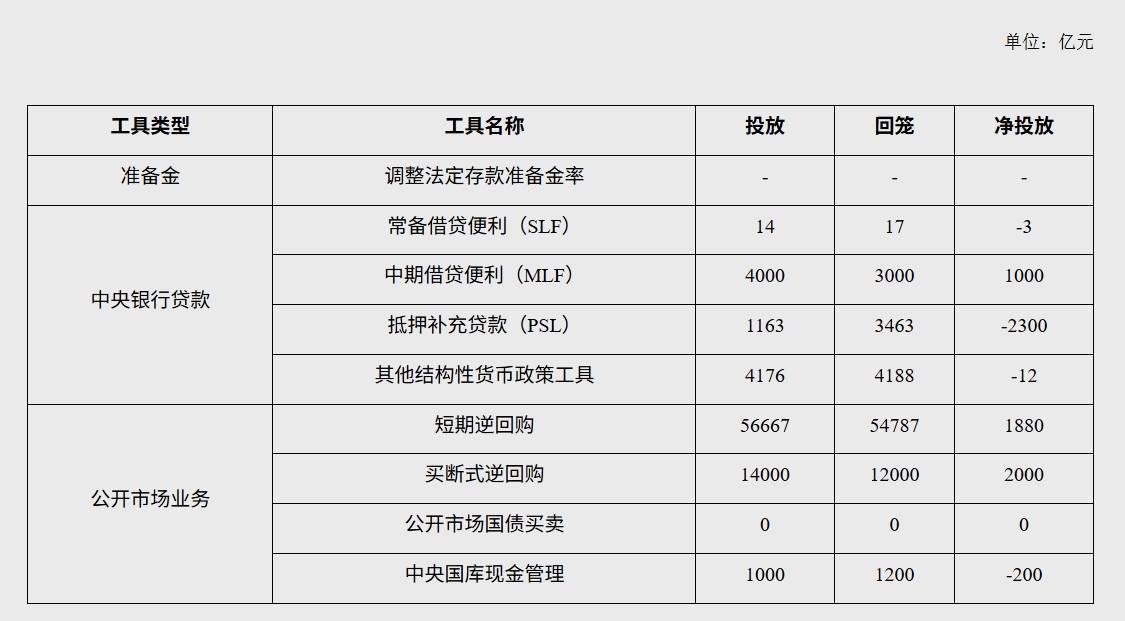
Core Viewpoint - The People's Bank of China (PBOC) has implemented various liquidity measures in July, resulting in a net liquidity injection into the financial system. Group 1: Liquidity Injection Details - In July, the PBOC conducted a Medium-term Lending Facility (MLF) injection of 400 billion yuan, with a withdrawal of 300 billion yuan, resulting in a net injection of 100 billion yuan [1] - The PBOC executed a reverse repurchase agreement (repo) with a total injection of 1.4 trillion yuan and a withdrawal of 1.2 trillion yuan, leading to a net injection of 200 billion yuan [1] - Short-term reverse repos amounted to 56.67 billion yuan in injections and 54.787 billion yuan in withdrawals, achieving a net injection of 18.8 billion yuan [1] - The PBOC provided 116.3 billion yuan through the Pledged Supplementary Lending (PSL) but withdrew 346.3 billion yuan, resulting in a net withdrawal of 230 billion yuan [1] Group 2: Market Operations - In July, the PBOC did not conduct any open market operations involving the buying or selling of government bonds [1]
7月央行MLF净投放1000亿元,短期逆回购净投放1880亿元
Sou Hu Cai Jing· 2025-08-04 10:54
Core Insights - The People's Bank of China (PBOC) reported liquidity conditions for July 2025, indicating a mixed approach to monetary policy with both net withdrawals and injections across various tools [1] Group 1: Liquidity Tools Overview - In July, the Standing Lending Facility (SLF) experienced a net withdrawal of 300 million yuan [1][2] - The Medium-term Lending Facility (MLF) saw a net injection of 100 billion yuan [1][2] - The Pledged Supplementary Lending (PSL) had a net withdrawal of 230 billion yuan [1][2] - The Short-term Reverse Repo recorded a net injection of 188 billion yuan [1][2] - The Buyout Reverse Repo also had a net injection of 200 billion yuan [1][2] - No open market transactions for government bonds were conducted in July [1] Group 2: Detailed Tool Performance - SLF: 14 billion yuan injected, 17 billion yuan withdrawn, resulting in a net withdrawal of 3 billion yuan [2] - MLF: 40 billion yuan injected, 30 billion yuan withdrawn, resulting in a net injection of 10 billion yuan [2] - PSL: 116.3 billion yuan injected, 346.3 billion yuan withdrawn, resulting in a net withdrawal of 23 billion yuan [2] - Other structural monetary policy tools: 41.76 billion yuan injected, 41.88 billion yuan withdrawn, resulting in a net withdrawal of 1.2 billion yuan [2] - Short-term Reverse Repo: 56.67 billion yuan injected, 54.787 billion yuan withdrawn, resulting in a net injection of 1.88 billion yuan [2] - Buyout Reverse Repo: 14 billion yuan injected, 12 billion yuan withdrawn, resulting in a net injection of 2 billion yuan [2] - Central Treasury Cash Management: 10 billion yuan injected, 12 billion yuan withdrawn, resulting in a net withdrawal of 2 billion yuan [2]

7月23日电,香港金管局通过贴现窗口向银行投放2000万港元流动性。
news flash· 2025-07-22 23:04
Group 1 - The Hong Kong Monetary Authority (HKMA) injected liquidity of 20 million Hong Kong dollars into the banking system through the discount window [1]
固收周度点评20250720:央行新动向?-20250720
Tianfeng Securities· 2025-07-20 09:12
1. Report Industry Investment Rating No relevant content provided. 2. Core Viewpoints of the Report - The bond market has returned to the main theme of oscillation, with short - term performance relatively strong. The central bank's series of operations, including conducting large - scale outright reverse repurchases and considering canceling the freeze of collateral in bond repurchases, aim to release liquidity and stabilize market expectations. Logically, short - term interest - rate bonds and high - liquidity credit products may benefit, but the long - term market may still be affected by various factors and maintain an oscillatory pattern [1][6][9]. 3. Summary According to Relevant Catalogs 3.1 Bond Market Trends - From July 14 - 18, the bond market maintained an oscillatory pattern, with most interest - rate bond yields declining. The adjustment pressure was mainly concentrated on long - term and ultra - long - term bonds, especially 30 - year treasury bonds. As of July 18, the yields of 1Y, 2Y, 10Y, 30Y, and 50Y treasury bonds changed by - 2.1BP, - 1.9BP, 0.0BP, + 1.4BP, - 0.7BP respectively compared to last week, reaching 1.35%, 1.38%, 1.67%, 1.89%, 1.95% [1][9]. - The bond market showed a "reverse V - shaped" trend due to the combination of multiple factors such as the central bank's operations, economic data releases, and the central bank's public consultation on canceling the freeze of collateral in bond repurchases [9]. 3.2 Central Bank's New Movements - During the tax payment period this week, the central bank continuously maintained net reverse repurchase injections and conducted 1.4 trillion yuan of outright reverse repurchases, with a net injection of 200 billion yuan, releasing a signal of caring for the capital market. The central bank's 7 - day reverse repurchases totaled 1.7268 trillion yuan, with 425.7 billion yuan due, achieving a net injection of 1.3011 trillion yuan. MLF due was 100 billion yuan, and the outright reverse repurchase injection was 1.4 trillion yuan, with a net injection of 200 billion yuan [9][17]. - As of July 18, R001 and R007 changed by + 8.4BP and - 0.1BP respectively compared to last week, reaching 1.49% and 1.51%; DR001 and DR007 increased by 11.4BP and 3.5BP respectively, reaching 1.46% and 1.51% [17]. - After the central bank cut the reserve requirement ratio by 0.5 percentage points in May and carried out outright reverse repurchases in advance in June, it conducted another 1.4 trillion yuan of outright reverse repurchases in July, making outright operations gradually normalized, which shows the central bank's attitude of caring for liquidity and supporting broad credit and further stabilizes market expectations [2][19]. - The reasons for the central bank to conduct outright reverse repurchases are to hedge the capital gap and relieve the pressure on the bank's liability side to support the real - economy credit supply [19][21]. - Compared with pledged repurchases, outright reverse repurchases have longer terms, reduce the pressure of short - term tool roll - overs, weaken the dependence on the credit quality of bank collateral, lower the financing threshold for small and medium - sized banks, and improve the efficiency of liquidity release [3][23]. 3.3 Understanding the Central Bank's Cancellation of the Freeze of Collateral in Bond Repurchases - On July 18, the central bank publicly solicited opinions on the "Decision of the People's Bank of China on Amending Some Rules (Draft for Comment)", which included canceling the freeze of collateral in bond repurchases, aiming to facilitate monetary policy operations such as open - market treasury bond trading and promote the high - level opening of the bond market [25]. - The reasons for the central bank to propose canceling the freeze of collateral in bond repurchases are that the current pledged repurchase model in China leads to a large "precipitation" of high - grade bonds and low efficiency in collateral disposal when the financing party defaults, while international mature markets generally use outright repurchases where collateral can be circulated again. Also, canceling the freeze can unfreeze the 6 - trillion - yuan daily repurchase market and enhance the flexibility of domestic liquidity management [4][27]. - If the freeze of collateral in bond repurchases is canceled, the capital market is expected to see a pattern of "stable quantity and falling price". Short - term interest - rate bonds may benefit and have downward space, while long - term bonds may maintain an oscillatory pattern, and the yield curve is more likely to steepen [5][32]. 3.4 Next Week's Key Points of Attention - Monday (July 21): China's 1Y and 5Y LPR quotes. - Tuesday (July 22): China's June bank foreign exchange settlement, US July Richmond Fed Manufacturing Index. - Wednesday (July 23): US June M2 month - on - month, EU July Consumer Confidence Index. - Thursday (July 24): Eurozone July benchmark interest rate, Eurozone July overnight deposit rate. - Friday (July 25): China's July MLF injection, Eurozone June M2 year - on - year [37].
7月8日电,香港金管局通过贴现窗口向银行投放46.7亿港元流动性。
news flash· 2025-07-08 10:51
Core Viewpoint - The Hong Kong Monetary Authority (HKMA) injected liquidity of HKD 46.7 billion into the banking system through the discount window [1] Group 1 - The liquidity injection aims to support the banking sector and ensure stability in the financial system [1] - The amount of HKD 46.7 billion reflects the HKMA's proactive measures in managing monetary conditions [1]
香港金管局通过贴现窗口向银行投放46.7亿港元流动性。
news flash· 2025-07-08 10:51
Core Viewpoint - The Hong Kong Monetary Authority (HKMA) has injected liquidity into the banking system through its discount window, amounting to HKD 46.7 billion [1] Group 1 - The liquidity injection aims to support the banking sector and ensure stability in the financial system [1] - The action reflects the HKMA's proactive approach to managing monetary conditions amid potential market fluctuations [1]
国泰海通|固收:“软连接”下的政策利率和资金利率——年中货币政策展望
国泰海通证券研究· 2025-07-04 08:10
Core Viewpoint - The article discusses the adjustments in monetary policy framework, emphasizing the shift towards a more neutral stance on price signals and the management of liquidity, which may lead to a consistent pattern of short-term interest rates declining ahead of long-term rates [1][2]. Group 1: Monetary Policy Adjustments - The second quarter monetary policy meeting indicates a shift from "timely reserve requirement and interest rate cuts" to "flexibly grasping the implementation strength and rhythm of policies," reflecting a more neutral approach [1]. - The central bank's cautious stance on broad monetary policy tools aligns with the need to avoid excessive market trading following initial cuts [1]. - The adjustments in liquidity management since mid-2024 show a clear distinction between guiding market pricing and influencing supply-demand dynamics [1][3]. Group 2: Constraints on Monetary Policy - The constraints on broad monetary policy are driven by two main factors: supporting economic growth by lowering financing rates for the real economy and maintaining stability in the financial system, particularly avoiding excessively low long-term bond rates [2]. - The phenomenon of "deposit migration" is influenced by yield differentials, with three key characteristics observed: bond market rates affecting deposit rate adjustments, equity market performance impacting fund outflows, and the dispersed nature of fund outflows [2]. Group 3: Long-term Liquidity Mechanism Changes - Following the dual cuts in May, the pace of liquidity easing has slowed due to changes in the liquidity adjustment framework, highlighting two significant shifts: the opportunity cost of reserve requirement cuts remains high, and the pricing of medium to long-term liquidity is now a "soft connection" with policy rates [3]. Group 4: Long-term Bond Rates Outlook - The potential for long-term bond rates to decline hinges on the performance of one-year time deposits; if these rates drop further, it could lead to a breakthrough in ten-year government bond rates [4]. - The relationship between one-year time deposit rates and ten-year government bond rates remains strong, with expectations that continued declines in deposit rates will facilitate downward movement in long-term bond rates [4].

央行昨日开展1310亿元7天期逆回购 公开市场实现净回笼2755亿元
Zheng Quan Ri Bao· 2025-07-01 16:28
Group 1 - The People's Bank of China (PBOC) conducted a 7-day reverse repo operation of 131 billion yuan at a fixed rate of 1.4%, resulting in a net withdrawal of 275.5 billion yuan due to 406.5 billion yuan of reverse repos maturing on the same day [1] - From June 23 to June 30, the PBOC conducted a total of 2,027.5 billion yuan in reverse repos, achieving a net injection of 1,067.2 billion yuan after offsetting 960.3 billion yuan of maturing repos [1] - In July, the overall net financing of government bonds is expected to be around 1,200 billion yuan, with a liquidity gap of approximately 1,000 billion yuan after excluding MLF and reverse repo maturities [1] Group 2 - Fiscal factors are anticipated to have an increasing impact on liquidity in July, with the possibility of the PBOC restarting government bond purchases to inject liquidity [2] - The PBOC's willingness to maintain liquidity support is expected to continue beyond the quarter-end, even if it does not restart government bond purchases or utilize total tools [2]
提前派发“定心丸” 半年末流动性整体无忧
Zhong Guo Zheng Quan Bao· 2025-06-24 20:26
Core Viewpoint - The People's Bank of China (PBOC) is implementing measures to maintain ample liquidity in the banking system, including a 300 billion MLF operation and a net injection of 1180 billion due to maturing MLFs [1][2]. Group 1: Monetary Policy Actions - The PBOC will conduct a 300 billion MLF operation on June 25, 2025, with a one-year term, resulting in a net injection of 1180 billion after 1820 billion MLF matures in June [1]. - In June, the PBOC has increased mid-term liquidity injections, conducting a total of 14,000 billion reverse repos on June 6 and June 16 [2]. - The total net injection of mid-term liquidity in June has exceeded 3000 billion, indicating a proactive approach to maintaining liquidity [2]. Group 2: Market Stability and Expectations - Maintaining ample liquidity helps prevent abnormal fluctuations in the funding environment and stabilizes market expectations, which is crucial given the large-scale issuance of government bonds and the maturity of interbank certificates of deposit [2]. - The PBOC's actions signal a continued commitment to using quantitative monetary policy tools to meet the financing needs of enterprises and households [2]. Group 3: Future Outlook - Experts anticipate that the PBOC will continue to exceed the renewal of maturing MLFs and utilize various monetary policy tools to keep liquidity abundant in the second half of the year [4]. - There is a possibility of the PBOC adopting measures such as reserve requirement ratio cuts to provide liquidity support, especially with the expected acceleration of government bond issuance in the third quarter [4]. - Discussions are ongoing regarding the potential resumption of government bond purchases by the PBOC, which is seen as a key tool for liquidity injection and reducing the cost of liabilities in the banking and financial system [4][5].