Robotaxi

Search documents
“终于上路了”!北汽、长安等车企竞逐L3
Xin Lang Cai Jing· 2026-01-11 11:44
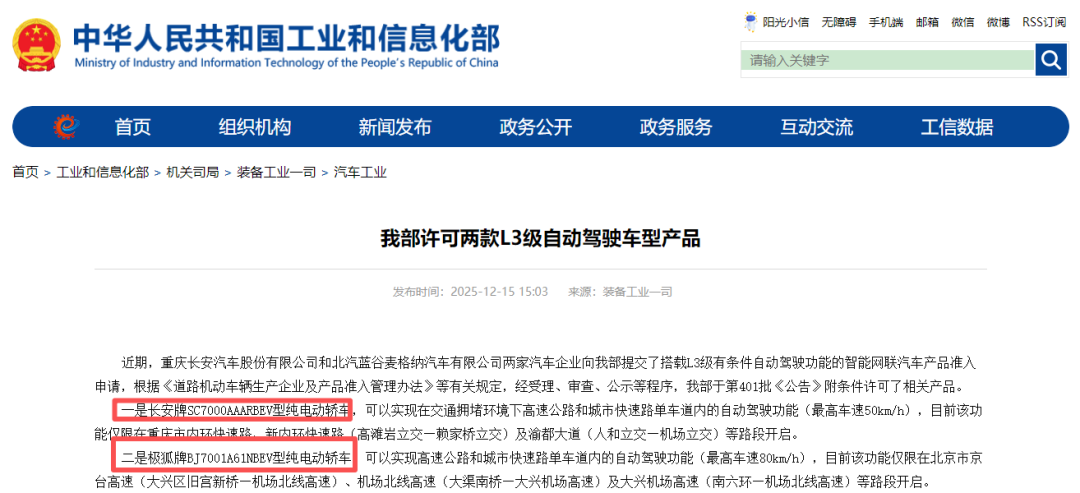
Core Insights - The approval of L3 conditional autonomous driving vehicles by the Ministry of Industry and Information Technology marks a significant step towards commercial application in China [4][18] - Companies like BAIC and Changan are leading the charge in the L3 autonomous driving sector, with their models set to begin trial operations [1][2] Group 1: L3 Autonomous Driving Approval - The first batch of L3 conditional autonomous driving vehicles approved includes the BAIC Arcfox Alpha S (L3 version) and Changan SC7000AAARBEV [1][2] - These vehicles are designed for specific urban and highway scenarios, with the Arcfox model capable of operating at speeds up to 80 km/h on designated routes in Beijing [2][3] - The approval process involves a phased approach, with commercial operations expected to gradually open to individual users by Q2 2026 [3][12] Group 2: Competitive Landscape - Multiple automakers, including BYD, NIO, and Geely, are vying for entry into the L3 autonomous driving market, with some obtaining local government permits for testing [2][14] - The distinction between permits from the Ministry of Industry and Information Technology and local governments lies in their nature; the former allows for commercial pilot projects, while the latter focuses on research and development [15][17] - Geely's Zeekr 9X has received a testing permit covering over 9,224 square kilometers in Hangzhou, indicating the scale of testing efforts [14] Group 3: Future Developments - The industry anticipates 2026 to be a pivotal year for the mass production of L3 autonomous driving technology, with potential breakthroughs in L4 technology as well [6][18] - BAIC is committed to expanding its lineup of vehicles equipped with L3 technology, indicating a long-term strategy in the autonomous driving space [18] - The partnership between BAIC and Pony.ai aims to develop a comprehensive operational model for Robotaxi services, showcasing the industry's focus on commercializing autonomous driving [19]


“终于上路了”!车企竞逐L3
Zhong Guo Ji Jin Bao· 2026-01-11 11:19
Core Insights - The article discusses the approval of L3 conditional autonomous driving vehicles by the Ministry of Industry and Information Technology in China, highlighting the competitive landscape among various automotive companies to secure entry into this advanced driving technology market [2][11]. Group 1: Approval and Launch of L3 Vehicles - BAIC's Arcfox Alpha S (L3 version) has officially started trial operations for L3 conditional autonomous driving [2][6]. - The first batch of approved L3 vehicles includes the Arcfox BJ7001A61NBEV and Changan SC7000AAARBEV, which are set to operate in designated areas in Beijing and Chongqing [6][11]. - The L3 vehicles are designed for specific scenarios, such as urban congestion and highway driving, with a maximum speed of 80 km/h [7][8]. Group 2: Competitive Landscape - Multiple companies, including BYD, NIO, and Geely, are vying for L3 conditional autonomous driving permits, with some obtaining local government approvals for testing [5][9]. - The distinction between the approvals from the Ministry and local governments lies in their nature; the former allows for commercial trial operations, while the latter is focused on research and testing [10][12]. Group 3: Future Developments and Collaborations - The industry is moving towards mass production of L3 technology, with 2026 anticipated as a pivotal year for its commercial launch [13]. - BAIC is collaborating with Pony.ai to enhance its Robotaxi services, aiming to expand its autonomous driving capabilities across various urban and highway scenarios [14]. - The development of Robotaxi services is seen as a significant opportunity for commercializing autonomous driving technology [14].
又一批L3上路!二季度将向个人用户开放
Zhong Guo Zheng Quan Bao· 2026-01-10 13:44
Core Viewpoint - The launch of the L3 version of the Arcfox Alpha S by BAIC New Energy marks a significant step in the commercialization of autonomous driving in China, with plans for trial operations beginning in designated areas [2][5][7]. Group 1: Launch and Operations - BAIC New Energy announced the initiation of trial operations for the Arcfox Alpha S (L3 version) in collaboration with Beijing Mobility, with a focus on safety and a phased approach to opening up to individual users by Q2 2026 [2][6]. - The first batch of 30 L3 autonomous vehicles is set to operate in specific areas of major highways, including the Beijing-Taipei and Daxing Airport highways [3][5]. - The L3 vehicles will initially operate under limited conditions, including specific scenarios, road segments, and speed limits, as part of the regulatory framework for autonomous driving [5][6]. Group 2: Industry Implications - The approval of the L3 autonomous vehicles signifies a transition from technology validation to mass application in the autonomous driving sector, highlighting BAIC New Energy's role as a key player in this evolution [7]. - The collaboration with Pony.ai aims to expand the Robotaxi service globally, with significant progress already made in mass production and operational deployment of the Arcfox Alpha T5 Robotaxi [8]. - The shared mobility market in China is shifting towards high-quality growth, with Robotaxi technology expected to fundamentally optimize the cost structure of the industry and drive the next growth curve [9].
智能汽车ETF(159889)盘中涨超1.7%,产业趋势与政策进展受关注
Mei Ri Jing Ji Xin Wen· 2026-01-09 06:59
Core Insights - The smart car ETF (159889) saw an intraday increase of over 1.7%, driven by industry trends and policy developments [1] - According to招商证券, 2026 is projected to be a breakout year for the smart driving and Robotaxi industries, with ongoing market attention on these trends [1] - Nvidia's release of the open-source VLA model Alpamayo 1 signifies a pivotal moment for physical AI, with unmanned taxis expected to be among the first beneficiaries [1] Industry Developments - Waymo is expected to exceed 450,000 weekly orders by 2025, while Tesla's Robotaxi operations are expanding in Austin, with Full Self-Driving (FSD) technology likely to validate the gradual transition from Level 2 to Level 4 [1] - Pony.ai has achieved single-vehicle profitability in Guangzhou, and WeRide has obtained a fully autonomous driving commercial license in the UAE [1] - Regulatory advancements are indicated by the establishment of national standards for L3 access permits and autonomous driving regulations, suggesting a faster pace of progress in legislation [1] Market Dynamics - The smart car ETF (159889) tracks the CS Smart Car Index (930721), which selects listed companies involved in smart driving and vehicle networking from the A-share market, covering the entire industry chain from hardware to software [1] - The index's constituent stocks are concentrated in the electronics, computer, and automotive sectors, providing a comprehensive reflection of the overall performance of the smart car-related industries [1]
汽车早报|小鹏开年发布四款新车 吉利汽车获L3级自动驾驶道路测试牌照
Xin Lang Cai Jing· 2026-01-09 00:37
Industry Regulation and Market Dynamics - The Ministry of Industry and Information Technology, along with other departments, held a meeting to regulate the competition order in the power and energy storage battery industry, highlighting rapid development and competitive advantages but also irrational behaviors like blind construction and price competition that need to be addressed [1] - The Secretary-General of the Passenger Car Association stated that by 2025, promotions and price reductions in the passenger car industry will return to rationality, with a notable improvement in market order, as the number of price reductions for various vehicle types has decreased compared to the previous year [1] Automotive Innovations and Developments - XPeng Motors launched four new models, including the new XPeng G6 and G9 electric versions, and plans to scale production of humanoid robots and flying cars this year [2] - Geely Auto received an L3 autonomous driving road test license for its Zeekr 9X model, covering an area of 9,224 square kilometers in Hangzhou, including over 1,500 kilometers of dual-direction expressways [3] - BYD introduced new models of the Qin L DM-i, with a starting price of 116,800 yuan and a pure electric range of 210 kilometers, along with a limited-time tax exemption for new energy vehicle purchases [4] Strategic Partnerships and Financial Support - The Taizhou Municipal Government signed a strategic cooperation framework agreement with Geely Holding Group to enhance investment and industrial layout, aiming to establish Taizhou as a high-end new energy vehicle manufacturing base [5] - XPeng Motors secured a 10 billion yuan financing support commitment from the Industrial and Commercial Bank of China, Guangdong Branch, for the next five years [6] Sales Performance and Market Trends - Jianghuai Automobile reported a total sales volume of 384,100 vehicles for 2025, reflecting a year-on-year decline of 4.72%, while December sales showed a significant increase of 42.24% [7] - Tesla announced the production of its 5 millionth electric drive system at its Shanghai Gigafactory, marking a significant milestone in its manufacturing capabilities [8]


NVIDIA Could Be a Huge Winner as it Joins the Robotaxi Race
247Wallst· 2026-01-08 14:02
Core Viewpoint - Nvidia is entering the robotaxi market and plans to test its own robotaxi offering by next year [1] Company Summary - Nvidia, known as the leader in AI chips, is expanding its business into the robotaxi sector [1]


进军商旅市场,能帮曹操出行提升想象力吗?
3 6 Ke· 2026-01-08 11:51
Core Insights - Cao Cao Mobility has announced its first strategic acquisition since going public, acquiring 50% of Weixing Technology and 100% of Geely Business Travel for a total cash consideration of 2.25 billion yuan and 65 million yuan respectively, aiming to integrate business travel and high-end transportation services [1][2][4] Group 1: Acquisition Details - The acquisitions will allow Cao Cao Mobility to fully own Weixing Technology and Geely Business Travel, enhancing its service offerings in the business travel sector [1][2] - The acquisition prices are slightly below the fair value estimates of the companies, indicating a strategic move to ensure successful integration [8][9] - Both acquired companies have strong ties to Geely Group, which may reduce uncertainties in the integration process [5][6][7] Group 2: Strategic Intent - The acquisitions signal Cao Cao Mobility's intent to enter the business travel market, which is projected to grow significantly, with global business travel spending expected to reach $1.57 trillion by 2025, a 6.6% increase from 2024 [18] - The company aims to build a "one-stop technology travel platform," addressing the fragmented nature of business travel services [20][24] - Cao Cao Mobility's existing strengths in short-distance travel services complement the offerings of the acquired companies, potentially creating a comprehensive solution for corporate travel needs [12][23] Group 3: Market Context - The business travel market has shown growth potential, with a significant demand for integrated services that cover various travel needs, including short-distance transportation [18][20] - Cao Cao Mobility's average daily order volume reached 2.108 million, a 50.6% year-on-year increase, indicating a strong operational foundation to support its expansion into business travel [20][21] - The company has been actively deploying customized vehicles, contributing to a GMV of 2.5 billion yuan, which reflects its capability to enhance service offerings in the business travel sector [21][28] Group 4: Future Prospects - The integration of Weixing Technology and Geely Business Travel is expected to enrich Cao Cao Mobility's platform functionalities, potentially allowing users to manage all aspects of business travel in one place [23][24] - The move towards business-to-business (B2B) services is anticipated to increase customer loyalty and transaction values, providing a new revenue stream for the company [31][32] - The acquisition may also facilitate the collection of valuable travel data, enhancing operational efficiency and service delivery [33]
Waymo is rebranding its Zeekr robotaxi
TechCrunch· 2026-01-08 02:43
Core Insights - Waymo has rebranded its Zeekr RT robotaxi to Ojai, named after a village in California, to enhance brand recognition in the U.S. market [1][2] - The Ojai robotaxi will greet passengers with "Oh hi" and their name, aiming to create a friendly user experience [2] - Waymo's partnership with Zeekr began in 2021, leading to the development of a purpose-built robotaxi prototype [3] Development and Features - The Ojai has undergone extensive testing in cities like Phoenix and San Francisco, with significant hardware features including 13 cameras, four lidar, and six radar [4][6] - The vehicle's paint color has been updated from a bluish tint to a more silver shade as part of final adjustments before its commercial launch [6] Expansion Plans - Waymo is rapidly expanding its commercial robotaxi service, currently operating in five cities and planning to launch in a dozen more, including Denver, Las Vegas, and London, within the next year [7]


Why Nvidia's Robotaxi Offensive Could Be Good News For Uber
Investors· 2026-01-07 21:07
Group 1 - The document does not contain any relevant information regarding companies or industries [2][3][5][6]

ETF Stories to Rule in 2026
ZACKS· 2026-01-07 14:01
Market Overview - The S&P 500 has experienced a strong performance, gaining over 14% in the past year and 0.3% so far in 2026, following three consecutive years of returns above the long-term average of approximately 10% [1] - Major Wall Street firms are optimistic about the S&P 500, with forecasts predicting the index to reach between 7,500 and 8,000 by the end of 2026 [4] Economic Conditions - The U.S. economy is showing signs of a "K-shaped" recovery, with higher-income households driving spending while labor market concerns persist [2] - GDP growth has accelerated and inflation has eased, but there are lingering worries about high equity valuations and risks in private credit and corporate debt [3] Investment Predictions - Elevated multiples are expected to drive stock market gains, supported by anticipated above-trend earnings growth, an AI-led capital spending boom, and rising shareholder payouts [5] - S&P 500-based ETFs such as Vanguard S&P 500 ETF (VOO), iShares Core S&P 500 ETF (IVV), and SPDR S&P 500 ETF Trust (SPY) are highlighted as balanced investment options [6] Commodities Outlook - Commodities, particularly metals, had a standout year in 2025, with gold and silver reaching all-time highs and copper hitting record levels due to supply-chain disruptions [7] - Industrial metals are expected to continue thriving in 2026, with ETFs like iShares Silver Trust (SLV) and United States Copper ETF (CPER) in focus [8] Banking Sector - Banks are entering a favorable period with falling benchmark rates and strong deal activity, leading to expectations of strong performance in 2026 [11] - The Invesco KBW Bank ETF (KBWB) has already outperformed the S&P 500, indicating positive momentum in the banking sector [11] Technology Sector - The tech sector remains robust, with a projected 30% year-over-year increase in global semiconductor sales, pushing the industry past the $1 trillion revenue mark in 2026 [12] - ETFs like First Trust Nasdaq Semiconductor ETF (FTXL) and WisdomTree Cloud Computing Fund (WCLD) are expected to benefit from this growth [12] Renewable Energy - The solar energy sector is experiencing a resurgence, driven by falling costs of photovoltaic panels and battery storage, making it a more attractive investment option [15][16] - Clean energy ETFs such as Invesco Solar ETF (TAN) and Invesco WilderHill Clean Energy ETF (PBW) have shown significant gains, reflecting the positive outlook for the sector [16] International Markets - International markets outperformed U.S. markets in 2025, driven by cheaper valuations and aggressive stimulus in Europe and Asia [17] - The trend of international equities delivering better performance than U.S. markets is expected to continue into 2026 [17]