
AI泡沫

Search documents
“泡沫担忧”弥漫、警告声四起,美股AI投资盛宴终结了?
Zhi Tong Cai Jing· 2025-11-05 09:24
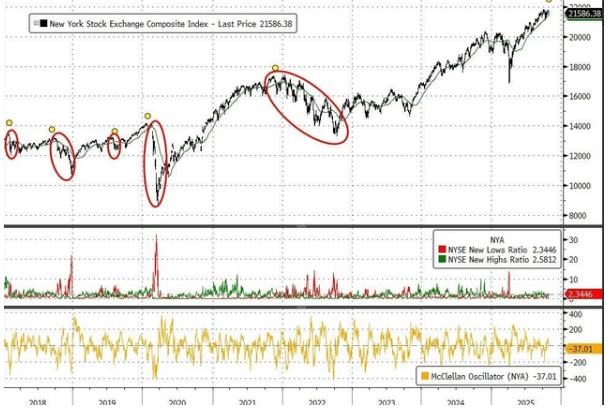
Group 1: Market Overview - The US stock market experienced a significant decline, with the Nasdaq falling over 2.5% and the semiconductor index dropping 4% [1] - Major tech companies like Alphabet, Meta Platforms, and Oracle are issuing substantial debt to fund AI investments, indicating a shift from cash-rich to leveraged balance sheets [1][6] - Concerns about an AI bubble are rising, fueled by warnings from Wall Street CEOs about potential market corrections [1][8] Group 2: Valuation Concerns - Current valuations of US stocks, particularly in AI and tech sectors, are considered high, with the P/E ratio of the Magnificent 7 at 39 times and the S&P 500 at approximately 26 times [2][13] - The market breadth is weakening, with over 330 stocks declining while the S&P 500 rises, indicating increased downside risk [2] - The CAPE ratio has recently surpassed 40, a level not seen since the tech bubble peak in 1999, raising concerns about financial sustainability [4] Group 3: Debt and Liquidity - Tech companies are increasingly issuing bonds for AI-related investments, with significant offerings from Alphabet ($25 billion) and Meta ($30 billion) [5] - The US credit market is shifting, with large tech firms returning to debt financing even in a high-interest-rate environment [6] - A substantial supply of investment-grade bonds is putting pressure on prices, as indicated by the recent decline in the iShares iBoxx USD Investment Grade Corporate Bond ETF [8] Group 4: Market Sentiment and Predictions - CEOs from Goldman Sachs and Morgan Stanley have expressed concerns about current valuation levels, predicting a potential 10% to 20% market correction in the next 12 to 24 months [8] - Michael Burry's Scion Asset Management has taken significant short positions against Nvidia and Palantir, highlighting fears of an AI bubble [9] - Despite current concerns, some analysts believe the market's primary risk is missing out on potential gains rather than facing a deep correction [12]





亚太股市暴跌!A股无惧低开高走,“美国缺电”带动电网板块高潮
Sou Hu Cai Jing· 2025-11-05 09:19
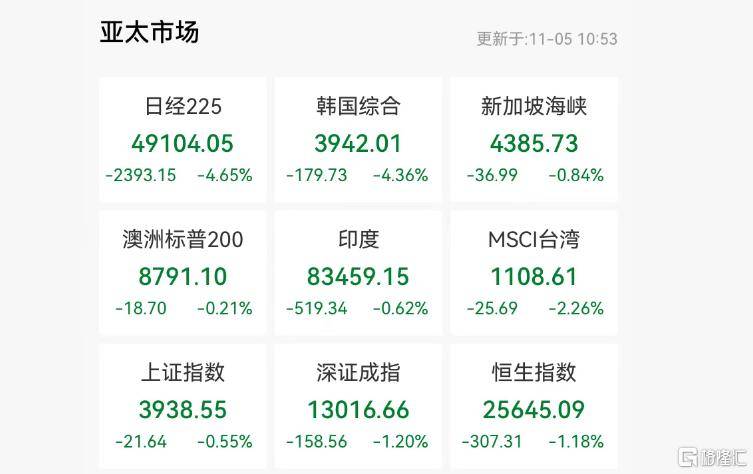
Group 1 - The core sentiment in the market is a significant decline in technology stocks, particularly in the AI sector, driven by liquidity issues and fears of an AI bubble, leading to a drop of over 2% in the Nasdaq and nearly 4% in Nvidia [1] - Asian markets mirrored this trend, with the Nikkei 225 falling nearly 5% and the Korean Composite Index dropping over 6%, indicating widespread panic in response to the US market's downturn [1] - The A-share market experienced a significant drop at the open, with the ChiNext Index falling 2%, but later recovered as large funds entered the market to buy the dip, resulting in a positive close for major indices [2] Group 2 - The global stock market decline is attributed to an overcrowded investment in technology stocks, affecting not only A-shares but also US and Asian markets, with significant weightings in key companies like TSMC and Samsung Electronics [3] - The US government shutdown has reached a record 36 days, which may further impact market sentiment and investor confidence [3] - The People's Bank of China conducted a 700 billion yuan reverse repurchase operation, indicating ongoing liquidity management in the face of market volatility [3] Group 3 - The narrative surrounding AI's growth is increasingly focused on the limitations of power supply rather than chip shortages, as highlighted by Microsoft CEO Satya Nadella, which has led to a surge in stocks related to electrical equipment in the A-share market [4][5] - Goldman Sachs reported that the power supply is becoming a significant constraint on AI development, predicting a dramatic increase in electricity demand from AI servers and data centers in the coming years [5] - The dollar index has surpassed the 100 mark, which may exert pressure on emerging markets [6] Group 4 - The market saw a mixed performance, with the Shanghai Composite Index up 0.23% and the ChiNext Index up 1.03%, while the Hong Kong Hang Seng Index experienced a slight decline [8] - Sectors such as electrical equipment, coal, and retail led the gains, while technology and non-bank financial sectors faced declines [8]
AI的资本狂欢离泡沫破灭还有多久?
佩妮Penny的世界· 2025-11-05 08:54
Core Viewpoint - The article discusses the potential bubble in the capital market driven by AI, questioning whether the current valuations are justified and how close the market is to a potential collapse [1][19]. Group 1: Market Sentiment - Optimists believe that today's investments will yield high returns in the long term, making larger valuations reasonable [1]. - Pessimists acknowledge the utility of AI but argue that current valuations are excessively high [1]. Group 2: Investment Positions - Michael Burry's hedge fund, Scion Asset, updated its holdings for Q3 2025, with short positions in Palantir and Nvidia making up 80% of its portfolio, exceeding $1 billion [3]. Group 3: Capital Expenditure Trends - The capital expenditure (Capex) in the tech sector has reached an 18% compound annual growth rate, nearing levels seen during the 1999-2000 internet bubble, indicating overheating in infrastructure investments [10]. - AI-related Capex includes investments in GPUs, AI chips, data centers, and energy, suggesting that computational power is becoming as critical as oil [10]. Group 4: Business Dynamics - A cyclical investment relationship exists among major players like Nvidia and cloud service providers, where revenue growth appears self-reinforcing despite no real change in value [13]. - The article references a report from Marathon Asset Management, drawing parallels between the current AI investment climate and the telecom bubble of the early 2000s, highlighting the risks of oversupply [17]. Group 5: Profitability Concerns - While some AI-native companies are generating profits, many large model companies are operating at significant losses, with reports indicating that OpenAI earns $13 billion but incurs losses of $20 billion [19]. - The article suggests that the high costs of talent and capital expenditures in AI may hinder profitability, especially in the domestic market where many companies struggle to generate revenue [19]. Group 6: Bubble Analysis - A UBS report indicates that the market may still be in the early stages of a bubble, as tech stock valuations are close to normal levels, and earnings growth remains strong [21]. - The potential for profit margins to decline as capital intensity increases and competition rises is highlighted as a risk factor [21].

美股将大崩盘 全球AI泡沫破裂?
Sou Hu Cai Jing· 2025-11-05 08:39
Group 1 - The core argument of the video suggests a potential crash in the US stock market next year, citing Warren Buffett's record cash holdings, Federal Reserve liquidity management, and an impending real estate adjustment cycle [1] - There is skepticism regarding the AI narrative, with concerns that a collapse in AI-related investments could end the current bull market driven by AI [2][6] - The video fails to address that Buffett's cash holdings have been substantial for several years and do not necessarily indicate an imminent market crash [4][5] Group 2 - The risks to the US economy and stock market are primarily linked to a potential collapse of the AI narrative, the end of the AI arms race among tech giants, and a decline in stock prices of leading companies like Nvidia [6][8] - AI investments have significantly contributed to US economic growth, and any issues in this sector could lead to broader economic problems [6][8] - The current AI infrastructure in the US is perceived as fragile, with significant amounts of GPUs sitting idle due to power supply issues and inadequate cooling systems [17][20] Group 3 - Major tech companies are facing rising capital expenditures that exceed their cash flows, leading to increased debt financing, which poses greater risks compared to equity financing [14][15] - Despite the current financial stability of these tech giants, the accumulation of risks due to AI investments is evident [16] - Nvidia's stock price has surged despite its earnings growth, indicating a market expectation for continued high growth, which may not be sustainable [22][24] Group 4 - The potential for a "Davis double kill" scenario exists, where both earnings growth and stock valuations decline, leading to significant drops in stock prices [27][28] - Nvidia's growth may depend on exporting high-end GPUs to China to maintain its growth trajectory amidst increasing competition from domestic GPU manufacturers [29][30] - Historical patterns suggest that the US stock market experiences minor corrections every two years and major corrections every five years, indicating that a significant downturn may not be imminent [32]
警惕泡沫!德银考虑做空AI股票进行风险对冲
Hua Er Jie Jian Wen· 2025-11-05 08:39
Core Insights - The surge in investment driven by artificial intelligence (AI) has pushed the data center industry to peak valuations, prompting key financial players to reassess potential risks [1] - Deutsche Bank is actively discussing risk management strategies related to its significant loans in the data center sector, which are primarily aimed at meeting AI and cloud computing demands [1][2] Group 1: Deutsche Bank's Position - Deutsche Bank has made substantial bets on data center financing, providing loans to companies serving major tech giants like Alphabet, Microsoft, and Amazon, with estimates of total loans reaching several billion dollars [2] - The bank is considering hedging strategies, including shorting a basket of AI-related stocks and utilizing synthetic risk transfer (SRT) derivatives to protect against potential loan defaults [2][3] Group 2: Market Concerns and Regulatory Warnings - There is a growing concern in the market regarding an AI-driven asset bubble, with comparisons being drawn to the early 2000s internet bubble due to rapid capital inflow into an untested industry [3] - Regulatory bodies, such as the Monetary Authority of Singapore, have issued warnings about the "relatively tight valuations" in the tech and AI sectors, indicating that a reversal in market sentiment could lead to significant corrections [3] Group 3: Challenges in Hedging - Notable investors, including Michael Burry, have taken short positions against leading AI companies, reflecting a bearish outlook on the AI hype [4] - Hedging against AI risks presents challenges, as shorting AI stocks can be costly in a thriving market, and SRT transactions require a diversified loan pool to achieve favorable ratings [4] Group 4: Internal Contradictions at Deutsche Bank - There are conflicting views within Deutsche Bank regarding AI risks, with some analysts previously suggesting that concerns about an AI bubble were overstated [6] - This internal contradiction highlights the complex situation faced by large financial institutions, balancing the desire to capitalize on AI opportunities while remaining vigilant about potential risks [6][7]

AI泡沫何时破?一场被资本催熟的技术狂欢终将回归理性
Sou Hu Cai Jing· 2025-11-05 08:07
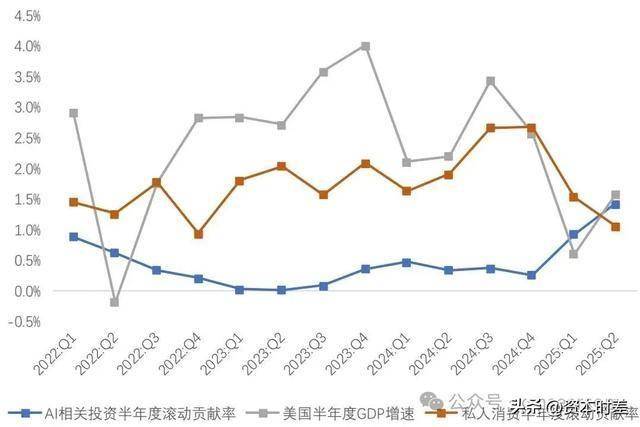
Core Insights - The AI market is experiencing significant volatility, with major companies like Nvidia losing substantial market value and Microsoft retracting data center projects, indicating a fragile bubble driven by capital investment [1][3] - The competition in AI infrastructure is becoming increasingly debt-driven, as exemplified by Oracle's $300 billion contract with OpenAI, raising concerns about the sustainability of such investments [1] - Historical parallels are drawn to the 2000 internet bubble, with current market indicators suggesting a potential repeat of past patterns, including high valuations and significant market corrections [1][3] Group 1: Market Dynamics - Major US tech companies have invested over $1.5 trillion in AI over the past three years, resulting in only a 0.9% GDP growth, highlighting inefficiencies in capital allocation [1] - DeepSeek's open-source strategy has disrupted the US AI dominance by achieving GPT-3.5 level performance at a fraction of the cost, leading to a 17% drop in Nvidia's stock price [3] - The emergence of competitive models from China, Europe, and other regions is reshaping the global AI landscape, indicating a shift away from reliance on hardware scaling [3] Group 2: Financial Viability - AI applications currently generate limited revenue, primarily in advertising optimization, necessitating an annual income of $600 billion to cover hardware costs [5] - A $1.5 trillion funding gap exists in global data center construction, with signs of fatigue in private credit markets, raising concerns about the financial sustainability of AI investments [1][5] Group 3: Regulatory Environment - The implementation of the EU AI Act and increased scrutiny on data privacy and algorithmic bias are tightening the regulatory landscape for AI companies [5] Group 4: Future Outlook - Predictions suggest that the AI bubble may burst between 2026 and 2027, driven by a combination of market corrections and cyclical fears surrounding AI stocks [3] - Historical trends indicate that significant technological advancements often follow market corrections, suggesting that the true potential of AI may only be realized post-bubble [7]

港股跌幅收窄,恒指午间收跌0.28%,有色金属股集体反弹
Ge Long Hui· 2025-11-05 04:07
忧AI泡沫导致港股早盘低开,盘中三大指数跌幅持续收窄。截止午盘,恒生指数跌0.28%,盘初曾跌 1.8%,国企指数跌0.31%,恒生科技指数跌0.8%,一度大跌至2.87%。权重科技股跌幅集体缩窄且部分 转涨,其中,美团涨1.8%,百度、腾讯飘红,小米、阿里巴巴微幅下跌;航空板块涨幅靠前,铜、黄 金股等有色金属股集体反弹。另外,受市场因素影响,应用软件股、SeeS概念股依旧表现低迷,汽车 股、半导体股普遍走低。(格隆汇) ...
“大空头”原型做空英伟达与Palantir,美股科技股集体收跌
Guan Cha Zhe Wang· 2025-11-05 03:24
当地时间周二,人工智能软件企业Palantir的首席执行官Alex Karp公开抨击卖空势力,并特别点出电影 《大空头》原型人物迈克尔·伯里(Michael Burry)的名字。 此前曝光的文件表明,伯里旗下基金已对Palantir与英伟达这两大AI行业龙头实施了做空布局。 上周五,伯里已在社交平台X上释放了明确信号,他分享了《大空头》中饰演自己的演员克里斯蒂安·贝 尔神情错愕注视电脑屏幕的剧照,并配文称:"有时,我们能察觉泡沫的存在。有时,我们能采取行动 应对。有时,唯一的获胜方式就是选择不参与。" 而本周一披露的信息则证实,他并非仅停留在口头警告层面,其管理的Scion资产管理公司正动用巨资 进行空头布局。 伯里还通过推文附带的图表进一步阐述其观点,他对比了Alphabet、亚马逊与微软在2018至2022年云业 务板块的增长态势与当前阶段的差异,暗指当前AI热潮的投资回报率远未达市场预期。这一论调与市 场上与日俱增的忧虑形成呼应:如同互联网泡沫初期对光纤领域的大规模过度投资,当前AI泡沫中的 头部企业未来或许可能遭遇崩盘危机。 具体来看,根据本周的一份证券公告,迈克尔·伯里已买入英伟达和Palantir ...

AI泡沫恐慌突袭亚太市场!日韩股市闪崩,韩股触发熔断!
Sou Hu Cai Jing· 2025-11-05 03:09
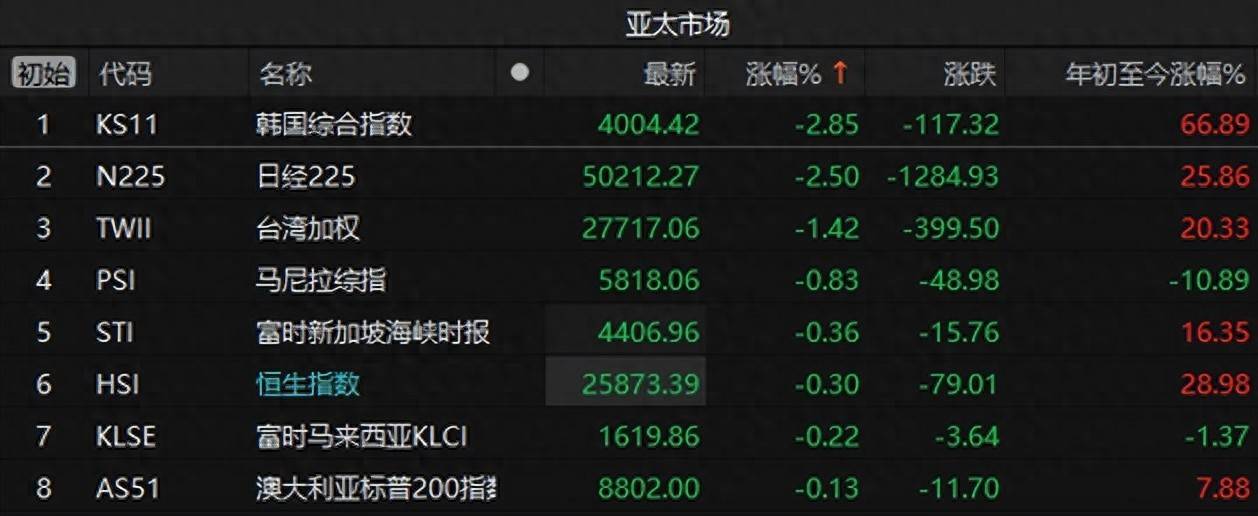
Market Overview - The Asia-Pacific markets experienced a sudden downturn, with significant declines in the Japanese and South Korean stock markets, leading to a drop in Taiwan and Hong Kong stocks [1][2] - The KOSPI index in South Korea fell over 5%, while the Nikkei 225 index dropped more than 4%, with major tech stocks like SK Hynix and Samsung Electronics also suffering losses [4][6] Technology Sector Impact - The technology sector, particularly semiconductor and AI chip companies, was heavily impacted, with major players facing substantial declines [1][4] - Prior to the downturn, the KOSPI index had seen a remarkable increase of nearly 70% year-to-date, and the Nikkei 225 index had risen approximately 23% [6][7] Market Sentiment and Factors - Market sentiment shifted due to several factors, including a strengthening US dollar, declining high-valuation tech stocks, mixed signals from Federal Reserve officials regarding interest rate cuts, and ongoing trade uncertainties [7][8] - Concerns over a potential AI bubble burst have led to a broader market sell-off, with the US stock market also experiencing significant declines [9][12] Notable Stock Movements - In the US market, major tech stocks such as Tesla and Nvidia saw declines of over 5% and 3% respectively, while Apple was the only stock to show a slight increase [10][11] - Michael Burry's significant short positions on AI-related stocks have raised concerns about the sustainability of valuations in the AI sector [12][14] Analyst Predictions - Major financial institutions like Goldman Sachs and Morgan Stanley have warned of potential market corrections, predicting declines of 10% to 20% in the coming months [14][16] - Analysts suggest that the current market lacks short-term catalysts for recovery, particularly ahead of Nvidia's upcoming earnings report [17]



美股散户惨遭半年最大单日亏损!恐慌为何突然蔓延?
Jin Shi Shu Ju· 2025-11-05 02:55
Core Viewpoint - The recent sell-off in the U.S. stock market, particularly affecting retail investors, is attributed to disappointing earnings from Palantir and concerns over high valuations in the AI sector, exacerbated by a notable decline in Bitcoin prices [2][3][5]. Group 1: Market Performance - The Retail Favorites Index, which tracks stocks heavily held by retail investors, experienced its largest drop since April, falling by 3.6%, significantly more than the S&P 500's decline [2]. - Despite a significant drop in stock prices on Tuesday, retail traders purchased $560 million worth of stocks and ETFs, briefly helping the market recover before it fell again [3]. - Palantir's stock, despite exceeding sales expectations and raising its annual outlook, dropped by 7.9% due to concerns over its high valuation and the sustainability of the AI boom [3][4]. Group 2: Influencing Factors - The sell-off was intensified by a well-known hedge fund manager's disclosure of short positions in Palantir and Nvidia, which raised alarms among investors [4]. - The decline in Bitcoin, which fell below $100,000 for the first time since June, negatively impacted related stocks and added pressure on retail investors [5]. - Market analysts suggest that while corporate earnings have been strong, the high expectations for tech companies could lead to disproportionate negative impacts if performance falls short [4].