去美元化

Search documents
历史罕见!全球性的疯狂逼空
格隆汇APP· 2026-01-26 09:43
Core Viewpoint - The article highlights the unprecedented surge in gold prices, which have surpassed $5,000 per ounce for the first time, leading to significant increases in related ETFs [2][30]. Group 1: Gold and Silver Market Dynamics - Gold prices reached a record high of $5,100 per ounce, with a rise of over 2%, positively impacting gold ETFs [2][3]. - Silver has experienced a textbook-style short squeeze, with extreme positioning in the COMEX futures market, where commercial short positions reached approximately 90,000 contracts, while speculative net long positions exceeded 25,000 contracts [9]. - The physical delivery segment for silver is under pressure, with global deliverable silver inventories at a ten-year low, indicating a fierce competition for physical silver [9]. - The price of silver has increased by over 40% since the beginning of 2026, outpacing gold's performance [10]. Group 2: Supply and Demand Factors - The silver market has faced a structural supply shortage for five consecutive years, with the expected shortfall in 2026 projected to be around 7,000 tons [12]. - The demand for silver is driven by sectors such as photovoltaics, AI data centers, and electric vehicles, while approximately 70% of silver production comes as a byproduct of mining other metals, limiting supply flexibility [12]. Group 3: Investment Trends and Institutional Behavior - There has been a significant inflow of funds into gold-related ETFs, with a net inflow of $34.7 billion in 2025, a 220% increase from 2024 [22]. - Major institutions, including Bridgewater and BlackRock, have increased their positions in gold ETFs, reflecting a strategic shift towards gold assets amid geopolitical and economic uncertainties [23]. - Central banks globally purchased a record 1,287 tons of gold in 2025, with China alone increasing its gold reserves by 287 tons, highlighting the ongoing demand from institutional investors [24][28]. Group 4: Geopolitical and Economic Influences - The article discusses the macroeconomic narratives driving gold and silver investments, including risks associated with the U.S. dollar, geopolitical tensions, and inflation concerns [16][19]. - Recent geopolitical events have intensified the demand for gold as a safe-haven asset, with significant actions taken by various countries that contribute to market instability [17][18]. - Investment banks have raised their gold price targets, with Goldman Sachs predicting a price of $5,500 per ounce within 12 months, driven by geopolitical risk premiums and central bank demand [30][31]. Group 5: Investment Vehicles and Cost Efficiency - The article emphasizes the low fee structure of gold ETFs, such as the 华夏 ETF (518850) and 黄金股 ETF (159562), both having a fee rate of 0.2%, significantly lower than the market average of 0.6% [39]. - These ETFs provide investors with efficient access to gold and gold-related equities, supporting T+0 trading and offering a diversified exposure to the gold market [38].


1月26日金市晚评:全球秩序重构不确定性助黄金 机构看高7150美元
Jin Tou Wang· 2026-01-26 09:36
Core Viewpoint - The gold price has surged past the $5000 per ounce mark, reaching a historical high, driven by geopolitical tensions and increased demand from central banks and retail investors [1][3][4]. Group 1: Gold Price Movement - As of January 26, 2026, the spot gold price is trading at $5083.29 per ounce, with a daily increase of 2.02%, peaking at $5110.25 and dipping to $5003.26 [1][2]. - The London Bullion Market Association (LBMA) annual survey indicates analysts' price expectations have soared to $7150 per ounce, with Goldman Sachs raising its December target to $5400 from $4900 [2][3]. Group 2: Geopolitical Factors - Ongoing geopolitical tensions, including the Russia-Ukraine conflict and U.S.-Iran confrontations, are significantly impacting market confidence and driving demand for gold as a safe-haven asset [3][4]. - The U.S. military presence in the Persian Gulf and rising tensions with Iran have escalated the demand for gold, reflecting a shift in investor sentiment towards safer assets [3]. Group 3: Central Bank Activity - In 2025, global central bank gold purchases reached 1087 tons, the highest since the Bretton Woods system's collapse in 1971, with expectations for continued strategic accumulation in 2026 [3][4]. - Central banks, particularly in emerging markets, are increasingly diversifying away from the U.S. dollar, with Poland planning to increase its gold reserves from 550 tons to 700 tons [3]. Group 4: Market Dynamics and Predictions - Analysts predict that gold prices may experience fluctuations but are expected to maintain a strong upward trend, with a potential target of around $5150 per ounce by the end of Q1 2026 [6][7]. - The current upward momentum in gold prices is supported by strong buying interest below $4900, limiting the potential for significant declines [6].
黄金的“简单逻辑”征服市场,业内人士:今年最高将触及7150美元
Jin Shi Shu Ju· 2026-01-26 09:30
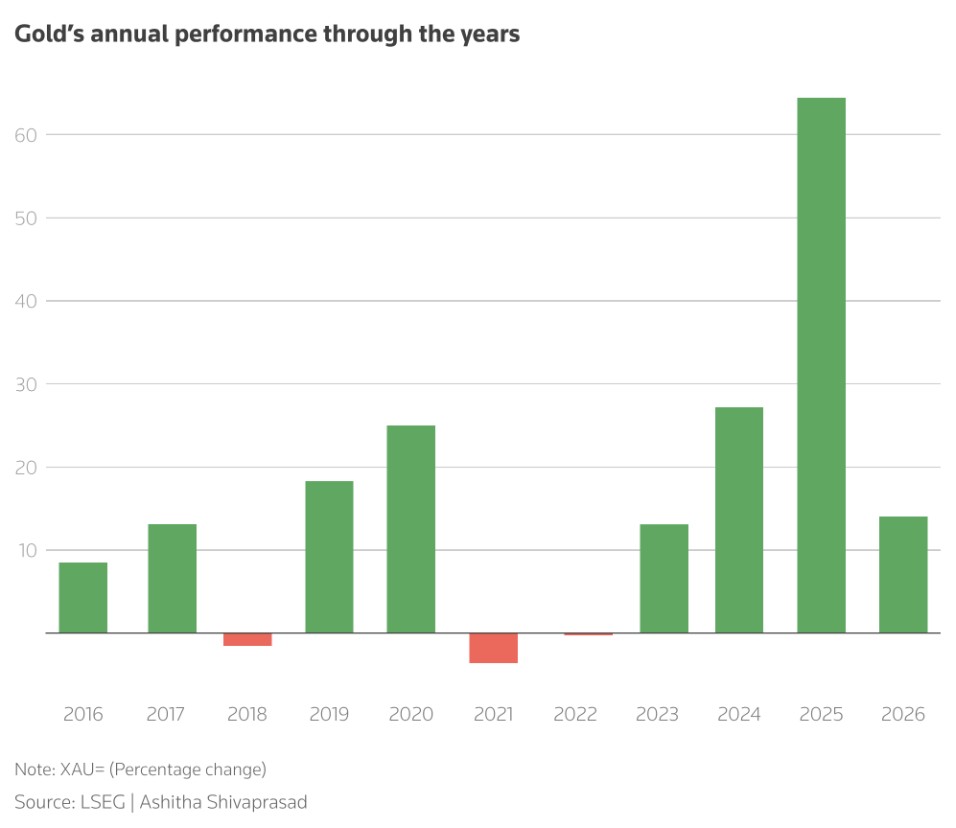
现货黄金价格周一突破每盎司5000美元关口创历史新高,分析师预计,受全球地缘紧张局势持续升级,以及各国央行和零售市场强劲买 盘支撑,金价今年将进一步攀升。 受地缘政治与经济风险冲击市场影响,黄金价格一度冲高至5110美元以上。这一避险资产在2025年大涨64%后,今年涨幅已超17%。 黄金近期的涨势,由多重地缘政治紧张局势共同推动,其中包括美欧因格陵兰岛问题产生的北约内部分歧、关税政策的不确定性,以及 市场对美联储独立性的质疑不断升温等。 金属聚焦咨询公司董事菲利普・纽曼(Philip Newman)称:"随着美国中期选举临近,政治层面的不确定性或进一步加剧。与此同时, 市场对美股估值过高的担忧始终存在,这或将推动更多资金为分散投资组合而流入黄金市场。" 他补充道:"在突破每盎司5000美元的里程碑后,我们预计金价将继续走高。" 各国央行购金热情居高不下 伦敦金银市场协会年度贵金属预测调查显示,分析师预计2026年黄金价格最高将触及7150美元,全年均价为4742美元。 高盛集团已将2026年12月黄金价格预期从4900美元上调至5400美元。 独立分析师罗斯・诺曼(Ross Norman)则预计,黄金价格今 ...
有色金属行业报告(2026.1.19-2026.1.23):地缘事件加速去美元化,大宗金属价格普涨
China Post Securities· 2026-01-26 08:48
Industry Investment Rating - The industry investment rating is maintained at "Outperform the Market" [1] Core Views - The report highlights that geopolitical events are accelerating the de-dollarization process, leading to a broad increase in commodity prices [4] - Precious metals are recommended for strong holding due to rising demand driven by political events and net selling pressure on U.S. Treasury bonds, with gold and silver prices increasing by 8.30% and 14.80% respectively [4] - Copper prices have risen by 1.09% due to a temporary easing of European risks, but there are signs of weak demand from downstream sectors [5] - Aluminum prices are expected to rise as supply continues to grow while demand shows signs of stabilization [5] - Tin prices have rebounded significantly due to macroeconomic factors and uncertainties in supply from conflict regions [6] - Lithium prices are on the rise due to low inventory levels and strong demand expectations, indicating a potential upward trend [6] Summary by Sections Industry Overview - The closing index for the industry is at 9972.0, with a weekly high of 9972.0 and a low of 4295.55 [1] Price Movements - Basic metals saw price changes: copper up 1.09%, aluminum up 0.25%, zinc up 1.08%, lead down 1.43%, and tin up 13.57% [19] - Precious metals experienced significant increases: gold up 8.30% and silver up 14.80% [19] - Lithium carbonate prices surged by 13.25% due to supply constraints [19] Inventory Levels - Global visible inventory changes: copper increased by 38,104 tons, aluminum by 21,952 tons, zinc by 2,662 tons, lead by 12,077 tons, tin by 16 tons, and nickel decreased by 1,711 tons [33][35]


贵金属周报:金价持续强势-20260126
Bao Cheng Qi Huo· 2026-01-26 08:40
Group 1: Investment Rating - No investment rating provided in the report Group 2: Core Views - Last week, the gold price continued to rise, with New York gold climbing from $4,600 to nearly $5,000. Although the geopolitical conflict between the US and Europe eased mid - week, causing a brief decline in safe - haven sentiment, the core drivers for the long - term rise of gold price remained unchanged, allowing the price to maintain at a historical high after short - term adjustments [6][23] - In the long run, the US's long - term trend of "weaponizing" economic and financial tools such as tariffs is eroding the US dollar credit system, accelerating the global "de - dollarization" process. Gold, as the "ultimate currency" beyond sovereign credit, has its strategic value redefined and enhanced. Central banks around the world, especially those in emerging markets, are continuously and massively buying gold to build a safer asset base, which provides a solid foundation for the gold price [6][23] - In the short term, attention can be paid to the Fed's interest - rate meeting at the end of the month [6][23] Group 3: Summary of Each Section 1. Market Review 1.1 Weekly Trend - The report shows the linkage chart between the US dollar index and the futures closing price of COMEX gold [10] 1.2 Indicator Changes - COMEX gold rose from $4,601.10 to $4,983.10, a 8.30% increase; COMEX silver rose from $89.95 to $103.26, a 14.80% increase; SHFE gold主力 rose from 1,032.32 to 1,115.64, an 8.07% increase; SHFE silver主力 rose from 22,483.00 to 24,965.00, an 11.04% increase [11] - The US dollar index fell from 99.37 to 97.50, a - 1.88% change; the US dollar against the offshore RMB fell from 6.97 to 6.95, a - 0.22% change [11] - The 10 - year US Treasury real yield increased slightly from 1.91 to 1.92; the S&P 500 fell from 6,940.01 to 6,915.61, a - 0.35% change [11] - The COMEX gold - silver ratio fell from 51.15 to 48.26, a - 5.66% change; the SHFE gold - silver ratio fell from 45.92 to 44.69, a - 2.67% change [11] - The SPDR gold ETF increased from 1,085.67 to 1,086.53, an increase of 0.86; the iShare gold ETF increased from 492.98 to 494.56, an increase of 1.58 [11] 2. Weakening US Dollar and Rising Gold Price - Last week, the US dollar index continued to weaken while the gold price showed an obvious upward trend. The strengthening of gold and the weakening of the US dollar index reflect the asset re - allocation in the market due to "US policy risks" [13] - The US stock market recovered after hitting a trough last week, with the market risk appetite rising. The short - term improvement in market liquidity also contributed to the rise of the gold price [15] 3. Tracking of Other Indicators - On January 23, the combined holdings of SPDR + iShares gold ETFs were 1,581.09 tons, an increase of 2.44 tons from the previous week [17] - Last week, precious metals continued to rise, silver regained its upward momentum, and the gold - silver ratio declined again, with the New York gold - silver ratio dropping to around 48. The decline of the gold - silver ratio is mostly due to the rise of silver, reflecting its high elasticity and increasing industrial demand [19] 4. Conclusion - The conclusion is the same as the core views, emphasizing the long - term rise of the gold price, the impact of "de - dollarization" on the gold price, and the need to pay attention to the Fed's interest - rate meeting at the end of the month [23]
宏观氛围回暖,有色企稳:铜铝周报-20260126
Bao Cheng Qi Huo· 2026-01-26 08:40
1. Report Industry Investment Rating - No information provided in the report 2. Core Views of the Report - Copper: With the macro environment improving, copper prices may maintain a high - level and strong - running trend. Last week, copper prices first oscillated around the 100,000 - yuan mark and then rebounded with increased positions on Friday. The weakening US dollar index is beneficial to copper prices, and the improvement in the Greenland incident has boosted short - term market risk appetite. The continuous rise of precious metals has driven the bullish sentiment in the non - ferrous sector. In the industrial aspect, when copper prices dropped to the 100,000 - yuan mark last week, the restocking willingness of some downstream industries increased, and the inventory accumulation of electrolytic copper slowed down. However, as copper prices rebounded, the basis and monthly spread weakened again, and it is expected that the restocking willingness will decline again. Copper prices may maintain a high - level oscillation and wait for industrial follow - up [5]. - Aluminum: With the macro environment improving, aluminum prices may maintain an oscillating trend. Last week, aluminum prices oscillated strongly around the 24,000 - yuan mark. On Friday, the macro environment warmed up, and non - ferrous metals generally rose. The continuous strength of precious metals last week largely drove the non - ferrous sector to stabilize and rebound. However, compared with copper, aluminum has a weaker financial attribute and a stronger industrial attribute, so its increase is limited. In the industrial aspect, the inventory of upstream bauxite has slightly increased, alumina is running weakly, the restocking willingness of downstream industries is weak, electrolytic aluminum inventory continues to accumulate, and the monthly spread also remains weak. Aluminum prices have strong technical support at the 24,000 - yuan mark and are waiting for industrial follow - up [6]. 3. Summary According to the Catalog 3.1 Macro Factors - Last week, the US dollar index dropped significantly, which is beneficial to the non - ferrous sector. The decline of the US dollar index and the sharp rise of gold largely reflect the intention of global asset allocation, that is, "de - dollarization" [10]. 3.2 Copper 3.2.1 Quantity and Price Trends - Last week, copper prices first oscillated around the 100,000 - yuan mark and then rebounded with increased positions on Friday. The weakening US dollar index is beneficial to copper prices, and the continuous rise of precious metals has driven the bullish sentiment in the non - ferrous sector [5]. 3.2.2 Copper Ore Shortage - On January 23, the second - phase project of Tibet Julong Copper Industry was completed and put into operation. The second - phase expansion project was approved, and it is planned to be completed and put into operation by the end of 2025. After reaching full production, the annual ore mining and processing volume will exceed 100 million tons, and the annual copper production will reach 300,000 - 350,000 tons. SMM expects the copper production of Julong Copper Industry to be 165,000 tons in 2025 and 250,000 tons in 2026. Last week, the copper ore port inventory increased slightly, and the TC processing fee decreased slightly [24][26]. 3.2.3 Continuous Accumulation of Electrolytic Copper Inventory - On January 22, the social inventory of electrolytic copper was 335,200 tons, a weekly increase of 7,700 tons; the inventory of COMEX + LME was 727,600 tons, a weekly increase of 47,800 tons. Overseas electrolytic copper inventory continued to accumulate, while the inventory accumulation in China slowed down [27]. 3.2.4 Downstream Primary Industry - On January 23, SMM reported that the operating rate of the refined copper rod industry rebounded by 10.51 percentage points to 67.98% week - on - week. Driven by the Spring Festival stockpiling and the decline of copper prices, downstream orders recovered, leading to the reduction of finished product inventory, and enterprises accelerated production to meet the demand. Looking forward to next week, the stockpiling demand will continue, and SMM expects the operating rate to further increase by 3.23 percentage points to 71.2% [29]. 3.3 Aluminum 3.3.1 Quantity and Price Trends - Last week, aluminum prices oscillated strongly around the 24,000 - yuan mark. On Friday, the macro environment warmed up, and non - ferrous metals generally rose. The continuous strength of precious metals last week largely drove the non - ferrous sector to stabilize and rebound. However, compared with copper, aluminum has a weaker financial attribute and a stronger industrial attribute, so its increase is limited [6]. 3.3.2 Upstream Industrial Chain - On January 23, the bauxite port inventory was 24.5 million tons, an increase of 392,400 tons compared with last week and an increase of 7.17 million tons compared with the same period in 2025 [44]. 3.3.3 Low - level Inventory of Electrolytic Aluminum - On January 22, the social inventory of electrolytic aluminum was 768,000 tons, an increase of 4,000 tons compared with last week; the overseas electrolytic aluminum inventory was 514,700 tons, an increase of 18,300 tons compared with last week [48]. 3.3.4 Downstream Primary Industry - Last week, aluminum prices oscillated around the 24,000 - yuan mark, the restocking willingness of downstream industries increased, and the processing fees of aluminum rods in some areas increased slightly. On January 22, the aluminum rod inventory was 123,300 tons, an increase of 1,700 tons compared with last week. The aluminum rod inventory is about to enter the seasonal inventory accumulation period, but high aluminum prices may suppress downstream demand, and the inventory accumulation speed can be continuously monitored [54][57]. 3.4 Conclusion - Copper: Last week, copper prices rose and then fell, and the trading volume continued to decline, indicating a strong willingness of long - position holders to close their positions. The decline of copper prices was mainly due to the cooling of the macro environment, and the non - ferrous sector and even the commodity market declined. The willingness of short - term funds to close positions continued to increase. In the macro aspect, the overseas US dollar index continued to rebound, and the margin ratio of margin trading in China was raised, increasing the market regulation expectation. In the industrial aspect, the monthly spread of nearby contracts weakened significantly, electrolytic copper inventory continued to accumulate, and the downstream industries were in a wait - and - see mood. As copper prices dropped to the 100,000 - yuan mark, the restocking willingness of some industries increased, which may provide some support for copper prices. The long - short game at the 100,000 - yuan mark can be continuously monitored [60]. - Aluminum: Last week, aluminum prices oscillated strongly around the 24,000 - yuan mark. On Friday, the macro environment warmed up, and non - ferrous metals generally rose. The continuous strength of precious metals last week largely drove the non - ferrous sector to stabilize and rebound. However, compared with copper, aluminum has a weaker financial attribute and a stronger industrial attribute, so its increase is limited. In the industrial aspect, the inventory of upstream bauxite has slightly increased, alumina is running weakly, the restocking willingness of downstream industries is weak, electrolytic aluminum inventory continues to accumulate, and the monthly spread also remains weak. Aluminum prices have strong technical support at the 24,000 - yuan mark and are waiting for industrial follow - up [60].
历史新高!金价突破5000美元,未来会继续涨吗?
Sou Hu Cai Jing· 2026-01-26 08:30
Core Viewpoint - The significant rise in international gold prices, surpassing $5000 per ounce, is driven by escalating geopolitical tensions, particularly between the US and Europe, which has heightened market risk aversion [2] Group 1: Geopolitical Tensions and Market Reactions - The US government's aggressive stance towards Greenland, a strategically important region, has intensified tensions with Europe, leading to increased speculation in the gold market [2] - The largest gold exchange-traded fund (ETF) saw its holdings rise to 1085.67 tons, a 24.9% year-on-year increase, indicating a strong global interest in gold [2] - The weakening of the US dollar's credibility and rising demand for gold from central banks are fundamental factors supporting the surge in gold prices [2] Group 2: Central Bank Strategies and Global Trends - A significant 95% of surveyed central banks expect to increase their gold reserves over the next 12 months, reinforcing the price floor for gold [4] - Poland's central bank purchased 150 tons of gold, raising its total reserves to 700 tons, positioning it among the top ten globally, highlighting a trend of nations increasing gold holdings as a strategic asset [4] Group 3: Market Predictions and Investment Strategies - Analysts predict three potential scenarios for gold prices: a full escalation of US-EU tensions leading to further price increases, a temporary diplomatic resolution resulting in a short-term price correction, or a prolonged stalemate maintaining gold's strong position [5][6] - Investment institutions are recommending increasing gold allocations to 5%-15% to hedge against the credit risks associated with US dollar assets, reflecting a shift in market sentiment towards gold as a safe haven [7] - The recent surge in gold prices is viewed as a collective response to US unilateralism and sovereign credit risks, with the ongoing US-EU conflict serving as a catalyst for this trend [7]
苍原资本:贵金属避险情绪提升 价格继续上行
Sou Hu Cai Jing· 2026-01-26 08:26
Core Viewpoint - Precious metals, particularly gold and silver, have experienced significant price increases, with gold achieving its best weekly performance in nearly six years, rising by 8.4%, and silver increasing by 14.4% [1] Group 1: Gold Market Analysis - Gold's financial attributes, including its roles as a currency, investment, and safe haven, are currently being driven by factors such as real interest rates, the US dollar index, and geopolitical situations [3] - The credibility of the US dollar is under pressure due to high national debt and fiscal deficits, leading to a decline in its global payment and reserve share, while gold's share is expected to rise to 25.94% by January 2026 [3] - The outlook for gold prices in 2026 remains positive, with potential for unexpected price increases due to the weakening credibility of the dollar and continued inflows into gold ETFs following interest rate cuts [3] Group 2: Silver Market Analysis - Silver's industrial demand is being bolstered by its essential role in solar energy, electric vehicles, and data centers, which is expected to continue driving prices upward [3] - The decline in silver inventories is creating tightness in the physical market, and some countries are expected to continue accumulating silver, further enhancing price elasticity [3] - The overall outlook for silver in 2026 is optimistic, with expectations of continued price increases driven by industrial demand and market dynamics [4]

机构还在看涨黄金
Di Yi Cai Jing Zi Xun· 2026-01-26 08:14
Core Viewpoint - Gold and silver prices have surged significantly, with gold breaking the $5000 per ounce mark and silver reaching historical highs, driven by increased demand for safe-haven assets amid geopolitical uncertainties and changing monetary policies [2][3]. Group 1: Price Movements - On January 26, London spot gold reached a peak of $5093 per ounce, while spot silver surpassed $109 per ounce, marking new historical highs [2][3]. - The domestic market saw a strong response, with several gold-related stocks hitting their daily limit up, including Hunan Gold and Sichuan Gold [2]. Group 2: Market Analysis - Analysts attribute the surge in gold prices to a combination of short-term safe-haven demand, medium-term policy expectations, and long-term monetary credit reconstruction [2]. - The ongoing geopolitical risks, particularly in the Middle East and trade tensions, have led to increased purchases of gold by European countries, further driving up prices [3]. Group 3: Future Projections - Analysts predict that gold prices could challenge the $6000 per ounce mark by 2026, with various institutions adjusting their price targets upwards, including UBS and Goldman Sachs [5]. - Bank of America has set a target of $6000 per ounce for gold, citing historical trends in bull markets [5]. Group 4: Market Risks - There are warnings about the overbought conditions in the gold and silver markets, with potential for profit-taking and increased volatility following the recent price surges [6]. - Regulatory measures have been implemented to curb excessive speculation in precious metals, with trading limits and margin requirements being adjusted [6]. Group 5: Economic Context - The U.S. economic indicators show mixed signals, with lower-than-expected non-farm payrolls and unemployment rates, leading to expectations that the Federal Reserve may maintain interest rates in the near term [4]. - The trend of "de-dollarization" is gaining momentum, with several European countries reportedly selling U.S. debt and increasing their gold holdings [4].
机构还在看涨黄金
第一财经· 2026-01-26 08:07
Core Viewpoint - Gold and silver prices have surged significantly, with gold breaking the $5000 per ounce mark and silver reaching over $109 per ounce, driven by increased geopolitical uncertainty and strong demand for safe-haven assets [3][4]. Price Movements - As of January 26, 2026, London spot gold was reported at $5076.53 per ounce, with a peak of $5093.19 per ounce. COMEX gold futures also rose, reaching $5076.2 per ounce [5]. - London spot silver reached a historical high of $109.453 per ounce, with a year-to-date increase of over 50% [5]. Market Analysis - Analysts attribute the rise in gold prices to a combination of short-term safe-haven demand, medium-term policy expectations, and long-term monetary credit reconstruction. Predictions suggest gold could challenge the $6000 per ounce mark in 2026 [3][4]. - The geopolitical risks in the Middle East and renewed trade tensions in Europe have led to increased purchases of gold by European countries, contributing to the upward trend in gold prices [5]. Institutional Perspectives - Various financial institutions maintain bullish outlooks on gold prices. UBS has set a target price of $5000 per ounce, while Goldman Sachs has raised its year-end target from $4900 to $5400 per ounce, citing growing demand from private investors and central banks [7]. - Bank of America has set a target price of $6000 per ounce, suggesting that historical trends indicate a potential for significant price increases in the coming months [7]. Risk Considerations - Despite the bullish outlook, there are warnings about the overbought conditions in the gold and silver markets, with potential for profit-taking and increased volatility as prices reach new highs [8][10]. - Regulatory measures have been implemented by exchanges to curb excessive speculation in precious metals, indicating heightened market sensitivity and the need for compliance among investors [10].