地缘政治风险

Search documents
对冲通胀?中国购金?为什么黄金飙升的6大理由通通不够?
Xin Lang Cai Jing· 2026-01-13 10:52
Core Viewpoint - Despite the significant rise in gold prices over the past year, there is no mainstream theory that reliably predicts its movements, leading to increased uncertainty for gold bulls regarding price trends in 2025 and beyond [1] Group 1: Common Narratives - **Inflation Hedge**: The common narrative that gold serves as a hedge against inflation is challenged by data showing a mere 1.1% correlation between CPI inflation changes and gold price changes over the past 40 years, indicating limited explanatory power [2] - **Expected Inflation Hedge**: The argument that gold is more sensitive to future inflation expectations rather than current inflation is also unsupported, as both 12-month and 10-year expected inflation changes show no significant correlation with gold prices, even less than CPI inflation changes [2] - **Geopolitical Risk**: The relationship between gold prices and geopolitical risk, as measured by the Geopolitical Risk (GPR) index, is negligible, with a correlation of only about 0.1% [3] - **Economic Policy Risk**: Similarly, the Economic Policy Uncertainty (EPU) index shows a correlation of only about 0.9% with gold price changes, indicating minimal predictive capability [4] - **Chinese Gold Purchases**: While the increase in China's gold reserves since 2000 appears to provide some explanatory power, the correlation between changes in Chinese gold reserves and gold prices is only about 0.6%, insufficient for effective timing [5] - **Gold ETF Net Inflows**: The net inflows into gold ETFs show a relatively higher correlation with gold prices, but statistical tests indicate that this relationship does not achieve significance at the 95% confidence level, making it unreliable as a predictive tool [6] Group 2: Investment Strategy Insights - Historical performance tracking indicates that various gold timing strategies have underperformed a simple buy-and-hold strategy by an average of about 4 percentage points annually since the mid-1980s [7] - The lack of reliable and verifiable frameworks for predicting gold price behavior complicates investment strategies and risk management, necessitating higher safety margins and stricter position discipline [7]
原油收盘连续上涨 国内汽柴行情零星上推
Sou Hu Cai Jing· 2026-01-13 09:42
Core Viewpoint - Recent international market news has been dominated by favorable factors, primarily driven by rising geopolitical risks, particularly in Venezuela and Iran, leading to significant increases in international oil prices [1][2] Group 1: Geopolitical Factors - The situation in Venezuela remains uncertain, impacting investor sentiment and market stability [1] - Ongoing tensions between the U.S. and Iran, along with escalating anti-government protests in Iran, raise concerns about potential supply disruptions [1][2] Group 2: Oil Price Trends - International oil prices have risen significantly over three consecutive days, with a current average price of $59.94 per barrel, resulting in a change rate of 0.45% [1] - The domestic gasoline and diesel prices are expected to increase by 5 yuan per ton due to the positive change rate [1] Group 3: Market Reactions - The current pricing cycle is halfway through, with expectations of price stabilization or slight increases, having minimal impact on the domestic wholesale market [1] - Despite the rise in oil prices, market participants are cautious, primarily engaging in demand-based procurement, leading to limited improvements in trading atmosphere [1] Group 4: Future Outlook - Concerns over potential supply disruptions from Iran may lead to further increases in international oil prices, although market sentiment is becoming more cautious after recent price hikes [2] - Seasonal factors are affecting diesel demand negatively, while gasoline consumption is supported by increased private vehicle usage and pre-holiday stocking [2] - Refinery pricing strategies remain conservative, with limited willingness to lower prices despite high costs, indicating a potential for price adjustments in the near future [2]
【UNFX财经事件】政策与地缘风险共振 黄金高位韧性显现
Sou Hu Cai Jing· 2026-01-13 09:33
Group 1 - The overall sentiment in the gold market remains high, with prices fluctuating around the $4600 mark, influenced by a mild rebound in the US dollar and upcoming CPI data [1] - Concerns regarding the independence of the Federal Reserve's policy have intensified, particularly following the legal investigation into Chairman Powell, which has reinforced risk-averse sentiment and supported gold prices [2] - Geopolitical factors, including ongoing unrest in Iran and potential military actions from the US, have also constrained the downside for gold, maintaining its appeal as a safe-haven asset [2] Group 2 - Market anticipation is focused on the upcoming December Consumer Price Index (CPI) data, with expectations of a month-on-month increase of approximately 0.3% and a year-on-year growth rate of 2.7% [3] - The actual performance of the inflation data is expected to directly influence market perceptions of the Federal Reserve's policy stance at the January 28 meeting, potentially amplifying short-term volatility in the US dollar and precious metals [3] - Despite the current high-level consolidation in gold prices, the underlying support from policy uncertainty, geopolitical risks, and interest rate expectations remains intact, attracting interest from institutional buyers [3]
新世纪期货:鲍威尔调查加剧独立性担忧 黄金偏强震荡
Jin Tou Wang· 2026-01-13 09:28
【黄金期货行情表现】 亚特兰大联储总裁博斯蒂克表示,通胀问题仍是他最关心的经济问题,他还称,在更广泛的不确定性 中,就业市场仍处于低雇佣、不解雇的模式。"通胀仍然过高,"他称。"必须将其控制住,我们需要高 度聚焦,确保我们所做的一切都能为此做出贡献。" 美国总统特朗普1月8日称,作为美国三军统帅,"我不需要国际法"。他的"道德标准和意志"是其在全球 范围内指挥军事行动的唯一制约因素。 美国国会预算办公室预计,美国GDP增速将在2026年加快至2.2%,2026年PCE通胀率为2.7%,2028年为 2.1%。美国失业率将在2026年降至4.6%,并在2028年进一步降至4.4%。2026年劳动力市场反映出劳动 力需求增加,劳动力供给增长乏力。美联储利率将在2026年第四季度降至3.4%。 【机构观点】 短期来看,鲍威尔刑事风暴增加对美联储独立性担忧,美最新非农就业数据表明美国劳动力市场增长动 能减弱,市场对美联储今年晚些时期的降息预期强化;地缘政治风险激发市场避险需求,支撑金价上 涨。美联储降息周期、全球央行购金和地缘政治冲突对金价形成坚实的中长支撑。 1月13日,沪金主力暂报1027.18元/克,涨幅1.0 ...
金价因获利了结回落,但仍持于4,600美元上方
Sou Hu Cai Jing· 2026-01-13 09:21
Core Viewpoint - Gold prices have declined slightly but remain above the $4,600 mark due to increasing concerns over the independence of the Federal Reserve and escalating tensions in Iran [1] Group 1: Market Reactions - New York gold futures fell by 0.3% to $4,602.50 per ounce as traders took profits after the previous trading day reached a historical high [1] - The U.S. dollar index rose by 0.1% to 98.98, indicating a rebound from previous sell-offs [1] Group 2: Economic and Geopolitical Factors - Analysts from Saxo Bank noted that the dollar's rebound followed a sell-off triggered by concerns that the Trump administration is undermining the Federal Reserve's independence [1] - Gold continues to be supported by broader economic and geopolitical risks, particularly following President Trump's decision to impose a 25% tariff on any country doing business with Iran, enhancing gold's appeal as a safe-haven asset [1]
邦达亚洲:美联储独立性受挫 黄金受益大幅攀升
Xin Lang Cai Jing· 2026-01-13 08:17
Group 1: Precious Metals Outlook - Citigroup has significantly raised its short-term outlook for precious metals due to increased geopolitical risks, physical shortages, and uncertainty regarding the independence of the Federal Reserve. The gold price target for the next 0-3 months has been increased from $4,200 to $5,000 per ounce, while the silver target has been raised from $62 to $100 per ounce [1][6] - The investment momentum remains strong, and several favorable factors are expected to persist in the first quarter. Analysts noted that the ongoing physical shortages of silver and platinum group metals may worsen in the short term due to potential delays in the U.S. Section 232 tariff decisions, which could further drive up prices [1][6] Group 2: Federal Reserve Interest Rate Predictions - Goldman Sachs has postponed its forecast for Federal Reserve interest rate cuts, now expecting a 25 basis point cut in June and September 2026, instead of March and June 2026 as previously anticipated. This adjustment follows weak non-farm employment data, indicating a gradually weakening labor market, while GDP growth remains stronger than expected [2][7] - The chief U.S. economist at Goldman Sachs stated that the Fed is likely to wait until mid-year to cut rates, anticipating inflation to return to target levels and the labor market to stabilize. The firm has reduced its probability of a recession within the next 12 months from 30% to 20% [2][7] Group 3: Currency Market Movements - The gold price surged to a historical high, breaking the $4,600 mark, supported by rising geopolitical tensions and a weakening U.S. dollar due to concerns over the Federal Reserve's independence. The current trading price is around $4,600, with resistance at $4,650 and support at $4,550 [3][8] - The USD/JPY pair experienced slight gains, supported by expectations of the Fed maintaining its current stance and a cooling of expectations for rate hikes from the Bank of Japan. The current trading price is around 158.80, with resistance at 159.50 and support at 158.00 [4][9] - The USD/CAD pair saw a slight decline, trading around 1.3870, influenced by profit-taking and a weakening dollar index. The current price is under pressure from rising oil prices, with resistance at 1.3950 and support at 1.3800 [5][10]


高盛年度机构调查:美股失宠、Mag7跑输,地缘政治成最大“灰犀牛”,金价上看6000美元
Hua Er Jie Jian Wen· 2026-01-13 08:02
Core Insights - The 34th Annual Global Strategy Conference hosted by Goldman Sachs revealed a stark contrast between macro optimism and micro caution among investors, with a strong GDP outlook but a rush towards safe-haven assets like gold and non-US markets due to geopolitical concerns [1] Group 1: Macroeconomic Outlook - Investors are highly optimistic about the US economy, with over 80% expecting GDP growth to exceed 2% by 2026, a figure more optimistic than Bloomberg's consensus of 2.1% [2] - The fear of a US recession has dropped to nearly zero, with 0% of respondents anticipating a recession [2] Group 2: Geopolitical Risks - Geopolitical risk has emerged as the largest threat to the global economy and markets, with 65% of investors identifying it as a major concern for 2026, up from 30% the previous year [2] - Inflation risk has decreased to 12%, and trade risk has plummeted from 41% to just 4% [2] Group 3: Central Bank Policies - Despite strong economic data, investors are still eager for monetary easing, with expectations for the Federal Reserve to cut rates by 70 basis points by 2026, more aggressive than the current market pricing of 50 basis points [3] - 35% of investors expect the European Central Bank to lower rates, while expectations for the Bank of England are even higher at a 60 basis point cut [3] Group 4: Equity Strategies - The strategy of "buying US stocks blindly" is losing favor, with only 23% of respondents believing the US will be the best-performing region, down from 58% [4] - Emerging markets are gaining traction, with Asia (excluding Japan) being the most favored region at 38% [4] - The perception of China as a long-term investment opportunity has rebounded to 25%, up from 9% in the past two years [4] Group 5: Sector Preferences - Technology stocks remain the top choice for 31% of investors, but the advantage is narrowing [5] - 60% of investors believe the S&P 493 will outperform the "seven giants," indicating a potential shift away from crowded AI trades towards undervalued sectors [5] Group 6: Commodity Market Trends - There is a significant divide in the commodities market, reflecting investor distrust in fiat currencies and supply-demand judgments [6] - 45% of investors believe copper will be the best-performing commodity by 2026, driven by demand from AI data centers and electrification [6] - 42% of respondents expect gold prices to rise to between $5,000 and $6,000 per ounce, with 10% predicting prices above $6,000 [6] - Conversely, 54% expect Brent crude oil prices to fall below $60 per barrel, a stark increase from 5% the previous year [6]
金荣中国:现货黄金守住隔夜大部分涨幅,强势震荡高位区间
Sou Hu Cai Jing· 2026-01-13 07:15
Fundamental Analysis - Gold prices have surged, breaking the historical $4600 per ounce mark, driven by geopolitical uncertainties and Federal Reserve policy fluctuations [1][3] - The price of gold has increased over 64% in the past year, marking its best annual performance since 1979, attributed to a low interest rate environment and heightened demand for safe-haven assets [3] - The criminal investigation into Federal Reserve Chairman Jerome Powell has intensified concerns about the Fed's independence, contributing to the decline of the US dollar index by 0.23% to 98.90 [3][4] - Ongoing geopolitical tensions, including the US response to protests in Iran and actions against Venezuela, have created a highly unstable global environment, further driving investment into gold [4] - The Federal Reserve's anticipated policy path, with expectations of two rate cuts later in the year, is expected to support gold demand [5] Technical Analysis - Gold prices reached a new high of $4630, indicating strong bullish momentum, although short-term market volatility may increase [6] - Traders are advised to monitor support levels around $4520 and $4500, with resistance near $4600 and $4630 [7] - Suggested trading strategies include light long positions near $4520 with a stop loss at $4510 and targets around $4550/$4590, as well as short positions near $4595 with a stop loss at $4603 and targets around $4560/$4530 [7]

美伊紧张局势刺激油气股 山东墨龙涨超9%
Zhi Tong Cai Jing· 2026-01-13 06:33
消息面上,1月12日,美宣布对与伊朗贸易的国家加征25%关税,并威胁采取军事行动,美伊紧张局势 骤然升级。光大期货指,由于伊朗的特殊地理位置,加之其在中东地区的重要角色,一旦与美国的冲突 加剧,势必会引发地缘紧张情绪的升温,从而造成油价的剧烈波动。更为重要的是,伊朗掌握着海湾地 区石油的运输命脉,霍尔木兹海峡,一旦伊朗因受到威胁而封锁该海峡,势必会斩断中东地区原油的对 外输出的最大途径,并造成供应中断的风险。 山东墨龙(002490)(00568)涨超9%,截至发稿,涨9.34%,报3.98港元,成交额4.12亿港元。 ...

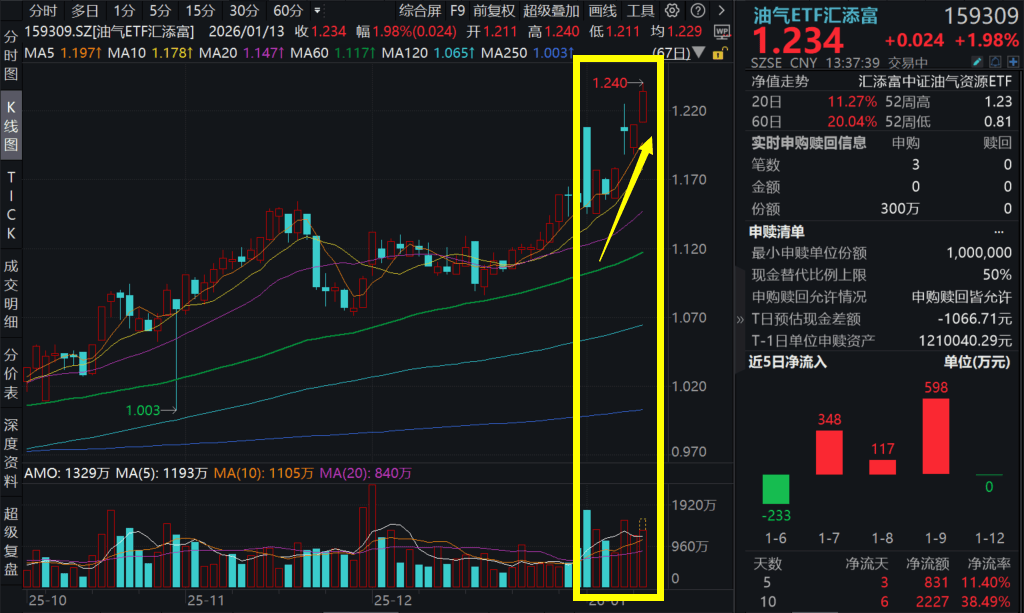
油气板块表现强势,中国海油涨超3%,油气ETF汇添富(159309)涨2%创新高!地缘风险推动油价回升,资源行情轮动到石油了?
Sou Hu Cai Jing· 2026-01-13 06:05
Core Viewpoint - The A-share market shows a mixed trend with the oil and gas sector experiencing significant inflows and price increases, particularly in the oil and gas ETF Huatai (159309), which reached a new high since its listing [1] Group 1: Market Performance - As of 13:38, the oil and gas ETF Huatai (159309) rose by 1.98%, hitting a new intraday high and attracting over 3.6 million yuan in capital [1] - The oil and gas sector saw most component stocks rise, with China National Offshore Oil Corporation (CNOOC) increasing over 3% and China Petroleum & Chemical Corporation (Sinopec) rising over 1% [5] Group 2: Geopolitical Factors - Concerns over the situation in Iran are supporting oil prices, with crude oil futures stabilizing near a one-month high [2] - Citic Futures indicates that geopolitical disturbances are likely to drive oil prices higher in the short term, despite a current oversupply in the global oil market [3] Group 3: Supply and Demand Dynamics - The OPEC+ group has decided to maintain its oil production levels, reflecting a desire to balance oil prices amid geopolitical tensions [4] - The International Energy Agency (IEA) projects a global oil demand increase of 860,000 barrels per day in 2026, with chemical feedstock demand expected to dominate this growth [6] Group 4: Investment Insights - The oil and gas sector is showing signs of recovery, with high dividend characteristics making it attractive for investors [6] - The oil and gas ETF Huatai (159309) focuses on the oil and gas industry chain, presenting long-term investment value amid external uncertainties [7]