全球去美元化

Search documents
黄金期货周报:沪金创1001元/克新高,黄金如期大幅回落-20251028
Guo Jin Qi Huo· 2025-10-28 06:42
Group 1: Report Industry Investment Rating - No relevant content Group 2: Core Viewpoints - Gold started to adjust this week. The SHFE gold futures contract 2512 reached a high of 1001.96 yuan/gram, then dropped sharply due to the potential short - term cease - fire in the Russia - Ukraine war, which cooled the risk - aversion sentiment. The December main contract of COMEX gold fell 376.8 dollars/ounce, a decline of 8.57%, and the December main contract of SHFE gold fell 78.34 yuan/gram, a decline of 7.82%. [1] - After a sharp and rapid short - term rise, it is highly likely that gold will adjust after reaching a key resistance level. Considering the 1000 - dollar/ounce increase in the past two months, the adjustment needs time and space. The short - term adjustment does not change the long - term upward trend due to central bank gold purchases in emerging markets and global de - dollarization. [1] Group 3: Summary by Directory (1. Disk Situation) - Last week, gold showed signs of exhaustion after continuous sharp upward movements. The December main contract of COMEX gold rose for the second time on Monday and hit a record high, then declined for two consecutive days on Tuesday and Wednesday, and hovered at the bottom on Thursday and Friday. The SHFE gold futures generally followed the COMEX trend, with a slightly smaller decline due to the RMB exchange rate. [2] - Based on the K - lines of the COMEX main December contract, the adjustment of gold may not be over. Although there is capital entering the SHFE market to push up the price after the decline, the adjustment of SHFE gold is hard to end before the external market stabilizes. [2] Group 4: Market Data - The table shows the weekly market data of SHFE gold futures, including the opening price, high price, low price, closing price, change, open interest, open interest change, settlement price, trading volume, and trading amount of different delivery months such as au2511, au2512, etc. [3]
【观投研】股指期货全线上涨,有色金属领涨商品
Sou Hu Cai Jing· 2025-10-27 15:03
Group 1 - The futures market showed structural differentiation on October 27, with industrial products outperforming agricultural products, indicating optimistic expectations for infrastructure and manufacturing demand [1] - The black and base metal sectors led the gains, while agricultural products weakened due to anticipated supply increases [1] - Strong performance in stock index futures was noted, with the CSI 500 (IC2512) rising 1.76% to 7254.4 points, reflecting optimism towards technology growth and cyclical sectors [1] Group 2 - The macroeconomic environment was dominated by positive signals, including a basic consensus reached in US-China trade talks, alleviating external uncertainties [1] - The emphasis on technological innovation and green development in the "14th Five-Year Plan" strengthened policy expectations, contributing to the recovery of risk asset valuations [1] Group 3 - In commodity futures, copper and tin main contracts rose by 1.73% and 1.15% respectively, supported by supply bottlenecks and green demand [1] - Coking coal prices remained strong due to environmental regulations limiting production in the Ulanqab region [1] Group 4 - Short-term policy benefits are expected to support risk appetite, with mid-cap stocks (IM, IC) showing better elasticity, although caution is advised regarding potential valuation corrections [1] - Clear supply-demand gaps for copper and aluminum warrant attention to South American copper mine strikes and domestic inventory changes [1] Group 5 - The fuel oil market is expected to continue its range-bound oscillation, influenced by the interplay between a relatively strong fundamental backdrop and macroeconomic pressures [3] - The PVC market is characterized by high supply and weak demand, with cost support and seasonal maintenance failing to provide sufficient upward momentum [4] Group 6 - Despite high US production levels, expectations for tightening supply and recovering demand are increasing, suggesting that oil prices may continue to run strong in the short term [5] - The urea market is supported by weather and agricultural demand, but overall demand remains weak, with limited upward price potential [6]
10月26日今日金价:拐点显现,黄金市场或将迎更大波动
Sou Hu Cai Jing· 2025-10-26 18:49
Core Viewpoint - The recent volatility in the gold market, particularly on October 26, 2025, indicates a potential significant shift in market dynamics, with prices experiencing dramatic fluctuations that suggest a struggle between bullish and bearish forces [1][3][8]. Market Dynamics - On October 26, gold prices saw a dramatic drop of $67, reaching a low of $4044.07 per ounce, before rebounding to close at $4126.9, showcasing extreme volatility [1][3]. - The trading session produced a long lower shadow candlestick, a pattern often seen at market turning points, indicating a temporary balance between buyers and sellers [3][6]. - The day prior, on October 21, the market experienced a significant drop of $250.53 per ounce, marking a 5.75% decline, the largest single-day drop since October 2021 [5]. Technical Analysis - The $4040 level is identified as a critical support line for the gold market, which has implications for both short-term and long-term price movements [6][8]. - If gold prices fall below this support, the next significant level to watch is around $3770; conversely, a rebound could lead to challenges against previous highs of $4180 [8]. Institutional Behavior - Recent data from CFTC indicates a divergence in institutional investor positions, with large hedge funds reducing their long positions while commercial traders are decreasing their short positions, suggesting a potential market direction change [8][10]. - Since late April, non-commercial net long positions in COMEX gold have decreased by nearly 40,000 contracts, a drop of about 20%, alongside a 40-ton outflow from the largest gold ETF, SPDR [10]. Central Bank Activity - Despite short-term market fluctuations, global central banks continue to purchase gold, with a net acquisition of 244 tons in Q1 2025, indicating ongoing support for gold prices [10]. - China's central bank has increased its gold reserves, reflecting a broader trend among central banks to maintain gold as a key asset amid rising geopolitical risks and challenges to the dollar's dominance [10]. Market Sentiment - The relationship between gold prices and the US dollar has shifted, with gold showing resilience despite a strong dollar, suggesting that market participants are pricing in future inflation risks and geopolitical uncertainties [12]. - The current market environment reflects a mix of historical patterns and new variables, such as high global debt levels and increased central bank gold purchases, which could influence future price movements [17].


特朗普宣布终止谈判,中国已接到通知,美国亲密盟友倒戈
Sou Hu Cai Jing· 2025-10-26 00:04
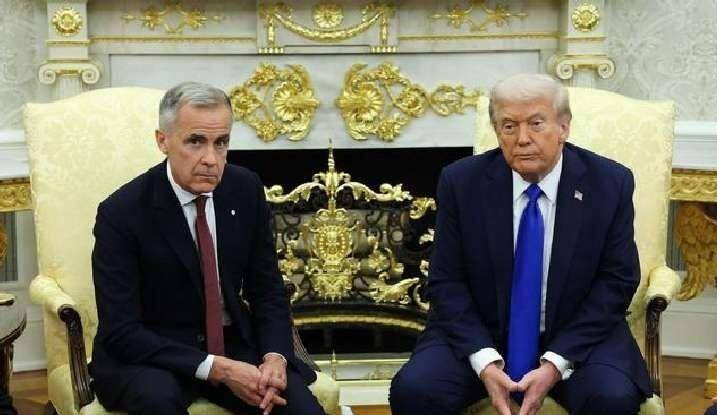
Core Points - The article discusses the sudden termination of trade negotiations between the U.S. and Canada by President Trump, triggered by a controversial advertisement from the Canadian government that criticized U.S. tariff policies [1][3] - The situation highlights the growing rift in U.S.-Canada relations and signals a potential restructuring of global trade dynamics [1][7] Group 1: U.S.-Canada Trade Relations - President Trump announced the immediate cessation of all trade negotiations with Canada due to what he termed "fraudulent" behavior related to an advertisement that misrepresented former President Reagan's views on tariffs [1][3] - The advertisement, released by the Ontario government, used a clip from Reagan's speech criticizing tariffs, which led to a backlash from the Reagan Foundation, claiming the ad distorted Reagan's original message [3][5] - The U.S. and Canada have a close trade relationship, with bilateral trade exceeding $900 billion in 2024, making Canada the second-largest trading partner of the U.S. [5] Group 2: Canadian Response and Strategic Shift - Canadian Prime Minister Carney indicated a strategic pivot towards China, seeking to double exports to non-U.S. markets over the next decade, which reflects a significant shift in trade policy [7][9] - The Canadian government is actively pursuing a strategic relationship with China, with plans for discussions during the upcoming APEC summit [7][9] - There is a growing trend among other countries, including Germany and the UK, to strengthen ties with China, indicating a broader shift in global trade alliances [7][9] Group 3: Economic Implications - The proposed digital services tax in Canada, aimed at large tech companies, has been a point of contention, with potential annual revenue estimated at $2 billion, but viewed by the U.S. as a targeted attack [5][10] - Following Trump's announcement, the Canadian dollar depreciated, and there were significant fluctuations in oil prices, raising concerns about the stability of the supply chain between the U.S. and Canada [5][10] - The article notes a division in Canadian public opinion regarding the government's pivot towards China, with some supporting the move while others criticize it as hasty [9][12]
金价5000美元是开始?达利欧一句话点破美元危机,散户血亏前必看
Sou Hu Cai Jing· 2025-10-25 16:33
Core Viewpoint - The current surge in gold prices is unprecedented, driven by a combination of geopolitical risks, changing interest rates, and a decline in the credibility of the US dollar [1][3][12]. Group 1: Market Dynamics - Gold prices have recently surpassed $4,200, marking a significant historical high, with both international and domestic markets experiencing a bullish trend [1]. - The ongoing geopolitical tensions, particularly in the Middle East, have led to increased demand for gold as a safe-haven asset [3][12]. - The global interest rate environment is shifting, with expectations of a nearing end to the Federal Reserve's rate hike cycle, enhancing gold's appeal as a non-yielding asset [3][12]. Group 2: Central Bank Actions - Central banks worldwide have been net buyers of gold for several years, setting historical records in gold purchases [4]. - Many countries are repatriating gold stored in foreign vaults, reflecting a growing distrust in the current international monetary system [4]. Group 3: Institutional Perspectives - Major investment banks are adjusting their gold price targets upward, indicating a consensus among institutions regarding the value of gold [6]. - Notable figures, such as Ray Dalio, emphasize gold as a fundamental alternative to debt, highlighting concerns over the sustainability of the global debt system [6][8]. Group 4: Debt Concerns - The global debt has reached three times the total GDP, raising alarms about the sustainability of this debt level and the trust in traditional currency systems [7]. - The US national debt has surpassed $37 trillion, leading to skepticism about the government's ability to meet its financial obligations [8]. Group 5: Market Risks - Despite the bullish outlook, there are risks in the gold market, including potential volatility and historical precedents of sharp price corrections [11]. - The use of leverage in modern gold trading can amplify both gains and risks, making the market susceptible to sudden reversals [11]. Group 6: Future Outlook - The peak of the current gold rally is uncertain and will depend on the persistence of key driving factors, including geopolitical tensions and interest rate movements [12][13]. - The ongoing "de-dollarization" process and adjustments in foreign exchange reserves by central banks suggest a long-term shift in the monetary landscape, with some institutions projecting gold prices could reach as high as $5,000 [15].
黄金价格大跳水,涨跌难测,抓紧机会赚大钱!
Sou Hu Cai Jing· 2025-10-24 05:04
Core Insights - The global financial market experienced significant volatility in October 2025, with gold prices briefly surpassing historical highs before dropping below the critical $4,200 mark, while silver prices also faced sharp declines [1] Market Performance - Year-to-date, gold prices have increased by over 60%, and silver prices have surged nearly 80%, leading to a wave of profit-taking and increased selling pressure [3] - The seasonal demand for physical gold in India has weakened, contributing to the decline in gold prices [3] Silver Market Dynamics - A notable short squeeze occurred in the silver market, with a temporary shortage of silver in London, forcing short sellers to seek alternative sources for delivery [4] - Following the initial price drop, buying interest returned, indicating a potential recovery in the silver market [4] Federal Reserve Influence - Expectations of interest rate cuts by the Federal Reserve are seen as a catalyst for gold and silver prices, with anticipated cuts in October and December [6] - Recent dovish comments from Fed Chair Jerome Powell suggest a shift in focus towards employment risks, hinting at future rate cuts [6] Geopolitical Factors - Ongoing geopolitical tensions and trade uncertainties have heightened market risk aversion, driving investors towards gold and silver as safe-haven assets [8] - Recent loan fraud cases involving U.S. regional banks have rekindled fears reminiscent of last year's banking crisis [8] Central Bank Actions - Central banks globally, particularly in China, India, and the Middle East, have been increasing their gold reserves, providing long-term support for gold prices [10] - Since November 2022, the People's Bank of China has added over 10 million ounces of gold to its reserves, indicating a strategic shift rather than short-term speculation [10] Structural Changes in Currency Reserves - The rise in gold prices reflects underlying cracks in the dollar credit system, with central banks significantly increasing gold holdings, reinforcing its status as a reserve asset [12] - As of Q2 2025, the dollar's share in global foreign exchange reserves fell to 56.32%, the lowest since 1995 [12] Investment Sentiment - A survey of 75 central banks managing $5 trillion in assets revealed that one-third plan to increase gold reserves in the next two years, the highest proportion in five years [15] - The current market dynamics suggest that gold is being redefined as a reserve asset independent of sovereign credit risk [15] Future Outlook - The potential for gold prices to continue rising or enter a period of volatility remains uncertain, influenced by Fed policies and global de-dollarization trends [17] - Major institutions have raised their gold price forecasts for 2026 to above $5,000, indicating a bullish long-term outlook [17] - The ongoing increase in gold reserves by various countries suggests that the current gold market dynamics may persist, with significant implications for future price stability [17]

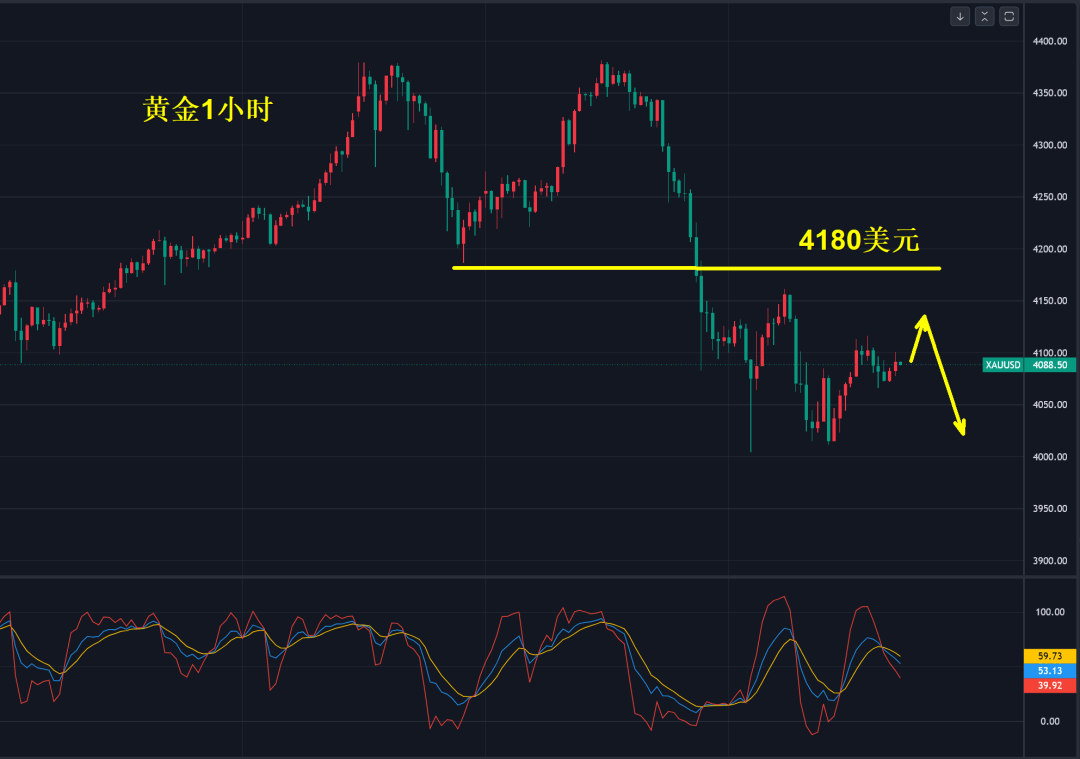
黄金,4180美元多空分界点!
Sou Hu Cai Jing· 2025-10-23 04:57
Core Insights - The unprecedented surge in gold and silver prices reflects deep-rooted skepticism towards fiat currency systems, with gold surpassing $4000 and silver increasing by over 70% [2][3] Group 1: Market Dynamics - The significant price increases in 2025 are driven by a combination of heightened demand for safe-haven assets and global monetary easing, with gold's price rising nearly 60% and silver over 70% [3][5] - The current market rally is primarily influenced by the reassessment of safe-haven assets amid turmoil in the global monetary system, rather than technical indicators [4] Group 2: Drivers of Gold and Silver Prices - The expectation of Federal Reserve interest rate cuts, escalating US-China trade tensions, and geopolitical risks have collectively contributed to gold's "safe-haven premium" [5] - The continuous net increase in global central bank gold reserves for 18 months has directly supported gold prices breaking the psychological barrier of $4000 [5] Group 3: Silver's Market Position - Silver's explosive growth, with over 70% of its price increase attributed to industrial demand, indicates a significant shift in market logic, positioning silver as a "flexible amplifier" in the current bull market [6] Group 4: Short-term Adjustments - The recent 5% drop in gold prices on November 21 has sparked market panic, but this adjustment is viewed as a profit-taking phase rather than a trend reversal [7] - Historical patterns suggest that a bull market peak is typically accompanied by signals such as the resumption of Fed rate hikes, formation of global deflation expectations, and a sharp decline in industrial demand, none of which are currently present [7] Group 5: Long-term Outlook - Gold's long-term value is evolving beyond its traditional safe-haven role, becoming a "currency anchor" and "strategic reserve asset" amid deepening cracks in the dollar credit system and accelerating de-dollarization [11] - A recommended investment strategy includes a "core + satellite" approach, with core positions in gold ETFs to hedge systemic risks and satellite positions in silver futures to capture industrial demand benefits [11]
黄金作为安全资产的需求持续提升,持续关注黄金基金ETF(518800)
Mei Ri Jing Ji Xin Wen· 2025-10-22 04:24
Core Viewpoint - The article highlights the significant rise in gold prices, driven by macroeconomic uncertainties due to the U.S. government shutdown and expectations of a Federal Reserve rate cut in October, with a 98.9% probability of a rate cut indicated by CME FedWatch [1] Group 1: Gold Market Dynamics - Spot gold prices surpassed $4,320, and gold ETF (518800) increased by 2.38% [1] - The ongoing U.S. government shutdown and political deadlock are eroding the dollar's status as a global reserve currency [1] - Central banks, particularly the People's Bank of China, continue to increase gold reserves, with a reported 7.406 million ounces as of the end of September, marking an increase of approximately 40,000 ounces month-over-month [1] Group 2: Investment Opportunities - Investors are encouraged to consider gold ETF (518800) for direct investment in physical gold, which has seen a significant increase in scale, growing over 5 billion yuan in the past week [2] - The gold stock ETF (517400) covers the entire gold industry chain, including mining, refining, and sales, and is expected to benefit from new consumption trends [2]
突发,金价巨震
Ge Long Hui· 2025-10-21 11:29
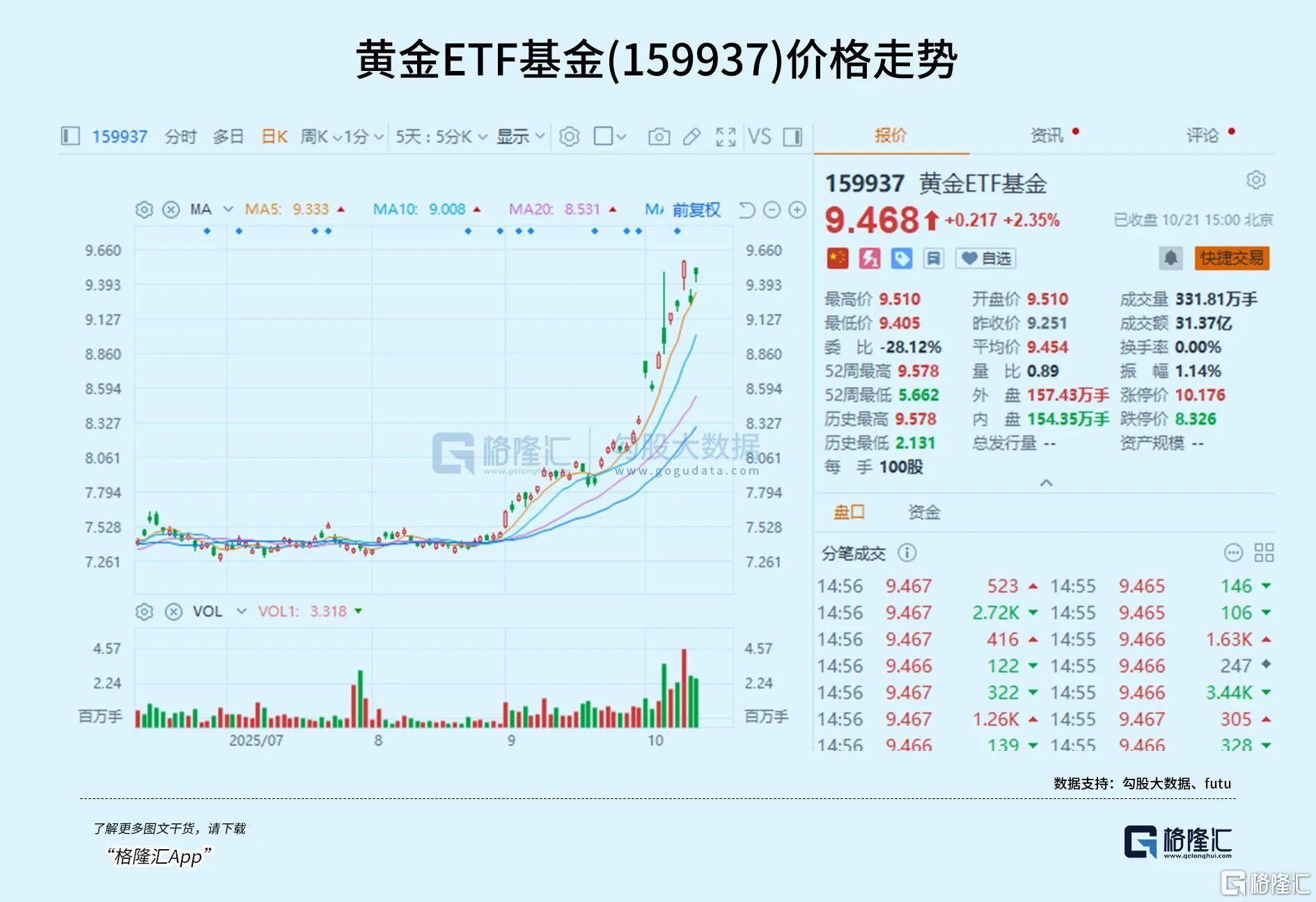
Core Viewpoint - Since 2025, international gold prices have experienced a remarkable surge, surpassing expectations set by major investment banks like Goldman Sachs, with prices nearing $4500 per ounce [1][4][6]. Price Movement - As of October 21, 2025, gold prices reached $4398 per ounce, marking a 3.82% increase [8]. - The gold ETF (159937) saw a 2.35% rise, with a year-to-date increase of over 59% [1][12]. - Despite recent volatility due to geopolitical tensions and economic factors, the stock market remains bullish on gold assets [4][16]. Market Dynamics - The total scale of gold-themed ETFs in mainland China reached 2361.31 billion yuan, a 223% increase from the beginning of the year [12]. - Nearly 20 gold stocks in the A-share market have doubled in value, with Zijin Mining's market cap increasing by 105.6% [14]. Institutional Investment - Global central banks have significantly increased their gold reserves, with a total value of approximately $4.5 trillion, surpassing U.S. Treasury holdings [21][23]. - The trend of central banks accumulating gold is expected to continue, with many aiming to increase gold's share in their reserves to 20%-30% over the next few years [23]. Future Outlook - International institutions have raised their gold price target for 2026 to $5000 per ounce, indicating further potential for price appreciation [25]. - The ongoing geopolitical conflicts and the trend of de-dollarization are expected to sustain the demand for gold as a safe-haven asset [20][24]. Investment Strategies - Ordinary investors are encouraged to consider gold ETFs as a viable investment option due to their liquidity, ease of trading, and lower risk of counterfeit compared to physical gold [26][27].

突发!金价巨震!
格隆汇APP· 2025-10-21 10:32
Core Viewpoint - Since 2025, international gold prices have experienced a remarkable surge, significantly outperforming traditional stock and bond assets, with a cumulative increase of 65.74% [8][22]. Group 1: Gold Price Trends - Major investment banks initially projected gold prices to reach $4,000 per ounce by year-end, but this target was surpassed effortlessly in the fourth quarter [3]. - As of October 21, international gold prices approached $4,500 per ounce, while domestic gold futures exceeded 1,000 yuan per gram, marking a historical high [4]. - The gold ETF (159937) saw a year-to-date increase of over 59%, outperforming many other popular sectors [4][31]. Group 2: Market Dynamics - Recent geopolitical events, including the Russia-Ukraine conflict and U.S. government shutdown, have caused significant fluctuations in gold prices, yet investor enthusiasm for gold assets remains high [7][20]. - Following a recent drop in gold prices, there is speculation that this may present a new buying opportunity for investors [8]. Group 3: Investment Flows - The total scale of gold-themed ETFs in mainland China reached 236.13 billion yuan, a 223% increase from the beginning of the year [16]. - The gold ETF (159937) has seen a net inflow of 13.25 billion yuan this year, ranking among the top in its category [16]. Group 4: Individual Stock Performance - Nearly 20 gold-related stocks in the A-share market have doubled in value this year, with Zijin Mining's market capitalization increasing by 105.6% to nearly 800 billion yuan [18]. Group 5: Central Bank Actions - Central banks globally have been increasing their gold reserves, with a significant shift observed since the onset of the Russia-Ukraine war, leading to a current valuation of approximately $4.5 trillion in gold reserves [25][27]. - The People's Bank of China has increased its gold reserves for the 11th consecutive month, indicating a strategic shift towards gold as a "risk-free asset" [27]. Group 6: Future Outlook - International institutions have raised their gold price targets for 2026 to $5,000 per ounce, suggesting further potential for price increases [29]. - The ongoing trend of de-dollarization and geopolitical tensions are expected to continue driving demand for gold as a safe-haven asset [24][25]. Group 7: Investment Strategies - For ordinary investors, gold ETFs are recommended as a more accessible and lower-risk investment option compared to physical gold or individual stocks [30][31].