扩内需政策

Search documents
制造业景气水平继续改善 市场活力趋于上升——透视9月PMI数据
Xin Hua Wang· 2025-09-30 08:08
Group 1: Manufacturing Sector - The manufacturing Purchasing Managers' Index (PMI) for September is 49.8%, an increase of 0.4 percentage points from the previous month, indicating continued improvement in manufacturing activity [1] - The production index rose to 51.9%, up 1.1 percentage points, reaching a six-month high, while the new orders index increased to 49.7%, up 0.2 percentage points [1] - Industries such as food and beverage, automotive, and aerospace equipment showed production and new order indices above 54.0%, indicating rapid demand release [1] Group 2: Market Demand and Supply - The procurement volume index increased to 51.6%, driven by the recovery in manufacturing production, as companies accelerated raw material purchases [1] - The new export orders index rose to 47.8%, up 0.6 percentage points, marking two consecutive months of increase, supported by stable performance in traditional export sectors [2] - The production-related indices indicate a steady increase in manufacturing activities since the second half of the year, with supply-side vitality continuing to rise [2] Group 3: Non-Manufacturing Sector - The non-manufacturing business activity index stands at 50.0%, a decrease of 0.3 percentage points, indicating overall stability in the sector [3] - The service sector business activity index is at 50.1%, remaining in the expansion zone, with sectors like postal and financial services showing strong growth [3] - The financial sector's business activity index has risen above 60% for two consecutive months, indicating robust performance and support for the real economy [3] Group 4: Future Expectations - The production and business activity expectation index for September is 54.1%, up 0.4 percentage points, reflecting positive market outlook among manufacturing enterprises [2] - The service sector business activity expectation index is at 56.3%, indicating stable optimism among service industry enterprises regarding future development [4] - Experts anticipate a demand surge in the restaurant and entertainment sectors due to the upcoming National Day and Mid-Autumn Festival holidays, which may boost industry performance [4]
张瑜:“生产性”魔咒的破除——张瑜旬度纪要No122
一瑜中的· 2025-09-23 07:44
Group 1 - The article discusses the current macroeconomic situation, focusing on a simplified model of the economy divided into four sectors: households, enterprises, government, and overseas [4] - The household sector is characterized by high precautionary savings, with savings as a percentage of nominal GDP rising from around 80% (2008-2018) to approximately 120% in recent years, indicating a liquidity accumulation issue [5] - The government sector faces challenges due to declining fiscal revenues, driven by falling PPI and increased local protectionism, which has led to a drop in tax revenues and a structural imbalance in land sales [9][10] Group 2 - The enterprise sector has seen production investment growth outpacing demand, with manufacturing investment growth averaging 8.3% from 2022 to 2024, while nominal GDP growth is around 4.7% [14] - There is a persistent trend of production credit growth exceeding terminal demand credit, with production credit increasing by nearly 5 trillion compared to 2019, while terminal demand credit has decreased by a similar amount [15] - The overseas sector shows signs of a mild recovery in global industrial production, with six out of eight leading indicators trending upwards, suggesting resilient external demand in the coming months [19] Group 3 - The article outlines two potential policy paths: the optimal path of "suppressing supply + boosting demand" and a reliance path that returns to "production investment" as a support for economic data [20][23] - The optimal path involves maintaining anti-involution measures, addressing local protectionism, and implementing policies to stimulate domestic demand, which could lead to a narrowing of PPI declines [23] - The company maintains a positive outlook on gold and suggests a strategy of "buying stocks like bonds," indicating a favorable macro environment for equities and a potential reversal in stock-bond dynamics [24]


读研报 | 从“杠铃策略”,到“反杠铃策略”
中泰证券资管· 2025-09-16 11:33
Core Viewpoint - The article discusses the shift from the "barbell strategy" to the "anti-barbell strategy" in the A-share market, highlighting a growing focus on assets outside of high-dividend and small-cap stocks [2][4]. Group 1: Barbell Strategy Overview - The barbell strategy is based on the concept of anti-fragility, where one end focuses on low-risk, low-return assets, while the other end targets high-risk, high-return assets, allowing for limited losses and potential for significant gains [2]. - In the A-share market, the barbell strategy has involved a combination of high-dividend assets and small-cap stocks, which have generated excess returns over the past few years [2]. Group 2: Anti-Barbell Strategy Explanation - The "anti-barbell strategy" suggests that, in the current market, assets beyond high-dividend and small-cap stocks are gaining attention, with a focus on middle assets represented by indices like the A500 [2]. - Factors contributing to this shift include historical extremes in yield differentiation between bank and small-cap stocks, regulatory constraints on small-cap stock funding, and a historical pattern of liquidity moving from undervalued to relatively valued assets [2]. Group 3: Market Dynamics and Future Outlook - Reports indicate that the barbell strategy is facing changes, with a potential migration towards a combination of large-cap value/dividend stocks and small-cap growth stocks [4]. - The success of policies aimed at stabilizing traditional economic sectors and the emergence of new demand drivers like overseas expansion and technological innovation may challenge the underlying logic of the barbell strategy [4]. - The anti-barbell configuration is expected to gain traction as inflation expectations rise, driven by improved corporate cash flows and the impact of supply-side constraints from anti-involution policies [4].

政策效果继续显现 主要数据指标总体平稳——透视8月我国经济运行态势
Xin Hua Wang· 2025-09-15 10:29
Core Viewpoint - The overall economic operation in China remains stable with signs of progress, as indicated by key economic indicators for August and the first eight months of the year [2][3][6]. Economic Performance - In August, the industrial added value for large-scale enterprises grew by 5.2% year-on-year, maintaining a rapid growth rate [2]. - The service sector's production index increased by 5.6% year-on-year, driven by increased travel during the summer [2]. - The total retail sales of consumer goods rose by 3.4% year-on-year, reflecting the release of service consumption potential [2]. Trade and Employment - In August, the total value of goods imports and exports increased by 3.5% year-on-year, with both exports and imports achieving growth for three consecutive months [3]. - The unemployment rate in urban areas was 5.3%, slightly up from the previous month but unchanged from the same period last year [3]. Policy Impact - Policies aimed at boosting consumption and investment are showing positive effects, with significant growth in retail sales of home appliances and furniture [4]. - Investment in equipment and tools rose by 14.4% year-on-year, contributing to a 2.1 percentage point increase in fixed asset investment [4]. Innovation and New Growth Drivers - The manufacturing sectors for integrated circuits and electronic materials saw an increase in added value exceeding 20% in August, indicating a strengthening of new growth drivers [5]. - The stock market showed increased activity in August, which is beneficial for market expectations and development vitality [5]. Future Outlook - The economic operation is expected to maintain a stable and progressive trend in the third quarter, supported by ongoing macroeconomic policies [6]. - Upcoming consumer policies and holiday seasons are anticipated to further enhance consumer capacity and willingness [6]. Private Investment - Private fixed asset investment decreased by 2.3% year-on-year in the first eight months, but future growth is expected due to supportive measures for private enterprises [7]. - The government is working to improve the investment environment for private sectors, which is likely to stimulate private investment stability [7].
国家统计局:前8个月设备工器具购置投资同比增长14.4%,拉动固定资产投资增长2.1个百分点
Zheng Quan Shi Bao Wang· 2025-09-15 02:33
Core Insights - The expansion of domestic demand policies has shown significant effects in August, with retail sales in categories such as household appliances, furniture, and cultural office supplies continuing to grow at double-digit rates [1] Group 1: Economic Indicators - Retail sales in household appliances and audio-visual equipment, furniture, and cultural office supplies maintained double-digit growth in August [1] - Investment in equipment and tools saw a year-on-year increase of 14.4% in the first eight months, contributing to a 2.1 percentage point increase in fixed asset investment [1]
核心CPI涨幅连续第4个月扩大,专家认为扩内需政策持续显效
Jing Ji Ri Bao· 2025-09-11 01:37
Group 1 - The consumer market in August showed overall stability, with the Consumer Price Index (CPI) remaining flat month-on-month and decreasing by 0.4% year-on-year, while the core CPI, excluding food and energy, increased by 0.9% year-on-year, marking the fourth consecutive month of growth [1] - The Producer Price Index (PPI) month-on-month ended an eight-month decline, stabilizing after a 0.2% drop in the previous month, with a year-on-year decrease of 2.9%, which is a narrowing of 0.7 percentage points from the previous month [2][3] - The improvement in supply-demand relationships in certain industries has contributed to the stabilization of PPI, with energy and raw material prices showing signs of recovery [2][3] Group 2 - The "old-for-new" consumption policy has been expanded, providing significant support for prices of covered goods, with transportation tool prices stabilizing month-on-month and the year-on-year decline narrowing from 2.1% to 1.9% [2] - Service prices have shown a continuous upward trend since March, with a year-on-year increase of 0.6% in August, indicating the release of service consumption potential [2] - The overall low price level since the beginning of the year is expected to continue, providing ample space for future growth-stabilizing policies [3][4]
核心CPI涨幅连续第4个月扩大,专家认为——扩内需政策持续显效
Sou Hu Cai Jing· 2025-09-10 22:30
Group 1 - The overall consumer market in August remained stable, with the Consumer Price Index (CPI) unchanged month-on-month and down 0.4% year-on-year, while the core CPI, excluding food and energy, rose by 0.9% year-on-year, marking the fourth consecutive month of increase [2] - The Producer Price Index (PPI) month-on-month ended an eight-month decline, stabilizing after a 0.2% drop in the previous month, while the year-on-year decline was 2.9%, narrowing by 0.7 percentage points compared to the previous month [3][4] - The improvement in supply-demand relationships in certain industries has positively influenced prices, with some energy and raw material sectors experiencing price increases month-on-month [3][4] Group 2 - The "old-for-new" consumption policy has been strengthened, providing significant support for prices of covered goods, with transportation tool prices stabilizing month-on-month and the year-on-year decline narrowing from 2.1% to 1.9% [3] - Service prices have shown a continuous upward trend since March, with household services, medical services, and educational services leading the increase, indicating the ongoing release of service consumption potential [3] - The overall low price level since the beginning of the year is expected to continue, providing ample space for future growth stabilization policies [5]

瑞达期货股指期货全景日报-20250910
Rui Da Qi Huo· 2025-09-10 08:59
Report Industry Investment Rating - Not provided Core View of the Report - A-share major indices closed generally higher, with small and mid-cap stocks outperforming large-cap blue-chip stocks. The market is in a performance and policy vacuum period, entering the macro data verification stage. The drag from trade data may be limited, and the Fed's rate cut will provide room for domestic policy easing. Therefore, stock indices still have long-term upward potential but are expected to remain volatile before policy implementation. It is recommended to wait and see in the short term [2] Summary by Relevant Catalogs Futures Disk - IF main contract (2509) was at 4432.4, up 11.6; IF next main contract (2512) was at 4400.6, up 7.4. IH main contract (2509) was at 2937.8, up 15.8; IH next main contract (2512) was at 2936.8, up 15.0. IC main contract (2509) was at 6863.4, down 3.4; IC next main contract (2512) was at 6682.8, down 9.2. IM main contract (2509) was at 7151.0, down 2.4; IM next main contract (2512) was at 6938.2, down 10.6 [2] - IF-IH current month contract spread was 1494.6, down 6.2; IC-IF current month contract spread was 2431.0, down 15.6. IM-IC current month contract spread was 287.6, down 5.4; IC-IH current month contract spread was 3925.6, down 21.8. IM-IF current month contract spread was 2718.6, down 21.0; IM-IH current month contract spread was 4213.2, down 27.2 [2] - IF current quarter - current month was -31.8, down 5.2; IF next quarter - current month was -54.2, down 7.2. IH current quarter - current month was -1.0, down 0.4; IH next quarter - current month was 2, up 0.8. IC current quarter - current month was -180.6, down 4.2; IC next quarter - current month was -332.2, down 9.4. IM current quarter - current month was -212.8, down 3.4; IM next quarter - current month was -401, down 12.0 [2] Futures Position - IF top 20 net position was -29,172.00, down 1344.0; IC top 20 net position was -18,960.00, up 716.0. IH top 20 net position was -13,395.00, down 497.0; IM top 20 net position was -47,080.00, down 2382.0 [2] Spot Price - The Shanghai and Shenzhen 300 was at 4445.36, up 9.1; IF main contract basis was -13.0, down 2.9. The Shanghai Stock Exchange 50 was at 2939.59, up 11.0; IH main contract basis was -1.8, up 1.4. The China Securities 500 was at 6932.11, up 3.1; IC main contract basis was -68.7, down 12.5. The China Securities 1000 was at 7230.17, up 4.1; IM main contract basis was -79.2, down 18.9 [2] Market Sentiment - A-share trading volume (daily, billion yuan) was 20,039.52, down 1481.28; margin trading balance (previous trading day, billion yuan) was 23,197.18, up 61.56. Northbound trading volume (previous trading day, billion yuan) was 2817.52, down 472.92; reverse repurchase (maturity volume, operation volume, billion yuan) was -2291.0, up 3040.0 [2] - Main funds (yesterday, today, billion yuan) was -808.17, down 105.08. The proportion of rising stocks (daily, %) was 44.98, up 21.05; Shibor (daily, %) was 1.425, up 0.006 [2] - IO at-the-money call option closing price (2509) was 33.40, down 7.60; IO at-the-money call option implied volatility (%) was 13.40, down 2.67. IO at-the-money put option closing price (2509) was 48.00, down 15.80; IO at-the-money put option implied volatility (%) was 13.40, down 2.67 [2] - Shanghai and Shenzhen 300 index 20-day volatility (%) was 18.46, down 0.07; trading volume PCR (%) was 60.67, up 1.86. Position PCR (%) was 81.25, up 1.38 [2] Wind Market Strength and Weakness Analysis - All A-shares were at 5.30, up 2.10; technical aspect was at 4.50, up 2.10. Capital aspect was at 6.20, up 2.10 [2] Industry News - In August, China's CPI was flat month-on-month and slightly down year-on-year, with core CPI continuing to rebound; PPI turned from decline to flat month-on-month, and the year-on-year decline continued to narrow. The overall price level is steadily recovering, reflecting the effectiveness of policies such as "anti-involution" and expanding domestic demand [2] - As of March 2025, the US non-farm payrolls were revised down by 911,000, the largest downward revision since 2000. Coupled with the significantly lower-than-expected non-farm data in August, the market has fully priced in the Fed's rate cut in September, and the external environment constraints faced by A-shares are loosening [2] Key Points to Focus On - To be determined: China's August financial data; 9/10 20:30: US August PPI and core PPI; 9/11 20:15: ECB interest rate decision; 9/11 20:30: US August CPI and core CPI [3]

8月份PMI三大指数均有所回升 我国经济景气水平继续保持扩张
Jing Ji Ri Bao· 2025-09-01 01:34
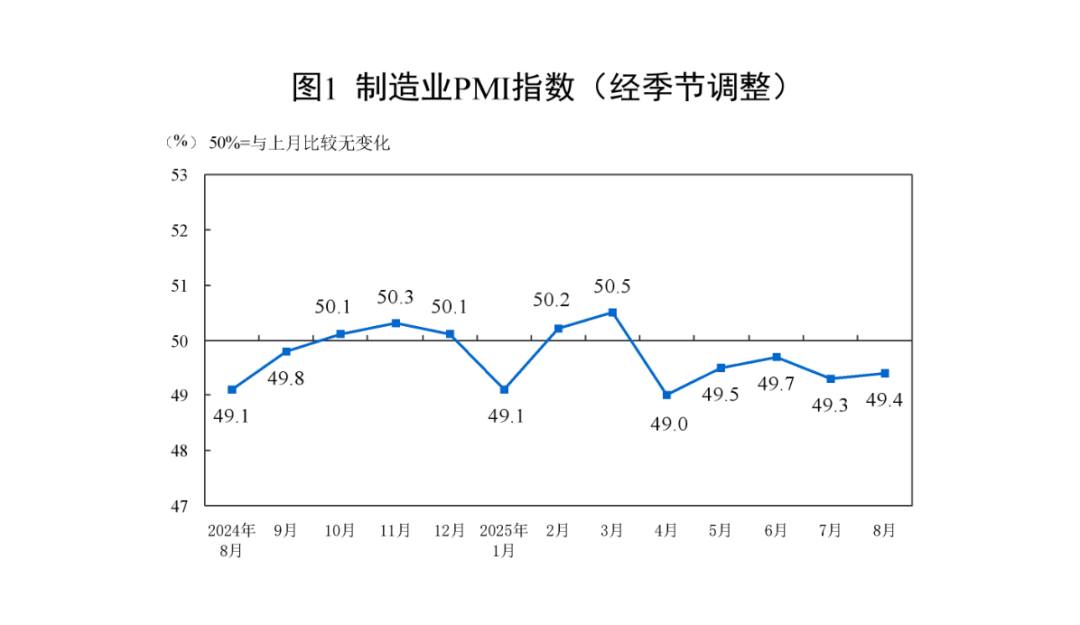
Group 1: Manufacturing Sector - In August, the Manufacturing Purchasing Managers' Index (PMI) was reported at 49.4%, indicating a slight increase of 0.1 percentage points from the previous month, but still below the expansion threshold [1] - The New Orders Index for manufacturing was at 49.5%, up by 0.1 percentage points, suggesting a stabilization in market demand [1] - The Production Index rose to 50.8%, an increase of 0.3 percentage points, marking the fourth consecutive month above the critical point [1] Group 2: Non-Manufacturing Sector - The Non-Manufacturing Business Activity Index stood at 50.3%, reflecting a 0.2 percentage point increase, indicating continued expansion in the non-manufacturing sector [2] - The Business Activity Expectation Index for non-manufacturing reached over 56%, showing improved business sentiment and stability in supply and demand [2] - The Service Sector Business Activity Index increased to 50.5%, the highest point of the year, with several industries, including capital market services, showing strong growth [2] Group 3: Economic Outlook - Experts suggest that the slight recovery in the manufacturing PMI indicates the initial effects of policies aimed at expanding domestic demand and reducing competition [3] - There is a call for increased macroeconomic policy adjustments to stimulate market orders and enhance production investment, employment, and consumption [3] - The expectation for September and the fourth quarter is that policy-driven growth will continue, with a focus on stabilizing demand and fostering effective demand increments [3]
最新发布:连续回升
Shang Hai Zheng Quan Bao· 2025-08-31 03:42
Group 1: Economic Indicators - The PMI index has slightly rebounded, indicating that policies aimed at expanding domestic demand and addressing "involution" competition are showing initial effects, with new growth momentum accelerating and the economic foundation continuing to strengthen [2] - In August, the production index for manufacturing was 50.8%, up 0.3 percentage points from July, marking four consecutive months above the critical point, indicating accelerated production expansion [4] - The new orders index was 49.5% and the new export orders index was 47.2%, both up 0.1 percentage points from July, suggesting a stabilization in market demand [4] Group 2: Manufacturing Sector Performance - Large enterprises' PMI was 50.8%, indicating an acceleration in expansion, while small and medium-sized enterprises remained below the critical point, with PMIs of 48.9% and 46.6% respectively [4] - High-tech manufacturing and equipment manufacturing PMIs were 51.9% and 50.5%, respectively, both showing increases from July, indicating sustained support and leading roles in the sector [4] Group 3: Price Levels in Manufacturing - The manufacturing raw material purchase price index was 53.3%, up 1.8 percentage points from July, marking three consecutive months of significant increases and remaining in the expansion zone [5] - The factory price index was 49.1%, up 0.8 percentage points from July, also showing three months of increases and reaching the highest point of the year [5][6] Group 4: Non-Manufacturing Sector Insights - The non-manufacturing business activity index was 50.3%, indicating continued expansion, with the services sector index rising to 50.5%, the highest point of the year [9] - The restaurant industry business activity index rose above 50%, with new orders showing a significant increase, both indices rising over 4 percentage points from July [11] Group 5: Future Outlook - Experts suggest that policies to expand domestic demand need to be strengthened to stabilize and recover market demand, with a call for increased macroeconomic policy adjustments and public investment [14] - The financial services sector continues to expand, with banking and capital market services performing well, providing strong support for the real economy and improving the financing environment for enterprises [13]