
智能网联汽车

Search documents
冰面上的“热引擎”新能源汽车高寒测试持续升温
Yang Shi Wang· 2026-01-16 00:27
Core Viewpoint - The article highlights the increasing importance of cold weather testing for electric vehicles in China, particularly in Inner Mongolia, as the country aims to enhance the quality and sustainability of its new energy vehicle industry. Group 1: Industry Development - The "15th Five-Year Plan" will introduce a development plan for the intelligent connected new energy vehicle industry to promote high-quality and sustainable growth [1] - The cold weather testing has become a crucial step before new vehicle launches, with the testing area in Inner Mongolia expanding to 1.7 million square meters this winter [1][2] - The number of vehicles tested in Inner Mongolia has exceeded 1,000, with over 90% being new energy vehicles [2] Group 2: Testing Innovations - New testing projects have been introduced to focus on full-scene and refined performance verification for electric vehicles in icy conditions [3] - The testing includes advanced features such as automatic emergency braking systems and intelligent chassis anti-skid systems to ensure safety [3][4] - Battery performance has improved significantly, with new batteries able to charge efficiently at -20°C, achieving over 96% charging efficiency [4] Group 3: Economic Impact - The cold weather testing industry in Inner Mongolia has seen a market share increase from less than 10% to over 40% in the past five years, with stable annual revenue growth of 20% [6] - The local economy has benefited from the testing industry, with increased demand for hotels and restaurants, and new tourism experiences related to ice and snow driving [6][8] - The region has served over 1,500 automotive companies and tested more than 40,000 vehicles, generating over 1.5 billion yuan in income and creating over 12,000 jobs [8]
工信部定调高级别自动驾驶 L3级产业化按下“快进键”
2 1 Shi Ji Jing Ji Bao Dao· 2026-01-15 22:43
Core Insights - The issuance of the first L3-level autonomous driving special license plates in China marks a significant milestone in the application of L3 autonomous driving technology [1][3] - The Chinese government is accelerating breakthroughs in advanced autonomous driving technologies as part of its national industrial strategy [1][3] Industry Developments - As of the first half of 2025, the installation rate of L2-level and above assisted driving functions in new energy passenger vehicles reached 82.6% [2] - The transition from L2 to L3/L4 autonomous driving is moving from technical demonstration to commercial pilot projects [3] - The Ministry of Industry and Information Technology (MIIT) has granted conditional licenses for L3 autonomous driving vehicles, indicating a shift towards limited commercial applications [3][4] Regulatory Framework - The issuance of L3 license plates in Chongqing and Beijing represents a historic step in regulatory advancement, although full-scale adoption is still a long way off [4] - There is a need for formal standards and regulations to address the challenges of high-level autonomous driving, including liability and safety concerns [4][5] - Recommendations for a management roadmap for autonomous driving levels and the revision of traffic safety laws have been proposed to support the industry [5] Market Projections - By 2030, the integration of advanced driving assistance and connected features is expected to create a trillion-yuan market increment, with urban NOA becoming a mainstream function [6] - The Shanghai action plan aims to establish a comprehensive testing area for autonomous vehicles by 2027, enhancing the region's competitive edge in the industry [7][8] Commercialization Challenges - The commercial viability of L3 autonomous driving remains limited, with significant hurdles in regulatory and technical aspects [9] - Companies like Mercedes-Benz are delaying the rollout of L3 systems due to cost and regulatory constraints, focusing instead on L2++ systems [9] - The Robotaxi sector is seen as the most promising area for early commercialization of autonomous driving technology [9][10] Company Initiatives - Baidu reported a significant increase in its fully autonomous driving service, with orders reaching 3.1 million in Q3 2025, reflecting a 212% year-on-year growth [10] - WeRide has entered the global commercial operation phase with its L4 Robotaxi, covering multiple international cities and approaching profitability in certain markets [10]
重夺“汽车第一城” 西部大佬杀回来了
Mei Ri Jing Ji Xin Wen· 2026-01-15 15:14
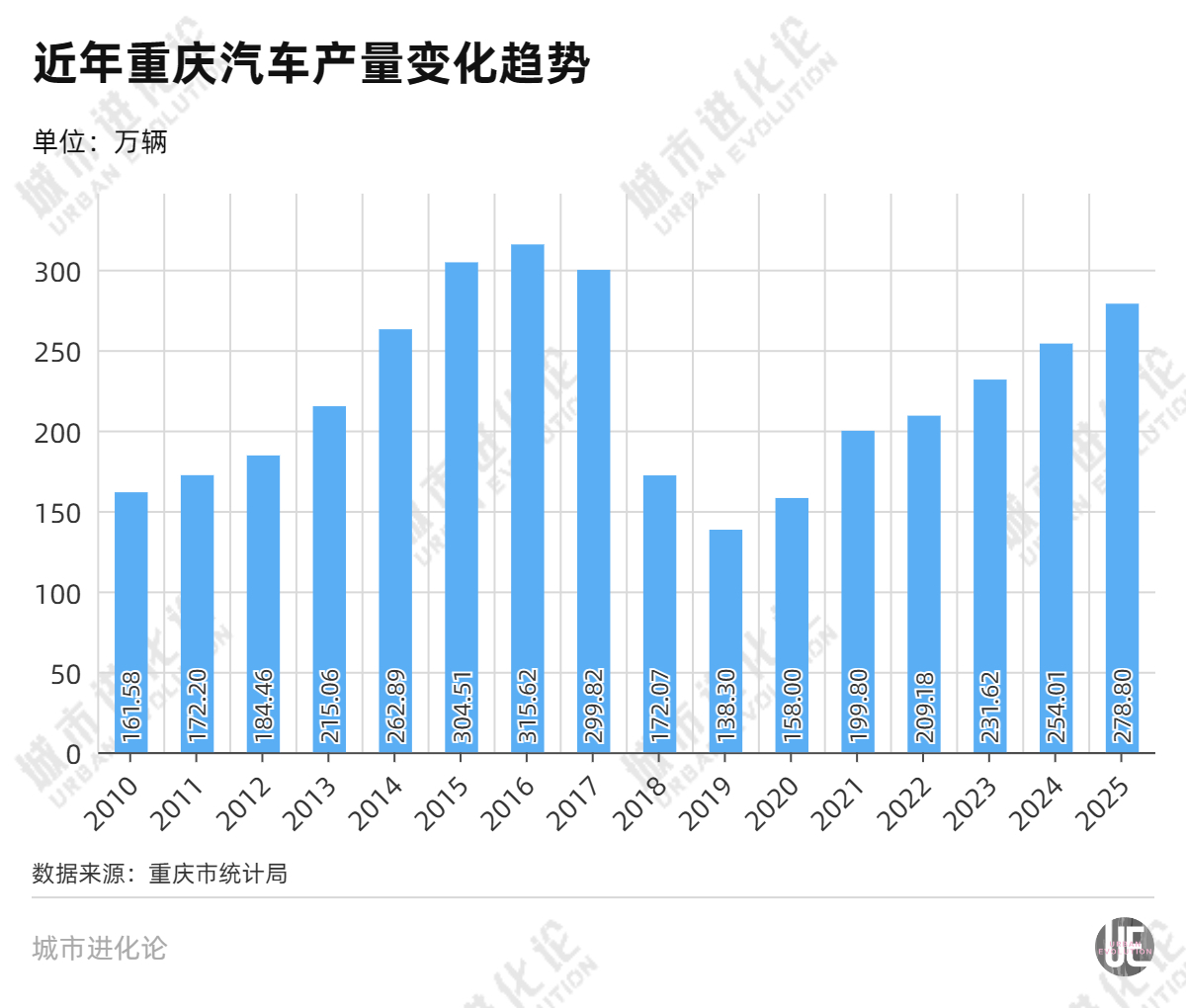
Core Insights - The competition for the title of "Automobile Capital" in China is intensifying, with Chongqing projected to produce 2.788 million vehicles in 2025, marking a 9.7% increase and solidifying its position as the top city in vehicle production [1] - Chongqing's automotive industry is experiencing a resurgence after a decade, particularly in the production of new energy vehicles (NEVs), which are expected to reach 1.296 million units, a 36% increase [1] - The issuance of China's first L3-level autonomous driving license to Changan Automobile signifies a historic milestone for smart driving in China, positioning Chongqing as a leader in this domain [1] Industry Overview - Chongqing aimed to become "China's Detroit" in 2013, achieving the highest vehicle production in the country by 2014, with production peaking at 3.156 million units in 2016 [4] - However, from 2017, Chongqing's vehicle production began to decline, dropping to 1.383 million units by 2019, attributed to a shift in consumer preferences towards mid-to-high-end vehicles and insufficient production capacity [5] - The rise of NEVs has disrupted the traditional automotive landscape, with national NEV sales surpassing 1 million units within three years after first exceeding 100,000 units in 2015 [6] Company Developments - Changan Automobile launched the "Shangri-La" plan in 2017, aiming for full electrification by 2025, but initially faced challenges as NEV production in Chongqing grew slowly from 40,400 units to 51,100 units by 2020 [7] - A turning point occurred in 2021 when Changan partnered with Huawei and CATL to introduce new high-end NEV brands, leading to a significant increase in sales, with total vehicle sales reaching 2.913 million units and NEV sales at 1.11 million units, a 51.1% increase year-on-year [7] - Seres, another key player, transitioned from traditional automotive manufacturing to NEVs, achieving profitability in 2024 and selling 472,300 NEVs in the previous year, a 10.63% increase [7] Competitive Landscape - The collaboration with Huawei has been pivotal for Chongqing's NEV transformation, with Seres being the first to adopt Huawei's smart selection model [8] - The automotive industry is entering a new competitive phase characterized by smart electric vehicles, with Chongqing positioned to lead due to its early adoption of L3-level autonomous driving technologies [12] - The competition is heating up, with cities like Guangzhou and Shenzhen also vying for leadership in the NEV sector, each setting ambitious goals for future growth [17] Challenges and Future Outlook - Despite its recent successes, Chongqing faces challenges in AI and core technology competitiveness, ranking 14th nationally in AI industry competitiveness, indicating a need for improvement in talent attraction and retention [20] - The city aims to address these shortcomings by enhancing its automotive industry through innovation and integration with advanced technologies, targeting high-quality development by 2024 [14][21]



重夺“汽车第一城”,西部大佬杀回来了
Mei Ri Jing Ji Xin Wen· 2026-01-15 15:12
Group 1 - The core viewpoint of the article highlights the intense competition among cities for the title of "Automobile Capital," with Chongqing regaining its position as the leader in automobile production after a decade of decline [1][2][3] - Chongqing's automobile production is projected to reach 2.788 million units in 2025, marking a 9.7% increase, with new energy vehicles (NEVs) expected to account for 1.296 million units, a growth of 36% [1][2] - The issuance of the first L3-level autonomous driving license in China to Changan Automobile signifies a historic milestone for smart driving in the country, positioning Chongqing as a frontrunner in this field [2][11] Group 2 - The article discusses the historical context of Chongqing's automotive industry, noting its peak production of 3.156 million units in 2016, followed by a significant decline starting in 2017, where production fell to 1.383 million units by 2019 [5][6] - The resurgence of Chongqing's automotive sector is attributed to its focus on new energy vehicles, with Changan and Seres leading the charge through strategic partnerships, including collaborations with Huawei [7][10] - The competitive landscape is evolving, with predictions that the penetration rate of L3 and above autonomous vehicles will exceed 10% by 2030, indicating a shift towards smart electric vehicles as a new competitive arena [13][21] Group 3 - Chongqing aims to become a "smart connected new energy vehicle capital" by 2024, leveraging its unique geographical features as a testing ground for intelligent vehicles [14][17] - The article notes that while Chongqing is making strides, it faces challenges in AI competitiveness, ranking 14th nationally in AI industry strength, which could hinder its automotive ambitions [19][20] - The need for Chongqing to address its weaknesses in core technologies and talent retention is emphasized, as it seeks to maintain its leading position in the next round of industry competition [21]
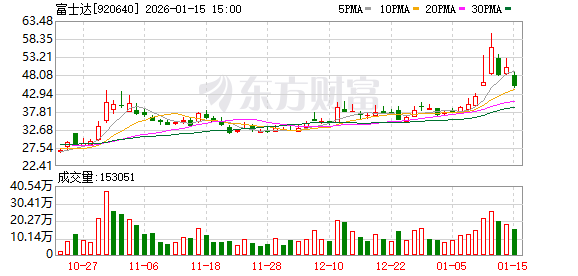
富士达:公司现有主要产品包括射频同轴连接器、射频电缆组件、射频电缆、先进陶瓷及射频链路等
Zheng Quan Ri Bao· 2026-01-15 13:39
Core Viewpoint - The company is shifting its strategic focus towards providing complete RF interconnection solutions in response to the increasing demand for system-level integration in emerging fields such as commercial aerospace, intelligent connected vehicles, computing power, and quantum computing [2] Group 1: Product Offerings - The company's main products include RF coaxial connectors, RF cable assemblies, RF cables, advanced ceramics, and RF links [2] - The company has completed technical reserves for related products such as special antennas and active/passive microwave devices [2] Group 2: Market Trends - There is a growing trend among customers to prefer suppliers that can offer comprehensive solutions rather than single components due to the complexity of RF connection needs [2] - The strategic shift towards RF links is aimed at enhancing the company's competitive edge and aligning with industry technological developments and market demands [2] Group 3: Strategic Direction - The company aims to elevate its position in the value chain by transitioning from a component supplier to a provider of system-level RF interconnection solutions [2]
华南市场再提速!浙江华远受益广州新政
Quan Jing Wang· 2026-01-15 11:22
Group 1 - The Guangzhou government has released a plan to accelerate the construction of a strong advanced manufacturing city, emphasizing the strategy of "industry first, manufacturing city," with a focus on building a world-class automotive industry cluster [1] - By 2035, the plan aims to double the industrial added value and prioritize the development of strategic industry clusters such as intelligent connected vehicles [1] - The supporting measures for the automotive and core component industries include up to 100 million yuan in funding for joint R&D of core components, promoting the localization strategy of suppliers [1] Group 2 - Zhejiang Huayuan has proactively established a national layout, setting up a dedicated service area in Guangzhou and integrating into the national automotive fastener supply and sales service system [1] - The company’s products, including special fasteners and seat locks, are widely used in GAC Group's AION series and mainstream models, providing stable order support as GAC Group aims for annual sales of 1.7215 million vehicles by 2025 [1] - The company has accumulated 158 patents, including 13 invention patents, and has developed a composite process that significantly improves precision and efficiency in the production of special fasteners [2] Group 3 - The automotive parts market in China is projected to exceed 5.2 trillion yuan by 2029, with the domestic output value of automotive parts expected to reach 8.2 trillion yuan by 2025, growing at 8.5% [2] - The company’s seat lock product shipments exceeded 6.5 million units in the first half of 2025, marking a 23% year-on-year increase [2] - The company reported revenue of 541 million yuan and a net profit of 78.95 million yuan in the first three quarters of 2025, maintaining a high sales gross margin of 28.31% [3]
上海公布重磅文件:量产L4级汽车,拓展自动驾驶开放区域
Di Yi Cai Jing· 2026-01-15 09:24
Core Viewpoint - Shanghai aims to accelerate the construction of a leading area for high-level autonomous driving by fostering industry-leading autonomous driving models and implementing the "Mosu Zhixing" action plan by 2027 [2][3] Group 1: Action Plan Overview - The action plan outlines the goal of achieving large-scale implementation of high-level autonomous driving applications by 2027, forming a competitive smart connected vehicle industry cluster [2] - The plan includes the exploration of innovative business models for L4-level autonomous driving technology in scenarios such as smart buses, taxis, and heavy trucks, with an open area of 2000 square kilometers and over 5000 kilometers of roads designated for autonomous driving [2][3] - The production ratio of new vehicles with combination driving assistance (L2) and conditional autonomous driving (L3) features is expected to exceed 90%, with L4 autonomous vehicles achieving mass production [2] Group 2: Infrastructure and Testing - Shanghai has opened 3173 testing roads with a total length of 5238.82 kilometers, covering about one-third of the city's area, with full-area openness in the Pudong New Area [3] - The city plans to gradually expand the autonomous driving open areas, focusing on key locations such as the Hongqiao hub, Pudong Airport, and Disneyland [2][3] Group 3: Data and Technology Development - The autonomous driving industry is currently in a "data-driven" phase, facing challenges such as high costs and difficulties in obtaining training data, insufficient scene distribution, and inadequate model testing [4] - Shanghai is promoting data sharing applications to support the training and iteration of benchmark intelligent driving models, including the deployment of data collection vehicles and the establishment of a secure data sharing mechanism [4] - A digital twin training ground for autonomous driving will be built, utilizing both real data collection and virtual generation to accumulate high-quality training datasets [4]
百度萝卜快跑已低调落地全国约20城
Ge Long Hui A P P· 2026-01-15 07:04
格隆汇1月15日|据蓝鲸新闻,目前,百度旗下萝卜快跑全国运营区域已低调落地约20城,仅广东省内 就已落地包括广州、佛山、东莞、深圳、江门市。在广东省投资项目在线审批监管平台上查询发现,去 年11月下旬以来,萝卜快跑通过多个备案项目,包括位于江门市、东莞市的智能网联汽车道路测试与示 范应用项目,项目总投资分别为5000万元、7000万元。其中,在江门,其计划投放不少于90台智能网联 汽车,开展智能网联汽车测试示范工作;在东莞,其计划采购1000台自动驾驶车辆在此投放,建立萝卜 快跑自动驾驶基地,包括智能网联监控指挥中心、大湾区"云车"中心等。此外,萝卜快跑华南运营总部 项目也已通过备案,项目所在地位于佛山市顺德,总投资预计1800万元。据悉,该项目计划建成依托智 能算法与车路协同技术的无人驾驶网约车示范项目总部,并规划了研学、展厅、5G云仓、办公区、运 维车间等。 ...

上海发布“模速智行”行动计划 有序扩大自动驾驶开放区域
Zheng Quan Shi Bao· 2026-01-14 17:33
Group 1 - The "Mosu Zhixing" action plan aims to accelerate the transformation of autonomous driving technology innovation into industrial competitiveness by 2027, establishing a leading area for high-level autonomous driving in Shanghai [1] - The plan targets the large-scale application of L4 autonomous driving technology in smart public transport, taxis, and heavy trucks, with expectations to serve over 6 million passengers and transport over 800,000 standard containers [1] - A public service platform will be established, including a digital twin training ground for autonomous driving, with an open area of 2,000 square kilometers and over 5,000 kilometers of road length for diverse scenarios [1] Group 2 - The plan emphasizes the production of new vehicles with over 90% featuring L2 and L3 autonomous driving capabilities, while L4 vehicles will achieve mass production [2] - It aims to create innovative applications for L3 autonomous vehicles in urban inspection, logistics, and municipal sanitation, focusing on high-tech, clear operational models, and effective demonstration applications [2] - Key technology development will include research on high-performance onboard chips, operating systems, and smart computing platforms, fostering collaboration between universities, research institutions, and key enterprises [2] Group 3 - The plan highlights the development of intelligent connected vehicle and key component industrial bases in regions like Pudong, Jiading, and Lingang, leveraging local industry strengths and talent [3] - It supports the establishment of testing and verification platforms for intelligent connected vehicles and traffic safety, promoting the application of virtual simulation and hardware-in-the-loop technologies [3]
自动驾驶 利好来了!上海发布行动计划
Zheng Quan Shi Bao· 2026-01-14 15:39
Core Insights - Shanghai has set ambitious goals for the development of high-level autonomous driving, aiming for large-scale application by 2027, with a focus on innovation, industry competitiveness, and international leadership in smart connected vehicles [1][4]. Group 1: Action Plan Overview - The "Mosu Zhixing" Action Plan outlines a framework for advancing autonomous driving technology, emphasizing model-driven leadership, application demonstration, industrial collaboration, and supportive policies [1]. - By 2027, the plan targets over 6 million passenger trips and 800,000 TEUs in freight transport using L4 autonomous driving technology, with a testing area of 2,000 square kilometers and road length exceeding 5,000 kilometers [1]. Group 2: Expansion of Testing Areas - The plan includes the gradual expansion of autonomous driving testing areas, with a focus on the full opening of the Pudong New Area and other key regions [2]. - As of December last year, Shanghai has opened testing roads covering approximately one-third of the city, with a total of 3,173 roads and 5,238.82 kilometers of testing mileage planned by the end of 2025 [2]. Group 3: Application Scenarios - The plan encourages organized smart taxi demonstration operations and pilot projects for L3 autonomous passenger vehicles, as well as the transition of intelligent heavy trucks at Yangshan Port to fully unmanned operations [3]. - It aims to create innovative application scenarios for autonomous vehicles in urban inspection, logistics, and municipal sanitation, exploring standards for unmanned delivery vehicles and autonomous parking [3]. Group 4: Automotive Industry Development - The plan aims to establish a world-class automotive industry cluster, focusing on regions like Pudong, Jiading, and Lingang, and promoting the development of smart connected vehicles and key components [4]. - It encourages the establishment of competitive automotive software and chip industries, and the development of high-performance hardware and software solutions [4]. Group 5: Data and Financial Support - The plan emphasizes the creation of a comprehensive data monitoring platform for autonomous vehicles, ensuring real-time monitoring and standardized data collection [5]. - It encourages social capital investment in smart connected vehicle startups and supports quality enterprises in accessing diverse financing channels [5]. Group 6: Industry Outlook - Analysts predict that L4 autonomous driving technology will achieve breakthroughs and accelerate commercialization within the next 2-3 years, with the Robotaxi business model expected to become viable [6].