
积极财政政策

Search documents
财政部:2025年财政政策有力支撑宏观经济发展
Yang Shi Wang· 2026-01-20 20:58
Core Viewpoint - The press conference held by the State Council Information Office on January 20 highlighted the role of proactive fiscal policies in promoting high-quality economic and social development [1] Group 1 - The Ministry of Finance provided insights on how to leverage fiscal policies to stimulate economic growth [1] - Emphasis was placed on the importance of fiscal measures in achieving sustainable development goals [1] - The discussion included strategies for enhancing the effectiveness of fiscal policies in various sectors [1]
财政金融支持民间投资“一揽子”政策落地
Xin Lang Cai Jing· 2026-01-20 20:57
Group 1 - The central government has introduced a bond risk-sharing mechanism to support private enterprises in issuing bonds, providing credit enhancement and compensating investors for partial losses to broaden financing channels [1] - A new loan interest subsidy policy for small and micro enterprises has been implemented, offering a 1.5% interest subsidy on loan amounts up to 50 million yuan for a maximum of two years, targeting key industries such as new energy vehicles and industrial robots [2][3] - The policy aims to guide small and micro enterprises to invest in state-prioritized sectors, enhancing their technological capabilities and market competitiveness [2] Group 2 - The central government will subsidize 1.5% of the principal on fixed asset loans for equipment updates, with a focus on advanced manufacturing, green low-carbon initiatives, and digital transformation [3] - The active fiscal policy aims to leverage fiscal funds to stimulate private investment, technological innovation, and consumption expansion, promoting sustainable domestic demand [4] - The fiscal policy emphasizes precision, collaboration, sustainability, and risk prevention, ensuring that financial resources are effectively utilized [5]
如何更好激发民间投资? 财政部答上证报记者
Shang Hai Zheng Quan Bao· 2026-01-20 18:53
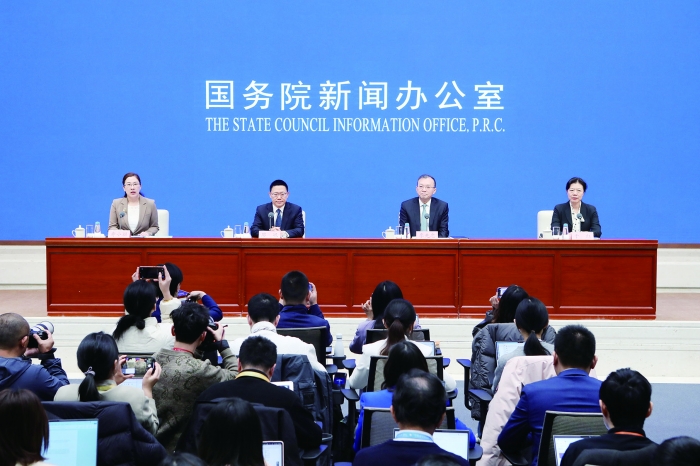
1月20日,国新办举行新闻发布会,财政部有关负责人介绍发挥积极财政政策作用,推动经济社会高 质量发展有关情况。上海证券报记者在会上提问。(上图) 记者 史丽 摄 ◎记者 白丽斐 李苑 1月20日,财政部副部长廖岷在国新办新闻发布会上回答上海证券报记者提问时表示,激发民间投资是 此次一揽子政策的"重头戏"。期待通过这一套"组合拳",实实在在地助力企业节约融资成本、增强盈 利,更好地激发民间投资这"一池春水"。 当天,财政部等部门发布实施民间投资专项担保计划、优化实施设备更新贷款财政贴息政策、实施中小 微企业贷款贴息政策等一揽子政策,其中四项是支持民间投资的政策。此外,财政部还就2026年积极财 政政策支持方向、加快培育新动能、推进全国统一大市场建设等市场热点作出回应。 政策同向发力 助力企业降低融资成本和融资门槛 此次支持民间投资的四项政策,惠及领域很广,支持力度比较大,工具箱也很丰富,有信贷、有贴息、 有担保、有补偿。 廖岷在回答上海证券报记者提问时表示,几项政策同向发力,对企业来说主要有两个方面直接利好:一 方面,降低融资成本,解决民营企业融资贵的问题;另一方面,降低融资门槛,解决民营企业融资难的 问题。 ...

用“真金白银”来补贴老百姓的消费
Bei Jing Qing Nian Bao· 2026-01-20 18:18
Group 1 - The Chinese government plans to increase the fiscal deficit rate to around 4% for 2025, which is a 1 percentage point increase from the previous year, and the new government debt scale will reach 11.86 trillion yuan, an increase of 2.9 trillion yuan compared to last year [1] - A special long-term government bond issuance of 1.3 trillion yuan is planned for 2025 to support consumption and related sales, with 300 billion yuan allocated for subsidies to encourage consumer spending [1] - The central government will allocate 667.4 billion yuan for employment support in 2025, along with various measures to enhance social insurance and reduce unemployment insurance rates [2] Group 2 - The central government will provide approximately 4.9 trillion yuan in total subsidies in 2025, including a basic pension increase of 2% and a minimum standard increase for rural residents' pensions [2] - A gradual implementation of free preschool education will begin, benefiting around 14 million children, and a new childcare subsidy system will be established with 100 billion yuan allocated for children under three years old [2] - The Ministry of Finance announced the cancellation or reduction of export tax rebates for over 200 products, including solar and battery products, to promote resource efficiency and reduce environmental pollution [3] Group 3 - For 2026, the fiscal policy will focus on increasing total spending, optimizing the spending structure, improving the effectiveness of fund usage, and enhancing economic vitality through tax reforms [4] - The government aims to ensure that necessary spending levels are maintained and that funds are directed towards critical areas such as consumption and social welfare [4] - The emphasis will be on improving the efficiency of fund usage, ensuring that every yuan spent generates the expected benefits [4]

财政部:“硬核”支持稳就业、稳企业、稳市场、稳预期
Zheng Quan Ri Bao· 2026-01-20 16:25
Core Viewpoint - The Chinese government is committed to implementing a more proactive fiscal policy in 2026, focusing on increasing total expenditure, optimizing structure, improving efficiency, and enhancing economic momentum to ensure a strong start for the 14th Five-Year Plan [1] Fiscal Revenue and Expenditure - Fiscal revenue in 2025 is expected to show a "front low, middle high, and back stable" trend, with a 1.1% decline in Q1, followed by a 0.6% increase in Q2, and a 2.5% increase in Q3, with October showing a 3.2% growth [2] - The overall balance of revenue and expenditure is projected to be achievable, with stable growth in public budget revenue and strong expenditure supporting economic development [2] - Key expenditures in social security, employment, technology, education, and health have been well-supported, with over 10 trillion yuan allocated to these areas, accounting for over 40% of total public budget expenditure [3] Support for Technological Innovation - The fiscal policy is a crucial tool for supporting technological innovation, with measures including increased funding, tax incentives, and government procurement to promote high-level self-reliance in technology [4] - In 2025, 3.44 million enterprises received over 140 billion yuan in bank loans, with comprehensive financing costs reduced to below 5% [4] - Key areas of focus include enhancing government investment funds, supporting quality upgrades in key industries, and accelerating the application of major technological achievements [5] Policy Implementation - A comprehensive package of policies aimed at promoting domestic demand has been deployed, with a focus on early implementation to maximize impact [6] - Key policies include loan interest subsidies for small and micro enterprises, special guarantees for private investment, and support for consumer loans [7] - The budget for 2026 has made sufficient arrangements for the fiscal expenditures required for these policies, encouraging local institutions to actively engage in business [8]
从保民生到促消费 2026年财政政策将“硬核”支持这些方面
Yang Shi Wang· 2026-01-20 15:51
Core Viewpoint - The Ministry of Finance emphasizes the implementation of proactive fiscal policies to ensure a strong start for the 14th Five-Year Plan and promote high-quality economic and social development [1] Group 1: Fiscal Policy and Economic Outlook - In 2025, fiscal revenue and expenditure are expected to achieve a balanced budget, with a focus on counter-cyclical adjustments [2] - The fiscal revenue is characterized by a "low at the beginning, high in the middle, and stable at the end," with tax revenue showing continuous year-on-year growth since April [4] - The fiscal deficit rate is set at around 4%, an increase of 1 percentage point from the previous year, with new government debt expected to reach 11.86 trillion yuan, an increase of 2.9 trillion yuan [4] Group 2: Social Welfare and Public Spending - Significant increases in social welfare spending are planned, with over 10 trillion yuan allocated to social security, employment, technology, education, and health sectors, accounting for over 40% of total public budget expenditure [4] - The government will provide 667.4 billion yuan in employment subsidies and extend social security benefits [4] - Healthcare subsidies will increase to 700 yuan per person per year for basic medical insurance and 99 yuan for public health services [4] Group 3: Consumer Stimulus Measures - The government aims to boost consumption by optimizing interest subsidy policies for personal consumption loans and service industry loans, with increased subsidy limits [6][7] - A new childcare subsidy system will be established, with 100 billion yuan allocated for subsidies to families with children under three years old [4] - The issuance of long-term special bonds totaling 1.3 trillion yuan is planned, with 300 billion yuan allocated for consumption upgrades, expected to drive sales of approximately 2.6 trillion yuan [4] Group 4: Future Fiscal Strategies - In 2026, the Ministry of Finance will continue to implement more proactive fiscal policies, focusing on increasing total fiscal expenditure and optimizing expenditure structure [10] - The government will support employment, enterprises, and market stability through various measures, including the replacement of hidden debt and the issuance of new special bonds [12] - The average interest cost of replaced debt is expected to decrease by over 2.5 percentage points, gradually reducing local government debt risks [12]
1月20日重要资讯一览
Sou Hu Cai Jing· 2026-01-20 15:00
Group 1: New Stock Offerings - Medela's new stock offering has a subscription code of 920119, with an issue price of 41.88 yuan per share and a price-to-earnings ratio of 14.99 times, allowing a maximum subscription limit of 720,000 shares per account [2] Group 2: Fiscal Policy and Economic Measures - The Ministry of Finance will continue to implement a more proactive fiscal policy, aiming for increased total spending, improved structure, better efficiency, and stronger momentum, with necessary levels of fiscal deficit, total debt, and spending maintained through 2026 [3] - The Ministry of Finance has optimized the personal consumption loan interest subsidy policy, including credit card installment payments, removing restrictions on certain consumption areas, allowing all consumer loans to enjoy interest subsidies [3] - Starting April 1, 2026, export tax rebates for photovoltaic products will be canceled, and electronic product export tax rebates will be phased out over two years, promoting efficient resource use and guiding rational industrial structure adjustments [3] - Tax and fee preferential policies for community services such as elderly care, childcare, and housekeeping will continue, benefiting institutions providing these services [3] Group 3: Commodity Market Adjustments - The Shanghai Futures Exchange will adjust margin ratios and price fluctuation limits for futures contracts of copper, gold, and other commodities starting January 22, 2026 [4] - Domestic gasoline and diesel prices will increase by 85 yuan per ton due to rising international oil prices, marking the first price hike in 2026, with an average increase of 0.07 yuan per liter for 92 and 95 gasoline and 0 diesel [4] - Shanghai has released an action plan to enhance the linkage between spot and futures markets for non-ferrous metals, aiming to expand the international influence of "Shanghai prices" [4] Group 4: Company Earnings Forecasts - Huicheng Environmental Protection plans to increase its shareholding by 25 million to 50 million yuan [7] - JianTou Energy expects a net profit increase of approximately 253.38% year-on-year for 2025 [7] - Hikvision's performance report indicates a year-on-year growth of 18.46% in net profit attributable to shareholders for 2025 [7] - Longzi Co. anticipates a net profit increase of 245.25% to 302.8% year-on-year for 2025 [7] - Zhaoyan New Drug expects a net profit increase of 214% to 371% year-on-year for 2025 [8] - Huachen Equipment forecasts a net profit increase of 193.64% to 242.04% year-on-year for 2025 [8] - Qianyuan Power anticipates a net profit increase of 160% to 190% year-on-year for 2025 [8] - Jin Fang Energy expects a net profit increase of 123.97% to 193.7% year-on-year for 2025 [8] - Other companies such as Zhongfu Industrial, Batian Co., and Dongwei Technology also project significant year-on-year profit increases for 2025, ranging from 50% to over 300% [8][9]





财政部2026年的“硬核”政策是什么?
Jing Ji Guan Cha Wang· 2026-01-20 12:50
Core Viewpoint - The Ministry of Finance plans to implement a more proactive fiscal policy in 2026, focusing on increasing total spending, optimizing structure, improving efficiency, and enhancing momentum to ensure a strong start for the 14th Five-Year Plan [1][2]. Group 1: Total Increase - The fiscal policy aims to expand the fiscal spending envelope, maintaining necessary levels of fiscal deficit, total debt, and overall expenditure, ensuring that spending increases rather than decreases [2]. - The fiscal deficit for 2026 is expected to exceed 56,600 billion yuan, based on a 4% deficit rate set for 2025, which is an increase of 1 percentage point from 2024 [2]. Group 2: Optimized Structure - The focus will be on optimizing the expenditure structure, ensuring funds are allocated to critical areas such as consumption stimulation, human investment, and social welfare [3]. - There is a shift from "investment in material" to "investment in people," indicating a transition towards a welfare-oriented fiscal policy [3][4]. - Expenditure related to consumption and social welfare has shown significant growth, with social security and employment spending reaching 40,721 billion yuan, a year-on-year increase of 8.1% [3]. Group 3: Better Efficiency - The goal is to enhance the effectiveness of fund utilization, ensuring that every yuan spent generates the expected benefits [4][5]. - In 2025, 1.3 trillion yuan of special long-term bonds will support major projects, with 8,000 billion yuan allocated to "two heavy" projects and 5,000 billion yuan for "two new" policies, driving total investment growth by 1.8 percentage points [5]. Group 4: Stronger Momentum - The policy aims to deepen fiscal and tax reforms to stimulate internal economic vitality, enhance local financial capabilities, and improve the efficiency of transfer payments [6]. - Cleaning up and standardizing tax incentives and subsidies is crucial for building a unified national market, which will help eliminate local protectionism and market segmentation [6].
财政部详解今年积极财政政策重点安排
Xin Lang Cai Jing· 2026-01-20 12:46
Group 1 - The effectiveness of the 2025 fiscal policy includes increased counter-cyclical adjustments, with a deficit rate set at around 4%, and new government debt of 11.86 trillion yuan, which is a significant increase compared to previous years [1] - The focus on boosting consumption involved issuing long-term special bonds totaling 1.3 trillion yuan, with 300 billion yuan allocated for consumer subsidies, leading to a sales increase of approximately 2.6 trillion yuan in related goods [2] - Strengthening social welfare included a 667.4 billion yuan employment subsidy, increased healthcare funding, and a rise in pension standards, with total financial support for social welfare reaching about 4.9 trillion yuan [3][4] Group 2 - The 2026 fiscal policy will continue to implement a more proactive approach, focusing on increasing total fiscal expenditure while ensuring sustainability and optimizing expenditure structure [6][7] - Four key policies to stimulate private investment include lowering financing costs through interest subsidies and expanding the scope of support for small and medium-sized enterprises [8][9] - The export tax rebate policy will see adjustments, with the cancellation of rebates for certain products starting April 1, 2026, to promote resource efficiency and environmental sustainability [10] Group 3 - The comprehensive policy to promote domestic demand includes a goal to expand domestic consumption and investment, with a focus on simplifying processes and ensuring targeted support for key sectors [11][12] - Six specific policies have been introduced, including interest subsidies for loans to small and medium-sized enterprises and enhancements to consumer loan support [12][13] - The agricultural insurance sector has seen significant growth, with premium subsidies leading to a scale exceeding 155 billion yuan, providing risk coverage for over 1.25 billion households [23][24] Group 4 - The optimization of personal consumption loan subsidies has increased the maximum subsidy amount and extended the policy's duration to the end of 2026, broadening the range of eligible institutions [25][26][27] - The focus on fostering new economic drivers includes increased funding for technology and innovation, with a 10% rise in central government technology spending [15][16][17] - The fiscal measures aim to facilitate the construction of a unified national market, with ongoing reforms in fiscal and tax systems to enhance efficiency and fairness [18][19][20]
多渠道增加居民收入!财政部发声
Zhong Guo Zheng Quan Bao· 2026-01-20 11:41
Group 1 - The core viewpoint is that the government will implement a more proactive fiscal policy, ensuring that total fiscal expenditure increases while optimizing the structure and improving efficiency [2][3][4] - The fiscal deficit, total debt scale, and total expenditure will maintain necessary levels in 2026, ensuring that overall expenditure intensity "only increases and does not decrease" and that key areas are guaranteed "only stronger and not weaker" [2][3] - The government will break the "base + growth" expenditure solidification pattern by actively using zero-based budgeting concepts to reduce ineffective expenditures and allocate more fiscal funds to boost consumption, invest in people, and ensure livelihood security [3][4] Group 2 - The government aims to increase residents' income through multiple channels, ensuring that funds are used in critical areas to enhance people's sense of gain [3][4] - The government will continue to arrange ultra-long-term special bonds for "two heavy" construction and "two new" work, optimizing policy implementation [3][4] - There will be a focus on deepening fiscal and tax reforms in key areas to further stimulate the internal vitality of the economy [4][5] Group 3 - The government will leverage the role of government investment funds to support early, small, long-term investments in hard technology and promote quality upgrades in key industries [6] - There will be a focus on enhancing the innovation capabilities of small and medium-sized enterprises through structural tax reductions and support policies [6] - A guiding document will be issued to promote high-quality development of agricultural insurance, emphasizing refined management and diversified collaboration [7]