能源转型

Search documents
二十国集团领导人峰会闭幕 强调多边合作与共同发展
Yang Shi Xin Wen· 2025-11-23 13:47
Group 1 - The G20 summit held in Johannesburg, South Africa, marked the first time the leaders' meeting took place on the African continent, highlighting the significance of placing the development needs of Global South countries at the core of the global agenda [1][2] - The summit resulted in the adoption of the Leaders' Declaration, which reflects the G20's commitment to multilateral cooperation and promoting common development amid global challenges [1][2] - The G20 has pledged to provide more support to low- and middle-income countries, aiming to create a virtuous cycle of "debt reduction - increased investment - growth" [1] Group 2 - The summit confirmed the advancement of the "Critical Minerals Framework" to promote sustainable development opportunities through key resources globally [2] - The Leaders' Declaration is viewed as a commitment to drive global action, emphasizing that multilateralism remains the best approach to address common challenges [2] - The summit called for accelerated implementation of the 2030 Sustainable Development Agenda to ensure a more inclusive, just, and prosperous world, ensuring that no one is left behind [2]
二十国集团南非峰会:领导人宣言(摘译)
Xin Hua She· 2025-11-23 12:32
新华社约翰内斯堡11月23日电 二十国集团南非峰会:领导人宣言(摘译) 序言 我们,2025年11月22日至23日相聚于南非约翰内斯堡的二十国集团领导人,出席南非主席国在非洲 大陆举行的首次历史性峰会,应对主要全球挑战,探讨促进以团结、平等、可持续为关键支撑的包容性 增长。 我们谴责一切形式和表现的恐怖主义。 我们一致认为,在《联合国宪章》宗旨和原则的全面指引下,我们将致力于在苏丹、刚果(金)、 巴勒斯坦被占领土、乌克兰实现公正、全面和持久的和平,并结束全球其他冲突与战争。只有在和平之 下,我们才能实现可持续发展和繁荣。 加强灾害韧性和应对 我们强调采取综合、包容、以人为本、全面的减灾方法至关重要。我们注意到需要加强灾害韧性和 灾害应对能力,包括采取协调行动减少地震、极端高温、洪涝、干旱、野火及荒漠化等灾害的频率和负 面影响,确保在必要时做好相互援助的准备。我们欢迎采用基于自然的解决方案和基于生态系统的方 法,在提供生态系统服务的同时,既最大限度降低风险,又增强应对特定灾害的韧性。 采取行动确保低收入国家债务可持续性 我们重申致力于以有效、全面和系统的方式支持中、低收入国家应对债务脆弱性问题。我们核准 202 ...
有色基本金属行业周报:非农超出预期,压制年内降息预期,金属价格承压-20251123
HUAXI Securities· 2025-11-23 08:27
Investment Rating - Industry Rating: Recommended [4] Core Views - The report indicates that the recent U.S. non-farm employment data exceeded expectations, which has suppressed interest rate cut expectations for the year, leading to downward pressure on metal prices [3][20] - Precious metals have seen price declines due to weakened rate cut expectations, with COMEX gold down 0.53% to $4,062.80 per ounce and COMEX silver down 1.47% to $49.66 per ounce [30][46] - The overall outlook for precious metals remains cautious, with geopolitical tensions and global debt concerns driving long-term investment in gold [20][49] Summary by Sections Precious Metals - COMEX gold and silver prices have decreased, with significant changes in ETF holdings, indicating a shift in market sentiment [30][46] - The U.S. job market shows mixed signals, complicating the Federal Reserve's decision-making regarding interest rates [3][9] - The report highlights a potential long-term bullish trend for gold due to rising global debt and inflation concerns [20][49] Base Metals - Base metal prices are under pressure due to reduced rate cut expectations, with copper, aluminum, zinc, and lead all experiencing price declines [8][9] - The supply side is facing challenges, with major copper producers reporting production declines due to operational issues [9][12] - Demand for copper is expected to remain tight in the long term, supported by energy transition policies and infrastructure investments [22] Small Metals - The report notes that magnesium prices are under pressure due to rising costs, while demand remains stable [18] - Molybdenum and vanadium prices are weak, reflecting a challenging market environment for these metals [19] Investment Recommendations - The report suggests a focus on gold and silver stocks, highlighting specific companies that may benefit from rising metal prices [20][50] - For base metals, companies involved in copper production are recommended due to expected supply constraints and long-term demand growth [22]
“十五五”经济社会发展主要目标解读积极稳妥推进和实现碳达峰
Jing Ji Ri Bao· 2025-11-22 23:43
Core Viewpoint - The article emphasizes China's commitment to achieving carbon peak and carbon neutrality as a solemn promise to the international community and an inherent requirement for high-quality development [1][2]. Group 1: Carbon Peak and Neutrality Goals - The "14th Five-Year Plan" period is crucial for China to actively promote carbon peak and carbon neutrality, contributing significantly to global climate governance [2][3]. - China has established a comprehensive carbon reduction policy framework over the past five years, with provincial governments implementing local carbon peak plans [3][4]. Group 2: Green Development and Energy Transition - China has cultivated over 6,400 green factories and more than 490 green industrial parks, leading the world in new energy vehicle production and sales [3]. - The country has built the world's largest renewable energy system, with renewable energy accounting for nearly 60% of total installed power generation capacity, achieving wind and solar power installation targets ahead of schedule [3]. Group 3: Carbon Emission Control Measures - The "Suggestions" propose implementing a dual control system for carbon emissions, focusing on both total emissions and intensity, transitioning from energy consumption control to carbon emission control [5]. - The energy sector's low-carbon transition is critical for achieving national contribution goals, requiring a balance between supply assurance and emission reduction [6]. Group 4: Carbon Market and Policy Recommendations - The article discusses the expansion of the national carbon emissions trading market and the establishment of a voluntary greenhouse gas reduction trading market [8]. - Recommendations include enhancing the carbon market's coverage, introducing quota allocation methods, and reforming the assessment of national carbon emission targets [9].
报告:全球能源转型呈现从低碳向零碳的发展趋势
Zhong Guo Xin Wen Wang· 2025-11-22 12:59
Core Insights - The global energy transition is at a critical stage, shifting from fossil fuels to renewable energy, with a trend from high carbon to low carbon and ultimately to zero carbon [1][2] - The report highlights the coexistence of challenges and opportunities in the energy transition, influenced by geopolitical factors and energy security needs [1] - There is a clear direction towards a diversified energy structure, with a slowdown in coal and oil demand, while natural gas is becoming a long-term energy pillar alongside renewable sources [1] Policy and Technology - Energy policies across multiple countries are facing divergences, leading to adjustments in energy strategies due to geopolitical and security concerns [1] - Significant advancements in clean energy technologies are noted, particularly in solar photovoltaic, wind power, and electric vehicles, while green hydrogen technologies still face challenges [1] - The report emphasizes the importance of a new power system supported by renewable energy sources, with hydropower, wind, solar, and nuclear power playing crucial roles [1] Future Outlook - The global energy trade flow is undergoing a transformation, with China transitioning from the largest energy importer to the largest clean technology exporter [2] - The integration of artificial intelligence in energy sectors is reshaping the efficiency of the entire energy supply chain, particularly in energy forecasting and grid optimization [2] - The ongoing energy transition conference in Beijing focuses on accelerating collaborative innovation for green transformation, featuring various activities including keynote sessions and technical exchanges [2]
中欧专家呼吁加强人工智能领域务实合作
Xin Hua She· 2025-11-22 12:07
Core Insights - The forum held in Paris emphasized the strong complementarity between China and Europe in artificial intelligence innovation, governance, and sustainable development, advocating for practical cooperation to contribute to global AI governance [1][2] Group 1: Forum Overview - The Global AI Sustainable Development Innovation Cooperation Forum was co-initiated by the China Electronics Chamber of Commerce AI Professional Committee and the Zhejiang New Era Industry-Finance Collaborative Innovation Research Institute, with strategic partners including HEC Paris and its alumni association [1] - The forum featured keynote speeches and roundtable discussions focusing on global AI governance, sustainable development pathways, industrial collaboration, and ethics [1] Group 2: Perspectives on Cooperation - Emmanuel Goffi, a professor of AI ethics at HEC Paris, noted a cognitive contradiction in Europe regarding AI, where there is an emphasis on regulation alongside complaints about insufficient development, suggesting a need for a more pragmatic view of cooperation with China [1] - Anis Ben Mahamoud, head of the French branch of the United Robotics Group, argued that competition in AI should not hinder collaboration, indicating that China and Europe will likely depend on each other in AI technology exploration for a considerable time, benefiting mutual development [1] Group 3: Joint Projects and Agreements - During the roundtable discussion themed "Integration of AI and Green Energy: Innovation, Efficiency, and Governance," former French ambassador to Nepal, Gilles Henry Garo, highlighted potential joint project areas such as green economy, energy transition, and smart cities for China-Europe collaboration [2] - A cooperation memorandum was signed between the China Electronics Chamber of Commerce AI Professional Committee and the HEC Paris Innovation and Entrepreneurship Ecosystem Center to jointly advance the establishment of a global AI sustainable development innovation cooperation center in Paris and Hangzhou [2] - Wang Ning, president of the China Electronics Chamber of Commerce, stated that China and Europe possess complementary advantages in AI innovation, ethical governance, and industrial collaboration, with China's vast application scenarios and Europe's strengths in standards, regulation, and basic research expected to create a positive interactive mechanism in the future [2]
视频丨我国已建成全球最完整清洁能源产业链
Yang Shi Xin Wen· 2025-11-22 10:22
Core Insights - China has established the world's largest and most complete clean energy industry chain, with a significant focus on energy transition and investment in renewable energy sources [1][5]. Group 1: Energy Transition and Investment - In 2024, global CO2 emissions related to energy are projected to increase by 0.8% year-on-year, reaching a historical high of 37.8 billion tons, highlighting the urgency for energy transition [1]. - China's energy transition investment reached $818 billion in 2022, a 20% increase year-on-year, surpassing the combined investments of the US, UK, and EU, making it the global leader [1]. - China exports wind power, photovoltaic, and new energy vehicles to over 200 countries, providing 70% of global wind power equipment and 80% of photovoltaic components, significantly reducing global wind and solar power generation costs by over 60% and 80%, respectively [1]. Group 2: Renewable Energy Capacity - As of September 2025, central enterprises in China have installed 840 million kilowatts of wind and solar capacity, accounting for approximately half of the national total [3]. - The share of coal-fired power generation in China's energy mix has decreased from 58.7% in 2015 to 33.1% in the first half of 2025, indicating a shift towards renewable energy [5]. - China is becoming a global leader in renewable hydrogen production, with a commitment of $33 billion in investments for clean hydrogen projects, leading the world [5][6]. Group 3: Future Goals and Commitments - By 2035, China aims for non-fossil energy consumption to account for over 30% of total energy consumption, with wind and solar power generation capacity expected to exceed six times that of 2020, targeting 360 million kilowatts [6].

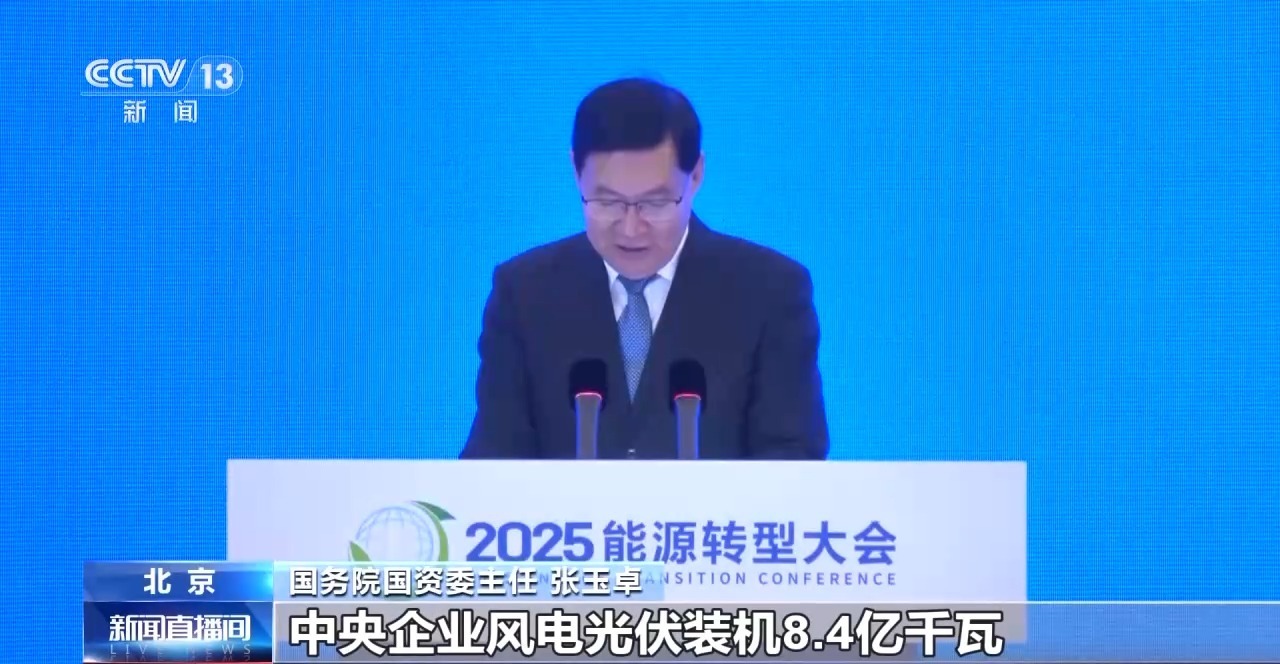
数据显示我国已建成全球最完整清洁能源产业链 涌动“绿色未来”惠及全球
Yang Shi Wang· 2025-11-22 10:11
Group 1 - The report indicates that China has established the world's largest and most complete clean energy industry chain, with fossil energy activities being the largest source of global carbon emissions [1] - In 2024, global CO2 emissions related to energy are projected to increase by 0.8% year-on-year, reaching a historical high of 37.8 billion tons, highlighting the urgency of energy transition [1] - China's energy transition investment reached $818 billion in the previous year, a 20% increase year-on-year, surpassing the combined investments of the US, UK, and EU, ranking first globally [1] Group 2 - As of September 2025, central enterprises in China have installed 840 million kilowatts of wind and solar power capacity, accounting for about half of the total national capacity [3] - Significant technological achievements in clean and efficient coal utilization, ultra-high voltage transmission, and advanced nuclear energy have been made, playing a key role in China's green and low-carbon energy transition [3] Group 3 - China's coal-fired power generation share has been declining, from 58.7% in 2015 to 33.1% in the first half of 2025, indicating a shift towards renewable energy [5] - China is becoming a global leader in renewable hydrogen production, with a committed investment of $33 billion in clean hydrogen projects, the highest in the world [5] - As of September 2025, China's green hydrogen production capacity exceeds 150,000 tons per year, accounting for over 50% of the global total [5] Group 4 - In the new round of national contributions, China aims for non-fossil energy consumption to account for over 30% of total energy consumption by 2035, with wind and solar power capacity expected to reach more than six times that of 2020, targeting 360 million kilowatts [7]
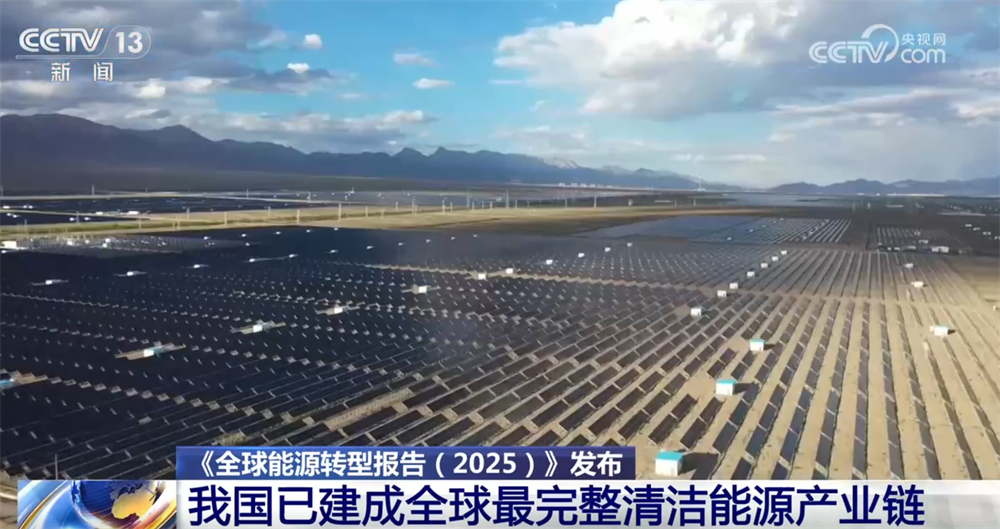
我国已建成全球最完整清洁能源产业链
Xin Lang Cai Jing· 2025-11-22 10:11
Core Insights - China has established the world's largest and most complete clean energy industry chain, as highlighted in the "Global Energy Transition Report (2025)" released by the China Enterprise Reform and Development Research Association [1] Investment and Growth - In 2023, China's energy transition investment reached $818 billion, marking a 20% year-on-year increase, surpassing the combined investments of the US, UK, and EU, positioning China as the global leader in this sector [1] - The country has exported wind power, photovoltaic, and new energy vehicle products to over 200 countries and regions, providing 70% of global wind power equipment and 80% of photovoltaic components, significantly reducing global wind and solar power generation costs by over 60% and 80% respectively [1] Carbon Emissions and Energy Transition - Fossil energy activities remain the largest source of global carbon emissions, with energy-related CO2 emissions projected to increase by 0.8% in 2024, reaching a historical high of 3.78 billion tons [1] - China's coal-fired power generation share has decreased from 58.7% in 2015 to 33.1% in the first half of 2025, indicating a significant shift towards renewable energy sources [1] Hydrogen Energy Development - China is becoming a global leader in renewable hydrogen production and related industries, with a committed investment of $33 billion in clean hydrogen projects, the highest in the world [1] - As of September 2025, global clean hydrogen project investments are expected to reach $110 billion, with China accounting for over 50% of global green hydrogen production capacity, exceeding 150,000 tons per year [1] - The country has established 540 hydrogen refueling stations, representing 40% of the global total [1] Future Goals - In its latest national contributions, China aims for non-fossil energy consumption to account for over 30% of total energy consumption by 2035, with wind and solar power generation capacity expected to exceed six times that of 2020, targeting 3.6 billion kilowatts [1]
每年全球消耗约50亿吨石油,按照这个速度,石油还能用多久?
Sou Hu Cai Jing· 2025-11-22 05:44
Core Viewpoint - The article discusses the evolving dynamics of oil consumption and production, highlighting that while oil reserves are substantial, the rate of consumption is decreasing due to the rise of renewable energy sources. The predictions of oil depletion are increasingly seen as inaccurate as technology advances and energy transitions occur. Group 1: Oil Consumption and Production Dynamics - Global oil consumption is approximately 5 billion tons annually, equating to about 13.69 million tons per day, enough to fuel 150 million cars for over six months [1] - The notion of oil depletion has been a recurring theme since 1914, yet technological advancements have continually expanded the potential for oil extraction [3][5] - The introduction of hydraulic fracturing technology has significantly reduced extraction costs, allowing the U.S. to transition from a major oil importer to an exporter, increasing global oil availability by 10% [9] - Deep-sea drilling advancements have also contributed to increased oil reserves, with deep-sea oil fields expected to add 5 billion barrels of reserves in 2025 alone [11] Group 2: Shifts in Energy Consumption - The speed of oil consumption is slowing, with predictions indicating that global oil demand will peak by 2030 and subsequently decline [35] - In China, the consumption of refined oil is projected to decrease by 2.4% in 2024, marking the first significant decline, attributed to the rise of new energy vehicles [18] - The industrial sector is also transitioning away from oil, with many factories replacing diesel with electricity and natural gas, leading to a reduction of 50 million tons of oil consumption in the steel industry alone [20] Group 3: Future of Oil in Energy Structure - By 2050, oil's share in the global energy mix is expected to drop from 30% to below 10%, with its primary use shifting towards chemical production rather than as a fuel source [38] - The development of bio-based alternatives for plastics and chemicals may further diminish the role of oil, as advancements in renewable energy technologies continue [40] - The transition to clean energy is anticipated to enhance energy security and reduce environmental pollution, leading to a more sustainable future [46][50]