贸易保护主义

Search documents
美钢铝关税加倍 多国表达反对
Xin Hua She· 2025-06-05 00:33
Group 1: U.S. Tariff Increase - The U.S. White House announced an increase in tariffs on steel and aluminum products from 25% to 50% for all trade partners except the UK, effective from June 4 [1] - In 2024, the U.S. is projected to import steel and aluminum products worth $147.3 billion, with major sources including Canada, Mexico, and Brazil for steel, and Canada for aluminum [1] Group 2: Canadian Response - The Canadian government condemned the U.S. tariff increase as "illegal and unreasonable," and is negotiating for the removal of these tariffs [2] - The Canadian steel and aluminum industry expressed strong opposition, warning that increased tariffs would cause widespread damage to the supply chain [2] - The Canadian Labour Congress highlighted the potential job losses for thousands of Canadian workers due to the U.S. decision [2] Group 3: European Union's Position - The EU is preparing to respond to the U.S. tariff increase, emphasizing that it could negatively impact global trade [3] - The EU Trade Commissioner stated that if negotiations fail, the EU is ready to defend its interests and rebalance trade relations [3] - The German Chamber of Commerce described the U.S. decision as a severe blow to transatlantic trade relations [4] Group 4: Impact on Japan - Japan expressed deep regret over the U.S. tariff increase, urging the U.S. to reconsider its policy [6] - The increase to 50% is expected to reduce Japan's annual steel and aluminum exports to the U.S. by approximately 114.5 billion yen, impacting Japan's GDP growth rate by 0.02 percentage points [7] Group 5: Reactions from Other Countries - Vietnam, as the fifth-largest steel supplier to the U.S., criticized the U.S. policy as a "new iron curtain," which could also harm U.S. steel consumers [8] - South Korea is actively discussing strategies to mitigate the impact of the tariff increase, as the U.S. is a major export market for South Korean steel [9] Group 6: Domestic Impact in the U.S. - Experts warn that the tariff increase will harm the U.S. metal manufacturing sector and lead to higher prices for various consumer goods, including canned foods [10] - The Peterson Institute for International Economics noted that previous tariffs resulted in significant cost increases for downstream industries [10] - The U.S. business community is experiencing growing pessimism about the economic outlook, with CEO confidence dropping significantly [11]
50%!美将钢铝进口关税翻倍,引加拿大、墨西哥和欧盟愤怒
Huan Qiu Shi Bao· 2025-06-04 22:35
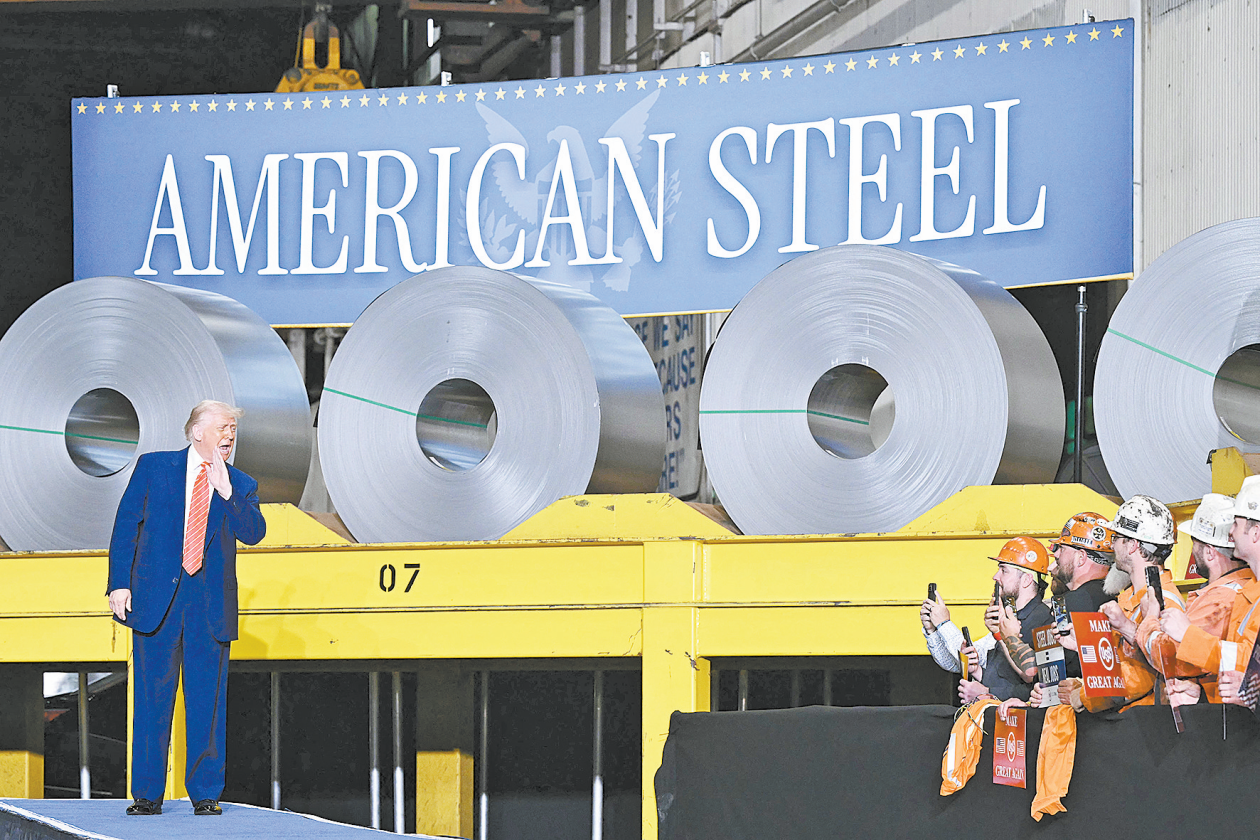
Group 1 - The U.S. has increased tariffs on imported steel and aluminum from 25% to 50% to protect domestic industries and address national security threats, effective from June 4 [1][3][4] - Canada and Mexico are expected to be the most affected by the tariff increase, with Canada being the largest supplier of steel and aluminum to the U.S. [5][6] - The OECD has downgraded the U.S. economic growth forecast for 2023 to 1.6% due to the impact of the tariffs and retaliatory measures from trade partners [1][4] Group 2 - The U.S. steel import volume decreased by 17% from March to April 2023, and further declines are anticipated following the new tariffs [4] - The Canadian government has expressed strong opposition to the tariffs, labeling them as illegal and unfair, and plans to support affected workers and businesses [5][6] - The broader impact of the tariffs is expected to increase production costs for U.S. manufacturers that rely on steel and aluminum, potentially leading to higher prices for consumers [7]

经合组织发布最新展望报告显示——关税战拖累全球经济增速
Jing Ji Ri Bao· 2025-06-04 22:00
首先,贸易保护主义和政策不确定性加剧,美国自2025年初大幅提高对中国产品的关税,平均有效关税 从2024年的2%升至15.4%,为1938年以来最高水平。据经合组织测算,此次美国加征关税及各国反制措 施涉及商品贸易额占全球GDP约2%,超过2018年美对中方首次贸易战时期的影响范围。报告预测,增 长放缓较为显著的包括美国、加拿大和墨西哥等经济体。2025年和2026年,美国经济预计将增长1.6% 和1.5%,较今年3月份预测值分别下调0.6个和0.1个百分点;欧元区经济预计将增长1.0%和1.2%,与3月 份预测值相同。根据"政策不确定性指数",近期不确定性急剧上升,尤其是在未来贸易政策走向方面, 企业和消费者信心因此下降。金融环境收紧与市场波动持续造成影响,虽然金融市场已部分稳定,但整 体金融条件比2024年底更为紧张,且金融系统对冲击更为敏感,可能触发连锁反应,如非银金融机构被 迫出售资产。另外,公司债务成本特别是低评级债券的利差仍然高企,表明市场对风险资产保持高度警 惕。 其次,投资和消费动力不足弱化复苏动能。商业投资疲弱,由于不确定性上升、融资成本提高以及结构 性问题,如市场集中度上升,企业投资意愿 ...
美企抢单凸显中美贸易固有韧性
Jing Ji Ri Bao· 2025-06-04 22:00
Group 1 - The core viewpoint of the articles emphasizes the significant improvement in Sino-U.S. trade relations following the reduction of tariffs, leading to a surge in orders from American buyers for Chinese goods, indicating the resilience of market dynamics and the irreplaceability of Chinese products in the U.S. market [1] - The adjustment of tariff policies has resulted in a nearly 300% increase in container shipping bookings from China to the U.S., driving up shipping prices in the U.S. market [1] - The articles argue that trade is fundamentally about mutual benefit and efficiency, and that any disruption caused by unreasonable factors will be quickly rectified, highlighting the importance of a stable and predictable international trade environment [1][2] Group 2 - The articles assert that Sino-U.S. economic relations are not a zero-sum game but rather structurally complementary, with China providing a robust manufacturing system and the U.S. offering high-level service trade and a large consumer market [2] - The complementary effect between the two economies is seen as a driving force for cooperation, with Chinese goods contributing positively to the quality of life for American consumers [2] - The phenomenon of U.S. companies rapidly ordering Chinese products should prompt U.S. policymakers to reassess the Sino-U.S. economic relationship, as American businesses and consumers have expressed a clear need for mutually beneficial cooperation [2][3] Group 3 - Historical evidence suggests that economic laws and market logic are irreversible, and that the U.S. should maintain cooperative trade relations with China as a responsible approach to internal economic challenges [3] - The articles advocate for a rational approach to Sino-U.S. relations, encouraging both sides to leverage their economic complementarity to expand and optimize trade cooperation [3] - A stable, open, and transparent economic cooperation mechanism is deemed essential for injecting certainty and positive energy into the global economic recovery [3]
最后通牒!美国逼各国交出“关税方案”,否则美国经济就要崩盘
Sou Hu Cai Jing· 2025-06-04 17:25
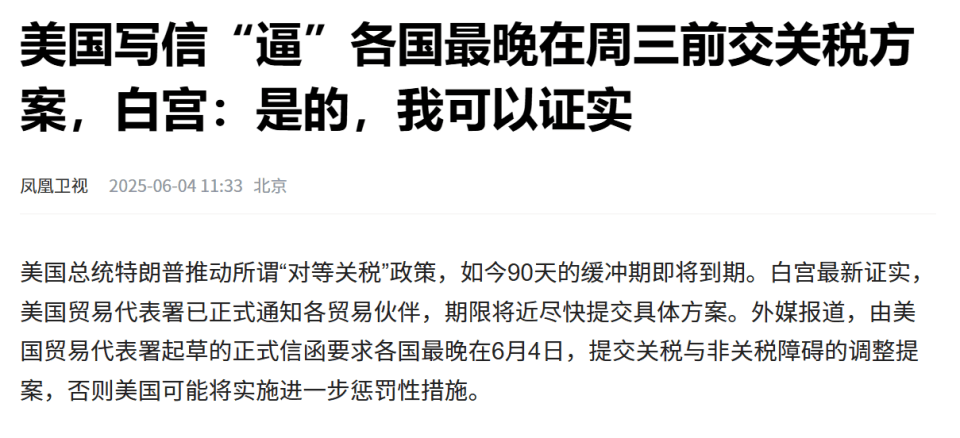
Group 1 - The U.S. government is pushing for a "reciprocal tariff" policy, with a 90-day grace period ending soon, demanding trade partners submit proposals by June 4 or face punitive measures [1][3] - The urgency for tariff proposals stems from the U.S. facing significant debt pressure, with national debt exceeding $36 trillion, leading to attempts to increase fiscal revenue through tariffs [3][11] - Countries like China have shown a firm stance against U.S. tariff pressures, emphasizing the importance of equality and mutual benefit in international trade [5][15] Group 2 - Japan, having previously suffered from U.S. tariffs in the 1980s, is adopting a guerrilla strategy and has not easily compromised under U.S. pressure [7] - European nations and ASEAN countries are also resisting U.S. tariff demands, focusing on their own economic strategies and regional stability [7][15] - The U.S. is experiencing a sense of urgency as its key industries, such as automotive and aerospace, are heavily reliant on Chinese rare earth materials, which are crucial for their operations [11][15] Group 3 - The U.S. "reciprocal tariff" policy is characterized as a self-centered unilateral action that may protect some domestic industries but could lead to higher consumer prices and provoke retaliatory measures from other countries [13][15] - The political implications of U.S. tariff policies have drawn international discontent, undermining the principles of the World Trade Organization and potentially isolating the U.S. on the global stage [13][15] - The global economic landscape is shifting towards multipolarity, with emerging economies like China, Europe, and Japan gaining more influence, challenging U.S. economic hegemony [15][17] Group 4 - If the U.S. continues its unilateral and protectionist trade policies, its economic challenges may worsen, while other countries collaborate to promote a fairer global economy [17] - The U.S. must recognize that cooperation and mutual benefit are essential in a globalized world, rather than relying on tariffs to resolve issues [17]
6月4日晚间央视新闻联播要闻集锦
Yang Shi Xin Wen Ke Hu Duan· 2025-06-04 13:52
Group 1 - China's high-tech zones reported industrial revenue exceeding 10 trillion yuan in the first four months of the year, with a year-on-year growth of 7.3% [6] - The "Two New" policies are being actively implemented across various regions, effectively accelerating the release of consumption potential [7] - The renovation of old urban residential areas is progressing rapidly, with 5,679 new projects started in the first four months of this year [8] Group 2 - The Ministry of Industry and Information Technology and other departments are launching a digital transformation plan for the electronic information manufacturing industry, aiming for over 85% CNC rate in key processes by 2027 [12] - A pilot program for the integration of human resources services and manufacturing industries will be conducted in about 30 cities over three years to promote high-quality employment [13] - The Ministry of Finance issued 12.5 billion yuan of government bonds in Hong Kong, with a subscription rate of 3.96 times, indicating strong investor interest [16]
美正式上调钢铝关税 欧盟德国表示遗憾
Xin Hua She· 2025-06-04 13:39
新华社纽约6月3日电(记者刘亚南)美国白宫3日发布公告,以应对所谓"国家安全威胁"和提高国内钢 铝产业竞争力为由,宣布从4日起将进口自除英国外所有贸易伙伴的钢铝产品关税从目前的25%上调至 50%。 鉴于5月上旬美英达成一项新的贸易协议,美国此次决定英国出口美国的钢铝产品将继续适用25%的税 率。 美国总统特朗普5月30日表示,将自6月4日起把美国进口钢铁和铝的关税从目前的25%上调至50%。 欧盟委员会发言人奥洛夫·吉尔2日重申,欧盟对美方决定深表遗憾。这一决定为全球经济增加了更多不 确定性,提高了大西洋两岸消费者和企业的成本,也破坏了欧盟与美国达成谈判解决方案的努力。 德国工商总会外贸主管福尔克·特赖尔表示,美方这一决定是"对跨大西洋贸易关系的严重打击"。 美国彼得森国际经济研究所高级研究员加里·赫夫鲍尔2日撰文说,特朗普第一任期对进口钢铁征收25% 关税,这些关税"每创造一个钢铁行业就业岗位,就导致下游行业年成本增加65万美元"。 2018年3月,时任美国总统特朗普以威胁美国国家安全为由,对多个国家和地区的钢铁和铝产品加征进 口关税,其中钢铁关税税率为25%,铝产品关税税率为10%。此后迫于国内产业遭冲 ...
对华关税降至12%?美国准备实行B计划,特朗普在等中方高层见面
Sou Hu Cai Jing· 2025-06-04 12:06
Core Points - A U.S. federal court has blocked President Trump's tariff policy announced on April 2, ruling that he overstepped his authority by imposing comprehensive tariffs on countries that export more to the U.S. than they import [1][3] - The court's 49-page ruling stated that only Congress has the power to regulate trade with other nations, thus prohibiting the Trump administration from executing tariffs under the International Emergency Economic Powers Act (IEEPA) [3][4] - The White House has expressed strong opposition to the ruling, claiming that non-elected judges should not dictate responses to national emergencies and that the administration will use all executive powers to address the crisis [1][3] Tariff Policy Implications - The court has mandated that the U.S. government must issue new enforcement notices to all customs ports within 10 days to implement the ban on tariffs, and during this period, the Customs and Border Protection must cease collecting tariffs based on IEEPA [4] - If the Trump administration's request for a stay of the ruling is not approved, the ban will take effect after 10 days, potentially reducing tariffs on China to around 12% [4] - The ruling has rendered previous tariff orders ineffective immediately upon issuance, and the government must publish necessary administrative orders to enforce the permanent ban [4] Responses from China - China's Ministry of Commerce reiterated the U.S. court's ruling and criticized the unilateral tariff measures, stating they have not resolved U.S. issues but have instead harmed international trade order [6] - The Chinese Foreign Ministry emphasized that there are no winners in a trade war and that protectionism ultimately harms all parties involved [6] Future Strategies - Amid the legal challenges, Trump's trade team is reportedly considering a backup plan involving a two-step approach: first, imposing a maximum 15% tariff globally for 150 days to address trade imbalances, and second, developing personalized tariffs for each major trading partner during that period [6][8]
经济预期再下行,贸易摩擦难解局,全球合作刻不容缓
Sou Hu Cai Jing· 2025-06-04 10:17
Core Viewpoint - The OECD has downgraded its global economic growth forecasts for 2025 and 2026 to 2.9%, indicating a weakening growth momentum and increasing risks in the global economy [1][10]. Group 1: Trade Barriers and Economic Policies - Trade barriers and economic policy uncertainty are identified as primary reasons for the global economic slowdown, with increased tariffs and trade restrictions disrupting supply chains and diminishing business and consumer confidence [3][4]. - The report highlights a notable slowdown in growth among North American economies, particularly the U.S., Canada, and Mexico, due to trade tensions impacting the largest economies [3][4]. - The U.S. inflation forecasts for 2025 and 2026 have been raised to 3.2% and 2.8%, respectively, indicating persistent inflationary pressures that could lead to continued tight monetary policies by the Federal Reserve [3][4]. Group 2: Impact of Protectionism - The rise of protectionism and trade barriers is harming global supply chain efficiency, increasing business costs, and ultimately affecting consumer prices, leading to constrained economic vitality and reduced global trade and investment flows [4][6]. - The fragmentation of trade is undermining the stability of the multilateral trading system, with historical evidence suggesting that rising protectionism hampers economic growth and leads to a "zero-sum game" scenario [6][7]. Group 3: Call for Cooperation - OECD Chief Economist Pereira emphasizes the necessity for countries to engage in sincere negotiations to avoid further trade fragmentation, advocating for multilateral cooperation and trade liberalization as essential for sustainable global economic growth [9][10]. - The report warns that the ongoing trade barriers could exacerbate international tensions and complicate global political dynamics, highlighting the need for stable and rule-based economic development rather than short-term protective measures [7][10].

特朗普暂缓收割75国,专心对付中国?美国专家认怂:咱们顶不住了
Sou Hu Cai Jing· 2025-06-04 10:05
根据白宫发布的行政命令,美国对华关税增加125%,加上3月份就开始实施的20%所谓芬太尼问题施加的关税,美国累计对华关税已达145%,堪称疯狂。 中国方面早有准备,先祭出84%的关税反制,然后又宣布将"尊重观众选择",拟减少美国电影的进口。此举可谓直掐美国命门,此举导致美国电影公司股票 暴跌。而今,中国又宣布了125%的关税反制措施。其实,此时中美之间已经没有贸易的可能性,此后再相互追加关税,已经毫无意义。 当时特朗普的逻辑是,外国的廉价产品大量充斥美国的市场,而美国的工人却得不到工作和收入的保障。正如他的口号"复兴制造业"一样,他要让美国自己 的制造业振兴起来,从而把其他国家的商品"赶出去"。 所以,他鼓励外国公司迁往美国,特朗普曾说过:"我希望德国汽车公司成为美国汽车公司。我希望他们在这里建厂。"这样,他可以对外国进入本国的商品 征税,而对本土企业减免税务,不仅赚了外国的关税,还能提升本土制造业的产能。 (二)填补贸易逆差 美国为什么会有巨大的贸易逆差,其实,美国的经济是以第三产业(服务业)为主。因此,他在货物贸易(第一、第二产业方面)中肯定是有贸易逆差的, 而且,贸易逆差主要集中在中国、墨西哥、越南、德 ...