避险资产

Search documents
Gold price hits $4,014 for the first time ever, up 50% year-to-date: Is the gold rate prediction outlook pointing to $4,900 by 2026?
The Economic Times· 2025-10-08 10:43
Core Insights - Gold prices have reached $4,000 per ounce for the first time, reflecting a remarkable 50% gain year-to-date, driven by rising inflation fears and global instability [1][10] - Central banks are purchasing record amounts of gold, with U.S. ETFs backed by gold recording approximately $35 billion in inflows by September 2025, indicating strong demand [2][10] - Geopolitical tensions and economic uncertainties are increasing gold's appeal as a safe-haven asset [3][10] Market Dynamics - The current rally in gold prices may face short-term corrections due to rapid gains leading to profit-taking, but forecasts remain optimistic [4][6] - Goldman Sachs projects that gold could reach $4,900 per ounce by 2026 if current trends persist, with the upward trajectory dependent on inflation rates, central bank policies, and global economic stability [4][6] Factors Influencing Gold Prices - Expected Federal Reserve rate cuts and looser monetary policy are making gold more attractive as a non-yielding asset [8] - A weaker U.S. dollar enhances gold's appeal to international buyers, increasing global demand [8] - Heavy buying by central banks, particularly from China, India, and Turkey, is contributing to gold's upward momentum [8] - Geopolitical uncertainties and global economic instability are driving safe-haven demand for gold [8] - Increased investment inflows into gold-backed ETFs and persistent inflation concerns are further supporting gold prices [8] Investment Options - Popular investment options for gaining exposure to gold include SPDR Gold Shares (GLD), iShares Gold Trust (IAU), and VanEck Gold Miners ETF (GDX), which provide liquidity and diversification [9][10]


见证历史!刚刚,集体爆发!
券商中国· 2025-10-08 08:10
Core Viewpoint - The article highlights a significant surge in gold prices, which have surpassed $4000 per ounce for the first time, driven by global economic and geopolitical uncertainties, with notable institutional interest in gold as a safe-haven asset [1][2][3]. Group 1: Gold Price Surge - On October 8, gold prices reached a historic high, breaking the $4000 per ounce mark, with a year-to-date increase of 53.6% [2][3]. - The surge in gold prices has led to a substantial rise in gold stocks in the Hong Kong market, with companies like Chifeng Jilong Gold Mining seeing an increase of over 17% [1][2]. Group 2: Catalysts for Gold Price Increase - The U.S. government shutdown has been identified as a direct catalyst for the recent rise in gold prices, causing delays in key economic data releases and increasing market uncertainty regarding Federal Reserve interest rate decisions [4][5]. - Political instability in France and Japan has further fueled concerns about fiscal risks, contributing to the demand for gold as a safe-haven asset [6]. Group 3: Institutional Interest and Predictions - Ray Dalio, founder of Bridgewater Associates, emphasized that gold is a safer investment compared to the U.S. dollar, suggesting a strategic allocation of approximately 15% of investment portfolios to gold [7]. - Goldman Sachs has raised its gold price forecast for December 2026 to $4900 per ounce, citing strong demand from institutional investors and central banks [7][8]. Group 4: Recommendations and Market Sentiment - Investment strategies are shifting towards increasing gold allocations to hedge against dollar risks, with suggestions to raise gold holdings to around 5% of investment portfolios [9]. - Analysts caution about potential short-term corrections in gold prices due to the rapid increase, indicating that profit-taking by speculators may occur [9].




金价亚盘再创历史新高,继续延续主力多单布局方案
Sou Hu Cai Jing· 2025-10-08 06:37
Core Viewpoint - The surge in gold prices, surpassing $4000 per ounce, is driven by multiple factors including global trade uncertainties, concerns over U.S. fiscal stability, and the Federal Reserve's monetary policy easing [1][3][4] Group 1: Market Dynamics - Gold prices have increased over 50% this year due to global trade uncertainties and concerns regarding the independence of the Federal Reserve [1] - The ongoing U.S. government funding impasse has heightened market volatility, prompting investors to seek safe-haven assets like gold [1][3] - The Federal Reserve's anticipated interest rate cuts are expected to further support gold prices, with a 94.6% probability of a 25 basis point cut in the near term [3] Group 2: Central Bank Actions - Central banks worldwide have laid the groundwork for the current gold price surge, with retail investors and ETF inflows driving the next phase of price increases [3] - The People's Bank of China has increased its gold reserves for the 11th consecutive month, reflecting a strategic move to diversify reserves and reduce reliance on the U.S. dollar amid geopolitical tensions [3][4] - China's actions have not only boosted physical demand for gold but also sent positive signals to the market, reinforcing the upward momentum in gold prices [3] Group 3: Future Outlook - The combination of political uncertainty, economic slowdown risks, and ongoing global market turmoil is expected to continue attracting funds into gold [4] - Investors are advised to monitor developments related to the Federal Reserve's meeting minutes and the U.S. government funding situation, as well as geopolitical events in the Middle East [4]

中泰国际每日晨讯-20251008
ZHONGTAI INTERNATIONAL SECURITIES· 2025-10-08 05:02
Market Overview - On October 6, the Hong Kong stock market experienced a decline, with the Hang Seng Index falling by 0.7% to close at 26,957 points, while the Hang Seng Tech Index dropped by 1.1% to 6,550 points. The total market turnover was HKD 121.26 billion. Despite the downturn, the market remained above the 10-day moving average, indicating stability [1] - The market showed a strong performance in chip stocks and precious metals, with Huahong Semiconductor (1347 HK) rising by 4.6% and Zijin Mining (2259 HK) increasing by 3.8% to 8.2% [1] Macro Dynamics - New home sales in 30 major cities showed mixed results, with a total transaction volume of 1.14 million square meters for the week ending October 5, representing a year-on-year increase of 25.1%. However, this was a 45.6% decrease compared to the previous week [3] - The election of Sanae Takaichi as the first female Prime Minister of Japan is anticipated to lead to proactive fiscal policies, contributing to a rise in the Nikkei Index, which reached new closing highs for three consecutive trading days [3] Industry Dynamics Consumer Sector - The Macao Statistics and Census Service reported that during the first four days of the 8-day holiday period in 2025, there were 677,000 visitors, averaging 169,000 daily, a year-on-year increase of 20.5%. However, the number of mainland visitors showed limited growth, leading to a decline in casino stocks listed in the U.S. [4] Pharmaceutical Sector - The pharmaceutical sector saw stable performance among major companies. Xuan Zhu Bio (2575 HK) is currently in the IPO process from October 6 to 10, attracting attention due to its notable parent company and promising product pipeline, including drugs for common diseases and cancers [5] New Energy and Utilities - The new energy and utilities sector experienced a slight pullback, with major players like Harbin Electric (1133 HK) and Shanghai Electric (2727 HK) declining by 2.7% and 4.1%, respectively. Despite this, some environmental and gas stocks showed mild technical rebounds [5]
普通老百姓买点黄金,作为投资存起来靠谱吗?你会选择这样做吗?
Sou Hu Cai Jing· 2025-10-08 04:52
Core Insights - The rising gold prices have attracted significant attention from investors, especially during periods of economic volatility, prompting a shift from riskier assets like stocks to gold as a perceived safe haven [1][3][20] Group 1: Gold Price Surge - On September 11, 2024, gold prices surged to 745 yuan per gram, marking a 9.08% increase, which led to a significant rise in gold bar prices from jewelry brands [3][4] - The increase in gold prices reflects the complexities of the global economic situation, including the depreciation of the US dollar and rising oil prices, contributing to market uncertainty [7][8] Group 2: Investment Considerations - Investors are increasingly considering gold as a stable investment option, but the differences between gold bars and gold jewelry must be understood; gold bars are more suitable for those seeking pure financial returns, while jewelry combines aesthetic value with investment [11][13] - It is crucial for investors to purchase gold bars through reputable channels to ensure price transparency and transaction security, while also being aware of gold purity and other factors affecting investment value [13][14] Group 3: Risks and Rational Investment - Despite being viewed as a safe asset, gold investment carries risks, including price volatility and challenges in liquidity when needing to sell quickly [14][15] - Rational investors should avoid overcommitting to gold and instead consider it as part of a diversified investment strategy, emphasizing the importance of financial literacy and awareness of macroeconomic factors [17][18][20]

黄金ETF持仓量报告解读(2025-10-8)金价一度短线杀跌至3940
Sou Hu Cai Jing· 2025-10-08 04:04
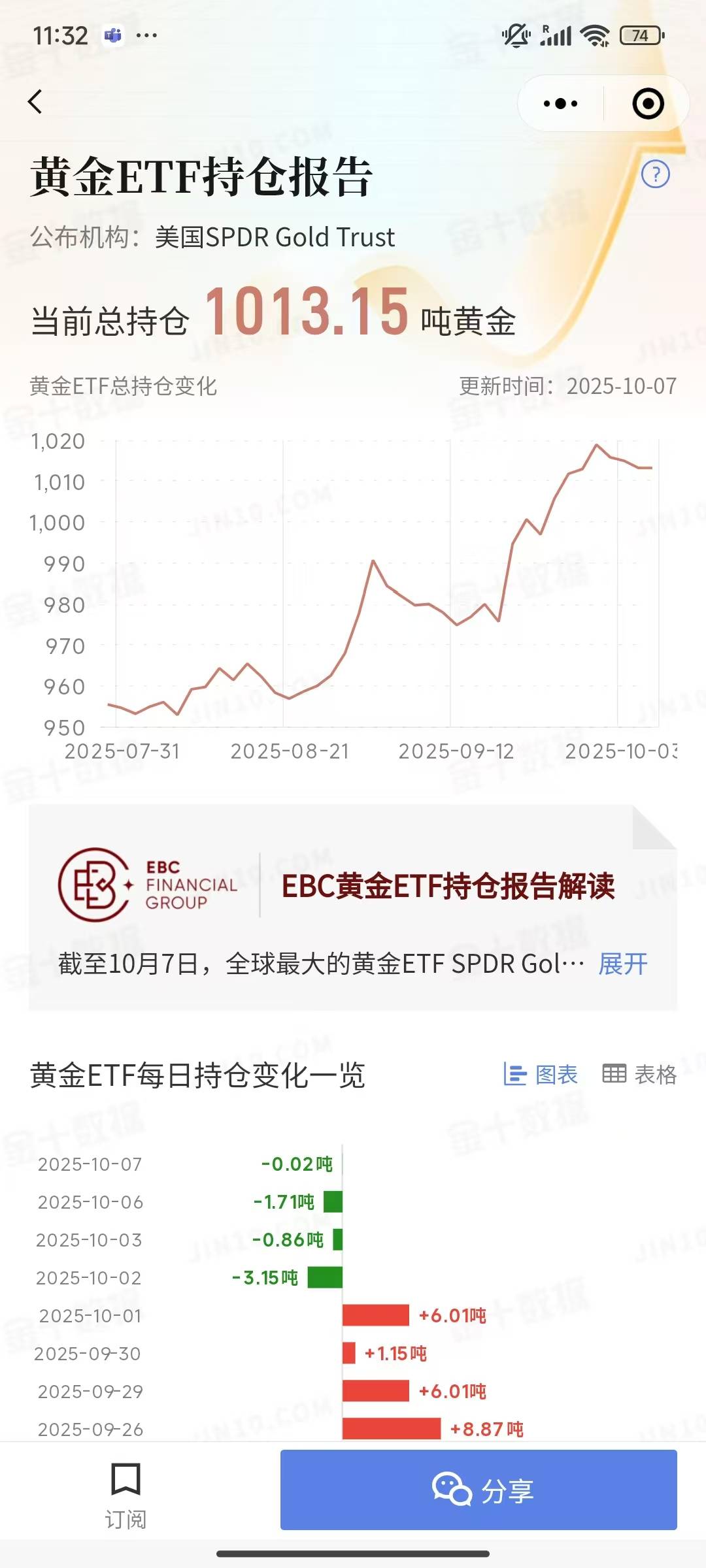
Core Viewpoint - The SPDR Gold Trust, the world's largest gold ETF, reported a total holding of 1013.15 tons of gold as of October 7, 2025, reflecting a slight decrease of 0.02 tons from the previous trading day. The price of spot gold reached a record high of $3990.90 per ounce, driven by strong demand for safe-haven assets amid ongoing U.S. government shutdown and expectations of further interest rate cuts by the Federal Reserve [2][7]. Group 1: Gold ETF Holdings - As of October 7, 2025, SPDR Gold Trust holds 1013.15 tons of gold, down by 0.02 tons from the previous day [7]. - The current gold ETF holdings indicate a strong interest in gold as a safe-haven asset during periods of economic uncertainty [7]. Group 2: Gold Price Movement - On October 7, spot gold prices peaked at $3990.90 per ounce, marking a significant increase of $23.49 or 0.59% [7]. - The price of gold is supported by expectations of a dovish stance from the Federal Reserve, with predictions of rate cuts in October and December [7][8]. Group 3: Market Influences - The ongoing U.S. government shutdown, now in its seventh day, has heightened demand for gold as a safe-haven asset [7]. - Geopolitical tensions in France and Japan have also contributed to increased global demand for gold [8]. Group 4: Future Outlook - Goldman Sachs has raised its long-term gold price forecast for 2026 from $4300 to $4900, citing strong inflows into gold ETFs and continued central bank purchases [8]. - Technical indicators suggest that while gold is in an upward trend, caution may be warranted as it approaches the psychological barrier of $4000 per ounce [8][9].
现货黄金突破4000美元,是顶点还是新起点?
Feng Huang Wang· 2025-10-08 03:54
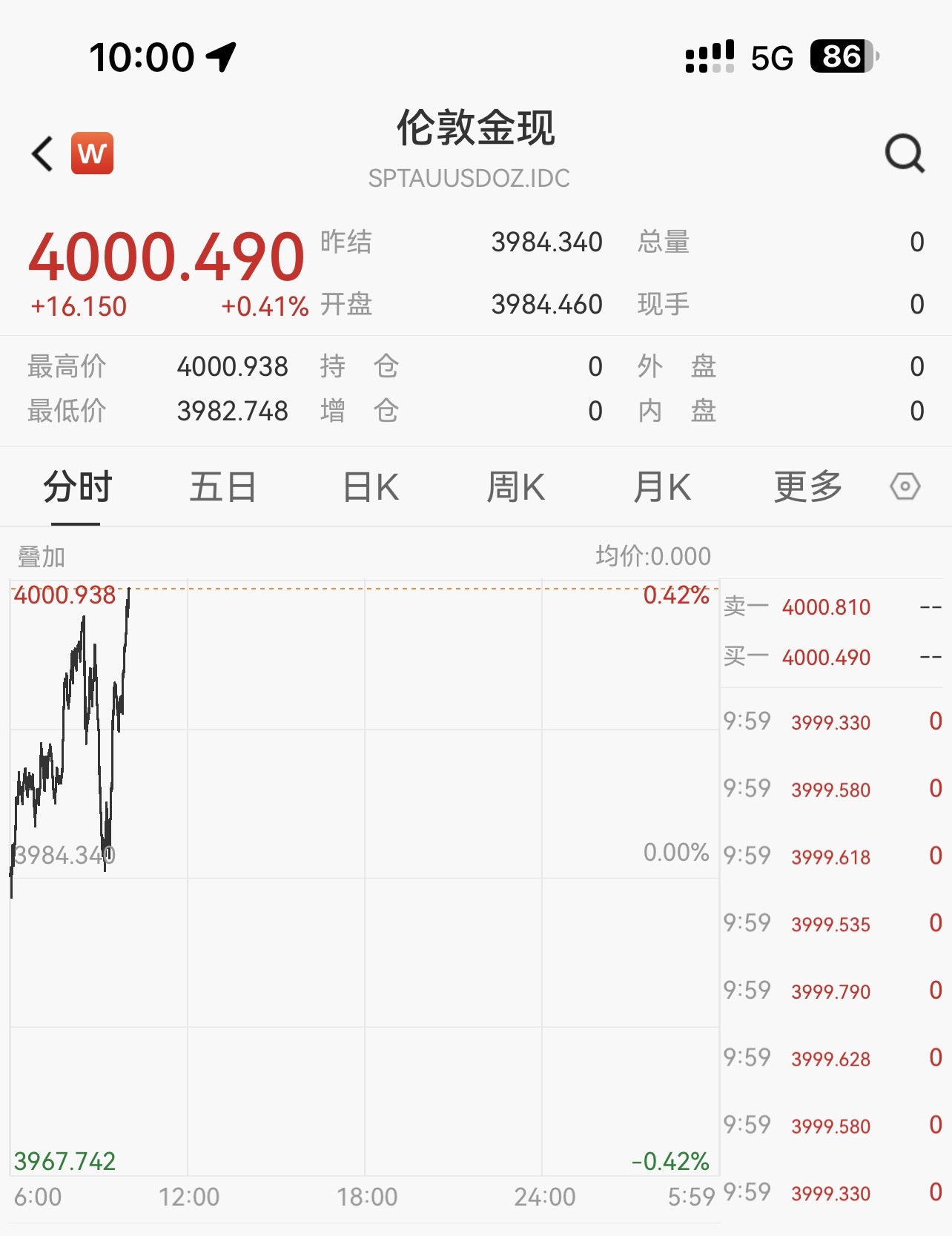
Group 1 - The core viewpoint of the articles highlights the significant rise in gold prices, with spot gold reaching $4000.49 per ounce and a year-to-date increase of over 50% [2][6] - On October 8, domestic gold jewelry prices in China surpassed 1160 yuan per gram, with notable brands like Lao Miao and Chow Sang Sang reaching 1176 yuan and 1165 yuan per gram respectively [3] - The recent surge in gold prices is attributed to geopolitical tensions, aggressive U.S. trade policies, and central banks' increased gold purchases, which have collectively driven gold's price up significantly [6][7] Group 2 - The People's Bank of China has continued to increase its gold reserves, reaching 7406 million ounces by the end of September, marking the 11th consecutive month of accumulation [7] - Goldman Sachs has raised its gold price target for the end of 2026 to $4900 per ounce, citing strong demand from Western ETFs, central banks, and speculative positions [8][9] - UBS forecasts that gold prices will reach $4200 per ounce by the end of this year, driven by fundamental and momentum support, with key variables including the Federal Reserve's interest rate path and geopolitical risks [9]
突发!金价又爆了,再创历史新高
Xin Lang Cai Jing· 2025-10-08 03:32
Group 1 - The core viewpoint is that gold prices have surged significantly, with spot gold breaking the $4000 per ounce mark, marking a year-to-date increase of over 52% [1][4] - COMEX gold futures also rose, reaching $4018.4 per ounce, indicating strong market demand for gold as a safe-haven asset [1][4] - Goldman Sachs has raised its gold price forecast for December 2026 from $4300 to $4900 per ounce, citing strong inflows into exchange-traded funds (ETFs) and continued central bank purchases [4] Group 2 - Domestic gold jewelry prices have increased, with Lao Miao gold jewelry priced at 1176 RMB per gram and Chow Sang Sang gold jewelry at 1165 RMB per gram [3][4] - The market's support for safe-haven assets has significantly strengthened, contributing to the rise in international gold prices [4]
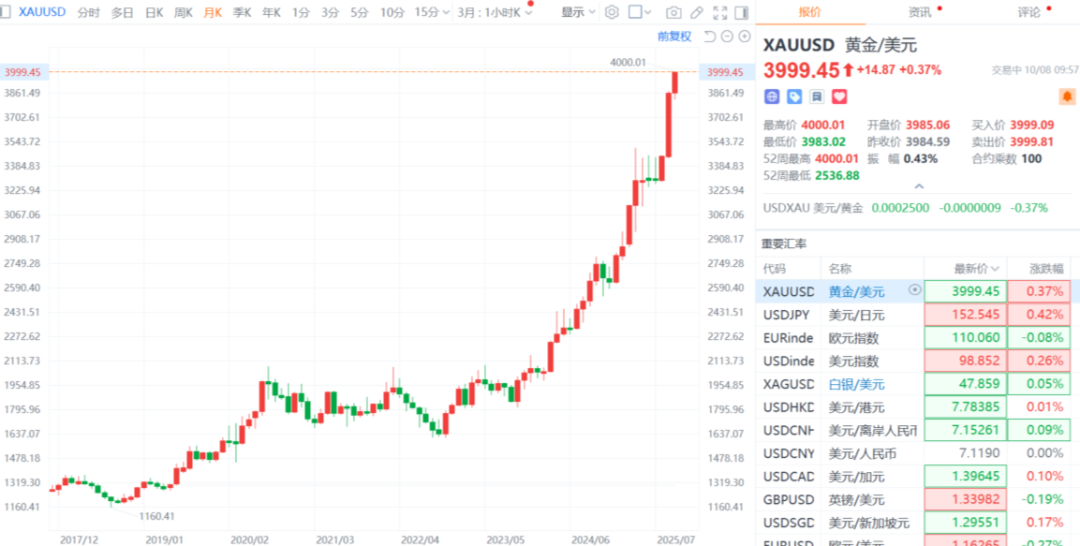
现货黄金历史性突破4000美元大关,年内涨幅超50%
Sou Hu Cai Jing· 2025-10-08 02:33
Core Viewpoint - Spot gold has historically surpassed the $4000 per ounce mark, driven by factors such as the U.S. government shutdown, a pullback in tech stocks, and global political uncertainties [1][4]. Group 1: Market Dynamics - Investors are flocking to the gold market seeking refuge amid escalating global economic and geopolitical risks, with gold prices soaring over 50% this year [4]. - The recent surge in gold prices is primarily catalyzed by the ongoing U.S. government shutdown, which has delayed key economic data and increased uncertainty regarding the Federal Reserve's interest rate decisions [4][5]. - Market expectations suggest a 25 basis point rate cut by the Federal Reserve this month, which typically enhances the appeal of non-yielding assets like gold [5]. Group 2: Global Political Factors - Political turmoil in various regions, including France and Japan, has intensified concerns over fiscal risks, further boosting demand for gold as a safe haven [5][6]. - The resignation of French Prime Minister Le Maire and the potential leadership change in Japan have contributed to market uncertainty, prompting increased investment in gold [5][6]. Group 3: Long-term Trends - The narratives of "de-dollarization" and "de-globalization" are providing structural support for the long-term rise in gold prices, as global investors shift from the dollar to safe-haven assets [7]. - Strong institutional demand is a significant characteristic of the current bull market, with central banks, including the People's Bank of China, actively increasing their gold reserves [8]. Group 4: Investor Sentiment - Despite the bullish outlook, some analysts caution about potential short-term pullbacks due to the rapid pace of price increases, suggesting that profit-taking may occur [9]. - More strategists recommend that investors increase their gold allocation to hedge against dollar risks and prepare for future market shocks, with a suggested allocation of around 5% [9].
现货期货金价均又创新高,高盛已上调金价预期
Sou Hu Cai Jing· 2025-10-08 02:28
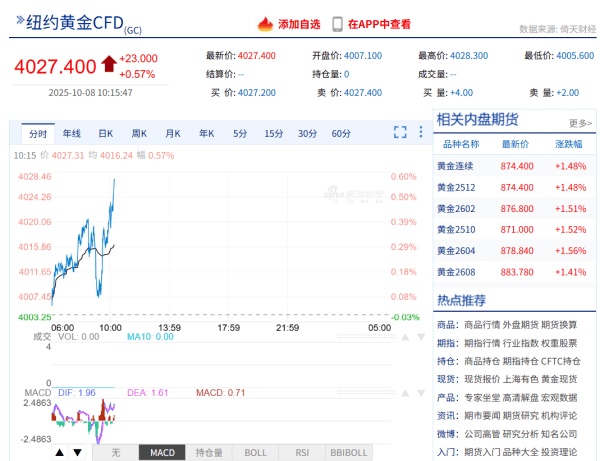
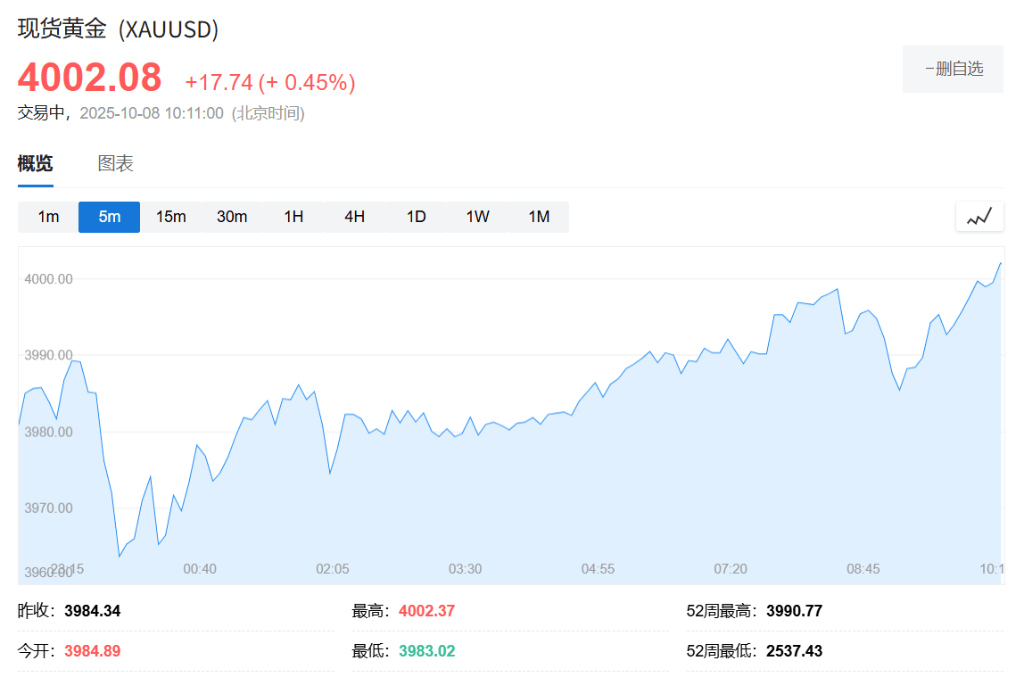
10月8日,纽约黄金期货在日前突破4000美元每盎司大关后继续上涨。截至发稿,纽约黄金期货价格已 超4027美元,其它黄金相关期货也纷纷上涨。 据每日经济新闻报道,多位市场分析人士认为,这轮金价迅速攀升的背后,是地缘政治紧张、美联储政 策预期摇摆及美国政府"停摆"危机叠加引发的避险情绪爆发。尤其是在非农就业数据延迟、美联储沟通 窗口模糊的背景下,黄金作为避险资产的独特价值再次凸显。 东方金诚首席宏观分析师王青指出,特朗普政府上台后,全球政治、经济形势出现新变化,国际金价有 可能在相当长一段时间内易涨难跌。王青分析,9月美联储恢复降息,美国政府持续对美联储货币政策 独立性施加压力,加之国际地缘政治风险居高不下,带动当月国际金价涨幅明显扩大。 受此影响,高盛日前已将2026年12月金价预期从此前的每盎司4300美元上调至4900美元,理由包括西方 市场交易所交易基金(ETF)资金流入强劲,以及各国央行有望持续购金。 此外,现货伦敦金价格截至发稿也已超4000美元,在年内已涨超50%的情况下又创历史新高。 ...