
反内卷

Search documents
申万宏观:开局之年,地方如何“因地制宜”?
Xin Lang Cai Jing· 2025-12-26 06:18
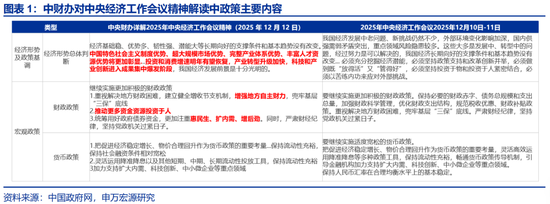
Group 1 - The central economic work conference emphasizes the need for structural changes in domestic demand and the concept of "anti-involution" across three levels [2][3][41] - The central financial office highlights the importance of leaving room for future risks in fiscal policy and the forward-looking, scientific adjustment of monetary policy [2][41] - The focus on optimizing consumption structure indicates a shift from commodity consumption to a balance between commodity and service consumption, aligning with current consumption trends [2][48] Group 2 - Investment strategies should combine investments in physical infrastructure and human capital, with a focus on consumer-related infrastructure projects [11][51] - The central financial office plans to implement major projects under the 14th Five-Year Plan and guide private investment towards high-tech and service sectors [11][51] - The emphasis on establishing a unified national market and "anti-involution" measures requires precise actions from the market, government, and enterprises [3][54] Group 3 - The fiscal and tax departments are focused on ensuring financial stability while addressing local fiscal difficulties, including the issuance of long-term special government bonds [4][58] - Financial regulatory bodies are using various tools to support the real economy and the real estate market, emphasizing the importance of timing and intensity in policy implementation [4][59] - The industrial departments are collaborating to cultivate new productive forces, particularly in digital transformation and key technology breakthroughs [4][65] Group 4 - Local governments are adapting the central economic work conference's spirit to their specific circumstances, focusing on breaking "involution," promoting "investment in people," and establishing a correct view of performance [5][66] - Different regions are pursuing development strategies based on their unique endowments, with eastern regions emphasizing outward competition and future technology, while central and western regions focus on green, transitional, and security aspects [5][34][66] - The emphasis on "investment in people" indicates a shift towards enhancing human capital alongside physical investments, with local governments recognizing the importance of this balance [5][66]

部委与地方学习中央经济工作会议精神解析:开局之年,地方如何“因地制宜”?
Shenwan Hongyuan Securities· 2025-12-26 06:17
宏 观 研 究 国内政策 中央经济工作会议后,中财办、相关部委及地方政府迅速推进会议精神的学习贯彻工作。其释 放的增量信息与政策信号有何深意?本文分析,可供参考。 中财办对中央经济工作会议的解读更具体,突出内需结构性变化与"反内卷"的三个层次等。 中央经济工作会议后,中财办、相关部委及地方政府围绕扩大内需、反内卷、新质生产力等方 向,密集开展会议精神的学习、解读与部署工作。各部门和地区部署亮点纷呈:中财办研判消 费结构演变等,财税部门聚焦财力保障,经济大省侧重开放布局,边疆地区强化安全建设。 中财办解读中央经济工作会议精神,重点强调财政"为未来风险留有余地"与货币政策"前瞻 性、科学性调节"两大核心方向。融资条件方面,其提出"促进社会综合融资成本低位运行", 与此前货币政策执行报告"推动社会综合融资成本下降"的表述有所变化。 内需方面,中财办提出把握消费结构性变化,坚持投资于物与投资于人相结合。其指出"我国 正在从以商品消费为主转向商品消费和服务消费并重",契合今年消费现状;投资方面则聚焦 消费类基建,并提出"靠前实施具备条件的'十五五'重大项目"。 改革方面,中财办注重统一大市场与"双碳"建设。"反内卷"层 ...
碳中和50ETF(159861)涨超1.3%,电力设备需求与技术迭代受关注
Mei Ri Jing Ji Xin Wen· 2025-12-26 06:10
Group 1 - The core viewpoint highlights that the demand for electric power equipment and technological iterations are gaining attention, with the carbon-neutral 50 ETF (159861) rising over 1.3% on December 26 [1] - Domestic wind power installations are expected to remain high by 2026, with the industry chain profits set to recover as "anti-involution" orders are delivered and bidding prices stabilize [1] - Global offshore wind power is expanding rapidly due to technological advancements and policy support, benefiting core segments such as foundational engineering and submarine cables [1] Group 2 - The photovoltaic industry is experiencing a positive impact from policy and market mechanisms, with "anti-involution" effects becoming evident, leading to deeper integration in silicon material and accelerated exit of outdated capacities [1] - The battery segment is expected to see a price increase cycle in 2026, with revenue and profits rising, driven by unexpected demand for energy storage and new technological catalysts [1] - The lithium battery industry chain has emerged from the cyclical bottom, with demand maintaining unexpectedly high growth and prices stabilizing, while supply tightness is observed in segments like 6F and electrolytes [1]
政策高频 | 中财办详解经济工作会议精神(申万宏观·赵伟团队)
申万宏源宏观· 2025-12-26 05:50
(二)《求是》发表重要文章《扩大内需是战略之举》 12月15日,《求是》发表重要文章《扩大内需是战略之举》,整理了2015年10月至2025年10月期间有关 扩大内需的重要论述。如2024年中央经济工作会议提到,要加快补上内需特别是消费短板,使内需成为拉动 经济增长的主动力和稳定锚;《关于〈中共中央关于制定国民经济和社会发展第十五个五年规划的建议〉的 说明》则强调坚持扩大内需这个战略基点,坚持惠民生和促消费、投资于物和投资于人紧密结合,大力提振 消费。 | 图表 19:《求是》发表重要文章《扩大内需是战略之举》 | | --- | | 事件 | 会议 | 主要观点 | | --- | --- | --- | | | | 过去,我国生产能力滞后,因而把工作直点放在扩大投资、提高生产能力上。现在,产能总体过剩,仍一味靠扩大规模投资 | | 2015/10/29 党的十八届五中全会第二次全体会议 | | 抬高速度,作用有限目边际效用递减。虽然短期内投资可以成为拉动经济增长的重要动力,但最终消费才是经济增长的持久 | | | | 动力 ... | | 2016/1/18 | 省部级主要领导干部学习贯彻党的十 | 供给 ...

热点思考 | 开局之年,地方如何“因地制宜”?(申万宏观·赵伟团队)
申万宏源宏观· 2025-12-26 05:50
Core Viewpoint - The article analyzes the implementation of the Central Economic Work Conference's spirit by the Central Financial Office, relevant ministries, and local governments, focusing on expanding domestic demand, countering "involution," and fostering new productive forces [2][8]. Group 1: Central Financial Office's Interpretation - The Central Financial Office emphasizes two core directions: leaving room for future risks in fiscal policy and forward-looking, scientific adjustments in monetary policy [9][48]. - It highlights the structural changes in consumption, indicating a shift from goods consumption to a balance between goods and service consumption, aligning with current consumption trends [11][48]. - Investment focus is on consumer-related infrastructure and the early implementation of significant projects under the "14th Five-Year Plan" [16][48]. Group 2: Ministry-Level Deployment - Fiscal departments are concentrating on financial security, addressing local fiscal difficulties, and utilizing various government bond funds [23][54]. - Financial regulatory bodies are using diverse tools to support the real economy and the real estate market, emphasizing the importance of timing and intensity in policy implementation [26][54]. - Industry departments are collaborating to cultivate new productive forces, focusing on digital transformation and key technological advancements [29][54]. Group 3: Local Implementation - Local governments are focusing on breaking "involution," promoting "investment in people," and establishing a correct view of performance, with regions like Guangdong and Henan actively participating in these initiatives [5][55]. - Different regions are tailoring their development strategies based on local endowments, with eastern areas emphasizing outward competition and future technologies, while central and western regions focus on green, transitional, and security aspects [38][42]. - The emphasis on "investment in people" is rising, with localities like Beijing and Inner Mongolia highlighting the need for coordination between material and human capital accumulation [35][55].
金融期货早评-20251226
Nan Hua Qi Huo· 2025-12-26 05:14
1. Report Industry Investment Ratings No industry investment ratings are provided in the report. 2. Core Views of the Report Financial Futures - **Macro**: Overseas, the US GDP in Q3 grew by 4.3% year - on - year, and the employment market recovered, weakening the rate - cut expectation. Domestically, the government will continue to implement proactive fiscal and moderately loose monetary policies, with expanding domestic demand as the primary task next year. However, the domestic demand in November was weak, still needing policy support [2]. - **Renminbi Exchange Rate**: Although there is an expectation that the RMB will "break 7 and enter 6" in 2026, there are three potential risks. The RMB's real purchasing power is underestimated, and the narrowing of the Sino - US interest rate spread is the core trigger for its appreciation. The attractiveness of the capital market has become a key variable for the exchange - rate trend [4]. - **Stock Index**: In the short term, it is expected to fluctuate strongly. Although the market sentiment has improved, there is still pressure on the index due to the approaching year - end and tightened capital [7]. - **Treasury Bond**: Maintain a non - pessimistic view on the medium - term bond market. Hold mid - term long positions [8]. - **Container Shipping to Europe**: The market is in a narrow - range consolidation, weighing between "weak reality" and "strong expectation", waiting for a clear pre - holiday driver [9]. Commodities Non - ferrous Metals - **Platinum & Palladium**: In the medium - to - long term, the bull market foundation of platinum remains. In the short term, beware of adjustment risks due to the large futures - spot price difference and light spot trading [16]. - **Gold & Silver**: In the short term, gold is in a relatively strong state after breaking through the previous high, while silver has high price risks. In the medium - to - long term, maintain a bullish view [17]. - **Copper**: The copper price has exceeded the expected range. After reaching a new high, the long - short game intensifies, and the price volatility is expected to increase in Q1 [19]. - **Aluminum Industry Chain**: For aluminum, it is expected to fluctuate strongly in the medium term. For alumina, it is in an oversupply situation and is expected to run weakly. For cast aluminum alloy, it is expected to fluctuate strongly [21][22]. - **Zinc**: It is expected to maintain a high - level shock in the short term [23]. - **Nickel - Stainless Steel**: It is expected to have a wide - range shock [24]. - **Tin**: It is expected to have a wide - range shock, and it is recommended to operate within the range [25]. - **Lithium Carbonate**: In the short term, beware of sharp fluctuations. In the medium - to - long term, there are opportunities to go long on dips [26]. - **Industrial Silicon & Polysilicon**: Industrial silicon is in a supply - demand double - weak pattern, with value for long - term bottom - fishing. Polysilicon has deviated from the fundamentals, and new registered warehouse receipts should be monitored [27][28]. - **Lead**: It is expected to fluctuate between 16700 - 17500 in the short term [29]. Black Metals - **Rebar & Hot - Rolled Coil**: The steel price is expected to fluctuate at a low level, with the rebar 2605 contract between 2900 - 3300 and the hot - rolled coil 2605 contract between 3000 - 3400 [30][31]. - **Iron Ore**: It is expected to run within a range, with limited upside space after valuation repair [33]. - **Coking Coal & Coke**: As the terminal winter - storage replenishment approaches, the coking - coal inventory structure is expected to improve. For coke, if steel mills resume production quickly, the supply - demand structure is expected to improve [35][36]. - **Ferrosilicon & Ferromanganese**: They are expected to fluctuate strongly in the short term, but the upside space is limited, and they may follow the steel - price trend [37][38]. Energy and Chemicals - **Pulp - Offset Paper**: The current market is neutral. The "breaking 7" of the RMB brings macro - level benefits, and the price has rebounded from a low level. For offset - paper futures, the market sentiment has improved, and it is recommended to wait and see or try short - term long positions [39][40][41]. - **Crude Oil**: The escalating geopolitical situation between the US and Venezuela will drive up the short - term oil price. Follow - up attention should be paid to the development of the situation [43]. - **LPG**: The fundamentals are stable. The near - term price has support, while the expected price is under pressure [44][45]. - **PTA - PX**: PX is in a good supply - demand pattern and is expected to be easy to rise and difficult to fall. PTA's processing - fee expectation center moves up, but the space is limited [47][48][49]. - **MEG - Bottle Chip**: The demand for ethylene glycol is weakening, and the supply has initially shown support signals. The over - supply expectation will continue to suppress the valuation [50][51]. - **Methanol**: The fundamentals are mixed, with a near - term weak and long - term strong expectation. Hold the 1 - 5 reverse spread [53]. - **Pure Benzene - Styrene**: Pure benzene is in an over - supply situation, with an internal - weak and external - strong pattern. Styrene has changed from strong reality to weak expectation, and the follow - up should focus on relevant news [56]. - **Soda Ash & Caustic Soda**: Soda ash is in an over - supply situation, and the price is expected to be under pressure. Glass needs to digest high inventory, and caustic soda is expected to fluctuate weakly [57][58][62]. - **Log**: It has low volatility, with limited upside and downside space. Consider interval operations [63][64]. - **Propylene**: It maintains a loose supply situation and is expected to fluctuate at a low level [65][66]. Agricultural Products - **Hogs**: In the long - term, it can be bullish, but in the short - to - medium term, focus on the fundamentals. The near - term出栏 pressure remains, while the far - term is affected by expectations and shows a strong trend [67]. - **Oilseeds**: The external - market soybeans are waiting for the January USDA report, and the internal - market soybean meal should focus on the supply increase from state reserves. Wait for a definite opportunity [68][69]. - **Oils and Fats**: In the short term, they will continue to fluctuate. Palm oil is relatively strong in the sector, and attention should be paid to the production and biodiesel market information [70]. - **Cotton**: In the short term, the hedging pressure on cotton prices is gradually digested. In the long - term, the supply - demand may be tight, and attention should be paid to pre - holiday downstream orders [71][72]. - **Sugar**: In the short term, it is difficult for the sugar price to rise further after the basis repair [73][74]. - **Eggs**: The long - term egg - laying hen capacity is still excessive, and the price is under pressure. In the short term, some farmers are culling hens. It is recommended to take a light - position long position if betting on a rebound [74][75]. - **Apples**: The near - term is strong, and the far - term is weak. Wait for the price to pull back to go long [76][77]. - **Jujubes**: In the short term, the jujube price is expected to fluctuate at a low level. In the long - term, the supply - demand is loose, and the price will be under pressure [78][79]. 3. Summaries According to Relevant Catalogs Financial Futures - **Market News**: The Chinese Ministry of Commerce responded to issues such as the relaxation of rare - earth magnet exports to the US, TikTok's joint - venture establishment in the US, and opposed the US's additional 301 tariffs on Chinese semiconductor products. Japan plans to launch a record - high budget of 122 trillion yen in the new fiscal year [1]. - **Renminbi Exchange Rate**: The on - shore RMB against the US dollar closed at 7.0066 on the previous trading day, and the mid - price rose. Japan raised its economic forecast for the 2025 fiscal year and is approaching the 2% inflation target [3]. - **Stock Index**: The stock index closed up on the previous trading day, and the market sentiment improved. However, there is pressure on the index due to the approaching year - end [5][7]. - **Treasury Bond**: The treasury bond closed down on Thursday, and the trading volume of medium - and long - term varieties continued to shrink. The market adheres to a non - pessimistic view on the medium - term [7][8]. - **Container Shipping to Europe**: The futures market fluctuates between "weak reality" and "strong expectation", with spot - price increase games and geopolitical disturbances [9][12]. Commodities Non - ferrous Metals - **Platinum & Palladium**: The overseas market was closed for Christmas, and the Guangzhou Futures Exchange continued to limit positions. The long - term prospects of platinum are good, but beware of short - term adjustment risks [14][16]. - **Gold & Silver**: The overseas market was closed for Christmas, while the domestic night - session was active. Silver rose sharply. Pay attention to the appointment of the new Fed chairman and economic data [17]. - **Copper**: The CSPT did not set a spot - purchase guidance price for Q1 2026. The copper price has reached a new high, and the price volatility is expected to increase in Q1 [18][19]. - **Aluminum Industry Chain**: The aluminum price is expected to fluctuate strongly in the medium term, alumina is in an over - supply situation, and cast aluminum alloy is expected to follow the aluminum - price trend [20][21][22]. - **Zinc**: The zinc price has strong support below. The supply is expected to be loose in the long - term, but the short - term raw - material supply is tight. It is expected to fluctuate at a high level [22][23]. - **Nickel - Stainless Steel**: They showed a slight correction and are expected to fluctuate widely. The nickel - ore market is expected to be stable and strong, and the stainless - steel market is relatively stable [23][24]. - **Tin**: It fluctuated widely at a high level. The supply from Myanmar and Indonesia is expected to recover in December, and the demand has no obvious increase in the short term [25][29]. - **Lithium Carbonate**: The futures price decreased, and the trading volume and open interest declined. The industry is in a state of production increase and inventory reduction [25][26]. - **Industrial Silicon & Polysilicon**: Industrial silicon is in a supply - demand double - weak pattern, and polysilicon has deviated from the fundamentals. Pay attention to new registered warehouse receipts [27][28]. - **Lead**: The lead price rebounded slightly. The supply is decreasing, and the demand is stable. It is expected to fluctuate between 16700 - 17500 [28][29]. Black Metals - **Rebar & Hot - Rolled Coil**: The steel price rebounded due to the rise of coking coal and iron ore prices and then fluctuated. The supply may increase, and the demand is in the off - season [30][31]. - **Iron Ore**: The port inventory is accumulating, but the steel - mill inventory is low. The iron - water production is expected to bottom out, and the price is expected to run within a range [32][33]. - **Coking Coal & Coke**: The coking - coal inventory structure is deteriorating, and the coke's third - round price cut has been fully implemented. As the terminal winter - storage replenishment approaches, the coking - coal inventory structure is expected to improve [34][35][36]. - **Ferrosilicon & Ferromanganese**: They rebounded from the bottom last week due to policy and cost factors. The supply may decrease, and the demand is expected to decline [37][38]. Energy and Chemicals - **Pulp - Offset Paper**: The pulp price rebounded from a low level, and the offset - paper market sentiment improved. The port pulp inventory is decreasing, and some pulp mills have reduced prices [39][40][41]. - **Crude Oil**: The overseas market was closed for Christmas. The escalating geopolitical situation between the US and Venezuela will drive up the short - term oil price [42][43]. - **LPG**: The LPG price fluctuated, and the fundamentals were stable. The near - term price has support, while the expected price is under pressure [44][45]. - **PTA - PX**: PX is in a good supply - demand pattern, and PTA's production has decreased significantly. The PTA processing - fee expectation center moves up, but the space is limited [47][48][49]. - **MEG - Bottle Chip**: The demand for ethylene glycol is weakening, and the supply has initially shown support signals. The over - supply expectation will continue to suppress the valuation [50][51]. - **Methanol**: The methanol price is mixed, with a near - term weak and long - term strong expectation. Hold the 1 - 5 reverse spread [52][53]. - **Pure Benzene - Styrene**: Pure benzene is in an over - supply situation, and styrene has changed from strong reality to weak expectation. Follow - up attention should be paid to relevant news [54][56]. - **Soda Ash & Caustic Soda**: Soda ash is in an over - supply situation, and the price is expected to be under pressure. Glass needs to digest high inventory, and caustic soda is expected to fluctuate weakly [57][58][62]. - **Log**: It has low volatility, with limited upside and downside space. Consider interval operations [63][64]. - **Propylene**: It maintains a loose supply situation and is expected to fluctuate at a low level [65][66]. Agricultural Products - **Hogs**: The futures price decreased slightly, and the spot price showed regional differences. The long - term can be bullish, but focus on the short - to - medium - term fundamentals [67]. - **Oilseeds**: The external - market was closed for Christmas. The soybean supply is expected to be stable, and the rapeseed supply is low. Wait for a definite opportunity [68][69]. - **Oils and Fats**: The external - market was closed for Christmas. Palm oil production is expected to decline, and the demand is expected to increase. The overall market will continue to fluctuate [70]. - **Cotton**: The external - market was closed for Christmas, and the domestic cotton price rose. The new - season cotton - planting area in Xinjiang is expected to decrease, and attention should be paid to pre - holiday downstream orders [71][72]. - **Sugar**: The external - market was closed for Christmas, and the domestic sugar price fell. In the short term, it is difficult for the sugar price to rise further after the basis repair [73][74]. - **Eggs**: The futures price was stable, and the spot price was mainly stable. The long - term egg - laying hen capacity is excessive, and some farmers are culling hens [74][75]. - **Apples**: The futures price fluctuated horizontally, and the spot price was stable. The consumption has slowed down, and wait for the price to pull back to go long [76][77]. - **Jujubes**: The new - jujube harvest is basically completed. The short - term price is expected to fluctuate at a low level, and the long - term supply - demand is loose [78][79].

磷酸铁锂龙头祭出“减产检修+涨价”组合拳
Xin Lang Cai Jing· 2025-12-26 05:00
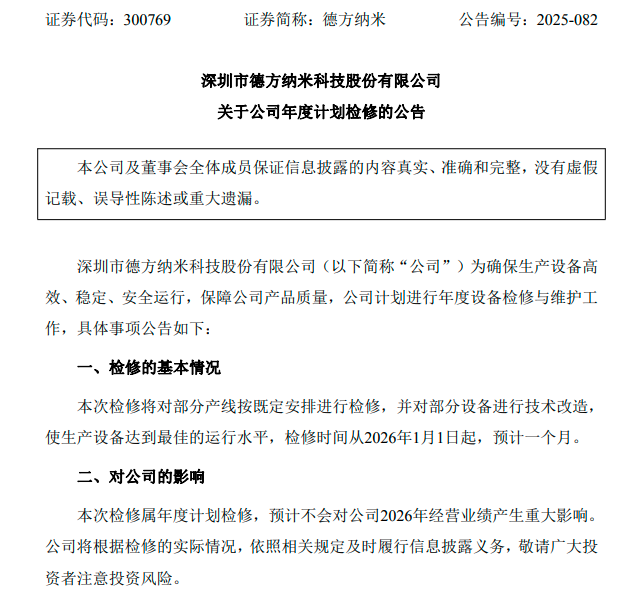
Core Viewpoint - The demand for lithium iron phosphate (LFP) materials is surging due to rapid growth in the downstream electric vehicle and energy storage markets, leading to full order books for leading companies until 2026, despite recent announcements of production cuts for maintenance by several major players [1][11]. Group 1: Production and Maintenance - Several leading LFP companies, including 德方纳米, 湖南裕能, and 万润新能, have announced production cuts for maintenance, with maintenance scheduled to start on January 1, 2026, for approximately one month [1][3][5]. - 湖南裕能 plans to reduce its phosphate positive material output by 15,000 to 35,000 tons during this maintenance period [3]. - 万润新能 expects a reduction of 5,000 to 20,000 tons in LFP production due to maintenance starting December 28, 2025 [5]. Group 2: Price Increases - A price increase trend has emerged among LFP manufacturers, with 湖南裕能 raising processing fees by 3,000 yuan per ton (excluding tax) [7]. - The price of battery-grade lithium carbonate has surged over 50% from its mid-year low, now ranging from 97,200 to 100,000 yuan per ton [7]. - The overall cost of upstream raw materials, including lithium salts and various auxiliary materials, has risen significantly, contributing to the price increase of LFP materials [7][19]. Group 3: Market Dynamics - In the first 11 months of 2025, LFP battery sales in China reached 760.5 GWh, capturing a market share of 72.8%, with a year-on-year growth rate of 66.9%, significantly outpacing the 18.6% growth of ternary lithium batteries [9][20]. - The LFP industry is facing challenges such as overcapacity and homogeneous competition, leading to significant pressure on profit margins [10][21]. - The profitability of LFP companies is low, with only 16.7% of companies in the sector reporting profits, which is considerably lower than other lithium battery materials [21]. Group 4: Financial Performance - The average asset-liability ratio of six listed LFP companies is as high as 67.81%, indicating financial strain within the industry [11][22]. - From the end of 2022 to August 2025, LFP material prices plummeted by 80.2%, from 173,000 yuan per ton to 34,000 yuan per ton, resulting in over 36 months of continuous losses for the industry [11][22]. - Leading companies, including 德方纳米 and 万润新能, have reported cumulative losses exceeding 10.9 billion yuan from 2023 to the third quarter of 2025 [11][22].



魏建军:魏牌至今仍缺乏营销能力,但这已不会阻碍品牌未来发展
Jing Ji Guan Cha Wang· 2025-12-26 04:42
Core Viewpoint - The founder and chairman of Great Wall Motors, Wei Jianjun, emphasized the need for improved marketing capabilities for the Wey brand, which has faced challenges in recent years due to frequent management changes and market competition [2][3]. Group 1: Company History and Leadership Changes - The Wey brand was established in 2016 and has seen nine different CEOs in its nine-year history, leading to concerns about its future [2]. - Wei Jianjun highlighted the importance of the brand's historical roots and personal naming conventions, linking it to a sense of responsibility and courage [2]. Group 2: Sales Performance and Market Challenges - The Wey brand initially experienced success, with the first model VV7 selling 86,000 units in its launch year, but sales declined significantly after 2021 due to increased market competition and price wars [3]. - The second-generation models faced challenges not solely due to marketing failures but also due to broader industry issues, including intensified price competition [3]. Group 3: Future Opportunities and Brand Strategy - Wei Jianjun believes that despite lacking marketing strength, the brand can still thrive by focusing on a healthy value system that prioritizes product quality and customer satisfaction [4]. - The new CEO, Zhao Yongpo, emphasized safety in the brand's offerings, showcasing the new Blue Mountain model's safety features through a dramatic demonstration [4]. Group 4: Technological Advancements - The newly launched Blue Mountain Intelligent Advanced Edition is the world's first mass-produced smart driving model equipped with the latest VLA model technology, which enhances vehicle safety through advanced features [4][5]. - The VLA model includes capabilities such as spatial semantic understanding and obstacle recognition, aimed at providing a safer driving experience in complex urban environments [5].

举牌、重组!银行业十大关键词,看这里!
券商中国· 2025-12-26 03:37
Core Viewpoint - In 2025, the Chinese banking industry is characterized by resilience amidst economic challenges, focusing on serving the real economy, embracing transformation, and maintaining a balance between national strategy and sustainable development [1] Group 1: Regulatory Indicators - Total assets of commercial banks are projected to grow from 380.52 trillion yuan at the end of 2024 to 409.63 trillion yuan by September 2025 [2] - The non-performing loan ratio is expected to fluctuate slightly, starting at 1.50% in December 2024 and reaching 1.52% by September 2025 [2] - The core tier one capital adequacy ratio is anticipated to decrease from 11% in 2024 to around 10.87% by September 2025 [2] Group 2: Industry Trends - The banking sector is shifting from aggressive expansion to a more cautious approach, emphasizing the need to avoid "involution" or excessive competition [3] - Regulatory bodies are actively working to curb harmful competition, leading to a collective industry effort to reduce risks and improve operational efficiency [3] Group 3: Interest Margin Protection - The banking industry is facing significant pressure on net interest margins, prompting banks to optimize asset allocation and diversify revenue sources [7][9] - Banks are focusing on cost control by reducing deposit rates and managing high-cost long-term deposits [8] Group 4: Deposit Migration - A trend of "deposit migration" is emerging as residents seek better investment channels due to low deposit rates, with bank wealth management products seeing significant growth [10] - The shift in deposit behavior is driven by a "price comparison effect," leading to a decline in demand for traditional long-term deposits [10] Group 5: Mergers and Restructuring - Over 400 banking institutions are expected to exit the market through mergers, dissolutions, or consolidations, marking a significant increase compared to previous years [11] - The restructuring efforts are focused on improving the quality of financial services rather than merely reducing the number of institutions [13] Group 6: Technological Finance - The banking sector is prioritizing technological finance, with a focus on supporting innovation and providing tailored financial products for tech companies [14][15] - The proportion of technology loans in total new loans has reached 28.8%, indicating a strong push towards financing technology-driven enterprises [15] Group 7: Capital Increases - A notable "capital increase wave" is occurring, with major state-owned banks raising 520 billion yuan through stock issuance to bolster capital adequacy [17] - Smaller banks are also responding by exploring various capital-raising methods, including targeted issuance and local state-owned capital participation [17] Group 8: Shareholder Engagement - The banking sector has seen a surge in insurance capital participation, with several banks experiencing significant shareholding increases from insurance companies [18] - Asset management companies are also actively increasing their stakes in various banks, indicating strong investor interest in the banking sector [18] Group 9: Corporate Governance Changes - A significant shift in corporate governance is underway, with many banks abolishing or not establishing supervisory boards, transitioning to a single board system [21][22] - This change aims to enhance efficiency and reduce governance costs while maintaining oversight through audit committees [22][24] Group 10: AI Integration - The banking industry is undergoing a transformation driven by artificial intelligence, with major banks adopting an "AI-first" strategy to enhance their operations [25][26] - AI applications are expanding from customer service to core business processes, indicating a shift towards value creation through technology [26]

中银证券:产业链涨价成趋势 终端开始接受高价组件
智通财经网· 2025-12-26 03:36
Group 1 - The core viewpoint of the report is that the photovoltaic industry is undergoing a "de-involution" process, characterized by two main routes: orderly exit of backward production capacity and stable continuation of new quality capacity [1][3] - Central state-owned enterprises are actively responding to the price increase of photovoltaic components, with a trend of rising bidding prices observed [2][3] - The industry is seeing a positive change in the price of components, with leading companies raising their component quotes and a strong willingness to maintain prices in the intermediate links of the supply chain [4] Group 2 - The "de-involution" strategy is a key focus for the photovoltaic industry, aiming to stabilize product prices and eliminate unhealthy competition [3] - Specific measures proposed by the government include promoting the orderly exit of backward capacity, curbing low-price competition, ensuring product quality, and supporting industry self-discipline [2][3] - Investment recommendations include companies such as Junda Co., Trina Solar, JA Solar, JinkoSolar, and LONGi Green Energy, with a focus on the potential for profit improvement in battery and component sectors [4]
