指数估值

Search documents
[6月24日]指数估值数据(螺丝钉定投实盘第370期发车;个人养老金定投实盘第20期;养老指数估值表更新)
银行螺丝钉· 2025-06-24 13:44
Market Overview - The overall market has risen, with the closing rating at 5 stars, very close to 4.9 stars [1] - All market caps (large, medium, and small) have increased, with small caps showing a more significant rise [2] - Value style has slightly increased, while growth style has seen a more substantial rise [3] Valuation Insights - The 300 Value and Preferred 300 indices have returned to normal valuations, with low valuation not far off [4] - The Hong Kong stock market has also seen an overall increase, remaining strong with 8 out of the last 9 weeks showing gains since early April [5][6] Sector Performance - Technology stocks in the Hong Kong market have led the gains, returning to normal valuations [8] - A significant drop in oil prices has occurred, contributing to lower energy prices, which may help reduce inflation and influence the Federal Reserve's interest rate decisions [9] Investment Strategies - The article discusses a systematic investment strategy using a "periodic but irregular" approach, where more is invested when valuations are lower [14] - Two methods for following investment strategies are outlined: manual and automatic tracking [16][17] Pension Fund Insights - The article includes details on personal pension fund investment strategies, highlighting specific funds and their current prices [19] - A valuation table for various indices is provided, showing metrics such as price-to-earnings ratios and dividend yields [23] Awards and Recognition - The investment advisory firm associated with the article has received the "Golden Bull Award" for three consecutive years, recognizing its performance in the market [24]


螺丝钉指数地图来啦:指数到底如何分类|2025年6月
银行螺丝钉· 2025-06-23 13:58
Core Viewpoint - The article introduces a comprehensive index map that includes various commonly used stock indices, their codes, selection rules, industry distribution, and average and median market capitalizations of constituent stocks, which will be regularly updated for easy reference [1][2]. Group 1: Types of Indices - The index map includes several categories of stock indices: broad-based indices, strategy indices, industry indices, thematic indices, and overseas indices [4][5]. Group 2: Specific Indices Overview - The Shanghai Stock Exchange 50 Index (000016.SH) consists of 50 large-cap, liquid stocks from the Shanghai A-share market, reflecting the performance of influential leading companies [5]. - The Shenzhen Component Index (399001.SZ) includes 500 large-cap, liquid companies from the Shenzhen Stock Exchange, representing the overall market performance [5]. - The ChiNext Index (399006.SZ) is composed of 100 representative companies from the ChiNext board, reflecting the market tier of innovative and growth-oriented enterprises [5]. - The MSCI A50 Index (746059.MI) selects the largest 50 stocks from the Shanghai and Shenzhen markets that are included in the Stock Connect programs [5]. - The Hang Seng Index (HSI.HI) measures the performance of the largest and most liquid companies listed in Hong Kong [5]. Group 3: Dividend Indices - The China Securities Dividend Index (000922.CSI) reflects the overall performance of high dividend yield companies in the Shanghai and Shenzhen markets [5]. - The Shanghai Dividend Index (000015.SH) aims to represent high dividend yield companies in the Shanghai market [5]. - The Hong Kong Stock Connect High Dividend Index (950090.CSI) tracks high dividend ordinary shares listed in mainland China [5]. Group 4: Performance Metrics - The article provides various performance metrics for different indices, including market capitalization and liquidity measures, which are essential for investors to assess the indices' effectiveness [5][6].

[6月22日]美股指数估值数据(美股红利,和A股港股红利,表现有何区别;全球指数星级更新)
银行螺丝钉· 2025-06-22 13:47
Core Viewpoint - The article discusses the valuation of global stock indices, U.S. Treasury indices, and the performance of dividend indices in different markets, highlighting the differences in investment opportunities and risks between domestic and overseas markets. Group 1: Global Stock Market Overview - The global stock market experienced an overall decline this week, with European stocks dropping more than 1% and Asian markets, including Hong Kong stocks, also facing downturns after previous gains [4][5]. - The fluctuations in the global market are primarily attributed to regional conflicts, which have a short-term impact on investor sentiment but are not expected to significantly affect the operations of listed companies [5]. Group 2: Dividend Performance Comparison - A-shares and Hong Kong stocks have shown strong dividend performance, while U.S. dividend indices have underperformed compared to the S&P 500 in recent years [6][11]. - The strong performance of A-shares and Hong Kong stocks is linked to the declining interest rates in RMB, making dividend-paying stocks more attractive compared to low-yielding bonds [13]. Group 3: U.S. Dividend Indices - U.S. dividend indices include various categories such as dividend aristocrats and shareholder return indices, which focus on companies with a history of increasing dividends or high share buybacks [8][10]. - The current yield of U.S. dividend indices is around 3-4%, which is less attractive compared to the yields available from U.S. dollar deposits and bonds [16]. Group 4: Investment Opportunities - There are currently no global stock index funds available in mainland China, but there are significant opportunities in overseas markets with global stock index funds totaling over a trillion dollars [20]. - The company has introduced a "Global Index Advisory Portfolio" that diversifies investments across multiple stock markets, including U.S., UK, Hong Kong, and A-shares [22]. Group 5: Valuation Data - The article provides a valuation table for various indices, including P/E ratios, P/B ratios, and dividend yields, indicating which indices are undervalued or overvalued [38][39]. - Indices highlighted as undervalued are suitable for regular investment, while those marked as overvalued should be approached with caution [41].

[6月20日]指数估值数据(港股反弹,港股指数估值如何;小微盘股波动变大;抽奖福利)
银行螺丝钉· 2025-06-20 13:08
Market Overview - The overall market experienced slight declines, closing around 5-5.1 stars [1] - The CSI 300 index saw a minor increase, while small and mid-cap stocks declined [2] - Value styles, including dividend stocks, showed strength with slight increases [3] - The liquor and consumer indices saw significant gains [4] - Hong Kong stocks performed well, with notable increases [5] - Hong Kong technology and dividend stocks also rose [6] - After recent gains, Hong Kong pharmaceutical stocks returned to normal valuations [7] - Hong Kong technology stocks experienced a pullback, approaching undervaluation [8] Small and Micro-Cap Stocks - Small and micro-cap stocks in A-shares often exhibit significant volatility [11] - In the past two years, three notable waves of volatility were observed: 1. In the second half of 2023, small micro-cap stocks surged, presenting high short-term risks [12] 2. By early 2024, options linked to these stocks faced liquidation, leading to a drop of over 30% in one month [13] 3. In late 2024, small micro-cap stocks rose by 20% while larger indices slightly declined, followed by a 20% drop in December [14] - The volatility of small micro-cap stocks has become more pronounced recently [16] Investment Landscape - The investment landscape for large and mid-cap stocks is increasingly characterized by index fund investments [18] - The CSI 300 has seen significant institutional investment, leading to reduced volatility [20] - The volatility of the CSI 300 is expected to continue decreasing, with a current annual volatility 60-70% higher than that of Western markets [23] - Small micro-cap stocks are primarily traded by retail investors, with increasing quantitative trading participation [25] - The lack of index funds for small micro-cap stocks contributes to their volatility [26] Implications for Investors - Public funds predominantly focus on large and mid-cap stocks, which are becoming more stable and mature [34] - Small micro-cap stocks are less represented in public funds, and investors should be cautious with their allocation [37] - The valuation of small micro-cap indices has returned to levels around 35-40% of the last ten years [39]

[6月19日]指数估值数据(港股下跌,港股科技重回低估;月薪宝的收益来源是什么;红利估值表更新;指数日报更新)
银行螺丝钉· 2025-06-19 12:47
Market Overview - The overall market experienced a decline today, closing at a 5-star rating [1] - Large-cap stocks saw less decline compared to small and mid-cap stocks, with value and dividend indices showing smaller fluctuations [2] - Growth style stocks faced more significant declines during market volatility [2] Hong Kong Stock Market - The Hong Kong stock market exhibited considerable volatility today [3] - After a significant drop in early April, the market rebounded strongly, with 8 out of 9 weeks showing gains, outperforming A-shares by 20% since the Lunar New Year [4] - The Hang Seng Index has seen three waves of increases and three waves of corrections over the past year [6] - The index's performance ranged from 16,000-17,000 points at a 5.9-star rating last year to 18,000-19,000 points at the beginning of this year, and 19,000-20,000 points after the April drop [7] - Earnings for Hong Kong stocks grew by 16% year-on-year in Q1, contributing to the market's gradual rise [8] - Future increases are expected to be accompanied by corrections of 10%-20%, similar to previous bull markets [9] Investment Products - The monthly salary product has shown relative stability, with minor fluctuations during market corrections [11] - The product typically follows a pattern of advancing three times and retreating once, with each correction leading to a gradual increase in the market's bottom [12] - A decline in deposit rates has led to an increase in income-generating assets, with products like dividends, REITs, and monthly salary products performing better in 2024 compared to previous years [13][14] Monthly Salary Product Composition - The monthly salary product consists of 40% stocks and 60% bonds, with a focus on value style for the stock portion [16][17] - Value style characteristics include lower volatility during bear markets and higher dividend yields, providing stable income regardless of market fluctuations [19][20] - The bond portion is primarily focused on short to medium-term bonds, with current interest rates around 1.6%-1.7% [21] - Rebalancing strategies have been employed to capitalize on market fluctuations, with the last adjustment occurring in early 2024 during a market dip [22][23] Future Expectations - The monthly salary product reached a historical high in Q2, surpassing previous stock purchase levels [23] - A rebalancing strategy is anticipated post-Q2, likely reducing stock exposure back to 40% and reallocating funds to bonds [26] - This rebalancing aims to create additional returns through low-buy high-sell opportunities, although such chances are not frequent [27] Dividend Indices and Funds - A summary of dividend indices and high-dividend funds' valuations has been provided for reference [30] - Various indices, such as the Hang Seng Dividend Index, have been analyzed for their earnings yield, dividend yield, and other financial metrics [31]

[6月18日]指数估值数据(未来消费行业还会起来么;ETF估值表已上线「今天几星」)
银行螺丝钉· 2025-06-18 12:49
Core Viewpoint - The article discusses the cyclical nature of various industries, particularly focusing on consumer, technology, and pharmaceutical sectors, highlighting their performance during different economic phases and the potential for recovery in the future [8][10][19]. Group 1: Market Performance - The overall market showed a slight decline at the opening but the drop narrowed by the close, with the CSI All Share Index experiencing a minor decrease [1]. - The CSI 300 Index saw a slight increase, while small-cap stocks faced more significant declines [2]. - Consumer stocks are on the rise, indicating a potential recovery in the sector [4]. Group 2: Sector Analysis - The technology sector in Hong Kong has recently experienced a downturn after weeks of gains, approaching a state of undervaluation [5][6][7]. - The pharmaceutical sector faced a decline in earnings from 2022 to the first half of 2024, but signs of recovery were noted in early 2024, with significant gains in the first quarter [11]. - The consumer sector has historically faced downturns during economic crises, such as the 2008 financial crisis and the 2012-2013 economic slowdown, but has also seen rapid recoveries following stimulus measures [13][16]. Group 3: Economic Cycles - The cyclical nature of industries means that periods of low earnings growth and low valuations are often followed by recovery phases where both earnings and valuations improve [26][28]. - The current consumer sector is compared to the pharmaceutical sector two years ago, indicating it is still in a low phase before a potential recovery [19][28]. - The article emphasizes that all sectors, including finance and energy, experience similar cyclical patterns, suggesting that investment opportunities arise during low periods [20][25].

[6月16日]指数估值数据(1星级大牛市10周年;月薪宝发薪日;黄金星级更新)
银行螺丝钉· 2025-06-16 14:00
Core Viewpoint - The article reflects on the 10th anniversary of the peak of the last major bull market in A-shares, highlighting the market's historical performance and the cyclical nature of stock valuations [5][6][24]. Market Performance - The market opened low but saw an increase by the close, maintaining a 5-star rating, close to 4.9 stars [1]. - Small-cap stocks experienced more significant gains compared to large-cap stocks, with the CSI 300 index showing a slight increase [2]. - Hong Kong stocks opened lower but rebounded by the close, with the Hang Seng Tech index leading the gains [3]. Historical Context - The peak of the last bull market in A-shares occurred on June 15, 2015, when the CSI All Share Index reached 8018 points [6]. - Following this peak, A-shares entered a prolonged bear market, with the index dropping to around 2300 points by 2013 [7][8]. - The market was characterized by low valuations, with the CSI 300 index trading at a price-to-earnings (P/E) ratio of only 8 times in 2014, and many stocks trading at P/E ratios of three to four times [12]. Economic Policies and Market Recovery - In the second half of 2014, a series of economic stimulus policies and interest rate cuts were introduced, leading to a rapid recovery in A-shares [14][15]. - The financial sector, particularly securities firms, benefited significantly from the ensuing bull market, with the CSI All Share Index rising from 2700 points in mid-2014 to 4253 points by the end of the year [16][17]. Market Dynamics - By mid-2015, the CSI All Share Index surged to 8018 points, driven by small-cap stocks which saw even more exaggerated gains [20]. - The average P/E ratio for small-cap stocks reached over 100 times, indicating a bubble [21]. - The market's rapid ascent from a 5-star rating to a 1-star rating occurred in less than a year due to the extreme volatility [22]. Long-term Trends - The article notes that the long-term annualized return for indices typically hovers around 8-10%, with significant fluctuations during bull and bear markets [26]. - The current market environment is described as being at a 5-star rating, suggesting it is a favorable time for investment [44]. Investment Strategies - The article discusses the importance of patience in investing, likening it to nurturing seedlings for long-term growth [49]. - It emphasizes the need for a balanced investment approach, particularly in the context of the recent adjustments to the "Monthly Salary Treasure" investment product, which now has a lower entry threshold and offers a systematic investment plan [38][42].

[6月15日]美股指数估值数据(港股红利类指数创新高;全球指数星级更新)
银行螺丝钉· 2025-06-15 13:58
Core Viewpoint - The article discusses the valuation of global stock indices, U.S. Treasury indices, and the performance of various dividend indices, highlighting investment opportunities in overseas markets and the recent trends in Hong Kong dividend indices. Group 1: Market Overview - The global stock market experienced minor fluctuations this week, returning to a rating of 3.2 stars [8] - The European market saw a slight decline, while the Asia-Pacific market remained stable [9][10] - Recent regional conflicts caused some volatility in global markets, but the impact on corporate operations is expected to be minimal and short-lived [11][12][13] Group 2: Hong Kong and A-shares Performance - The Hong Kong stock market experienced a pullback on Thursday and Friday, but overall, it showed a slight increase for the week [14] - A-shares remained stable with little fluctuation [15] - Notably, Hong Kong dividend indices have recently reached historical highs, including the Hong Kong Dividend Index, Hang Seng Dividend Low Volatility, and Shanghai-Hong Kong-Shenzhen Dividend Low Volatility [16][17] Group 3: Dividend Indices Valuation - The article provides a valuation table for various dividend indices, including earnings yield, price-to-earnings ratio, and dividend yield [20][21][22] - The recent rise in dividend indices is attributed to a decrease in deposit rates, leading to a shift of funds from deposits and bonds into dividend and REIT assets [27] - The valuation of dividend indices remains relatively low, with adjustments made during index rebalancing that typically lower the average price-to-earnings ratio of included stocks [28] Group 4: Global Investment Opportunities - The article mentions the availability of global stock index funds in overseas markets, which have substantial assets under management, but such options are limited in mainland China [32] - The company has introduced a "Global Index Advisory Portfolio" that diversifies investments across U.S., UK, Hong Kong, and A-shares to track global stock market performance [33] - There are current restrictions on the purchase amounts for overseas market investment funds, with a maximum daily purchase limit of 350 yuan [34] Group 5: New Book Release - The article announces the release of the new edition of "The Long-Term Investment Guide," which includes updated data and new chapters, emphasizing the importance of stock assets for long-term wealth accumulation [37][40] - The book has achieved significant sales rankings upon release, indicating strong interest in investment literature [38]

[6月15日]美股指数估值数据(港股红利类指数创新高;全球指数星级更新)
银行螺丝钉· 2025-06-15 13:58
Core Viewpoint - The article discusses the valuation of global stock indices, U.S. Treasury indices, and the performance of dividend indices, particularly in the Hong Kong market, highlighting recent trends and potential investment opportunities. Group 1: Global Stock Market Overview - The global stock market experienced minor fluctuations this week, with the global stock market index returning to 3.2 stars. European markets saw slight declines, while the Asia-Pacific markets remained stable. Recent regional conflicts caused short-term volatility but are not expected to significantly impact corporate operations [3][4]. - The Hong Kong stock market experienced a pullback on Thursday and Friday, but overall, it showed slight gains from Monday to Wednesday. The A-share market also exhibited minimal fluctuations [5]. Group 2: Dividend Indices Performance - Despite recent global stock market volatility, Hong Kong's dividend indices have reached historical highs, with three main indices: Hong Kong Dividend, Hang Seng Dividend Low Volatility, and Shanghai-Hong Kong-Shenzhen Dividend Low Volatility [6][7]. - The article provides detailed valuation tables for various dividend indices, including metrics such as earnings yield, price-to-earnings ratio, and dividend yield [9][10][11][12]. Group 3: Investment Trends and Valuation Insights - The rise in dividend indices is attributed to the decline in deposit rates over the past two years, leading to a shift of funds from deposits and bonds into dividend-paying assets and REITs [17]. - The valuation of dividend indices remains relatively low, with adjustments made during index rebalancing that typically lower valuations by selecting stocks with lower price-to-earnings ratios [19][20]. - The article notes that the global stock index can be accessed through various overseas funds, although domestic options are limited. A global index advisory portfolio has been introduced to simulate similar investment effects [27][29]. Group 4: New Book Release - The article mentions the release of a new edition of "The Long-Term Investment Guide," which has gained significant attention and sales, emphasizing its historical impact and updated data over the past 30 years [34][36].

增量信号成关键变量,A500ETF基金(512050)交投活跃,成交额超17亿元
Sou Hu Cai Jing· 2025-06-13 03:32
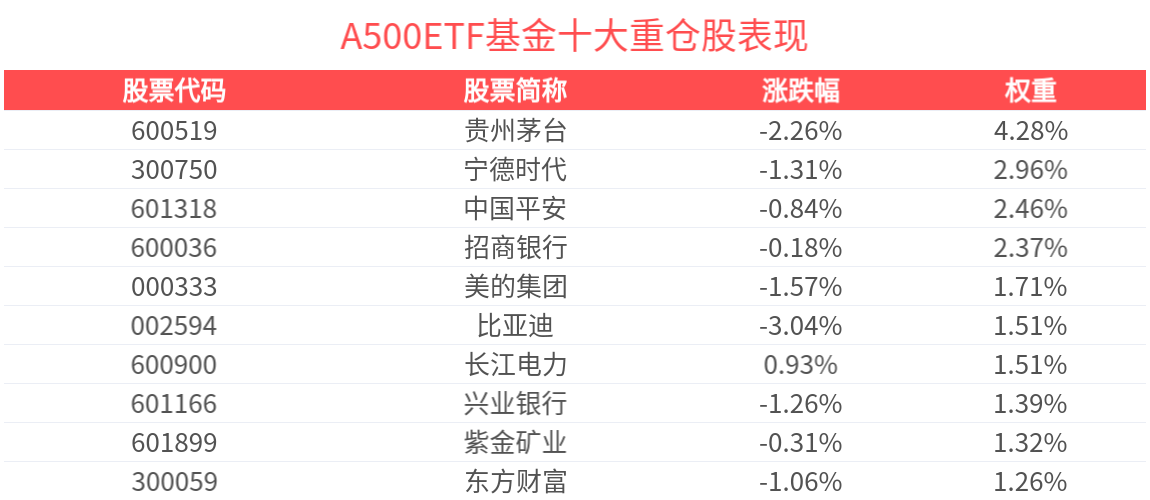
Group 1 - The core viewpoint indicates that the A500 index has shown a decline of 0.92% as of June 13, 2025, with mixed performance among constituent stocks [1] - The top-performing stocks include China Merchants Energy, which rose by 8.84%, and China Merchants Shipping, which increased by 6.29% [1] - The A500 ETF fund has also decreased by 0.85%, with a latest price of 0.94 yuan, and has shown active trading with a turnover rate of 11.09% and a transaction volume of 1.739 billion yuan [1] Group 2 - According to Bohai Securities, the Shanghai Composite Index is near previous highs, leading to increased divergence regarding short-term upward movement [2] - The report suggests that if new positive catalysts or policies emerge, market sentiment could improve, potentially leading to further index increases [2] - Key sectors to watch include non-bank financials due to upcoming major financial policy catalysts, defensive investment opportunities in the banking sector, and thematic investment opportunities in TMT, pharmaceuticals, and defense industries [2] Group 3 - As of May 30, 2025, the top ten weighted stocks in the A500 index account for 21.21% of the index, with Kweichow Moutai being the highest at 4.28% [3] - The top ten stocks also include CATL, Ping An Insurance, and China Merchants Bank, all showing varying degrees of decline [5]