
港股

Search documents
资金进场!单日净流入超百亿
Zhong Guo Zheng Quan Bao· 2026-02-25 13:09
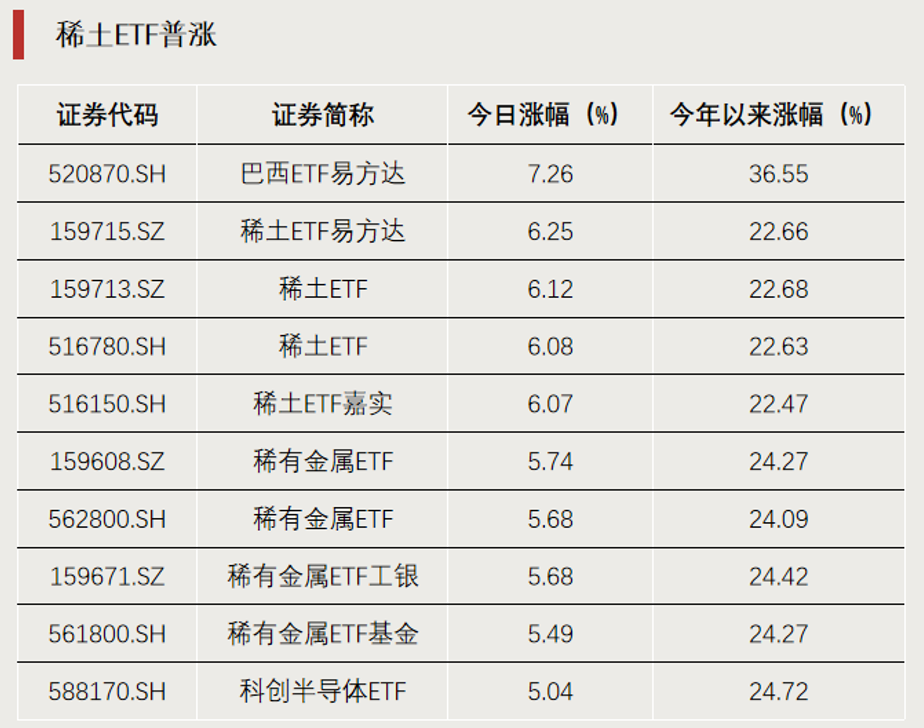
Market Overview - On February 25, major A-share indices collectively rose, with the ChiNext Index increasing by over 1.4%. More than 1,000 out of over 1,400 ETFs in the market saw gains [1] ETF Performance - The rare earth and rare metal sector ETFs performed notably well, with 8 related ETFs ranking among the top ten for daily gains, all exceeding 5%. Year-to-date, these 8 ETFs have accumulated gains of over 20% [2] - On February 24, the ETF market experienced a net inflow of over 11 billion yuan, marking the highest single-day net inflow in the past six trading days. ETFs focused on the Hong Kong stock market showed strong capital attraction, with over half of the top ten ETFs by net inflow being Hong Kong ETFs [3][8] Rare Earth and Rare Metal ETFs - On February 25, all 8 ETFs focused on rare earth and rare metals closed higher, with gains leading the ETF market. Four products linked to the CSI Rare Earth Industry Index rose over 6%, while four linked to the CSI Rare Metal Theme Index rose over 5%. The CSI Rare Earth Industry Index includes 43 constituent stocks related to rare earth mining, processing, trading, and applications, with only one stock declining by the close [4] - During the trading session, four rare earth ETFs reached new highs since their inception, with some funds doubling in value since launch. The CSI Rare Metal Theme Index includes up to 50 constituent stocks involved in rare metal mining, smelting, and processing, with all 50 stocks rising by the close [5] Specific ETF Gains - The following ETFs showed significant daily and year-to-date gains: - Brazil ETF E Fund: 7.26% daily gain, 36.55% YTD - Rare Earth ETF E Fund: 6.25% daily gain, 22.66% YTD - Rare Earth ETF: 6.12% daily gain, 22.68% YTD - Rare Earth ETF: 6.08% daily gain, 22.63% YTD - Rare Earth ETF Jiashi: 6.07% daily gain, 22.47% YTD - Rare Metal ETF: 5.74% daily gain, 24.27% YTD - Rare Metal ETF: 5.68% daily gain, 24.09% YTD - Rare Metal ETF ICBC: 5.68% daily gain, 24.42% YTD - Rare Metal ETF Fund: 5.49% daily gain, 24.27% YTD - Sci-Tech Semiconductor ETF: 5.04% daily gain, 24.72% YTD [6] Declining ETFs - Energy sector ETFs experienced some pullback, with two S&P Oil & Gas ETFs showing the largest declines in the market, both of which had risen over 9% the previous day. Additionally, some media sector ETFs also saw significant declines [6] Hong Kong ETFs - On February 24, Hong Kong market-focused ETFs attracted significant capital, with the top ten ETFs by net inflow including seven Hong Kong ETFs that collectively saw over 7 billion yuan in net inflows. Since the beginning of February, these seven ETFs have accumulated over 28 billion yuan in net inflows [8][9] New ETF Issuances - On February 25, several ETFs began issuance, including the Huatai-PB Hang Seng Technology ETF and the Huaxia CSI Battery Theme ETF, with the issuance period for the Huatai-PB CSI Animal Husbandry Industry ETF ending on March 6 [11] Investment Outlook - Looking ahead, the technology and resource sectors are expected to remain key investment themes. Emerging technologies, including internet, media, computing, robotics, electronics, and military sectors, are highlighted as potential areas of focus. Value stocks in consumer services, food and beverage, and building materials are also anticipated to present investment opportunities [12]

1.19犀牛财经早报:首批新能源主题基金四季报解密基金经理布局运作
Xi Niu Cai Jing· 2026-01-19 01:39
Group 1 - The first batch of new energy theme funds has reported that investment strategies are shifting from traditional lithium batteries to advanced technologies such as smart driving, artificial intelligence, and controllable nuclear fusion, indicating strong confidence in the structural market for new energy in 2026 [1] - The public fund issuance market has seen a significant increase in activity, with many new products being oversubscribed and some sold out in a single day, reflecting a recovery in market confidence and changes in product strategies and investor allocation [1] - Over 10 private equity firms have been penalized for regulatory violations, including issues related to fund pools and guaranteed returns, indicating a push for compliance and internal control improvements in the private equity industry [1] Group 2 - Three securities investment consulting firms have been penalized and ordered to stop accepting new clients due to regulatory issues, highlighting ongoing scrutiny in the investment advisory sector [2] - Several small and medium-sized banks have raised deposit rates by up to 20 basis points as part of a strategy to attract deposits amid a competitive market environment, reflecting a cautious approach to managing their funding needs [2] - The S transaction market has gained traction with increased activity in the transfer of shares from popular companies in sectors like humanoid robotics and commercial aerospace, driven by renewed confidence in the primary market for unprofitable companies [3] Group 3 - The People's Bank of China has announced a structural interest rate cut, reducing the re-lending and rediscount rates by 0.25 percentage points, which is expected to encourage lending in key sectors and support economic transformation [4] - The bond market is anticipated to experience increased volatility in 2026, with a focus on capturing short-term opportunities rather than long-term trends, as investors navigate the balance between strong expectations and weak realities [4] - The Hong Kong stock market has seen a surge in refinancing activities, with nearly 30 companies raising over HKD 26 billion, a significant increase compared to the previous year, indicating a robust environment for capital raising [4] Group 4 - Insurance companies are optimistic about the equity market in 2026, planning to enhance their asset allocation strategies to capitalize on favorable macroeconomic trends and potential profit opportunities [5] - Morgan Stanley has projected significant price increases for DDR4 and NOR Flash memory chips in the first quarter of 2026, driven by supply constraints and strong demand for advanced storage products [5] - The commercial aerospace sector has shown signs of market enthusiasm, although recent price corrections suggest a need for careful evaluation of long-term trends versus short-term adjustments [6] Group 5 - Porsche's global sales fell to approximately 279,000 units in 2025, a decline of 10% year-on-year, with a significant drop in the Chinese market, reflecting challenges in supply and a strategic shift towards prioritizing profit margins over volume [7] - The Beijing Yiren Angel Children's Hospital is facing operational challenges due to rental debts, prompting public donations that have exceeded 15 million yuan, highlighting community support for healthcare initiatives [7] - Ningbo Ronbay New Energy Technology Co., Ltd. is under investigation by the China Securities Regulatory Commission for misleading statements regarding a major contract, which could impact its market reputation and operations [8][9]


21专访丨浙商宏观首席林成炜:黄金上涨仍有支撑 长期看好A股
2 1 Shi Ji Jing Ji Bao Dao· 2026-01-15 23:32
Group 1 - The core view is that the trend of residents moving savings from deposits to diversified assets like equities, gold, and insurance will continue into 2026, supported by improving fundamentals and declining deposit rates [1][18] - The A-share market is expected to experience a main upward trend driven by liquidity and risk appetite recovery, with a focus on indices like the CSI 2000, STAR 50, and ChiNext [4][21] - The bond market is anticipated to see a downward trend in interest rates, with the 10-year government bond yield expected to reach around 1.5% [5][22] Group 2 - The RMB/USD exchange rate is projected to peak at around 6.8 in the first half of 2026, with an average around 7 for the year [7][23] - The outlook for commodities includes a bullish stance on precious and non-ferrous metals, while maintaining a bearish view on crude oil, targeting $50 per barrel for WTI [8][24] - The GDP growth target for 2026 is set at approximately 4.8%, with quarterly expectations of 5.1%, 4.8%, 4.6%, and 4.7% [10][26] Group 3 - The fiscal policy for 2026 is expected to be more proactive, with a deficit rate projected between 4.0% and 4.2%, corresponding to a deficit scale of approximately 5.89 trillion to 6.19 trillion yuan [11][27] - The monetary policy is anticipated to be moderately loose, with potential for 50 basis points of reserve requirement ratio cuts and 10 basis points of interest rate cuts throughout the year [12][28] - The demand for financing in 2026 is expected to improve, with new credit estimated at 17.6 trillion yuan, reflecting a year-end growth rate of 6.5% [15][30] Group 4 - Key investment opportunities in 2026 are expected to focus on core technology breakthroughs, integration of technology and industry, and the transformation of manufacturing towards high-end, intelligent, and green practices [16][31] - The investment landscape will likely benefit from policies supporting infrastructure and high-end manufacturing, with a focus on projects that enhance economic stability [11][30]

中欧长谈第一季|价值派付倍佳:稳定的超额来自于,不犯大错,度量风险
Xin Lang Cai Jing· 2025-12-23 12:26
Core Insights - The article emphasizes the importance of maintaining enthusiasm for work and the value of enjoying one's career, as exemplified by Warren Buffett's attitude towards investing and life [6][31]. - It discusses the principle of "do not lose money" as a fundamental discipline in value investing, highlighting the need to control maximum drawdowns in the face of systemic risks [7][32]. - The pursuit of a high Sharpe ratio is presented as a key investment philosophy, focusing on achieving stable excess returns while managing volatility [8][33]. Investment Philosophy - The concept of the Sharpe ratio is explained as a measure of excess return per unit of risk, with a focus on achieving higher and more stable excess returns while controlling volatility [8][33]. - The article outlines a three-layer framework for investment strategy: macroeconomic direction, sector allocation, and individual stock selection [10][36]. - The macroeconomic perspective involves assessing interest rate differentials and profit margins to determine whether to adopt an offensive or defensive stance in portfolio management [10][36]. Market Dynamics - The article notes that the Hong Kong stock market has unique characteristics, including high foreign participation and a short-selling mechanism, which necessitate a focus on value investing [20][46]. - It highlights the increasing pool of investable assets in the Hong Kong market, particularly with the secondary listings of leading A-share companies, indicating a positive outlook for future investment opportunities [21][47]. Value Investment Challenges - The article discusses the challenges of value investing, including the need for patience in waiting for good prices and the tendency of the market to favor growth assets over stable value assets [13][40]. - It emphasizes the importance of understanding the time frame and volatility associated with realizing value, which can often extend over several years [14][41]. - The distinction between the "cake base" (stable cash flows) and the "cream layer" (growth expectations) is used to illustrate the evolving nature of asset valuation, particularly in the context of internet companies transitioning from growth to value [18][45].

中金:近期港股为何在三地中走得更弱?
Zhi Tong Cai Jing· 2025-12-09 09:57
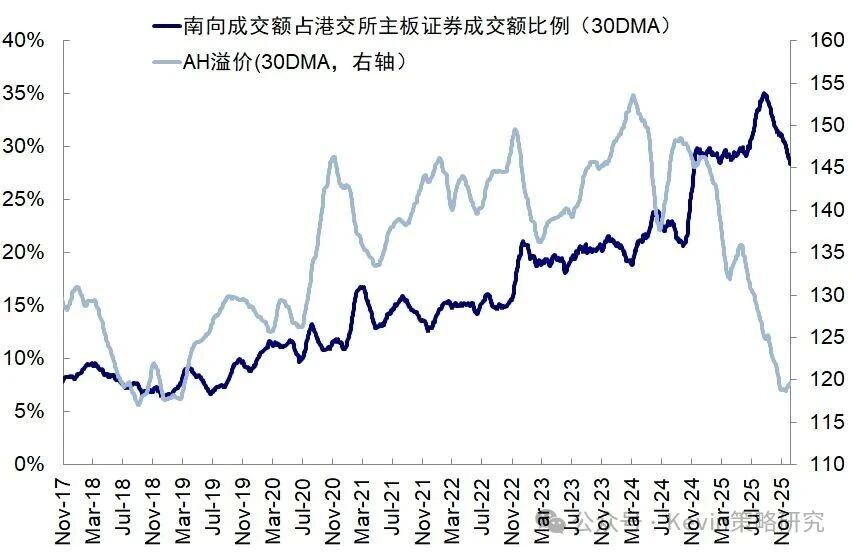
Core Viewpoint - The recent underperformance of Hong Kong stocks compared to the US and A-share markets is attributed to a combination of factors including a declining credit cycle, liquidity pressure, and a mismatch between fundamentals and expectations [1][2]. Group 1: Market Performance - Hong Kong stocks have shown particular weakness among the three markets, influenced by a shrinking southbound capital flow and the upcoming expiration of lock-up periods for major IPOs [2][4]. - Concerns over the Bank of Japan's potential interest rate hike and the Federal Reserve's stance have contributed to the market's volatility, with US Treasury yields rising despite a recent rate cut by the Fed [2][4]. Group 2: Credit Cycle and Fundamentals - The key issue is the downward trend in the credit cycle, which has been evident for the past two months, leading to a likely stagnation or phase of slowdown in private credit and overall credit cycles unless there is significant policy intervention [4][6]. - The current market dynamics reflect a disconnect between the fundamentals and expectations, particularly in the technology sector, where high valuations and investor sensitivity to negative news are prevalent [6]. Group 3: Sector Analysis - The report outlines four main sectors: 1. AI requires new industrial catalysts, with hardware visibility being more significant than application visibility [6]. 2. Strong cyclical sectors are influenced by US fiscal and real estate demand, alongside rising domestic PPI [6]. 3. Consumer sectors lack fundamental support, making them less attractive [6]. 4. Dividend stocks provide stable returns but lack upward elasticity [6][7]. Group 4: Economic Indicators - Investors should monitor the PPI year-on-year growth rate and the M1 money supply growth rate, as these indicators may signal a potential turning point in private sector financing and economic activity [8].
博时宏观观点:市场方向有望更加明确,守望春季躁动
Xin Lang Cai Jing· 2025-12-09 03:58
Group 1: Economic Indicators - In the US, November PMI shows weak manufacturing but strong services, indicating overall stable growth [1] - The market is fully pricing in a 25 basis point rate cut by the Federal Open Market Committee (FOMC) in December, with expectations of a signal to pause further cuts afterward [1] - Japan's central bank is expected to raise interest rates, leading to an increase in bond yields and greater asset volatility [1] Group 2: Domestic Economic Conditions - China's November manufacturing PMI shows a marginal recovery but remains seasonally weak, while the services PMI has declined again [1] - Supply and demand indicators have shown marginal improvement, and price indicators have also recovered, reflecting that the foundation for domestic demand recovery still needs further consolidation [1] - There is a noticeable increase in expectations for stable real estate policies, which could further support demand and expectations if implemented [1] Group 3: Market Strategy - In the bond market, there was a loosening of liquidity across months, with reports indicating the central bank's strategy of "short-term collection and long-term release," leading to weak sentiment in the bond market [1] - The overnight funding price fell below 1.3%, suggesting that the central bank's strategy is aimed at preventing fund turnover and reducing bank liability costs, rather than tightening monetary policy [1] - The fundamental and liquidity conditions remain favorable for the bond market, but the lack of bullish momentum may keep interest rates in a fluctuating pattern [1] Group 4: A-share Market - The A-share market has been fluctuating without clear policy guidance, with trading volume continuing to decline [2] - There is a slight reversal in style, with a rebound in the previously corrected technology growth sector [2] - Looking ahead to December, the upcoming Central Economic Work Conference and FOMC meeting are expected to provide clearer market direction [2] Group 5: Hong Kong Market and Commodities - Following the December FOMC meeting, the Federal Reserve may signal a pause in rate cuts, which could temporarily hinder capital inflow into the Hong Kong market [3] - In the oil market, initial rate cuts may not boost demand, as supply continues to be released and inventories accumulate, keeping prices under pressure [3] Group 6: Gold Market - The potential pause in rate cuts after the December FOMC meeting may cause short-term disturbances in gold prices, but the long-term development trend remains positive [3]
长城基金:12月哪类资产占优?十年数据指向这些方向
Xin Lang Ji Jin· 2025-11-27 04:10
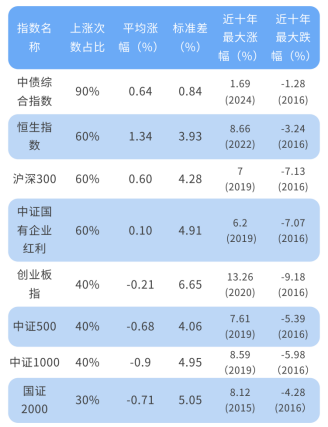
Group 1: Major Indices - The bond index (China Bond Composite) shows a strong performance with a 90% increase rate, making it a stable choice for investors [2][3] - The Hang Seng Index stands out among stock indices with a 60% increase rate and an average increase of 1.34%, indicating potential opportunities in Hong Kong stocks [3] - Large-cap indices like CSI 300 outperform small-cap indices, suggesting a market preference for larger leading stocks in December [3][4] Group 2: Fund Types - Short-term and medium to long-term bond funds have a high increase rate of 90%, making them suitable for investors seeking certainty [5][7] - "Fixed income plus" products, such as secondary bond funds, show a 70% increase rate and an average return of 0.44%, balancing risk and return effectively [7] - Equity funds exhibit a divergence, with high-position ordinary stock and mixed equity funds having a 40% increase rate but higher average returns, appealing to risk-tolerant investors [7] Group 3: Industry Perspective - Consumer sectors, particularly social services, food and beverage, and home appliances, show a 70% increase rate, highlighting the "year-end consumption season" as a driving force [8][10] - Financial and energy sectors, including banks and oil and gas, demonstrate strong defensive characteristics with high increase rates, indicating stability during December [11] - Specific consumer segments like white goods and non-liquor beverages have an 80% increase rate, marking them as significant alpha sources [12][13]
四季度以来近2000亿元资金涌入权益类ETF
Sou Hu Cai Jing· 2025-11-26 06:59
Group 1 - The pace of capital inflow into equity ETFs has significantly accelerated, with a total net subscription amount reaching 196.48 billion yuan as of November 21 [1] - On November 21, the single-day net subscription amount for equity ETFs exceeded 40 billion yuan, marking the highest net inflow in over seven months [1] - The capital flow is directed towards three main categories: broker-themed ETFs and dividend-themed ETFs, technology growth-themed ETFs, and Hong Kong stock-themed ETFs [1] Group 2 - Morgan Asset Management states that despite recent market adjustments, liquidity shocks are nearing full pricing, and the overall market trend has not fundamentally changed [2] - The Chinese AI industry is still in its early development stage, avoiding the excessive capital expenditure issues seen in the U.S., with a solid foundation for technological innovation and self-sufficiency [2]
中国银河证券:港股科技板块有望再次迎来配置机会
Ge Long Hui· 2025-11-24 00:32
Core Viewpoint - Investor sentiment is significantly influenced by expectations of interest rate cuts by the Federal Reserve and geopolitical situations, leading to rapid rotation of market hotspots and a likely continuation of a volatile trend in the Hong Kong stock market [1] Sector Recommendations - The market's fluctuating risk appetite may drive investors towards dividend stocks for defensive positioning [1] - Concerns regarding the AI bubble are gradually diminishing following recent market corrections, presenting new allocation opportunities in the technology sector [1] - The effects of "anti-involution" policies are becoming evident, with changes in supply and demand dynamics potentially leading to a sustained rebound in cyclical stocks as commodity prices rise [1]

10 月市场展望:贵金属与港股成焦点?两类配置思路参考
Sou Hu Cai Jing· 2025-09-23 05:25
Core Insights - The market outlook for September and October is influenced by two main factors: the Federal Reserve's interest rate policy and the rotation of hot sectors in the A-share market [2][6] Group 1: Market Variables - The Federal Reserve's interest rate cut schedule is a critical factor, with the meeting on September 17 being a key date. If the rate cut exceeds expectations, it could benefit Hong Kong stocks and precious metal prices [2][3] - The A-share market is expected to see a "high-low rotation" trend, with funds shifting from previously high-performing sectors to lower-valued areas such as Hang Seng Technology and innovative pharmaceuticals [2][3] Group 2: Investment Strategies - "Multi-Asset Rotation" strategy focuses on conservative allocation suitable for risk-averse investors, with 30% in A-shares, 35% in precious metals, and 35% in overseas assets like Nasdaq and Nikkei [3][4] - "Investment Strategy Discussion (Liang Shan)" proposes a balanced offensive strategy, emphasizing A-shares as the main battlefield and allocating 10%-15% to Hong Kong stocks, particularly in technology and innovative pharmaceuticals [4][5] Group 3: Precious Metals Allocation - A small allocation of 5%-10% in precious metals through gold ETFs is recommended as a risk-hedging tool against geopolitical uncertainties [5]