日元贬值

Search documents
受日元贬值和稳健订单支撑 日本11月制造业信心创近四年新高
Xin Hua Cai Jing· 2025-11-11 23:36
Core Insights - Japan's manufacturing confidence has risen to its highest level in nearly four years, driven by a weaker yen and robust orders, with the manufacturing confidence index increasing from 8 in October to 17 in November, the highest since January 2022 [1] - The electronics sector's sub-index surged to 25, marking the highest level since December 2021, indicating strong performance in this industry [1] - The automotive and transportation machinery sectors also saw significant increases, with their confidence index rising from 9 to 27 [1] Industry Analysis - The depreciation of the yen has provided a boost to exports, as noted by an electronics company manager, with the yen falling over 5% against the US dollar during the survey period from October 28 to November 7 [1] - The semiconductor market, particularly in the memory sector, is performing well, contributing to the overall positive sentiment in the electronics industry [1] - Despite the current optimism, there are concerns regarding a potential decline in the overall manufacturing index, which is expected to drop to 15 in February, with some managers expressing worries about sluggish automotive production and sales [1]
索尼上调2025财年净利润预期,《鬼灭》贡献大
日经中文网· 2025-11-11 08:00
Core Viewpoint - Sony Group has raised its consolidated net profit forecast for the fiscal year 2025 to 1.05 trillion yen, an increase of 80 billion yen from previous estimates, driven by the success of the "Demon Slayer" movie and the depreciation of the yen [2]. Group 1: Financial Performance - The expected operating revenue for fiscal year 2025 is 12 trillion yen, with operating profit projected at 1.43 trillion yen, both up by 300 billion yen and 100 billion yen respectively from prior forecasts [4]. - The profit forecast for the ongoing business, excluding the financial sector, is expected to decline by 2% year-on-year [2]. - The impact of U.S. tariff policies on operating profit has been reduced by 20 billion yen, now estimated at 50 billion yen [4]. Group 2: Business Segments - The semiconductor segment has seen the largest upward revision in operating profit, aided by yen depreciation and cost reductions [4]. - The gaming segment has the most significant increase in operating revenue, supported by strong sales of the PlayStation console, although operating profit remains unchanged due to asset impairment losses from sold software [5]. - The "Music" segment, including contributions from the "Demon Slayer" film, has positively impacted operating profit in both Japan and North America [4]. Group 3: Shareholder Returns - Sony announced a stock buyback program of up to 100 billion yen, representing 0.59% of the total issued shares (35 million shares), aimed at improving capital efficiency [4].



金融机构纷纷下调预期,日元还要再贬?
3 6 Ke· 2025-11-10 08:59
Core Viewpoint - Japanese financial institutions are revising their forecasts for the yen's exchange rate against the US dollar, expecting it to depreciate to a range of 149 to 156 yen by the end of the year due to fading expectations of early interest rate hikes by the Bank of Japan and concerns over Prime Minister Kishida's expansionary fiscal policies [2][4]. Summary by Relevant Sections Exchange Rate Predictions - JPMorgan has significantly lowered its forecast for the yen, predicting it will depreciate to 156 yen by the end of 2025 (previously 142 yen) and to 152 yen by the end of March 2026 (previously 139 yen) [4]. - Other banks, including Mitsubishi UFJ and Sumitomo Mitsui, have also adjusted their predictions for the yen's depreciation [4][6]. Monetary Policy and Market Reactions - The Bank of Japan maintained its policy interest rate at a recent meeting, with Governor Ueda indicating no immediate plans for rate hikes, leading to increased selling pressure on the yen [5]. - Market sentiment reflects a cautious stance on potential early rate hikes, with a 57% probability of a rate increase in December as of November 7 [6]. Fiscal Policy Concerns - There is growing caution regarding Kishida's "responsible active fiscal" policies, with expectations that the supplementary budget for 2025 will exceed that of 2024, potentially increasing yen selling pressure [7]. - Analysts note that the government appears to tolerate yen depreciation, which has led to a stronger market reaction than initially anticipated [7]. Potential for Yen Appreciation - Some analysts, like Citigroup's Takashima, predict that the yen may appreciate due to stock market adjustments and a reversal of the current depreciation trend, forecasting a rate of 147 yen per dollar by the end of 2025 [8]. Effective Exchange Rate - The nominal effective exchange rate, as measured by the Nikkei Currency Index, reached a low of 71.4 on October 31, indicating a significant depreciation since the last intervention in July 2024 [10].



金融机构纷纷下调预期,日元还要再贬?
日经中文网· 2025-11-10 07:30
Core Viewpoint - Japanese financial institutions are revising their forecasts for the yen's exchange rate against the US dollar, expecting it to depreciate to a range of 149 to 156 yen by the end of the year due to fading expectations of early interest rate hikes by the Bank of Japan and concerns over Prime Minister Kishida's expansionary fiscal policies [2][6]. Group 1: Exchange Rate Predictions - Morgan Stanley has significantly lowered its forecast for the yen, predicting it will depreciate to 156 yen by the end of 2025, down from a previous estimate of 142 yen [6][7]. - Other banks, including Mitsubishi UFJ and Sumitomo Mitsui, have also adjusted their predictions, indicating a general consensus on the yen's depreciation [7]. - The yen depreciated over 4% in October, with a notable drop of more than 7 yen, reaching around 154.5 yen per dollar in early November, marking its lowest point since February [4][6]. Group 2: Monetary Policy and Market Reactions - The Bank of Japan maintained its policy interest rate during the monetary policy meeting on October 30, with Governor Ueda expressing caution regarding future rate hikes [6][8]. - Market sentiment reflects a growing awareness of potential currency intervention by the Japanese government and the Bank of Japan, as the nominal effective exchange rate index for the yen hit a low of 71.4 on October 31 [11]. - Analysts express skepticism about the immediate prospects for yen appreciation, citing a lack of clear support for early rate hikes and the potential for further yen selling pressure due to the government's fiscal policies [8][9]. Group 3: Economic and Fiscal Concerns - Concerns over Prime Minister Kishida's "responsible active fiscal" policies are prevalent, with plans for a supplementary budget expected to exceed the previous year's budget, raising fears of increased yen selling pressure [8][9]. - The market is reacting to the government's perceived tolerance for yen depreciation, with some analysts predicting a reversal in the yen's trend as stock market adjustments occur [9][10].

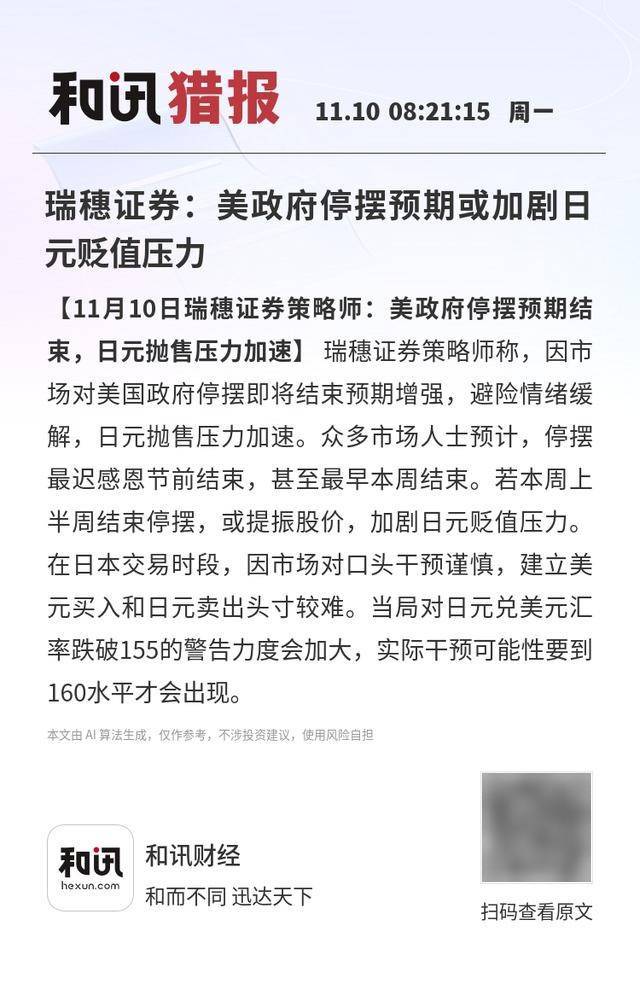
瑞穗证券:美政府停摆预期或加剧日元贬值压力
Sou Hu Cai Jing· 2025-11-10 01:23
Group 1 - The core viewpoint is that the expectation of the end of the U.S. government shutdown is increasing, leading to a reduction in risk aversion and accelerating the selling pressure on the Japanese yen [1][2]. - Market participants anticipate that the government shutdown will end by Thanksgiving at the latest, with a possibility of it concluding as early as this week [1][2]. - If the shutdown ends in the first half of this week, it could boost stock prices and further exacerbate the depreciation pressure on the yen [1][2]. Group 2 - During the Japanese trading session, establishing positions for buying USD and selling JPY is challenging due to market caution regarding verbal interventions [1][2]. - Authorities are expected to increase warnings if the JPY/USD exchange rate falls below 155, with actual intervention likely only occurring at the 160 level [1][2].
日元疲软受薪资数据拖累
Jin Tou Wang· 2025-11-06 10:12
Core Viewpoint - The USD/JPY exchange rate is experiencing fluctuations, currently trading at 153.6200, following a significant rebound after a dip, influenced by various economic indicators and statements from Japanese officials [1]. Group 1: Economic Indicators - The USD/JPY rate saw a decline of 0.5% on Tuesday due to warnings from Japan's Finance Minister, but rebounded on Wednesday, driven by better-than-expected ADP data from the US [1]. - Japan's September wage income level showed a year-on-year decline of 1.4%, raising concerns about the sustainability of demand-driven inflation in Japan [1]. - The market is questioning the Bank of Japan's ability to generate sustainable inflation pressure, given the ongoing weakness in wages despite a rising inflation environment [1]. Group 2: Central Bank Actions - The Bank of Japan is awaiting wage growth momentum before considering interest rate hikes, with the December rate increase not guaranteed [1]. - The upcoming speech by Bank of Japan Governor Kazuo Ueda on December 1 is anticipated to be a critical factor, especially after an unexpected rise in Tokyo's CPI last month [1]. - Market expectations for a rate hike by the Bank of Japan are increasing, as indicated by interest rate futures for January to April next year [1]. Group 3: Technical Analysis - The USD/JPY remains within an upward channel, but the recent decline in the exchange rate amidst a rising dollar index suggests a decrease in market enthusiasm for shorting the yen [2]. - There is a growing risk of adjustment for the USD/JPY as the dollar approaches a potential peak and as the yen's interest rate hike process progresses [2].
【环球财经】美元指数重返100关口,本次“剧本”有何不同?
Xin Hua Cai Jing· 2025-11-06 08:29
Core Viewpoint - The recent strengthening of the US dollar index, surpassing the 100 mark, is attributed to a combination of hawkish signals from the Federal Reserve and external factors such as tightening dollar liquidity and the depreciation of non-US currencies, particularly the Japanese yen [1][2]. Group 1: Economic Indicators and Federal Reserve Actions - The dollar index's rise since mid-September is linked to the Federal Reserve's hawkish stance during the October meeting, which emphasized economic resilience and persistent inflation risks, leading to a decline in rate cut expectations [1][2]. - Analysts note that the current economic environment differs significantly from previous periods, with a lack of clear economic data making the market more susceptible to the Fed's hawkish comments [2][3]. Group 2: Currency Movements and External Influences - The depreciation of the Japanese yen, influenced by the election of Fumio Kishida as Japan's Prime Minister and subsequent fiscal and monetary easing, has contributed to the dollar's strength [2]. - The widening yield spread between US and Japanese bonds following the Fed's meeting has also facilitated carry trades, further supporting the dollar's rise [2]. Group 3: Future Outlook for the Dollar - Analysts suggest that while the dollar may have short-term upward potential, the current situation does not indicate a new long-term appreciation cycle for the dollar [3]. - Market expectations for the Fed's December meeting indicate a probability of maintaining interest rates, which could influence the dollar's performance depending on employment data and inflation trends [3]. - The potential for increased dollar supply due to the Fed's decision to halt balance sheet reduction could weaken the dollar's upward momentum [3]. Group 4: External Economic Conditions - Japan's high core inflation may provide the Bank of Japan with room to raise interest rates, which could limit the extent of the dollar's strength [4].
私人就业数据好于预期 美债收益率多数上行
Xin Hua Cai Jing· 2025-11-05 15:40

Group 1 - The ADP report indicates that U.S. private sector employment growth in October exceeded expectations, adding 42,000 jobs compared to the Dow Jones forecast of 22,000 jobs, suggesting the labor market is not at risk of recession [3][4] - Following the report, U.S. Treasury yields mostly rose, with the 10-year Treasury yield increasing by 1.9 basis points to 4.11% [3] - The U.S. government shutdown has entered its 36th day, surpassing the longest shutdown during Trump's first term, with an estimated economic loss of $11 billion if it continues for another week [3][4] Group 2 - European stock markets opened lower, reflecting a global decline, with concerns over overvaluation in tech stocks [4] - In the bond market, there was a mixed performance in European debt yields, with German yields mostly declining while Italian yields rose [4] - The Nikkei index in the Asia-Pacific region hit a new low since October 24, with significant declines in AI and semiconductor-related stocks, leading to profit-taking [4] Group 3 - The Japanese yen has depreciated significantly, with a nearly 5% drop against the U.S. dollar over the past month, as market participants test the Japanese government's tolerance for yen depreciation [5] - Japanese government bonds saw a decline in yields, with the 10-year yield falling by 2.5 basis points to 1.668% [5] - The U.S. Treasury is set to issue $2.05 billion in bonds, including a $690 million short-term bond [5] Group 4 - As of November 3, the total U.S. federal debt decreased by $36 billion from the previous month, totaling approximately $38 trillion [6]
日元汇率还会跌?在测试日本政府容忍度
日经中文网· 2025-11-05 08:00
Core Viewpoint - The Japanese yen has depreciated significantly against the US dollar, with a nearly 5% drop in the past month, raising concerns about potential government intervention in the foreign exchange market [2][4]. Group 1: Exchange Rate Trends - The exchange rate for the yen against the dollar was recorded at 154.15 to 154.25 yen per dollar at the close of the New York market on November 3, with fluctuations primarily above 154 yen during Tokyo trading on November 4 [4]. - The yen's depreciation reached a low of 154 yen on October 30, marking the lowest level in eight months [4]. - The yen has experienced a 4.4% decline compared to 21 trading days prior, with the most significant drop of 4.6% occurring on October 30, the largest since July 31 [4][6]. Group 2: Government and Central Bank Responses - Former Japanese Finance Minister and current ADB President Kanda Masato noted that a 5% fluctuation is a significant indicator for potential government intervention, although it is not a strict condition [2][6]. - The Japanese government and the Bank of Japan intervened in the currency market in July 2022, buying yen and selling dollars when fluctuations were deemed excessive [6]. - Despite the recent depreciation, the Bank of Japan decided to maintain its policy interest rate, which has led to further yen depreciation and a stronger dollar [6][7]. Group 3: Market Sentiment and Future Outlook - Market sentiment indicates a lack of urgency within the government regarding the yen's depreciation, suggesting that the yen may continue to seek lower levels in the short term [6]. - Japanese Finance Minister Kato Sakuyuki acknowledged the rapid and one-sided nature of the yen's depreciation but supported the Bank of Japan's decision as reasonable under current circumstances [7].

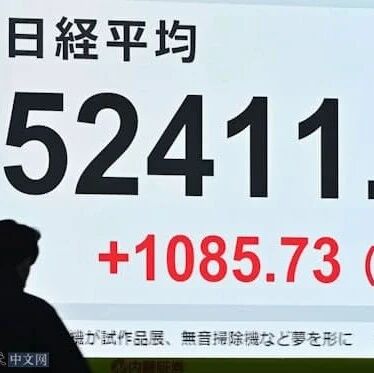
日经平均股指首次站上52000点
日经中文网· 2025-10-31 07:51
Core Viewpoint - The Nikkei average stock index rose significantly, supported by the depreciation of the yen and strong earnings reports from Japanese and American companies, marking a breakthrough above the 52,000-point level for the first time. Group 1 - On October 31, the Nikkei average closed at 52,411.34 points, an increase of 1,085.73 points (2.12%) from the previous day, surpassing the 52,000-point mark for the first time [2]. - Despite a decline in U.S. stocks the previous day and a significant drop in Meta's share price, the Japanese stock market remained buoyant due to the yen's depreciation and strong corporate earnings [4]. - The Nikkei index reached its highest point of the day at the close, indicating robust buying interest in the market [4].