核心CPI

Search documents
11月CPI同比创20个月新高
21世纪经济报道· 2025-12-10 11:12
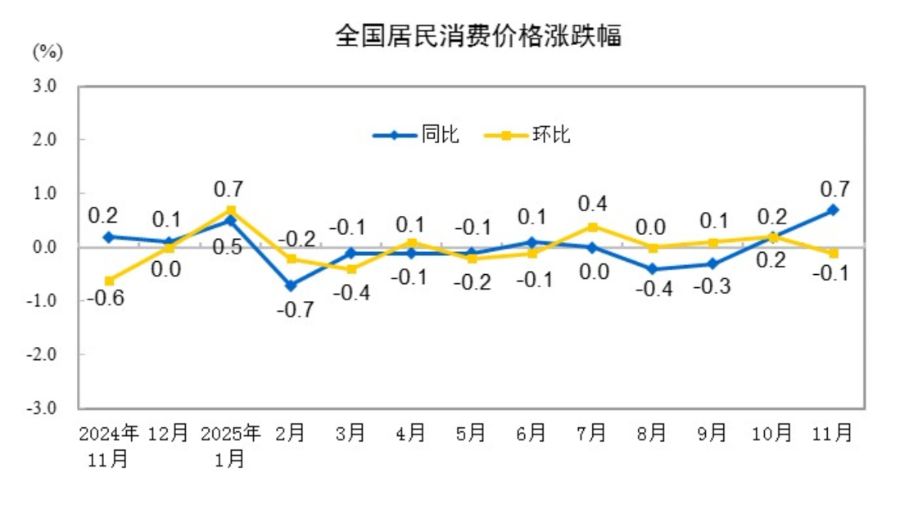
作者丨冉黎黎 编辑丨包芳鸣 12月10日,国家统计局发布的数据显示,2025年11月份,全国居民消费价格(CPI)同比上涨 0.7%,环比下降0.1%;全国工业生产者出厂价格(PPI)同比下降2.2%,环比上涨0.1%。值 得注意的是, 11月CPI同比上涨0.7%,涨幅比上月扩大0.5个百分点,为2024年3月份以来最 高。PPI环比上涨0.1%,连续两个月上涨。 国家统计局城市司首席统计师董莉娟解读称, CPI同比涨幅扩大主要是食品价格由降转涨拉 动。 食品价格由上月下降2.9%转为上涨0.2%,对CPI同比的影响由上月下拉0.54个百分点转 为上拉0.04个百分点。 扣除食品和能源价格的核心CPI同比上涨1.2%,涨幅连续3个月保持在 1%以上。 另外,PPI同比下降2.2%,降幅比上月扩大0.1个百分点, 主要受上年同期对比基 数走高影响。 展望未来,中国民生银行首席经济学家温彬对21世纪经济报道记者表示,随着扩内需等政策措 施发力显效,现代化产业体系加快构建,叠加重点行业产能治理持续推进、市场竞争秩序优 化,物价有望低位温和回升。 (全国居民消费价格涨跌幅 来源:国家统计局) 核心C PI涨幅连续三 ...


11月CPI增速创去年3月以来新高 食品价格带来显著提升
经济观察报· 2025-12-10 11:07
Core Viewpoint - The current low price levels are closely related to the relatively weak domestic demand, and the next phase will focus on boosting internal demand and stabilizing prices, which will positively impact the stabilization of CPI [1][2]. Group 1: CPI Trends - In November, the national Consumer Price Index (CPI) rose by 0.7% year-on-year, the highest increase since March 2024, with a month-on-month increase of 0.5 percentage points [2]. - Throughout the first eleven months of the year, there were six months with negative year-on-year CPI growth, leading to an average CPI that remained flat compared to the previous year [2]. - The core CPI, excluding food and energy, increased by 1.2% year-on-year in November, maintaining a growth rate above 1% for three consecutive months [2][3]. Group 2: Food Prices Impact - The rise in food prices was a significant factor contributing to the increase in CPI in November, with seasonal growth in food prices driving the year-on-year CPI growth [3]. - The impact of food prices on CPI shifted from a negative contribution of -0.54 percentage points in the previous month to a positive contribution of 0.04 percentage points in November [3]. Group 3: Economic Outlook - Analysts caution that the recent rise in CPI should not be oversimplified as a sign of economic recovery, as the supply-demand relationship indicates a significant imbalance with supply being forced to contract [4]. - The overall economic cycle is characterized by demand contraction leading to supply adjustments and declining economic growth, which further exacerbates demand contraction [4]. - The core CPI's upward trend suggests some improvement in domestic consumption demand, but the foundation for sustained improvement remains fragile, requiring ongoing policy support [4]. Group 4: Policy Implications - The adjustment of the CPI growth target from around 3% to 2% reflects a more realistic approach given the current economic conditions, aiming to avoid deflation [5]. - The lower CPI target is seen as a benchmark rather than a ceiling, indicating a policy effort to bridge the gap between nominal and real GDP growth [5]. - Looking ahead to 2026, maintaining stable price growth will remain a key macroeconomic policy goal, with various initiatives expected to support CPI recovery [5].

菜篮子与金饰齐发力,11月CPI创近20个月新高
Jing Ji Guan Cha Wang· 2025-12-10 11:03
Group 1 - The Consumer Price Index (CPI) in November increased by 0.7% year-on-year, marking the highest level in 2023 and since March 2024 [1] - Urban CPI rose by 0.7%, while rural CPI increased by 0.4%. Food prices saw a 0.2% rise, and non-food prices increased by 0.8% [1] - The increase in CPI is attributed to seasonal price rebounds in food items, particularly fresh vegetables, which contributed significantly to the CPI's upward movement [2][4] Group 2 - Core CPI remains resilient despite a slight month-on-month decline of 0.1%, maintaining a year-on-year growth rate of 1.2% [2] - The rise in core CPI is supported by increasing gold prices and the effects of domestic demand expansion policies, which have led to price increases in household goods and clothing [2][4] - The potential for sustained improvement in CPI relies on continued policy support, particularly in stimulating consumption in sectors like dining and tourism [4] Group 3 - The Asian economy is expected to shift towards a more balanced and sustainable growth model by 2025, with inflation projected to decline significantly due to falling food prices [3] - A low inflation environment in 2026 may support a continued easing of monetary policy across several Asian countries, including China, which could create investment opportunities [3] - The main macroeconomic risk for Asia is not high inflation but the combination of deflationary pressures and high real policy rates, which could hinder economic recovery [3]
菜价金价带动11月CPI上行,物价进一步企稳
Xin Jing Bao· 2025-12-10 10:25
Group 1 - The core viewpoint of the articles indicates that consumer prices are recovering, with the Consumer Price Index (CPI) showing a month-on-month decrease of 0.1% but a year-on-year increase of 0.7%, marking the highest increase since March 2024 [1][2] - The increase in CPI is primarily driven by a turnaround in food prices, which shifted from a decrease of 2.9% in the previous month to an increase of 0.2% in November, contributing positively to the CPI [2][3] - The core CPI, excluding food and energy, rose by 1.2% year-on-year, indicating a gradual recovery in consumer spending [2][3] Group 2 - The Producer Price Index (PPI) increased by 0.1% month-on-month, marking two consecutive months of growth, although the year-on-year decline widened to 2.2% [5][6] - The PPI's year-on-year decline is attributed to a high comparison base from the previous year, and the industrial market remains characterized by weak demand despite some seasonal price increases [6][7] - Looking ahead, the PPI is expected to decline by approximately 0.5% year-on-year in 2026, with a narrowing of the decline due to ongoing policy measures aimed at stabilizing prices and enhancing competition [7]
2025年11月价格数据点评:CPI涨势能否延续?
EBSCN· 2025-12-10 08:52
Group 1: CPI Analysis - In November 2025, the CPI increased by 0.7% year-on-year, up from 0.2% in the previous month, aligning with market expectations[2] - The main driver for the CPI increase was the turnaround in food prices, particularly fresh vegetable prices, which rose by 14.5% year-on-year, compared to a decline of 7.3% in the previous month[4][5] - Core CPI remained stable at 1.2% year-on-year, with gold prices contributing significantly to this stability, while service prices showed a slowdown due to seasonal demand[6] Group 2: PPI Analysis - The PPI decreased by 2.2% year-on-year in November, slightly worse than the previous month's decline of 2.1%, primarily due to a high base effect from the previous year[8] - PPI showed a month-on-month increase of 0.1%, marking the second consecutive month of growth, driven by rising prices in the coal and non-ferrous metal sectors[8][9] - The "anti-involution" effect is evident as downstream consumer goods prices stabilize, while upstream coal and metal prices continue to rise[11] Group 3: Future Outlook - The CPI is expected to maintain its upward trend in December, supported by low base effects and rising food prices, with a projected average CPI growth rate of 0.7% for the coming year[10] - The PPI's year-on-year decline is anticipated to narrow, influenced by global manufacturing recovery and domestic supply-demand adjustments, although the timing for a return to positive growth remains uncertain[11] - The recovery of domestic demand and the potential for a rebound in pork prices are critical factors that could influence CPI trends in the upcoming months[10]
我国2025年11月份CPI同比涨幅扩大 核心CPI继续上涨
Yang Shi Xin Wen· 2025-12-10 07:47
Core Insights - In November, consumer spending continued to recover, with the Consumer Price Index (CPI) slightly decreasing by 0.1% month-on-month but increasing by 0.7% year-on-year, marking the highest year-on-year increase since March 2024 [1][2] - The core CPI, excluding food and energy prices, rose by 1.2% year-on-year, maintaining above 1% for three consecutive months [2] CPI Analysis - The year-on-year increase in CPI was primarily driven by a shift in food prices from decline to increase, with food prices rising by 0.2% after a previous decline of 2.9% [2] - Fresh vegetable prices saw a significant turnaround, increasing by 14.5% after a 7.3% decline, contributing approximately 0.49 percentage points to the CPI year-on-year [2] - Energy prices decreased by 3.4%, with gasoline prices dropping by 7.5% [2] - Service prices experienced a seasonal decline of 0.4%, impacting the month-on-month CPI decrease [4] PPI Analysis - The Producer Price Index (PPI) increased by 0.1% month-on-month, marking two consecutive months of growth, while the year-on-year decline expanded to 2.2% [5][6] - Seasonal demand increases in certain domestic industries, such as coal and gas, contributed to the month-on-month price increases [5] - The international price trends for metals and oil led to a mixed impact on domestic prices, with some sectors experiencing price increases while others saw declines [6] - New industries, such as new materials and green technology, are driving price increases in related sectors, with specific categories like external storage devices seeing a year-on-year price increase of 13.9% [6][7]
11月PPI环比连续两个月上涨,CPI同比创20个月新高
2 1 Shi Ji Jing Ji Bao Dao· 2025-12-10 07:40
(全国居民消费价格涨跌幅来源:国家统计局) 核心CPI涨幅连续三月保持1%以上 同比来看,11月份,CPI同比上涨0.7%。其中,城市上涨0.7%,农村上涨0.4%;食品价格上涨0.2%,非食品价格上涨0.8%;消 费品价格上涨0.6%,服务价格上涨0.7%。 1—11月平均,CPI与上年同期持平。 国家统计局数据显示,9月份,CPI同比下降0.3%;10月份,同比上涨0.2%。对比前两个月,CPI由降转涨后持续恢复,11月CPI 同比上涨0.7%,涨幅比上月扩大0.5个百分点。 21世纪经济报道记者冉黎黎北京报道12月10日,国家统计局发布的数据显示,2025年11月份,全国居民消费价格(CPI)同比上 涨0.7%,环比下降0.1%;全国工业生产者出厂价格(PPI)同比下降2.2%,环比上涨0.1%。值得注意的是,11月CPI同比上涨 0.7%,涨幅比上月扩大0.5个百分点,为2024年3月份以来最高。PPI环比上涨0.1%,连续两个月上涨。 国家统计局城市司首席统计师董莉娟解读称,CPI同比涨幅扩大主要是食品价格由降转涨拉动。食品价格由上月下降2.9%转为上 涨0.2%,对CPI同比的影响由上月下拉0.5 ...
解读:2025年11月份CPI同比涨幅扩大 核心CPI继续上涨
Guo Jia Tong Ji Ju· 2025-12-10 07:24
CPI同比上涨0.7%,涨幅比上月扩大0.5个百分点,为2024年3月份以来最高,同比涨幅扩大主要是食品 价格由降转涨拉动。食品价格由上月下降2.9%转为上涨0.2%,对CPI同比的影响由上月下拉0.54个百分 点转为上拉0.04个百分点。食品中,鲜菜价格由上月下降7.3%转为上涨14.5%,为连续下降9个月后首次 转涨,对CPI同比的上拉影响比上月增加约0.49个百分点;鲜果价格由上月下降2.0%转为上涨0.7%;牛 肉和羊肉价格分别上涨6.2%和3.7%,涨幅均有扩大;猪肉和禽肉类价格分别下降15.0%和0.6%,降幅均 有收窄。能源价格下降3.4%,降幅比上月扩大1.0个百分点,其中汽油价格降幅扩大至7.5%。扣除食品 和能源价格的核心CPI同比上涨1.2%,涨幅连续3个月保持在1%以上。服务和扣除能源的工业消费品价 格分别上涨0.7%和2.1%,分别影响CPI同比上涨约0.29个百分点和0.53个百分点。其中扩内需政策措施 继续显效,家用器具和服装价格分别上涨4.9%和2.0%,飞机票、家政服务和在外餐饮价格分别上涨 7.0%、2.4%和1.2%。金饰品价格涨幅扩大至58.4%。另外,燃油小汽车和新能 ...
2025年11月份CPI同比涨幅扩大核心CPI继续上涨
Guo Jia Tong Ji Ju· 2025-12-10 06:02
11月份,居民消费持续恢复,居民消费价格指数(CPI)环比略降0.1%,同比上涨0.7%,扣除食品和能 源价格的核心CPI同比上涨1.2%。受国内部分行业供需结构优化、国际大宗商品价格传导等因素影响, 工业生产者出厂价格指数(PPI)环比上涨0.1%,同比下降2.2%。 一、CPI同比涨幅扩大,核心CPI上涨1.2% CPI环比下降0.1%,主要受服务价格季节性下降影响。服务价格下降0.4%,影响CPI环比下降约0.16个 百分点。其中,节后出行需求季节性回落,宾馆住宿、飞机票、旅行社收费和交通工具租赁费价格分别 下降10.4%、10.2%、6.2%和3.6%,合计影响CPI环比下降约0.13个百分点;房屋租赁进入淡季,房租价 格下降0.2%。受国际油价变动影响,国内汽油价格下降2.2%,影响CPI环比下降约0.07个百分点。扣除 能源的工业消费品价格上涨0.3%,其中受国际金价变动影响国内金饰品价格上涨7.3%,受冬装换季上 新影响服装价格上涨0.8%。食品价格上涨0.5%,高于季节性水平0.9个百分点,主要是鲜菜价格上涨影 响。部分地区降雨降温影响鲜菜生产储运,鲜菜价格上涨7.2%,远高于平均下降3.2% ...
重磅经济数据发布!
证券时报· 2025-12-10 04:35
Group 1 - The core viewpoint of the article highlights the continuous recovery of consumer spending in November, with the Consumer Price Index (CPI) showing a year-on-year increase of 0.7%, marking the highest growth since March 2024 [1][3] - The core CPI, excluding food and energy prices, rose by 1.2% year-on-year, maintaining a growth rate above 1% for three consecutive months [5][6] - The Producer Price Index (PPI) experienced a year-on-year decline of 2.2%, with the drop rate expanding by 0.1 percentage points compared to the previous month, primarily due to a high comparison base from the previous year [9][10] Group 2 - In November, food prices increased by 0.5%, exceeding seasonal levels by 0.9 percentage points, largely driven by a significant rise in fresh vegetable prices, which turned from a 7.3% decline to a 14.5% increase [4][3] - Fresh vegetable prices rose by 7.2% month-on-month, significantly higher than the average seasonal decline of 3.2%, contributing approximately 0.17 percentage points to the month-on-month CPI increase [2][3] - The increase in food prices was complemented by rising prices in other categories, such as household appliances and clothing, which rose by 4.9% and 2.0% respectively [7] Group 3 - The article notes that the comprehensive rectification of "involution-style" competition has shown results, with price declines in industries such as coal mining, photovoltaic equipment manufacturing, and lithium-ion battery manufacturing narrowing for several consecutive months [1][10] - Emerging industries are experiencing rapid development, leading to price increases in related sectors, such as a 13.9% rise in external storage devices and components, and a 3.8% increase in graphite and carbon products manufacturing [11] - The effective release of consumer potential is reflected in price recoveries in various industries, including a 20.6% increase in the manufacturing of arts and crafts and ceremonial goods [11]