
油价上涨

Search documents
瑞讯银行:霍尔木兹海峡风险仍支撑油价上行
news flash· 2025-06-16 06:42
Core Viewpoint - The ongoing conflict between Iran and Israel continues to support upward pressure on oil prices, despite a relatively calm market reaction at the beginning of the week [1] Oil Market Analysis - Analysts from Swissquote Bank indicate that both WTI and Brent crude oil opened higher but quickly retraced some gains [1] - Natural gas prices initially surged at the opening but also experienced a decline, similar to gold prices which retraced some of their earlier gains [1] - Some analysts believe that the conflict may ultimately suppress global economic growth, thereby limiting the potential for oil price increases [1] - Conversely, others argue that high oil prices could incentivize shale oil producers to increase output [1] Supply Risk Factors - The Strait of Hormuz, a critical chokepoint for one-third of global oil flow, faces risks of supply disruptions, suggesting that the balance of risks still leans towards rising oil prices [1]
伊以冲突升级危及石油供应 交易员押注油价飙涨
智通财经网· 2025-06-16 01:18
Core Viewpoint - The recent escalation of conflict between Israel and Iran has led to a significant increase in oil prices, with Brent crude rising over 5.5% and WTI approaching $75 per barrel, raising concerns about potential disruptions in oil supply from the Middle East [1][3]. Group 1: Oil Price Movements - Oil prices experienced their largest increase in three years last Friday, rising over 13% before slightly retracting [3]. - Brent crude is currently priced above $76 per barrel, while WTI is nearing $75 per barrel [1]. Group 2: Geopolitical Risks - Analysts are preparing for potential further disruptions in oil supply due to the ongoing conflict, particularly as Israel targets Iran's energy infrastructure [3]. - The closure of the Strait of Hormuz, a critical shipping route for oil, could lead to prices soaring to $130 per barrel, exacerbating global inflation [3]. Group 3: Market Reactions - The market is showing increasing concern over supply risks, with significant buying of call options indicating expectations for oil prices to rise above $80 [6]. - The price spread between two nearby December contracts has increased by $1.29 per barrel, reflecting heightened supply-demand concerns [6]. Group 4: Current Supply Situation - Despite the ongoing conflict, major oil facilities have not yet been damaged, providing some reassurance to the market [9]. - The International Energy Agency has indicated that global oil supply remains adequate, even with recent increases in OPEC+ production [9].

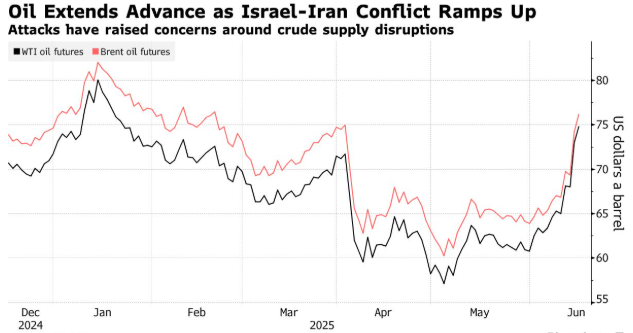
伊以因核问题冲突升级,油价应声上涨
Ping An Securities· 2025-06-15 14:33
Investment Rating - The report maintains an "Outperform" rating for the oil and petrochemical sector [1]. Core Viewpoints - The escalation of conflicts related to nuclear issues between Israel and Iran has led to a significant increase in oil prices, with WTI crude futures rising by 13.81% and Brent oil futures increasing by 12.80% from June 6 to June 13, 2025 [6]. - Geopolitical tensions, particularly the ongoing conflict between Ukraine and Russia, have contributed to market volatility and concerns over oil supply [6]. - The report highlights that while there are short-term price increases due to geopolitical risks, there are long-term concerns regarding oversupply in the oil market [7]. Summary by Sections Oil and Petrochemical - The report notes that the geopolitical situation has led to a rise in oil prices, with specific data indicating a 13.81% increase in WTI and a 12.80% increase in Brent prices during the specified period [6]. - The U.S. has seen a notable increase in gasoline and jet fuel demand as the summer travel season approaches, despite a current oversupply in gasoline and distillate inventories [6]. - OPEC's production increase in May was below expectations, alleviating some concerns about oversupply in the short term [6]. Fluorochemical - The upcoming 618 shopping festival is expected to boost demand for air conditioning, with production of household air conditioners projected to increase by 29.3% and 22.8% year-on-year in June and July 2025, respectively [6]. - Prices for refrigerants such as R32 and R134a remain high due to strong demand and supply constraints [6]. - The report suggests that the supply of second-generation refrigerants will continue to decrease, while the production of third-generation refrigerants is limited, supporting price stability [6]. Semiconductor Materials - The semiconductor materials sector is experiencing a positive trend with inventory reduction and improving end-market conditions, suggesting a potential rebound in the industry index [7]. - The report recommends focusing on companies involved in semiconductor materials as the market shows signs of recovery [7].
能源情报集团记者Amena Bakr:如果(能不能成还是个大问号)伊朗关闭霍尔木兹海峡的这种情况真的发生,油价将飙升至三位数。
news flash· 2025-06-14 13:09
能源情报集团记者Amena Bakr:如果(能不能成还是个大问号)伊朗关闭霍尔木兹海峡的这种情况真 的发生,油价将飙升至三位数。 ...
油价暴涨!港A两市油气股狂欢,山东墨龙H股飙升逾75%
Jin Rong Jie· 2025-06-13 11:56
Group 1 - The Israeli airstrikes on Iran have raised concerns about potential disruptions to Middle Eastern oil supplies, leading to a significant increase in international oil prices [2][3] - On June 13, Brent crude oil surged over 13% to $78.5, while WTI crude rose by 14% to $77.62, indicating a volatile market response to geopolitical tensions [2] - Iran's oil production is projected to reach 200 million tons in 2024, accounting for 4% of global oil output, with the Strait of Hormuz being a critical route for approximately 30% of global seaborne oil trade [2][3] Group 2 - Market analysts suggest that a strong blockade of the Strait of Hormuz by Iran could significantly impact global oil supply, with Morgan Stanley estimating a potential reduction of 2.1 million barrels per day in Iranian oil exports [3] - Current oil prices are around $70, which is approximately $4 higher than the estimated fair value of $66, indicating that the market has priced in a 7% probability of worst-case scenarios [3] - The geopolitical situation has created a favorable environment for oil and gas exploration and production companies, as well as oilfield service providers, potentially leading to structural investment opportunities [3]

油气ETF(159697)大涨2.7%,地缘冲突引爆原油产业链行情
Xin Lang Cai Jing· 2025-06-13 05:45
截至06月13日13:25,油气ETF(159697.SZ)上涨2.70%,其关联指数国证油气(399439.SZ)上涨2.47%;主 要成分股中,中国海油上涨2.76%,招商轮船上7.10%,中国石油上涨1.24%,中远海能上涨7.55%,洲 际油气上涨9.95%。 消息面上,当地时间6月13日以色列空军对伊朗境内数十个与核计划及其他军事设施相关的目标发动空 袭,引发地缘政治紧张局势升级,市场避险情绪显著升温,国际油价应声大涨,布伦特原油盘中一度涨 超13%,WTI原油期货同步攀升逾13%至逾4个月新高,带动油气产业链相关资产走强。 券商研究方面,信达指出看好三季度油价,抓住做多机会: 三、油服公司存在错杀:一方面油公司的资本开支并未出现因二季度油价回落而大幅下调情况;另一方 面油服相关费率并未出现明显回调;三是油服公司绝大部分钻井船、海工装备等已有中长期合同,合同 期内费率不变。中海油服、海油工程业绩增长确定性极高。 关联产品: 油气ETF(159697),联接基金(A类 019827,C类 019828,I类 022861) 关联个股: 中国石油(601857)、中国石化(600028)、中国海油(60 ...

交易员表示,在油价上涨的背景下,印度央行可能正在出售美元以支持卢比。
news flash· 2025-06-13 04:10
Core Viewpoint - The Reserve Bank of India may be selling dollars to support the rupee amid rising oil prices [1] Group 1 - Traders indicate that the Indian central bank's actions are a response to the increasing oil prices [1]
原油大涨4.9%,国内油价大涨130元/吨,6月17日调价,抓紧加油!
Sou Hu Cai Jing· 2025-06-12 06:46
Core Viewpoint - Recent significant increase in international oil prices driven by geopolitical tensions, economic negotiations, and seasonal demand [2][4] Group 1: Oil Price Movements - As of June 12, international oil prices surged by 4.9%, with WTI crude rising by $3.17 to $68.15 per barrel and Brent crude increasing by $2.9 to $69.77 per barrel [2] - Domestic crude oil prices also increased, with Shanghai crude rising by 16.2 yuan to 497.4 yuan per barrel, reflecting a 3.37% increase [2] Group 2: Factors Supporting Price Increase - Tensions between the U.S. and Iran may escalate, raising concerns about potential military actions by Israel against Iran, which heightens supply risk [2] - Optimism surrounding negotiations between the world's two largest economies has alleviated fears of economic downturn, supporting energy demand prospects [2] - The onset of the summer season is expected to boost energy consumption significantly, reinforcing concerns about tight supply [2] Group 3: Domestic Price Adjustments - The average crude oil price in the domestic market was $65.62 per barrel as of the seventh working day of the current pricing cycle, with a crude oil change rate of 3.89% [4] - Predictions indicate a potential increase in domestic oil prices by 130 yuan per ton, with expectations of gasoline and diesel prices rising by approximately 0.1 to 0.12 yuan per liter [4] - The next oil price adjustment is anticipated to result in an increase of 160 to 220 yuan per ton, with the final adjustment expected on June 17 [4]
美、布两油短线走高0.3美元,日内涨约3%,现分别报65.9美元/桶和68.13美元/桶。
news flash· 2025-06-11 17:33
美、布两油短线走高0.3美元,日内涨约3%,现分别报65.9美元/桶和68.13美元/桶。 ...
多重因素推动油价上涨
Qi Huo Ri Bao· 2025-06-10 00:42
Group 1 - Recent geopolitical conflicts have led to a rebound in market risk appetite, with international oil prices rising over 6% in the past week [1] - The SC crude oil futures contract reached a high of 476.8 yuan per barrel, the highest since mid-May, closing up 1.37% [1] - The lack of a peace agreement in the recent Russia-Ukraine negotiations and new U.S. sanctions on Iran have contributed to rising oil prices due to increased geopolitical risk premiums [1] Group 2 - OPEC+ production growth has not met expectations, with only a few countries like Saudi Arabia, UAE, and Russia capable of increasing output, while others face production constraints [2] - North American oil production has declined, with U.S. active drilling rigs significantly reduced and Canadian production affected by wildfires [2] - Seasonal demand during the U.S. summer travel peak and increased electricity demand in Middle Eastern countries are supporting high oil prices [2] Group 3 - The oil market is characterized by high elasticity in both supply and demand, with current conditions favoring a rebound in prices due to declining North American supply and geopolitical factors [3] - However, the support for oil prices is primarily short-term, with ongoing uncertainties in geopolitical and macroeconomic conditions [3] - Investors should monitor developments in U.S.-Iran and Russia-Ukraine negotiations, OPEC+ production schedules, and U.S. tariff policies, as these factors could significantly impact oil demand [3]