
贸易顺差

Search documents
2026年度金融市场展望策略会
2025-12-10 01:57
Summary of Key Points from Conference Call Records Industry Overview - The global economy is experiencing a bifurcation between new and traditional economies, with new economies driving stock markets and traditional economies supporting bond markets. This relationship should not be viewed in isolation [1][3] - The U.S. is facing "three highs" pressures: high inflation, high interest rates, and high wages, which are squeezing corporate profits and leading to a cooling job market and low consumer confidence. In contrast, the AI sector remains relatively stable [1][6] - China's economy also shows a similar bifurcation, with rapid growth in new economies but traditional economies still dominating. The real estate downturn is dragging down overall economic performance [1][10] Stock Market Insights - The U.S. stock market's recent rise is primarily driven by leading AI companies, with a clear divergence between AI and non-AI sectors in terms of performance and profitability [1][8] - The risk premium in the U.S. stock market is approaching zero, indicating a high risk appetite among investors. However, caution is advised regarding the long-term stability of this market, as the current rally is concentrated among a few leading firms [1][13] - In 2026, stock market opportunities will depend on capital return rates, external funding for the real economy, and government fiscal support. A high trade surplus and increased fiscal support in 2025 have positively impacted capital returns [4][17] Economic Challenges - The U.S. economy is under significant pressure from high inflation, high interest rates, and high wages, which are negatively impacting corporate profits. The job market is cooling, and consumer confidence is at a historical low [6][7] - The AI sector's contribution to U.S. GDP is increasing, while investment demand in non-AI sectors is weak or contracting. This structural change may continue to affect the overall economic performance in the U.S. [7][9] China’s Economic Dynamics - China's new economy is growing rapidly, supported by government policies, but traditional sectors still account for a significant portion of the economy, with real estate and infrastructure facing challenges [10][11] - Manufacturing is becoming the core driver of China's current and future development, but high investment growth is leading to overcapacity issues [11][12] - The "K-shaped" divergence in China's economy is evident, with emerging industries like IT and AI growing rapidly, while traditional sectors like construction are struggling [12][20] Fiscal and Monetary Policy Implications - Fiscal policy is crucial for economic and stock market performance, with a noted shift from monetary policy influence to fiscal policy impact since 2017 [21][27] - High trade surpluses are a double-edged sword for China, as they can lead to increased trade friction and potential economic challenges [22][25] - The anticipated fiscal policy for 2026 is expected to be similar to 2025, with marginal effects slowing down due to a focus on debt resolution rather than direct investment [27][28] Market Predictions - The bond market is expected to benefit from a declining interest rate environment, particularly in the first half of 2026, despite potential rate increases towards the end of the year [46] - Credit risk in 2026 will be influenced by the disappearance of floating profits and reduced liquidity management tools, which may affect demand for short- to medium-term credit bonds [57][58] Investment Strategies - Investors are advised to look for opportunities in high-quality state-owned enterprises in the real estate sector amidst ongoing market volatility [51][64] - The development of financial products and their management strategies will play a significant role in shaping the credit bond market dynamics in the coming years [55][56] This summary encapsulates the critical insights and forecasts from the conference call, highlighting the ongoing economic bifurcation, market dynamics, and strategic investment considerations.
彭博:中国在明年的经济路线图中流露出对贸易的担忧
彭博· 2025-12-10 01:57
Investment Rating - The report indicates a positive investment rating for the industry, highlighting a rebound in exports and a trade surplus exceeding 1 trillion USD [10]. Core Insights - China's political bureau has prioritized boosting domestic demand as the primary goal for 2026, indicating a strategic shift towards internal consumption [10]. - Despite the growth in exports driving manufacturing development, the manufacturing sector in China is still experiencing a decline [10]. - The report outlines a moderate growth target of 5% for 2026, emphasizing a commitment to long-term progress [10].
创历史新高!中国外贸顺差首超1万亿元,摆脱对美依赖,引领全球市场新格局
Sou Hu Cai Jing· 2025-12-09 23:53
Core Insights - China's trade surplus has historically surpassed $1 trillion, reaching $1.076 trillion in the first 11 months of the year, equating to over $30 billion in daily net earnings from global trade [1][3] Trade Dynamics - The U.S. has rapidly diminished as China's largest trading partner, with trade volume between China and the U.S. declining by 16.9% year-on-year, reducing the U.S. share of China's foreign trade to 8.9%, now the third-largest partner [3] - ASEAN has become China's largest trading partner, with trade volume reaching 6.82 trillion yuan, an increase of 8.5% [3] - In November, China's exports to the U.S. plummeted by 29%, while exports to the EU grew by 14.8% and to Australia surged by 35.8% [5] Export Growth and Product Shifts - Overall exports from China increased by 6.2% year-on-year, with electromechanical products accounting for 60.9% of total exports, growing by 8.8% [6] - High-tech products, particularly integrated circuits, saw a 25.6% increase in exports, while automotive exports grew by 17.6%, with a remarkable 53% growth in November alone [7] - Traditional labor-intensive product exports fell by 3.5%, indicating a shift towards higher value-added products and a transition in China's manufacturing capabilities [9] Role of Private Enterprises - Private enterprises have played a crucial role in reshaping global trade, with their import and export volume reaching 23.52 trillion yuan, a 7.1% increase, now accounting for 57.1% of total foreign trade [9] Import Trends - Imports of bulk commodities have increased in volume but decreased in price, effectively lowering domestic input costs [11] - The import of electromechanical products rose by 7.5%, with integrated circuit imports increasing by 14.8% in volume, reflecting strong domestic production and technological upgrade demands [11] Economic Resilience - China's goods trade in the first three quarters reached 33.61 trillion yuan, a 4% year-on-year increase, marking eight consecutive quarters of growth [12] - The economic foundation remains strong, with long-term positive trends expected to continue [13] Future Outlook - Analysts predict that China's share of global goods exports could rise from approximately 15% to 16.5% by 2030, driven by strengths in electric vehicles and industrial robotics [14]

新闻1+1丨贸易顺差首超万亿美元 中国外贸韧性源自哪
Yang Shi Xin Wen Ke Hu Duan· 2025-12-09 23:48
Core Viewpoint - China's trade surplus has exceeded 1 trillion USD for the first time in the first 11 months of the year, with private enterprises becoming the core pillar of stable growth in foreign trade, accounting for 57.1% of the total foreign trade value [1]. Group 1: Resilience of China's Foreign Trade - The resilience of China's foreign trade is attributed to its comprehensive advantages in manufacturing and global trade, as China is the largest trade and manufacturing country in the world [5]. - A complete industrial structure and supply chain system are crucial for sustaining trade growth amid complex international circumstances [5]. - Trade diversification has been actively pursued, with emerging markets becoming significant contributors to growth, particularly in trade with ASEAN and the EU [5]. Group 2: Trade Structure Optimization - Despite a significant decline in exports to the U.S., China's overall trade surplus has increased, indicating a strengthening of trade relationships with various countries [9]. - The optimization of trade and industrial structures is evident, with industrial products such as integrated circuits, machinery, and automobiles being key drivers of trade growth [7]. Group 3: Changes in China-EU Trade Relations - There has been a notable shift in the trade structure between China and the EU, with a 14.8% increase in exports to the EU in November, and the trade surplus expected to exceed 350 billion euros [12]. - The similarity in the top ten export products between China and the EU suggests a transition from vertical to horizontal division of labor, which may lead to trade friction [12]. Group 4: Future Economic Adjustments - The focus on counter-cyclical and cross-cyclical adjustments reflects a long-term consideration for macroeconomic regulation, utilizing structural policy tools such as tax, financial, and credit policies [16]. - This approach aims to provide precise benefits to market entities and enterprises rather than relying on large-scale fiscal stimulus [16].
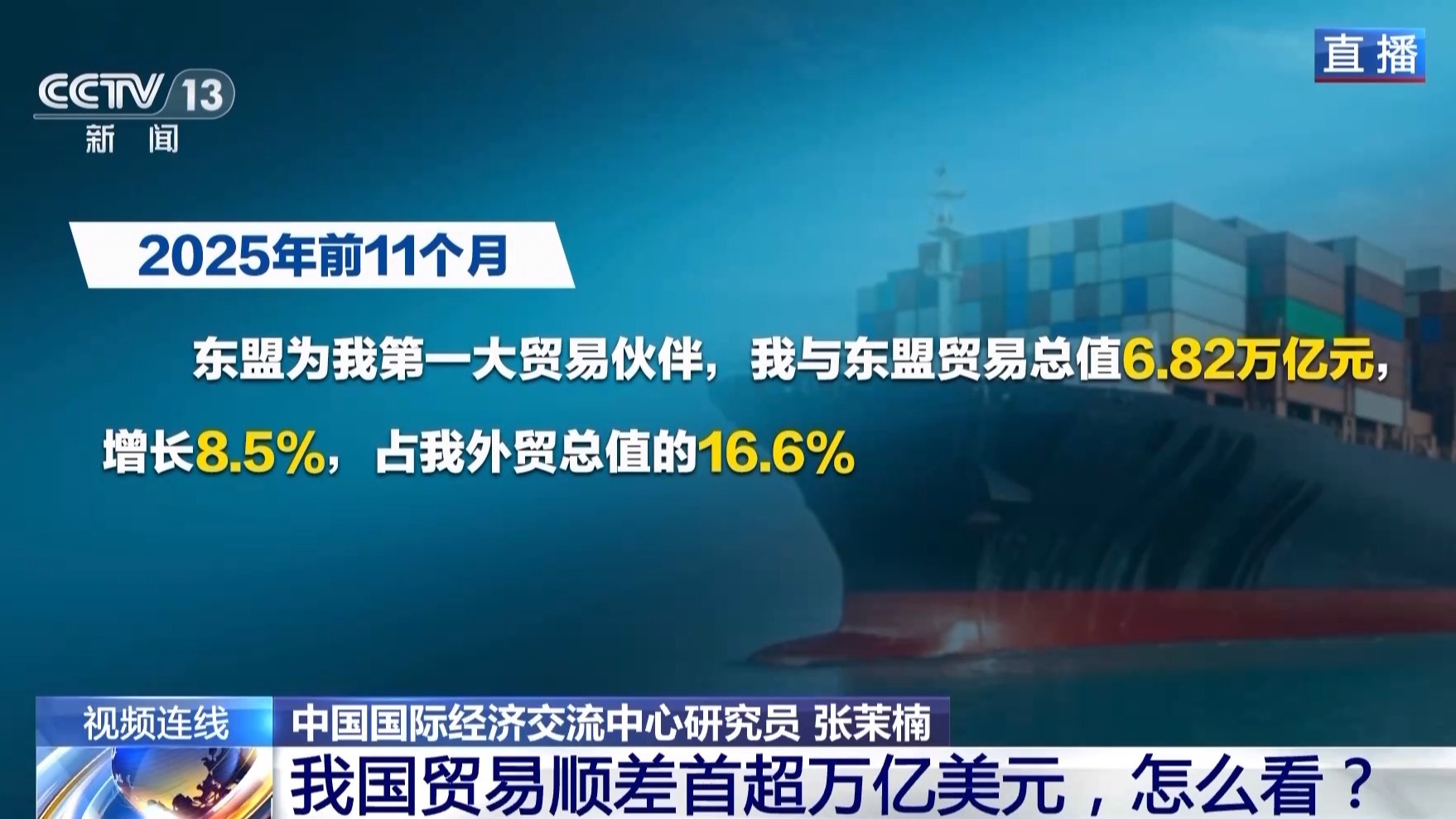
我国贸易顺差首超万亿美元,怎么看?
Yang Shi Wang· 2025-12-09 23:11
Core Viewpoint - China's foreign trade surplus has surpassed 1 trillion USD for the first time, with private enterprises becoming the core pillar of stable growth in foreign trade, accounting for 57.1% of the total foreign trade value [1] Group 1 - The export product structure has upgraded, indicating a shift from quantity growth to quality improvement in exports [1] - Emerging markets are showing diversified growth, contributing to the overall increase in exports [1]
前11个月越南货物进出口达8397.5亿美元,超2024年全年总额
Shang Wu Bu Wang Zhan· 2025-12-09 18:19
Group 1 - Vietnam's total goods import and export reached $839.75 billion in the first 11 months of 2025, a year-on-year increase of 17.2%, surpassing the total for the entire year of 2024, which was $786.29 billion [1] - The trade surplus for the same period was $20.53 billion, down from $24.38 billion in the previous year [1] - Exports amounted to $430.14 billion, reflecting a year-on-year growth of 16.1%, with domestic enterprises contributing $102.41 billion (down 1.7%) and foreign-invested enterprises contributing $327.73 billion (up 23.1%) [1] Group 2 - The structure of exports shows that processed goods accounted for 88.7%, agricultural and forestry products for 8.3%, aquatic products for 2.4%, and fuel and mineral products for 0.6% [1] - Imports totaled $409.61 billion, a year-on-year increase of 18.4%, with domestic enterprises importing $128.4 billion (up 1.7%) and foreign-invested enterprises importing $281.21 billion (up 28.0%) [1] - The import structure indicates that 93.7% of imports were raw materials for production, with machinery, tools, and components making up 52.7%, raw materials and fuels 41.0%, and consumer goods 6.3% [1] Group 3 - The United States is Vietnam's largest export market, with exports to the U.S. reaching $138.6 billion and a trade surplus of $121.6 billion, marking a year-on-year increase of 27.5% [2] - China is the largest source of imports for Vietnam, with imports from China totaling $167.5 billion and a trade deficit of $104.3 billion, which is a year-on-year increase of 38.1% [2]
中国贸易顺差超过1万亿美元,来看哪个国家和地区贡献最多
Sou Hu Cai Jing· 2025-12-09 10:14
美国万万没想到的是,他们越限制中国的外贸越强大。 根据我国海关总署公布的最新数据,2025年1~11月份,我国货物贸易进出口总值41.21万亿元(人民 币),同比增长3.6 %。 看到这个数据,我估计美国一些政客彻底蒙圈了。 这几年,美国一些政客始终认为中美两国的贸易顺差过大,因为一直以来美国都是我国最大的贸易顺差 来源国,这让他们心里非常不爽。 于是他们通过采取关税等各种措施来限制中国出口的发展,结果导致中国出口到美国的商品持续下降, 今年1~11月份,中国出口到美国的货物同比更是减少29%。 大家原以为中国对美国货物出口大幅下降之后,贸易顺差肯定会持续收窄,但没想到1~11月份,中国 的外贸顺差非但没有下降,反而出现明显的增长,这确实有点出乎大家意料。 那我国的贸易顺差到底来源于哪里呢?我们不妨来参考海关总署公布的相关数据。 目前海关总署还没有公布11月份跟不同贸易国家的具体数据,我们就参考1~10月份的数据。 目前我国跟全球250多个国家和地区有贸易往来,其中跟51个国家和地区的贸易往来是逆差;剩余的200 多个国家和地区全都是贸易顺差,其中十大贸易顺差来源国和地区具体如下。 | | | 2025年1- ...

中国贸易顺差破万亿美元,出口版图在“关税战”中重塑
Sou Hu Cai Jing· 2025-12-09 08:10
Core Insights - China's trade surplus has surpassed $1 trillion for the first time, reaching $1.076 trillion in the first 11 months of 2025, marking an unprecedented economic milestone [3][4] - The trade dynamics have shifted, with a notable decline in exports to the U.S. while increasing reliance on markets such as the EU, Southeast Asia, and Australia [3][5] Trade Surplus Composition - China's total goods trade value reached 41.21 trillion yuan, a year-on-year increase of 3.6%, driven by exports of 24.46 trillion yuan (up 6.2%) and imports of 16.75 trillion yuan (up only 0.2%) [4] - In November, trade growth showed signs of recovery, with total trade value at 3.9 trillion yuan, a 4.1% increase year-on-year, where exports grew by 5.7% and imports by 1.7% [4] - Exports to the U.S. saw a significant decline, with total trade value dropping to 2.08 trillion yuan in the first half of 2025, a decrease of 9.3% year-on-year, and a 20.8% decline in the second quarter [4] Market Diversification - In response to the decline in U.S. exports, China is accelerating market diversification, with strong growth in exports to other major trading partners [5] - Exports to the EU increased by 14.8%, to Australia by 35.8%, and to Southeast Asia by 8.2% in the first 11 months of the year [6] - The trade relationship with Australia has seen nearly 100% growth over the past decade, with bilateral trade reaching $211.53 billion in 2024, surpassing U.S.-Australia trade [6] Differentiated Market Opportunities - The trade relationship between China and the EU is characterized by high complementarity, with a 30.4% increase in high-end equipment imports from the EU and an 81.9% increase in industrial robot exports to the EU [6] - In Southeast Asia, increased investment by Chinese companies in countries like Vietnam and Thailand has driven exports of intermediate electronic products [6] - The Australian market benefits from the entry of Chinese e-commerce platforms, potentially reducing overall inflation rates by 20-50 basis points [7] Structural Changes in Exports - China's export structure is shifting from labor-intensive products to mid-to-high-end manufacturing, with significant growth in shipbuilding (43.7%) and integrated circuits (33.4%) [7] - Traditional labor-intensive products are facing challenges, with declines in exports of bags, textiles, and toys [7] - The transition towards providing comprehensive solutions in high-end manufacturing is enhancing China's position in the global supply chain [7] Emerging Trade Patterns - China's trade with Belt and Road Initiative countries reached 11.29 trillion yuan, a 4.7% increase, accounting for 51.8% of total trade, marking a fundamental shift in trade patterns [8] - The share of U.S. exports has decreased from 16.8% in 2019 to 12% in 2025, while ASEAN's share has increased to 17.8% [8] - The global supply chain is experiencing an "eastward" shift, with rising demand for automation and engineering machinery in emerging markets [8] Cross-Border E-commerce Growth - Cross-border e-commerce has become a significant new force in China's foreign trade, with a 14% year-on-year growth in import and export scale, and a 16.9% increase in exports [8] - The changes in China's trade landscape reflect a continuous optimization of export structures and an expanding global trade network [8]
德国10月出口增长而进口下跌 贸易顺差小幅扩大
Xin Hua Cai Jing· 2025-12-09 07:33
美国财经网站investinglive评论称,德国10月贸易顺差扩大,因出口环比上升0.1%,而进口下降1.2%, 这组数据不足以撼动市场,也不会对欧洲央行的政策产生任何影响。 (文章来源:新华财经) 新华财经北京12月9日电德国联邦统计局周二公布的数据显示,德国10月出口较上月小幅增长0.1%。这 一结果好于路透调查中预测的0.5%降幅。 报告显示,出口额为1313亿欧元,环比增长0.1%,同比增长4.2%。进口额为1145亿欧元,环比下降 1.2%,但同比增长2.8%。 10月,经季调后的德国对欧盟成员国出口达763亿欧元,自欧盟进口为611亿欧元。对非欧盟国家出口为 551亿欧元,自非欧盟国家进口为534亿欧元。 ...
德国10月季调后贸易顺差录得169亿欧元
Mei Ri Jing Ji Xin Wen· 2025-12-09 07:09
每经AI快讯,12月9日消息,德国10月季调后贸易顺差录得169亿欧元,前值为152亿欧元。 ...